World Cup Host Cities & Stadiums: The 16 Venues Revealed
The FIFA World Cup 2026 will be co-hosted by 16 cities across Canada, Mexico, and the United States. The opening match is at Estadio Azteca in Mexico City on June 11, 2026; the final is at MetLife Stadium in East Rutherford, New Jersey, on July 19, 2026. Eleven venues are in the USA, three in Mexico, and two in Canada, featuring a mix of NFL, MLS, and dedicated soccer stadiums.
Most guides just list the stadiums. They miss the real story. The scale of this tournament isn’t about the number of cities. It’s about moving hundreds of thousands of fans across three countries with three different infrastructures, three currencies, and border controls that don’t disappear for a month of football.
This guide maps every host city and stadium, explains why each was chosen, and lays out what you need to know beyond the postcard photos. We cover capacities, key matches, and the logistical reality of following a team from Vancouver to Miami.
Key Takeaways
- The 2026 World Cup is a three-nation first, with 48 teams and 104 matches spread across 16 cities from June 11 to July 19.
- Estadio Azteca in Mexico City hosts the opener, making history as the first stadium to stage World Cup games in three different tournaments (1970, 1986, 2026).
- MetLife Stadium in New York/New Jersey gets the final on July 19, while AT&T Stadium in Dallas and Hard Rock Stadium in Miami land a semi-final and the third-place match, respectively.
- Stadium capacities range from 45,736 at Toronto’s BMO Field to 92,967 at Dallas’s AT&T Stadium, dictating ticket availability and atmosphere.
- FIFA organized the cities into three geographic clusters to cut down on crazy travel for teams, but fan movement between countries will still be a major logistical hurdle.
The Complete Stadium List: 16 Venues Across 3 Nations
Forget the simple count. The real impact of 16 host cities is felt in the travel schedules. FIFA didn’t just pick the biggest stadiums. They picked stadiums that could handle the global broadcast footprint, the security apparatus, and the fan experience for a tournament that’s 40% larger than the last one. Each selection tells a story about modern football economics.
The 2026 FIFA World Cup marks the first tournament hosted by three nations and the first to feature 48 competing teams. The 104-match schedule runs from June 11 to July 19, 2026, utilizing stadiums with an average capacity of approximately 68,000 spectators. This expansion necessitates a coordinated logistical operation across multiple time zones and international borders.
The table below breaks down the core facts. Notice the match allocations. Dallas and New York/New Jersey get the semi-finals because their stadiums are massive and built for mega-events. Miami gets the bronze final because of its climate and direct flights from Europe and South America. It’s not random.
| City | Stadium | Capacity | Key Matches | Roof Type |
|---|---|---|---|---|
| Dallas, USA | AT&T Stadium | 92,967 | Semi-Final, 8 other matches | Retractable |
| New York/New Jersey, USA | MetLife Stadium | 87,157 | Final, Semi-Final | Open |
| Los Angeles, USA | SoFi Stadium | 86,702 | Group Stage, Knockouts | Fixed Canopy |
| Mexico City, Mexico | Estadio Azteca | 87,523 | Opening Match | Open |
| Atlanta, USA | Mercedes-Benz Stadium | 83,000 | Group Stage, Knockouts | Retractable |
| Houston, USA | NRG Stadium | 72,220 | Group Stage, Knockouts | Retractable |
| Seattle, USA | Lumen Field | 72,214 | Group Stage, Knockouts | Open |
| Boston, USA | Gillette Stadium | 70,000 | Group Stage, Knockouts | Open |
| Philadelphia, USA | Lincoln Financial Field | 69,796 | Group Stage, Knockouts | Open |
| Kansas City, USA | Arrowhead Stadium | 76,416 | Group Stage, Knockouts | Open |
| San Francisco Bay Area, USA | Levi’s Stadium | 68,500 | Group Stage, Knockouts | Open |
| Miami, USA | Hard Rock Stadium | 67,518 | Bronze Final | Open |
| Guadalajara, Mexico | Estadio Akron | 48,071 | Group Stage | Open |
| Monterrey, Mexico | Estadio BBVA | 53,500 | Group Stage | Open |
| Vancouver, Canada | BC Place | 54,500 | Group Stage, Knockouts | Retractable |
| Toronto, Canada | BMO Field | 45,736 | Group Stage | Open |
TL;DR: Sixteen stadiums across three countries will host matches, with capacities from 45,736 to 92,967. Dallas and New York/New Jersey get the semi-finals, Mexico City opens the tournament, and Miami hosts the third-place match.
USA: The 11 American Powerhouses
Eleven venues might seem like overkill. It’s not. The United States has the hotel inventory, the airport infrastructure, and the corporate sponsorship depth to carry the financial weight of a modern World Cup. These aren’t just football grounds. They are billion-dollar entertainment complexes designed for television.
Common mistake: Assuming all US stadiums are equal for fan experience — the ones with open roofs in Atlanta, Houston, and Dallas offer climate control that will be a godsend during a June/July tournament in the South and Midwest.
The American stadiums fall into two camps. You have the colossal NFL temples like AT&T Stadium and MetLife Stadium, built for spectacle. Then you have the more intimate, soccer-specific venues like Atlanta’s Mercedes-Benz Stadium, which feels like it was designed for this moment. Its retractable roof and 360-degree video board change how the game is watched live.
SoFi Stadium in Los Angeles is the wildcard. Its playing surface sits 100 feet below ground level. The acoustics are unlike any other venue on the list. For a night match, with that canopy lit up and the Hollywood sign in the distance, it will be the most televisually striking venue of the tournament. It’s also a nightmare for broadcast trucks to navigate, but that’s a producer’s problem.
Here’s what you need to know about the key US venues:
– AT&T Stadium (Dallas): Largest capacity. Those retractable doors are for moving entire stage sets in and out for concerts. For football, they’ll just open for air.
– MetLife Stadium (New York/New Jersey): Built on a swamp. The pitch has had issues before. They’ll re-sod it twice before July.
– Mercedes-Benz Stadium (Atlanta): The eight-petal roof opens like a camera aperture. It’s a engineering marvel that also happens to host football.
– Hard Rock Stadium (Miami): Gets the bronze final. The late-July humidity there is brutal. That match will be a war of attrition.
– Lumen Field (Seattle): Artificial turf. It will be replaced with a grass pitch for the tournament, a costly but necessary operation.
If you’re tracking 2026 World Cup news, the US venue preparations are the most documented. The scale is familiar to anyone who follows American soccer venues in the MLS.
Mexico’s Historic Trio
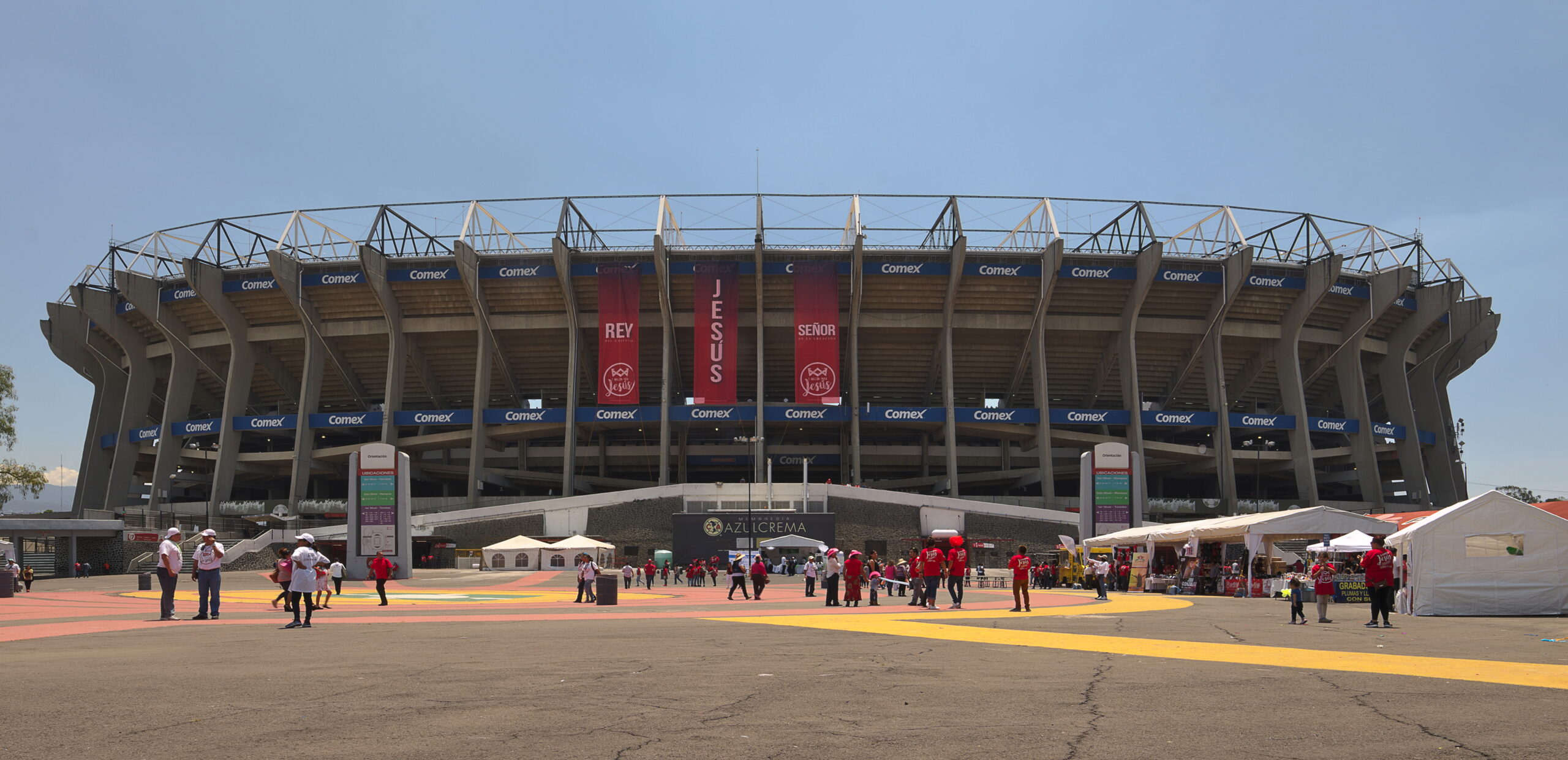
Photo: Carlos Valenzuela / Wikimedia Commons / CC BY-SA 4.0
Mexico didn’t need to build a thing. Their three venues are cathedrals. Estadio Azteca is the obvious headliner. Hosting the opening match in 2026 will mean it has staged World Cup games in three separate tournaments over 56 years. That’s a record no other stadium will touch for a very long time.

The atmosphere at Azteca is a physical force. At 2,200 meters above sea level, the ball travels differently. Visiting teams have wilted there for decades. The Mexican federation fought hard to get the opener. It’s a statement of footballing heritage.
I watched a Club América match at Azteca a decade ago. The noise doesn’t hit you in waves. It’s a constant, low-frequency pressure that sits in your chest. You don’t hear the person next to you. For a World Cup opener, that energy will be terrifying for any opponent not used to it.
The other two Mexican World Cup stadiums offer completely different experiences. Estadio Akron in Guadalajara looks like a volcano from the outside. It’s modern, steep, and incredibly loud for its 48,000 capacity. Estadio BBVA in Monterrey is tucked into a mountainside. The view from the upper deck is stunning, but the approach for broadcast helicopters is notoriously tricky.
| Stadium | City | World Cup History | 2026 Role | Unique Challenge |
|---|---|---|---|---|
| Estadio Azteca | Mexico City | 1970 Final, 1986 Quarter-Finals | Opening Match | High altitude, aging infrastructure updates |
| Estadio Akron | Guadalajara | First World Cup | Group Stage | Limited hotel capacity in immediate area |
| Estadio BBVA | Monterrey | First World Cup | Group Stage | Mountainous terrain limits fan transport routes |
TL;DR: Mexico’s three venues are steeped in history and atmosphere, with Estadio Azteca making its third World Cup appearance. They offer authentic, challenging environments that newer stadiums can’t replicate.
Canada’s Two-Stadium Strategy
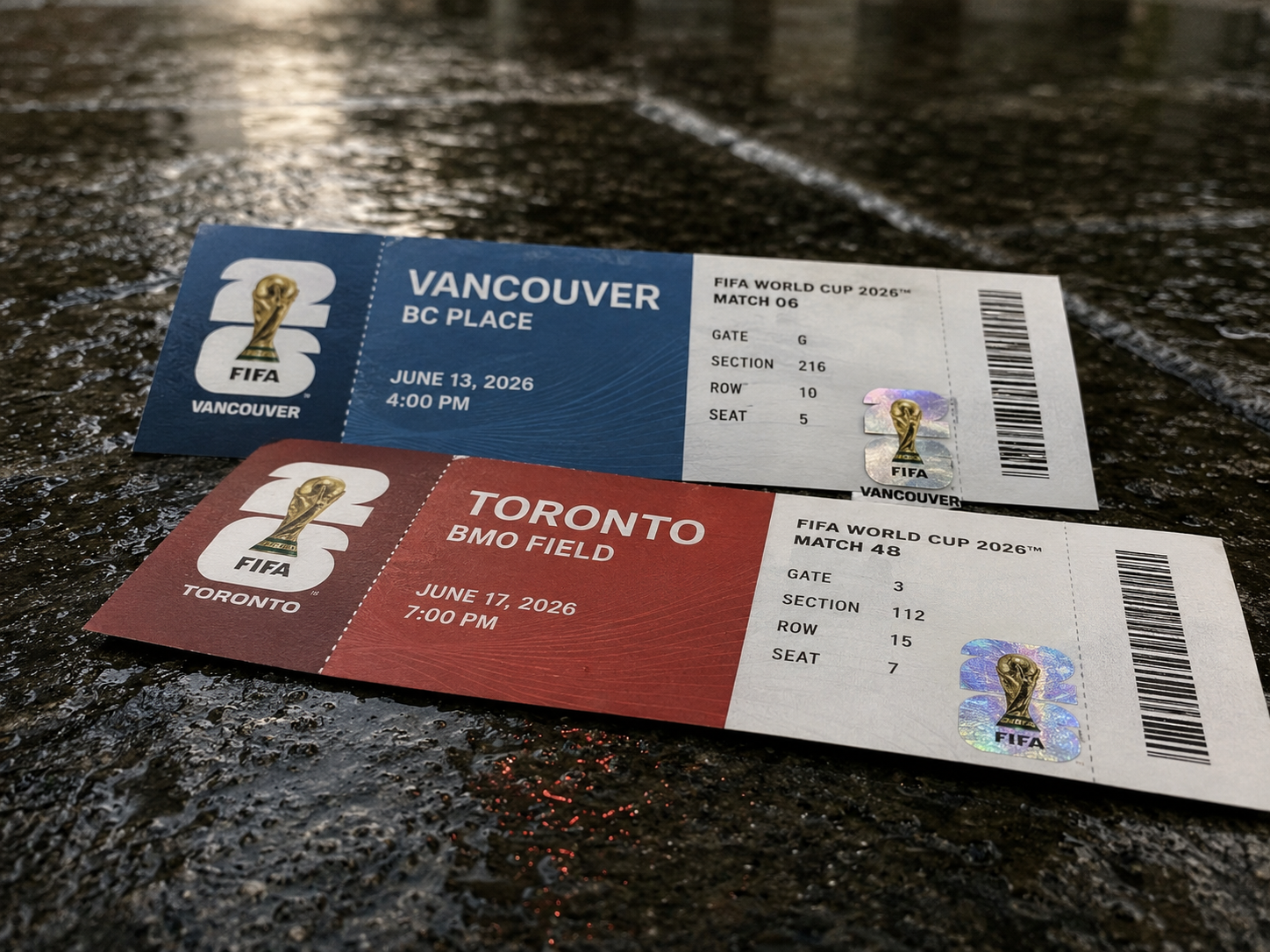
Canada got two host cities for a reason. They are the supporting actors in this three-nation show. Vancouver and Toronto are world-class cities with existing stadiums that meet FIFA’s minimum requirements. They didn’t need to spend billions.
BC Place in Vancouver has a retractable roof. That’s crucial for a June tournament in a city known for rain. It’s also hosted major events before, including the 2015 Women’s World Cup final. The operations staff know the drill. BMO Field in Toronto is the smallest venue on the list at 45,736 seats. It’s a proper football ground, home to Toronto FC. The sightlines are good, the atmosphere is tight, and it will be sold out for every match.
The Canadian strategy is smart. They get the prestige and tourism bump without the financial risk of building white elephants. Their matches will likely feature teams from the CONCACAF region and perhaps a European side with a strong diaspora in Toronto. It’s a controlled, profitable slice of the tournament.
Common mistake: Underestimating travel between Vancouver and Toronto — it’s a five-hour flight across the continent. A team drawn to play group matches in both cities would face a brutal travel schedule, which is exactly why FIFA created the regional cluster system.
For fans, Vancouver is a spectacular summer city. Toronto is a logistical dream with its transit and airport links. Both will be fantastic host cities. But they are not the main event. This is clear in the latest 2026 World Cup information from FIFA, which often leads with the American and Mexican venues.
Match Schedule and Stadium Roles
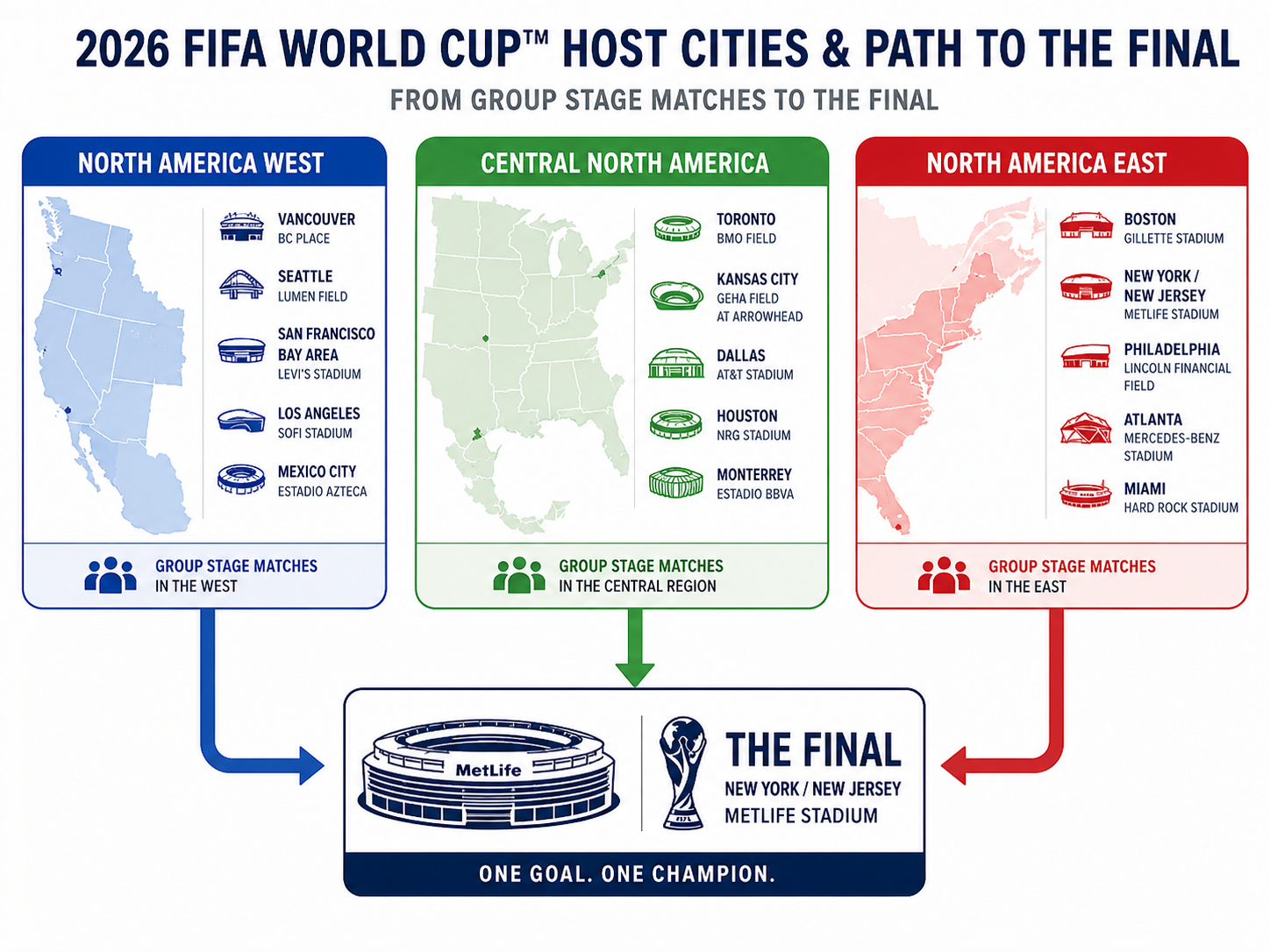
The match schedule isn’t just a list of dates. It’s a blueprint for fatigue management, television rights, and political compromise. The semi-finals are in Dallas and New York/New Jersey. The final is in New Jersey. The bronze final is in Miami. Every other stadium gets a mix of group stage and round-of-32 or round-of-16 matches.
FIFA released the schedule with teams and fans in mind. They created three regional clusters:
– West: Vancouver, Seattle, San Francisco Bay Area, Los Angeles
– Central: Dallas, Houston, Kansas City, Atlanta, Monterrey, Guadalajara, Mexico City
– East: Toronto, Boston, New York/New Jersey, Philadelphia, Miami
A team will ideally play all its group matches within one cluster. This isn’t a guarantee, but it’s the goal. It prevents a scenario where a squad has to fly from Vancouver to Miami between matches. The clusters make sense on a map. The execution will be the hard part.
The marquee matches have clear homes. The opener in Mexico City is a foregone conclusion. The final in the New York metro area guarantees maximum global audience and commercial impact. Dallas gets a semi-final because Jerry Jones built a stadium that can swallow 93,000 people and look good on TV doing it. This FIFA World Cup 2026 venue report from an international broadcast outlet breaks down the broadcast-specific advantages of each site.
Logistical Realities for Fans and Teams
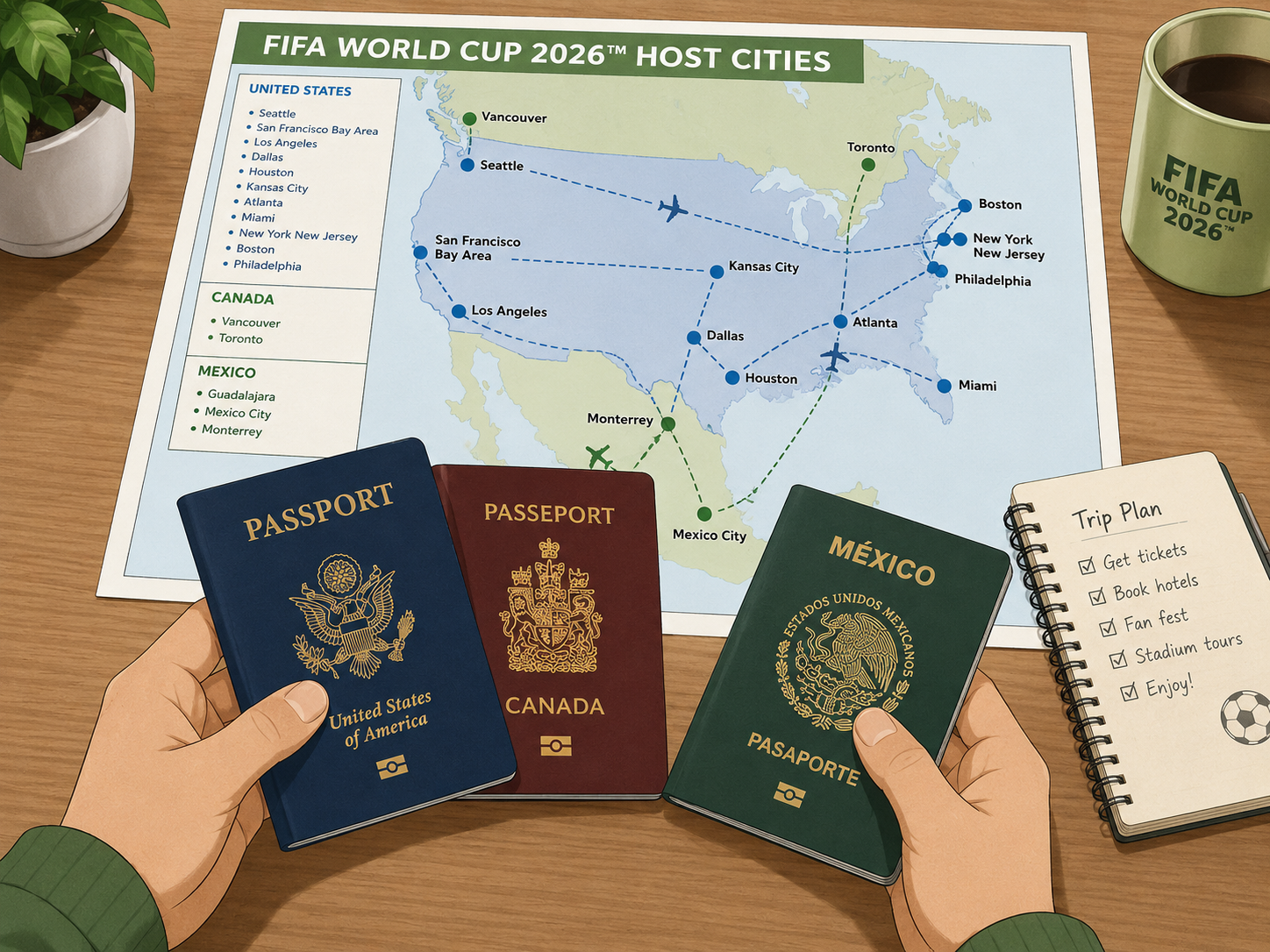
Let’s talk about the elephant in the room. Moving between host countries isn’t like taking a train from London to Manchester. You have customs. You have visas. You have currency exchanges. A fan with a ticket to a match in Guadalajara on a Wednesday and another in Atlanta on a Saturday has a serious puzzle to solve.
The visa situation is the biggest unknown. Will there be a special World Cup visa that covers all three nations? Probably not. Most fans will need valid travel documents for the USA, which may or may not grant them entry to Canada and Mexico. This isn’t the Schengen Area. Planning a multi-city, multi-country trip requires military-level precision.
For teams, the logistics are handled by FIFA’s army of liaison officers. Their training bases will be pre-selected for proximity and quality. Their travel will be via chartered flights with police escorts. For the average supporter, it’s a different story. You’re on your own with Amtrak, airlines, and rental car companies. My advice? Pick one cluster and stick to it. Trying to follow a team across all three countries is a recipe for exhaustion and bankruptcy.
Packing for this requires planning. You need gear for blistering heat in Dallas, potential rain in Vancouver, and cool nights in Mexico City. A good football gear bag is essential, as is a solid football water bottle for those long days in the sun. And if you’re documenting the trip, a capable sports action camera will capture the moments your phone misses.
Frequently Asked Questions
Which stadium is the largest for the 2026 World Cup?
AT&T Stadium in Dallas, Texas, is the largest with a capacity of 92,967. It will host nine matches, including one of the semi-finals.
Where is the 2026 World Cup final?
The final will be played at MetLife Stadium in East Rutherford, New Jersey, on July 19, 2026. This stadium is in the New York/New Jersey metropolitan area.
Which stadium is hosting the opening match?
Estadio Azteca in Mexico City will host the opening match on June 11, 2026. This will be its third World Cup, having previously hosted in 1970 and 1986.
How many host cities are there in total?
There are 16 host cities: 11 in the United States, 3 in Mexico, and 2 in Canada.
What is the smallest World Cup 2026 stadium?
BMO Field in Toronto, Canada, is the smallest with a capacity of 45,736. It will host group stage matches.
Before You Go
The 2026 World Cup is an experiment in scale. Sixteen cities, three nations, 48 teams. It’s a logistical monster wrapped in a football festival. The stadiums themselves run the gamut from historic icons like Azteca to futuristic wonders like SoFi. Your experience will depend entirely on which cluster you choose and how well you plan the borders.
Remember the capacities. A ticket in Dallas is different from a ticket in Toronto. Remember the climates. Miami in July is not Vancouver in June. And remember the history being made in Mexico City. This tournament will be remembered for its size, but its soul will be in those 16 very different venues. Start saving now. And maybe pick up some quality football cleats – you might just find yourself in a pickup game in a park outside the stadium.
I come from the “soccer heart” of Germany, the Ruhrpott. I have played, trained and followed soccer all my life and am a big fan of FC Schalke 04. I also enjoy following international soccer extensively.