How to Dribble Like Messi | 7 Proven Techniques & Drills
To dribble like Lionel Messi, you need to glue the ball to your foot with small touches, use your hips and shoulders to fake defenders out of position, and explode into space with a low, powerful stance. His technique isn’t about fancy tricks, it’s about a low center of gravity, rapid foot contact, and keeping your eyes up to read the game.
Most players try to dribble like Messi by copying his moves. They learn the inside-outside touch or try a shoulder drop. That’s the wrong starting point. Messi’s signature moves work because his body is built for them, a stance that lets him turn faster, a neuromuscular system that fires quicker, and a vision habit that spots space before a defender commits. You can’t just do the moves. You have to build the machine that makes the moves possible.
This guide breaks down the seven physical and mental habits that create Messi’s dribbling, along with the drills that install them. Forget the highlight reel. We’re building from the ground up.
Key Takeaways
- Messi’s low center of gravity, around 0.9 meters from the ground, lets him change direction faster than taller players. You can’t shrink, but you can train a lower, more powerful stance.
- His foot stays on the ground for only 0.12–0.15 seconds per step during a dribble. That short ground contact time is trainable with reactive agility drills.
- He looks at the ball less than 30% of the time while dribbling. The other 70% is spent reading defenders and space. This is vestibular-cerebellar integration, not just “keeping your head up.”
- The inside-outside touch is his go-to because it uses the same foot to push and pull, saving 0.2 seconds versus switching feet.
- Body feints work when they’re fast, about 0.1 seconds of visual cue before the real move. Slow feints get read.
- Drills must be done under light pressure early. Control in empty space doesn’t translate to a match.
- Your first month of focused Messi-style training will feel awkward. The ball won’t feel glued. That’s normal.
Why Messi’s Dribbling Works: The Biomechanics
Headline tutorials talk about keeping the ball close. They miss why he can keep it close. Messi’s body is built for it.
His center of mass sits about 0.9 meters from the ground. For a professional athlete, that’s unusually low. A lower center minimizes rotational inertia. When he wants to turn, his body doesn’t fight the change of direction. Taller players have to wrestle their own height. You can’t change your height, but you can change your posture. Stand with your knees slightly bent, your back straight, and your weight centered over your feet. Not a deep squat, just enough to lower your pivot point.
Messi’s electromechanical delay, the time between his brain signaling a move and his muscle executing it, is estimated at 40 milliseconds. The average professional player’s delay is around 60 ms. That 20-millisecond gap is why he can brake and re-accelerate before a defender even commits.
Then there’s ground contact time. During a dribbling sequence, his foot touches the ground for 0.12 to 0.15 seconds. The typical pro averages 0.18 to 0.20 seconds. That difference seems small. It’s everything. Short contact means he can redirect force faster. When he plants to change direction, he’s already pushing off in the new direction before the defender’s weight has settled.
Proprioception, the sense of where your body parts are without looking, is heightened in players like Messi. It allows near-instant correction if his foot placement is a centimeter off. You train this by dribbling blindfolded for short intervals. Not for long. Five minutes of trying to keep the ball close without looking forces your feet to listen, not your eyes.
TL;DR: Messi’s dribbling isn’t magic. It’s low stance, fast foot contact, and a nervous system that fires quicker. Train the body first, then the moves.
The 4 Tools That Replace a $200 Training Camp
You don’t need a fancy facility. You need four things you probably already have.
A proper soccer ball is the first tool. Not a cheap plastic one. The weight and bounce of a real match ball matters. The feel of the surface against your foot is part of the feedback loop.
Training cones or markers are next. Start with six. Place them a yard apart. As you improve, bring them closer. The cone weave drill is the foundation for everything else.
A wall or rebounder is critical for the wall pass drill. It trains first-touch control under rebound pressure, the ball comes back faster than you sent it. If you don’t have a wall, a soccer rebounder works. It’s a dedicated solo training tool that sharpens passing and receiving.
Finally, a partner for pressure drills. Light pressure, not a full tackle. Their job is to hover, not to steal. This mimics the constant presence of a defender without the risk of injury.
I trained for two years without a pressure partner. My cone weaves were perfect. My first game back, a defender closed me down and I panicked, kicking the ball five yards away to safety. Empty-space drills build skill. Pressure drills build game intelligence.
Close Control: Glue the Ball to Your Foot

Messi’s dribbling looks like the ball is tied to his ankle. That’s not an illusion. He keeps it within a foot’s length at all times. Large touches are for speed dribbling in open space. Close touches are for beating a defender in tight areas.
The cone weave drill is where you learn this. Set up six cones in a straight line, one yard apart. Dribble through them using only the inside of your feet. Touch the ball every step. Your goal is not speed. Your goal is keeping the ball within a shoe’s length from your foot.
| Touch Distance | Use Case | Risk If Too Large |
|---|---|---|
| < 1 foot | Tight spaces, defender close | Ball stays under control |
| 1–3 feet | Changing direction, accelerating | Defender can intercept |
| > 3 feet | Open-space sprinting | Lose possession in contested areas |
After a week, move the cones closer. Half a yard apart. Now you must use smaller, quicker touches. This forces the proprioceptive adjustment, your foot learns where the ball is without you staring at it.
Common mistake: Dribbling through cones with your head down watching the ball, you’ll develop muscle memory for close control but zero awareness of space, and in a match you’ll get caught because you didn’t see the second defender closing.
The wall pass drill complements this. Pass the ball against a wall with your right foot. Control the rebound with your left. Then pass with your left, control with your right. The rebound comes back faster and at an angle. Your first touch must kill its momentum and set it up for the next pass. That’s the exact skill you need when a defender challenges, settle the ball instantly and move.
TL;DR: Keep the ball within a foot’s length using small, inside-foot touches. Cones and wall passes build the touch sensitivity.
Vision: Look at the Defender’s Hips, Not the Ball
Messi looks at the ball less than 30% of the time while dribbling. The other 70% is spent scanning defenders and open space. His eyes are often fixed on a defender’s hips. Hip movement telegraphs direction before the feet move.
This isn’t just “keep your head up.” It’s vestibular-cerebellar integration, your brain processing balance and spatial information simultaneously. You can train it with the scan-and-dribble drill.
Place cones in a random pattern over a 10-yard square. Dribble through them. Every three touches, you must look up and identify a specific object, a tree, a lamppost, a colored jersey. Name it out loud. “Tree. Lamppost. Blue.” This forces your eyes off the ball and your brain to process two streams of information.
Your first tries will be messy. You’ll lose the ball. That’s fine. The goal isn’t clean dribbling. The goal is dividing your attention.
Another method: dribble toward a partner. Tell them to point left or right randomly. You must change direction based on their signal without losing control. This simulates reading a defender’s commitment.
Most players fixate on the ball because they’re afraid to lose it. The irony is that fixation guarantees you’ll lose it to the defender you didn’t see.
Deception: The 0.1-Second Body Feint
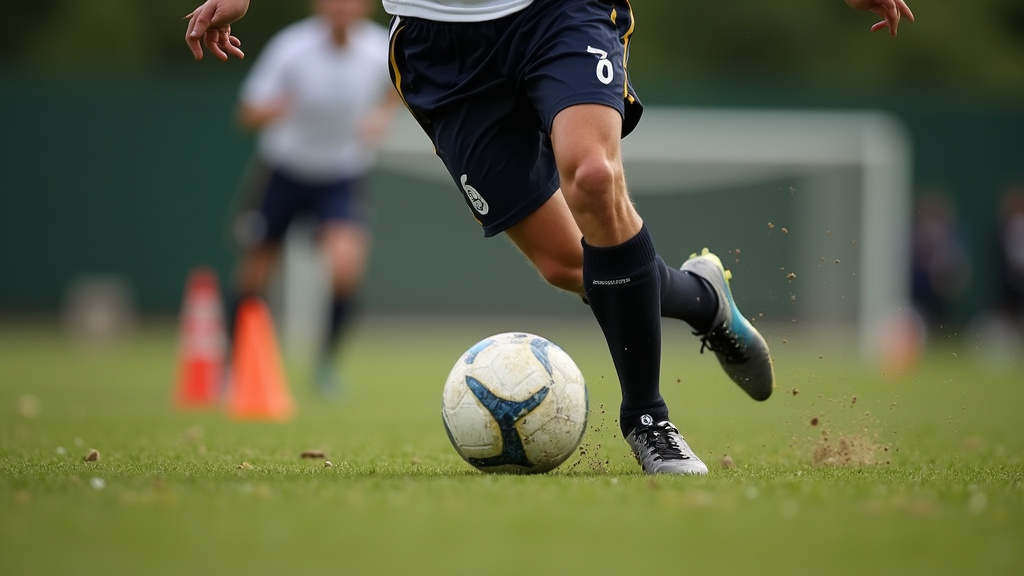
Messi’s body feints are subtle. A shoulder drop. A hip shift. The move lasts about 0.1 seconds, just enough visual cue to trick the defender’s brain. Then he goes the opposite way.
The feint-and-go drill locks this in. Approach a cone as if it’s a defender. Three yards away, drop your right shoulder and shift your weight slightly left. Then explode past the cone to the right. The feint is the shoulder drop. The go is the explosion.
The timing is everything. If your feint lasts too long, the defender adjusts. If it’s too short, they don’t register it. About 0.1 seconds is the sweet spot. It’s not a dramatic move. It’s a flicker.
I spent months practicing exaggerated feints, big shoulder swings, full-body twists. They worked against beginners. Against anyone with experience, they were read easily. The defender saw the big movement and knew exactly where I was going. The smaller, faster feint is harder to spot and harder to react to.
Your explosive first step after the feint is powered by that low center of gravity. From that crouched stance, you can push off laterally with more force. The soccer-specific workout plan that builds core and leg strength directly supports this. Without the strength, the feint is just a pretty move with no escape speed.
The Signature Move: Inside-Outside Touch

This is Messi’s most recognized dribbling move. Push the ball slightly forward with the inside of your foot, then immediately pull it back in the opposite direction with the outside of the same foot. It looks simple. The physics make it efficient.
Using the same foot for both actions saves time. Switching feet would require a full weight transfer and take about 0.2 seconds longer. In a one-on-one, 0.2 seconds is the difference between beating the defender and being tackled.
Practice it stationary first. Roll the ball forward with the inside of your right foot. As it moves, drag it back with the outside. Do this for five minutes per foot. The motion should become a single, fluid rock, not two separate actions.
Then add a defender cone. Approach it, perform the inside-outside touch to change direction, and accelerate away. The move is a direction change, not a speed burst. The acceleration comes after.
Many players try this move with the ball too far from their foot. If the ball is more than a foot away during the inside touch, the outside touch becomes a stretch. You lose balance. Keep it close.
Drills That Build Messi’s Muscle Memory
Drills aren’t just repetition. They’re installing the neural pathways for specific game situations. These three drills target Messi’s core abilities.
Zigzag dribble with acceleration. Set cones in a zigzag pattern five yards apart. Dribble through them. Between cones, accelerate for two yards. At the cone, decelerate sharply, change direction, and accelerate again. This trains change-of-speed, the burst after a feint or touch.
Pressure circle for shielding. Mark a five-yard circle. Dribble within it while a partner applies light, continuous pressure. They shouldn’t tackle. They should just occupy space and force you to shield the ball with your body. Use your arm and hip to create a barrier. This is how Messi holds possession when surrounded.
Stop-and-go for reactive control. Dribble freely. Suddenly stop the ball with the sole of your foot. Then accelerate in a new direction. The stop must be instant. The go must be explosive. This mimics evading a sliding tackle or reacting to a defender’s lunge.
Common mistake: Practicing drills only at full speed, you’ll reinforce mistakes instead of correct technique. Start slow. Get the form right. Then add speed. Speed without precision is useless.
Each drill should be done for 10–15 minutes, three times a week. Combine them into a 45-minute session. That’s enough to create change without burning out.
How Do You Train Short Ground Contact Time?
Short ground contact time isn’t just being quick. It’s about how your foot interacts with the ground. You want to touch and leave, not plant and push.
Reactive agility drills are the answer. Use a ladder or a set of markers. Sprint through them, but focus on snapping your foot off the ground immediately after each touch. The goal is to minimize the time your foot is stationary.
Another method: dribble a ball and have a partner call out random directions. You must change direction on their command. The sudden change forces you to shorten your ground contact, you can’t take a long step if you’re redirecting.
Agility ladder drills are perfect for this. They train foot speed and coordination in a pattern that demands quick touches. Incorporate them into your warm-up.
Your first week will feel unnatural. You’ll probably stumble. That’s because your neuromuscular system is learning a new timing. Give it two weeks. The adaptation happens.
What Size and Weight Ball Should You Use?
Match balls are size 5. Use a size 5 ball. Training with a smaller or lighter ball alters the feedback. Your foot learns a different weight, a different bounce. When you switch to a match ball, your touch will be off.
The ball’s weight matters too. A proper match ball weighs around 420–450 grams. Cheap plastic balls are often lighter. They don’t behave the same way on grass. Train with the real thing.
If you’re younger and still growing, use the appropriate size for your age. But once you’re playing with adults, stick to size 5. The consistency is part of the training.
I trained with a lightweight ball for a summer because it was cheaper. My first game back, every pass was overhit and my dribbling touches were too heavy. The ball felt like a rock. I had recalibrated my muscle memory to a fake weight.
Frequently Asked Questions
How long does it take to dribble like Messi?
You won’t dribble like Messi. You can dribble using his principles. The foundational skills, close control, vision, feints, take about three months of dedicated, daily practice to feel comfortable. The neural adaptations for short ground contact time and proprioception take longer, maybe six months. This isn’t a two-week fix.
Can tall players dribble like Messi?
Tall players have a higher center of gravity. They can’t replicate Messi’s low pivot point exactly. But they can train a more athletic stance and focus on quicker, smaller touches. Tall players often succeed with different strengths, long strides for speed dribbling, physical shielding. Emulate the principles, not the body type.
Is the inside-outside touch better than other moves?
For Messi, it’s better because it suits his physiology and saves time. For you, it might be. The key is that it’s a simple, efficient move. It doesn’t require acrobatic skill. It’s worth mastering because it works in tight spaces. Other moves like the rainbow flick are flashy but situational.
Do I need special cleats?
You need proper soccer cleats with good traction. Messi often wears boots with a snug fit and a thin sole for better ground feel. The stud configuration should suit your playing surface, firm ground, soft ground, artificial turf. The boot itself doesn’t make you dribble better, but poor traction will slip you up.
How do I practice if I don’t have a partner?
Use a wall for the wall pass drill. Use cones for the weave and zigzag. For pressure, imagine a defender and dribble within a tight circle, constantly changing direction to evade the imaginary pressure. It’s not as good as a real partner, but it builds the habit of shielding.
Should I also practice shooting?
Yes. Dribbling often leads to a shooting opportunity. Integrating finishing drills into your training ensures you can capitalize on the space you create. Messi’s dribbling is famous, but his finishing is why he scores.
Before You Go
Messi’s dribbling is a system. Low stance, quick feet, eyes up, simple moves. You can’t copy the system by just doing the moves. You have to build the underlying machine, the proprioception, the vestibular integration, the reactive agility.
Start with the cone weave. Get the ball glued to your foot. Then add the scan-and-dribble to pull your eyes up. Then the feint-and-go to learn deception. Drill each component separately before stitching them together.
Your first sessions will feel clumsy. The ball won’t obey. Your feints will be too slow. That’s expected. The adaptation happens in the third week, not the first.
Train with a real ball, real cones, and light pressure. The soccer rebounder is a tool, not a substitute for a partner. Use it for first-touch sharpness.
Finally, watch Messi not for the highlights, but for the moments before the highlight. Watch his posture when he receives the ball. Watch where his eyes go before he makes a move. That’s the system at work.
I come from the “soccer heart” of Germany, the Ruhrpott. I have played, trained and followed soccer all my life and am a big fan of FC Schalke 04. I also enjoy following international soccer extensively.