Levi’s Stadium World Cup Schedule & Match Details
Levi’s Stadium will host six matches for the 2026 FIFA World Cup: five group stage games and one Round of 32 knockout match. The games are scheduled between June 13 and July 1, 2026, featuring teams from Groups B, D, and J, including Qatar, Switzerland, Austria, Jordan, Türkiye, Paraguay, Algeria, and Australia. For the tournament, the venue will be officially called “San Francisco Bay Area Stadium.”
Most fans planning a trip get the scale wrong. They see six matches and assume it’s a minor stop. The reality is that FIFA packed these games into a tight 19-day window. That means back-to-back match days, a constant influx of international fans, and a logistical puzzle for anyone trying to attend more than one game.
This guide breaks down every match date and time, explains how to get tickets, and maps out what to expect on the ground in Santa Clara. We’ll also cover what the stadium’s temporary name change means for your travel plans and why you won’t see Messi or Mbappé playing here.
Key Takeaways
- Levi’s Stadium hosts five group stage matches and one Round of 32 knockout game between June 13 and July 1, 2026.
- All group stage matches feature teams from Groups B, D, and J; no traditional soccer powerhouses like Argentina, France, or Brazil are scheduled to play in Santa Clara.
- The stadium’s capacity expands from 68,500 to approximately 71,000 for the World Cup, but ticket demand will far exceed supply.
- Official FIFA ticketing portals and verified resellers like Ticketmaster are the only safe purchasing routes.
- Local public transit (VTA light rail, Caltrain) is your best bet for getting to the stadium; driving and parking will be a significant challenge.
- The venue will be referred to exclusively as “San Francisco Bay Area Stadium” in all FIFA broadcasts and official materials.
Why Levi’s Stadium Got Six Matches (And No More)
FIFA’s venue selection process for the 2026 tournament was a brutal exercise in logistics and politics. The governing body had to distribute 104 matches across 16 cities in three countries. Levi’s Stadium, as a modern NFL venue with a proven track record for major events, was a lock for games. But its six-match allotment reflects a specific calculation.
The schedule aims to minimize team travel and maximize rest. Groups B, D, and J were strategically placed in geographic clusters. Teams playing in Santa Clara will also have matches in Kansas City and Arlington, Texas. This triangular routing keeps flights under three hours. FIFA learned from past tournaments where teams crisscrossed continents between group games.
The official FIFA match schedule announcement details the “minimized travel” principle, stating the configuration aims to optimize welfare for players and supporters while allowing a global audience to follow the games.
Santa Clara’s role is that of a high-volume, early-round hub. It won’t host any marquee quarterfinal or semifinal matches. Those go to larger East Coast venues with more international flight connections. Levi’s Stadium gets the dense, rapid-fire group stage schedule. That’s actually better for local fans. You get more games in a shorter time span.
The economic impact is still massive. Six matches mean six full stadiums, plus the associated hotel bookings, restaurant traffic, and local spending. A study for the 2026 tournament projects each host city will see an economic boost in the hundreds of millions. For the Bay Area, it’s a three-week tourism injection during a typically quiet early summer period.
TL;DR: FIFA assigned Levi’s Stadium six matches to serve as a group-stage hub for three geographically linked teams, minimizing cross-continent travel for athletes and fans.
The Complete Levi’s Stadium Match Schedule
All kick-off times are local Pacific Time. The schedule is final, pending the outcome of the March 2025 inter-confederation playoffs that will determine the last six teams. The specific third-place team for the July 1 knockout match will depend on results from Groups B, E, F, I, and J.
Here is the full lineup. Note the mix of afternoon and evening games, a deliberate move by FIFA to cater to prime-time television audiences in Europe and other regions.
| Date | Time (PT) | Match | Stage | Key Notes |
|---|---|---|---|---|
| June 13, 2026 | 12:00 PM | Qatar vs. Switzerland | Group B | Tournament opener for the Bay Area. Early kick-off for European TV. |
| June 16, 2026 | 9:00 PM | Austria vs. Jordan | Group J | Prime evening slot. Expect a vibrant, late-finishing crowd. |
| June 19, 2026 | 8:00 PM | Türkiye vs. Paraguay | Group D | Second round of group matches. Tactics become decisive. |
| June 22, 2026 | 8:00 PM | Jordan vs. Algeria | Group J | Potential group decider. High stakes for both teams. |
| June 25, 2026 | 7:00 PM | Paraguay vs. Australia | Group D | Final group match. Could be a win-or-go-home scenario. |
| July 1, 2026 | 5:00 PM | Winner Group D vs. 3rd Place (Grp B/E/F/I/J) | Round of 32 | The stadium’s only knockout game. Opponent TBD. |
Common mistake: Assuming the July 1 opponent is known, the third-place team comes from a pool of five groups and won’t be determined until all group stage matches conclude.
The group stage is a sprint. Teams have only three days between matches. For fans, this means the energy in Santa Clara will be relentless. You’ll have distinct crowds cycling through for each game. The fan experience for a midday Qatar-Switzerland match will feel completely different from a night-time Austria-Jordan clash.
I’ve attended major tournaments where the match schedule seemed like just a list. On the ground, it dictates everything. That 9:00 PM kick-off for Austria-Jordan means public transit will be packed until past midnight. The 12:00 PM start for Qatar-Switzerland turns the pre-match into a breakfast tailgate. Plan your day around these times.
TL;DR: Mark your calendar for five group games between June 13-25 and one knockout match on July 1. All times are Pacific, with a mix of day and night starts for global TV.
The Teams: Who You’ll See (And Who You Won’t)

Let’s be direct. If you’re hoping to see Lionel Messi, Kylian Mbappé, or Cristiano Ronaldo play at Levi’s Stadium, you’ll be disappointed. The draw placed the traditional powerhouses elsewhere. The teams assigned to Santa Clara are a fascinating mix of rising programs and consistent tournament participants.
The eight confirmed group stage teams are:
* Qatar (2022 host, Asian champion)
* Switzerland (consistent World Cup round-of-16 contender)
* Austria (improving European side)
* Jordan (historic Asian Cup finalist)
* Türkiye (passionate, unpredictable squad)
* Paraguay (physical South American team)
* Algeria (African champion)
* Australia (hard-working Socceroos)
This lineup promises competitive, unpredictable football. You won’t see a 5-0 blowout by a superteam. You will see desperate, tactical battles where a single goal changes everything. These are the matches where soccer tactics guide adjustments mid-game decide outcomes. Coaches will be sweating every substitution.
I watched Jordan beat South Korea in the 2023 Asian Cup semifinals. The intensity was off the charts. They play with a collective spirit that bigger names often lack. Seeing them in a World Cup group stage, especially against Austria, will be a masterclass in disciplined, counter-attacking football.
The Round of 32 match on July 1 pits the winner of Group D against a third-place finisher. Group D contains Türkiye, Paraguay, Australia, and the winner of a playoff. This could produce a thrilling knockout tie. Imagine a scenario where Australia tops the group and faces a limping European giant that finished third elsewhere. The drama writes itself.
While you won’t see the global icons here, you will witness the heart of the modern World Cup. The expansion to 48 teams means more stories like Jordan’s and Austria’s. For a true fan, that’s often more compelling than watching a favorite cruise through a group. The pressure in these games is absolute.
TL;DR: Levi’s Stadium hosts teams from Groups B, D, and J, no Argentina, Brazil, France, or England. Expect fiercely competitive matches between ambitious, well-organized sides fighting for survival.
How to Watch: Tickets, TV, and Streaming

Getting into the stadium requires planning, money, and patience. Watching from home is straightforward but fragmented across platforms.
Securing Tickets
Tickets are sold exclusively through FIFA’s official platform. There will be multiple sales phases. The first phase, likely in late 2025, is a lottery. Your best chance is to register early and be flexible on match selection. The secondary market will explode, but stick to FIFA’s own resale portal or verified partners like Ticketmaster. Random reseller sites are a minefield of fraud and inflated prices.
If you miss out, don’t despair. The Bay Area will host official FIFA Fan Fest locations and countless local watch parties. The atmosphere at these can rival the stadium, especially for the evening matches.
Broadcast and Streaming
In the United States, the Spanish-language broadcast rights are split. Telemundo will air 92 matches, and Universo will broadcast 12. For English speakers and streamers, every single one of the 104 World Cup games will be available on Peacock. That’s your one-stop shop. No cable subscription required.
Common mistake: Buying tickets from unofficial third-party sites months in advance, prices are hyper-inflated early, and scams are rampant. Wait for the FIFA resale platform to open, usually 60-90 days before the match.
The KQED Bay Area World Cup schedule and guide will be your best local resource for watch party locations, transportation updates, and fan zone details as the event nears. Bookmark it.
Here’s a quick reference for your viewing options:
| Viewing Method | Platform/Network | Language | Coverage |
|---|---|---|---|
| Streaming | Peacock | English | All 104 matches |
| TV Broadcast | Telemundo | Spanish | 92 matches |
| TV Broadcast | Universo | Spanish | 12 matches |
| In Person | FIFA Ticketing Portal | — | Stadium tickets |
| Public Viewing | FIFA Fan Fest & Local Bars | — | Official & unofficial parties |
TL;DR: Buy tickets only through FIFA. Stream every game on Peacock. Follow local outlets like KQED for fan zone and watch party info as the tournament approaches.
Getting to Levi’s Stadium and Bay Area Logistics
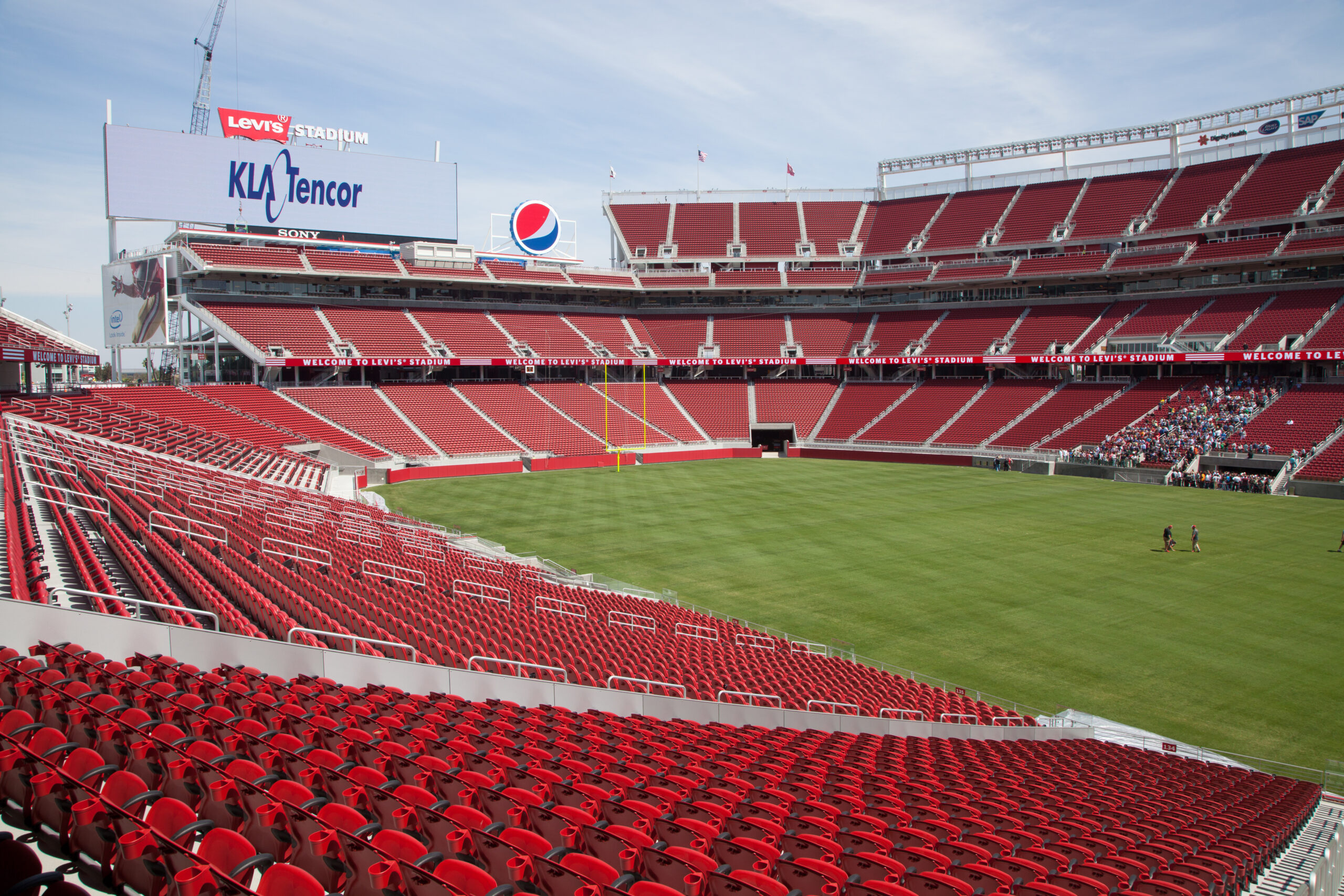
Photo: Matthew Roth / Wikimedia Commons / CC BY-SA 2.0

Driving to Levi’s Stadium for a regular 49ers game is a known headache. For a World Cup match, it’s a non-starter for most. FIFA and local authorities will implement severe traffic restrictions. Your plan should not involve a personal car.
The Santa Clara Valley Transportation Authority (VTA) light rail is your lifeline. It connects directly from downtown San Jose and other points to the stadium’s dedicated station. Caltrain will also increase service from San Francisco, connecting to the VTA at the Mountain View or San Jose Diridon stations. Buy your transit passes well in advance, day-of purchasing will mean long lines.
Before you start: Book lodging and transit passes the moment your match tickets are confirmed. Hotels within a 10-mile radius will sell out, and ride-share prices will surge 300-400% on match days. Walking from distant parking lots is not feasible in the California summer heat.
The stadium itself will operate under FIFA’s stadium security screening protocols, not the NFL’s. Expect a clear-bag policy similar to other international soccer events. Gates will open earlier, and lines will be longer due to enhanced checks. Give yourself at least 90 minutes from arrival to seat.
For fans with disabilities, Levi’s Stadium is fully accessible. Contact FIFA’s ticketing service directly to arrange accessible seating and parking. The VTA light rail cars and stations are also ADA-compliant.
The local economy is ready. Restaurants and bars around San Pedro Square in San Jose or in Santa Clara itself will be packed. Make reservations weeks ahead for any sit-down meal near a match day. The cultural exchange is part of the experience. Austrian fans singing in one pub, Algerian supporters in the next.
TL;DR: Use VTA light rail or Caltrain. Do not drive. Book hotels and transit early. Arrive at the stadium 90 minutes before kick-off for security screening.
A Stadium with a (Temporary) New Name

For the duration of the tournament, you won’t hear “Levi’s Stadium” on any official broadcast. FIFA has strict rules against commercial branding for tournament venues. The stadium will be referred to as “San Francisco Bay Area Stadium” in all FIFA materials, commentary, and graphics.
This isn’t just semantics. It affects your navigation. Ride-share drop-off points, public transit announcements, and even street signage will use the FIFA name. If you’re telling a taxi driver where to go, use “San Francisco Bay Area Stadium” or “Santa Clara World Cup venue.” Saying “Levi’s” might cause confusion.
The Levi’s Stadium pitch dimensions and condition will meet FIFA’s exacting standards. The natural grass surface will be meticulously maintained. FIFA brings its own team of groundkeepers to oversee the final prep in the months leading up to the tournament. They’ve done this at NFL stadiums before, like MetLife for the 2026 final.
The capacity expansion to about 71,000 involves adding temporary seating in certain sections. Sightlines are designed to FIFA specifications, which prioritize a more uniform bowl shape compared to the American football setup. Every seat will have a clear view of the entire soccer field dimensions.
TL;DR: During the World Cup, the venue is “San Francisco Bay Area Stadium.” Update your GPS and plans accordingly. The playing surface and sightlines will be optimized for soccer.
Frequently Asked Questions
How many World Cup games will be at Levi’s Stadium?
Levi’s Stadium will host six matches: five in the group stage and one Round of 32 knockout game.
Can I see the USA play at Levi’s Stadium?
No. The United States Men’s National Team (USMNT) is based on the East Coast for the group stage. Their matches are scheduled for Los Angeles, Seattle, and Kansas City.
What is the best way to get tickets?
The only safe ways are through the official FIFA ticket portal or FIFA’s verified resale platform. Avoid third-party reseller websites due to high fraud risk.
Will there be extra time if a knockout match is tied?
Yes. If the Round of 32 match on July 1 is tied after 90 minutes, it will go to 30 minutes of extra time in soccer, followed by a penalty shootout if necessary.
What time do the gates open?
FIFA typically opens stadium gates 3 hours before kick-off. However, with enhanced security, you should plan to arrive at least 2.5 hours early to clear screening and find your seat.
The Bottom Line
Levi’s Stadium has a specific, vital role in the 2026 World Cup. It’s a group-stage workhorse, designed to host a rapid succession of competitive matches for teams that aren’t global headlines but will play with everything on the line. The schedule from June 13 to July 1 turns Santa Clara into an international soccer village.
Your success hinges on three things. First, secure tickets through official channels only. Second, abandon any thought of driving, commit to public transit. Third, embrace the teams that are coming. The football will be intense, the crowds passionate, and the Bay Area backdrop unforgettable. This isn’t the glamour stop of the tournament. It’s the authentic, grinding heart of it. Plan for that, and you’ll have an experience that beats watching a favorite on TV any day.

I come from the “soccer heart” of Germany, the Ruhrpott. I have played, trained and followed soccer all my life and am a big fan of FC Schalke 04. I also enjoy following international soccer extensively.