Understanding Soccer Field Lines: The Ultimate Visual Guide
To mark a soccer field correctly, you must follow the official dimensions, use lines 8–12cm wide, and understand that each line is part of the area it defines. The ball is only out or a goal only scored when it fully crosses the line.
Most guides stop at naming the lines. They miss the real shift happening right now, how those lines are made. Paint fades. Chalk washes away. By 2026, the durable standard for new fields and renovations won’t be paint. It’s artificial turf inlay.
This guide covers every line’s name, FIFA dimension, and tactical purpose. More importantly, it shows you the two ways to put them on a field: the old temporary method and the new permanent one. We’ll look at the tools, the costs, and why the future of a crisp pitch is woven into the turf itself.
Key Takeaways
- A soccer field line is part of the area it encloses. A ball on the line is still in play; a goal is only valid if the entire ball crosses the entire goal line.
- For professional matches, the international standard pitch is 105 meters long by 68 meters wide. All lines must be 12 centimeters wide.
- The penalty area is 40.32m wide x 16.5m deep. A foul by the defending team inside this box results in a penalty kick from the spot 11 meters out.
- Artificial turf inlay lines are becoming the standard for durability. They are strips of white synthetic grass knitted or paved into the field, lasting years without repainting.
- Field dimensions are scaled down for youth play. A common U9/U10 pitch is roughly 70m x 50m, with proportionally smaller penalty areas and a 6m radius center circle.
The 8 Essential Lines and What They Do
Forget just calling them sidelines and boxes. Each marking has a formal name and a specific rulebook function. Knowing them changes how you watch the game.
The touch lines and goal lines define the field of play and are considered part of that field. The ball is out of play only when it has wholly passed over the touch line or goal line on the ground or in the air. All lines must be of the same width, between a minimum of 8cm and a maximum of 12cm.
Touch Line. This is the long side boundary. When the ball fully crosses it, play stops for a throw-in. The throw is taken from the point where it left the field. This line also dictates offside, a player cannot be offside in their own half, which is divided by the halfway line.
Goal Line. The shorter end boundary. A goal is scored when the whole ball crosses this line between the posts and under the crossbar. If the defending team last touches it before it fully crosses, it’s a corner kick. If the attacking team last touches it, it’s a goal kick.
Halfway Line. It splits the pitch into two halves. At kick-off, every player must be in their own half. This is a fundamental soccer field layout diagram rule. It’s also the visual reference for the offside rule’s “halfway line” exemption.
Center Circle. Has a 9.15-meter radius from the center spot. During a kick-off, opposing players must stay outside this circle until the ball is played. It’s not just decoration, it enforces the 10-yard rule on restarts.
Penalty Area. The 18-yard box. This is a zone of heightened consequences. The goalkeeper can handle the ball anywhere inside it. A direct free foul by the defending team here results in a penalty kick. It also defines where goal kicks are taken from.
Goal Area. The 6-yard box. Its primary function is to give the goalkeeper space for goal kicks. The kick must be taken from within this smaller box. It also restricts opposing players during a goal kick, they must remain outside the area until the ball is in play.
Penalty Spot. A solid circle 11 meters (12 yards) from the midpoint of the goal line. This is where the ball is placed for a penalty kick. The exact distance is non-negotiable in professional regulation field size setups.
Penalty Arc. A small arc at the top of the penalty area, with a 9.15m radius from the penalty spot. Its only job is to mark the 10-yard exclusion zone for players during a penalty kick. It is not a playing boundary.
Corner Arc. A quarter-circle with a 1-meter radius in each corner. The ball must be placed inside this arc for a corner kick. The corner flagpost is planted at the center of this arc.
TL;DR: Every line has a law attached to it. The touch and goal lines are boundaries, the circles enforce distance, and the boxes create special rule zones for keepers and penalties.
Official Soccer Field Dimensions: From Youth to World Cup
The field isn’t one size. It’s a range, tightening to a precise rectangle at the highest level. Getting the field dimensions wrong doesn’t just break rules, it changes how the game is played.
The Laws of the Game allow a broad range: 100-110 meters long and 64-75 meters wide. That’s a lot of wiggle room for local parks. But FIFA and UEFA lock it down for tournaments. The 2026 World Cup, like every World Cup since 1998, will use the 105m x 68m standard for every venue. Why? Consistency. A team that trains on a 68m-wide pitch shouldn’t face a 75m-wide ocean in the knockout stages.
| Field Type | Length (Min–Max) | Width (Min–Max) | Primary Use |
|---|---|---|---|
| FIFA International | 105m (fixed) | 68m (fixed) | World Cup, Champions League |
| Adult Professional | 100m – 110m | 64m – 75m | Domestic leagues |
| U13/U14 Youth | 80m – 90m | 55m – 65m | Competitive youth play |
| U9/U10 Youth | 70m – 80m | 50m – 60m | Small-sided development |
The width matters more than people think. A wider field stretches defenses horizontally, creating more space for wingers. A narrower pitch condenses play, favoring physical, central battles. When Barcelona’s tiki-taka was dominant, they famously petitioned UEFA to allow them to maintain the maximum width at the Camp Nou. It gave their passing lanes an extra few meters of space.
For youth soccer, scaling is critical. A full-size pitch is overwhelming for an 8-year-old. The standard U9/U10 field is about 70m x 50m. The penalty area shrinks accordingly, and the center circle radius is often reduced to 6 meters. This scaling preserves the game’s tactical shape while matching a child’s physical capacity.
Common mistake: Building a youth field with full-size penalty areas, the kids never get out of their own box, play gets congested, and goalkeepers can’t reach the 18-yard line to clear a ball.
TL;DR: Pro fields use a strict 105m x 68m template. Youth fields must be scaled down proportionally, or you create a game that doesn’t function.
How to Mark a Field: Paint vs. Future-Proof Inlay
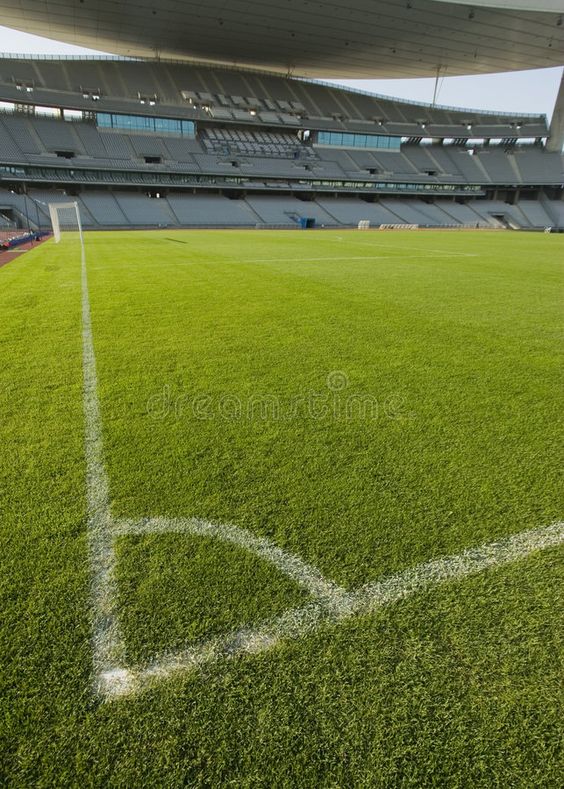
You can draw the lines with paint or build them into the turf. The choice isn’t just about today’s cost. It’s about who’s going to be repainting them every six weeks for the next decade.
The traditional method uses field marking paint. You need a spray machine, stakes, string, and a good measuring tape. The process is straightforward but perishable. On natural grass, a heavy rain can blur the lines after two games. On artificial turf, the paint wears off from cleat friction, requiring re-application several times a season. The smell of that paint is sharp, chemical, it hangs in the air for an hour after you finish.
The modern method is artificial turf inlay. These are precut strips of white synthetic grass. For new field construction, they are often knitted simultaneously with the green turf filament. For retrofits, you cut out a 12cm-wide channel in the existing turf and pave the white strip into place, seaming it with adhesive and field tape.
| Method | Durability | Visibility | Maintenance | Best For |
|---|---|---|---|---|
| Paint | 2–8 weeks | High initially, fades | Frequent repainting | Budget projects, multi-use fields |
| Artificial Turf Inlay | 8–12 years | Consistent, never fades | Occasional brushing | Dedicated soccer facilities, schools, pro clubs |
The inlay doesn’t fade. It doesn’t wash away. You brush it with the rest of the field. The initial cost is higher, sometimes 3–4 times the cost of a paint job. But the math flips over a five-year period. You eliminate paint, labor, and field downtime. For a club with ten fields, that’s hundreds of maintenance hours saved.
I oversaw a field renovation for a local academy where we switched from paint to inlay. The first season, the board questioned the extra €15,000 line item. By the third season, the grounds crew was reallocated to irrigation and pitch leveling because line marking was a non-issue. The lines were still laser-sharp in year five. Paint would have been reapplied over thirty times in that span.
TL;DR: Paint is a temporary, recurring cost. Artificial turf inlay is a higher upfront investment that pays off in under three years by eliminating repainting labor and materials.
Why Line Width and Clarity Are Non-Negotiable

A fuzzy line is a broken rule. The standard 12cm width isn’t arbitrary. It’s the minimum size needed for clear visibility from the assistant referee’s position 50 meters away, in rain, under floodlights.
The law states lines must be between 8cm and 12cm wide. All lines on the same field must be the same width. Almost every professional and FIFA-sanctioned competition uses the maximum 12cm. This width creates a definitive visual edge. When a ball is spinning on the grass, that extra centimeter of white can be the difference between “in” and “out.” Assistant referees are trained to watch for the gap between the ball and the line’s outer edge.
Poor line clarity causes real problems. In a cup match I watched, a faded touch line led to three contentious throw-in calls in the first half. The referee crew had to convene at halftime to physically remark the line with spray chalk. It killed the match’s flow and undermined their authority. The home team was fined for failing to provide a properly marked pitch.
For video assistant referee (VAR) technology, crisp lines are data. The system uses high-definition cameras and software to make offside and goal-line judgments. A blurred or uneven line introduces calibration error. The 2026 World Cup will use even more advanced semi-automated offside technology. It relies on perfect pitch markings guide as a digital baseline. A sloppy field literally breaks the tech.
Common mistake: Using 8cm lines to save paint or inlay material, the lines become nearly invisible in evening matches, leading to constant player complaints and officiating errors.
The Penalty Area: A Zone of Its Own Laws
The penalty area is a kingdom with its own rules. It’s not just a big rectangle. It’s where the game’s highest-stakes decisions are made.
First, it’s the goalkeeper’s domain. They are the only player allowed to handle the ball within these 16.5m x 40.32m boundaries. The moment a keeper picks up a back-pass, however, they cannot drop it and pick it up again. That’s an indirect free kick offense. Second, it’s the origin point for goal kicks, which must be taken from anywhere inside the goal area.
Its most famous function is triggering the penalty kick. A direct free kick offense committed by the defending team inside their own penalty area results in a penalty. Not all fouls there are penalties, only those punishable by a direct free kick. The ball is placed on the penalty spot, 11 meters from goal. This rule creates immense pressure, defining careers.
The area also dictates defender behavior during a penalty kick. Except for the kicker and the opposing goalkeeper, all players must be outside the penalty area and the penalty arc until the ball is struck. This is why you see players crowding the D but not crossing the line.
Understanding the difference between the penalty area and the smaller goal area is crucial. The goal area’s main job is to provide a zone for goal kicks. It also gives the goalkeeper protection, opponents cannot challenge them when they have control of the ball in their hands inside this six-yard box. The penalty area rules are about major fouls and keeper privileges. The goal area rules are about restarts and keeper safety.
TL;DR: The penalty area grants the keeper handling rights and turns certain fouls into penalties. The goal area is for goal kicks and protecting the keeper in possession.
Corner Kicks and the Center Circle: Restart Geometry
Set-piece restarts have specific geometry. The corner arc and center circle aren’t suggestions. They are measured zones that enforce fairness on the restart.
The corner arc is a 1-meter radius. The ball must be placed inside it for the kick. The corner flagpost must not be removed; it sits at the arc’s center point. This small zone ensures the kick is taken from the corner, not from a yard infield where the angle is better. Opponents must stand at least 9.15 meters away until the ball is in play, which is why you see defenders lining up on the edge of the penalty area.
The center circle’s 9.15-meter radius serves the same purpose for kick-offs: keeping opponents 10 yards away. This distance gives the team taking the kick a moment of uncontested possession to start play. The rule is strictly enforced. An encroaching player is warned, and a re-kick is ordered.
These dimensions are tied to the center circle purpose. They standardize the restart environment. A team in Barcelona faces the same 9.15m of space on a kick-off as a team in Buenos Aires. This consistency is a cornerstone of the game’s fairness.
Frequently Asked Questions
What is the standard width of a soccer field line?
The official Laws of the Game require lines to be between 8cm and 12cm wide. For all FIFA-sanctioned competitions, including the World Cup and Champions League, the standard is the maximum 12cm width for optimal visibility.
Is the ball out if it touches the line?
No. A ball is only out of play when the entire ball has crossed over the outside edge of the line. The line itself is considered part of the field of play. The same rule applies for goals, the whole ball must cross the whole goal line.
What’s the difference between the penalty area and the goal area?
The penalty area (18-yard box) is where the goalkeeper can handle the ball and where defensive fouls result in a penalty kick. The goal area (6-yard box) is where goal kicks are taken from and where the goalkeeper is protected from challenge when holding the ball.
How far is the penalty spot from the goal?
The penalty spot is exactly 11 meters (12 yards) from the midpoint of the goal line. This distance is universal in professional and official pitch dimensions.
What are soccer field lines made of?
Traditionally, they are made with biodegradable field marking paint on grass or artificial turf. The modern, durable standard is artificial turf inlay, permanent strips of white synthetic grass woven or paved into the field surface, which can last over a decade.
Why is there a circle around the penalty spot?
That’s the penalty arc. It has a 9.15m radius from the penalty spot and its sole function is to mark the minimum distance that all players (except the kicker and goalkeeper) must stand from the ball during a penalty kick procedure.
Before You Go
Marking a soccer field is equal parts geometry and law. You need the right measurements, 105m by 68m for the pros, scaled down for the kids. You need the right lines, each 12cm wide and each with a specific name and rule attached. The touch line, the goal line, the penalty area. They’re not just paint. They’re the framework of the game.
But the real takeaway is how you put them down. The old way is paint. It’s cheap today and expensive tomorrow. The new way, the 2026 way, is artificial turf inlay. It’s an investment that ends the cycle of repainting. It gives you a pitch where the lines are as permanent as the rules they represent.
Finally, remember the core principle. The line is part of the field. A ball on the line is in. That simple fact dictates throw-ins, goals, and a thousand tight calls every season. Get the markings right, and you give the game a fair, clear stage to play on.
I come from the “soccer heart” of Germany, the Ruhrpott. I have played, trained and followed soccer all my life and am a big fan of FC Schalke 04. I also enjoy following international soccer extensively.