Soccer Field Lines Called: A Complete Guide to Their Names
Soccer field lines are called touchlines (the long sides), goal lines (the short ends), the halfway line, the center circle, the penalty area, the goal area, the penalty mark, the penalty arc, and corner arcs. Every marking has a specific name and a strict rule governing its use, from restarting play to enforcing player positioning.
Most people get this wrong by focusing on just the “box” or the “circle.” They miss that the lines themselves are active participants in every decision. A ball kissing the touchline is still in. A toe on the penalty arc during a kick is a violation.
This guide names every line on the pitch, explains its exact purpose under the Laws of the Game, and shows you how referees use them to make split-second calls. You will learn the difference between a goal line and a byline, why the penalty arc exists, and what happens when a player disrespects a simple painted circle.
Key Takeaways
- The touchline and goal line are the boundaries. The ball is only out when it completely crosses the line—any part on the chalk means play continues.
- The penalty area is the 18-yard box where the goalkeeper can use hands and fouls may result in a penalty kick. The smaller goal area (6-yard box) is for goal kicks and protects the keeper on restarts.
- The penalty arc (or “the D”) has one job: to keep all players except the kicker and goalkeeper 9.15 meters away from the penalty mark during a spot kick.
- Field dimensions are flexible (90-120m long, 45-90m wide) but fixed for international matches (100-110m x 64-75m). The size directly changes the game’s speed and stamina demands.
- All lines must be the same width (max 12cm/5 inches) and are considered part of the area they define. Stepping on the line is the same as being inside the space.
The 9 Essential Soccer Field Lines and Their Names
Forget “sidelines” and “end lines.” The official terminology is precise for a reason. Referees, coaches, and players use these specific names because each one ties directly to a Law of the Game. Get the name wrong, and you might misunderstand the rule.
Here is the complete roster, from boundary to center spot.
1. Touchlines
The two longest boundary lines running the length of the field are the touchlines. They define the field of play laterally. When the whole ball crosses a touchline, play stops for a throw-in. The term comes from early rules where the ball was “in touch” when out of bounds. You will hear “sideline” in casual conversation, but the law book says touchline.
2. Goal Lines
The two shorter boundary lines at each end are the goal lines. This is the critical line for determining goals. A goal is scored only when the entire ball crosses the goal line between the posts and under the crossbar. The portion of the goal line extending beyond the goalposts to the corner flags is sometimes called the byline, especially by commentators. This distinction matters. A ball crossing the byline outside the post results in a goal kick or corner, not a goal.
The goal line is the entire line from corner flag to corner flag. The section between the goalposts decides a goal; the sections outside the posts (the bylines) decide whether a restart is a goal kick or a corner.
3. Halfway Line
This single line divides the pitch into two equal halves. It connects the midpoints of the two touchlines. Its primary function is for the kick-off to start each half and after a goal. During a kick-off, every player must be in their own half. The line also helps referees judge offside positions at the moment the ball is played.
4. Center Circle
Drawn around the center mark with a radius of 9.15 meters (10 yards), the center circle enforces distance on kick-offs. Opposing players must remain outside this circle until the ball is in play. It is a visual cue for players and officials alike. The circle itself has no other function once the game is live.
The Critical Areas Around the Goal
The markings near the goal are where games are won, lost, and argued over. They create zones with special privileges and severe consequences.
5. The Penalty Area
Often called the “18-yard box,” this is the large rectangle in front of each goal. Two lines extend 16.5 meters (18 yards) into the field from each goalpost, connected by a line parallel to the goal line. This area grants the goalkeeper the privilege to handle the ball. More critically, a defensive foul punishable by a direct free kick that occurs within this area results in a penalty kick. The entire ball must be inside the area for the foul to warrant a penalty.
6. The Goal Area
Inside the penalty area lies the smaller “6-yard box,” or goal area. It is formed by lines extending 5.5 meters (6 yards) from each post. This zone has two key uses. First, it is the spot from which goal kicks are taken; the ball must be stationary anywhere within this area. Second, it provides a small zone of protection for the goalkeeper during indirect free kicks awarded to the attacking team inside the goal area—the kick is taken from the point on the 6-yard line nearest to where the offense occurred.
Common mistake: Using the goal area to judge a penalty. Penalty decisions are based on the larger penalty area, not the 6-yard box. A foul right on the goal area line is still a penalty, because that line is part of the penalty area.
7. The Penalty Mark
This is a simple spot, 11 meters (12 yards) from the midpoint between the goalposts, centered within the penalty area. It is the placement point for the ball during a penalty kick. Nothing else happens here. Its location is non-negotiable and must be visibly marked.
8. The Penalty Arc
A small arc of a circle with a 9.15-meter radius drawn outside the penalty area, centered on the penalty mark. Colloquially called “the D.” Its purpose is singular and absolute.
| Line/Area | Primary Purpose | Key Rule Detail |
|---|---|---|
| Penalty Arc | Enforce distance on penalty kicks | All players except kicker & keeper must stay outside the arc and penalty area until the kick is taken. |
| Center Circle | Enforce distance on kick-offs | Opponents must stay outside the circle until the ball is in play. |
| Goal Area | Designate goal kick zone & keeper protection | Ball is placed anywhere within this area for a goal kick. |
TL;DR: The penalty arc exists only to keep players 9.15m from the penalty spot. It is not a decoration.
The Supporting Cast: Center Spot and Corners
The remaining markings are about restarts and geometry.
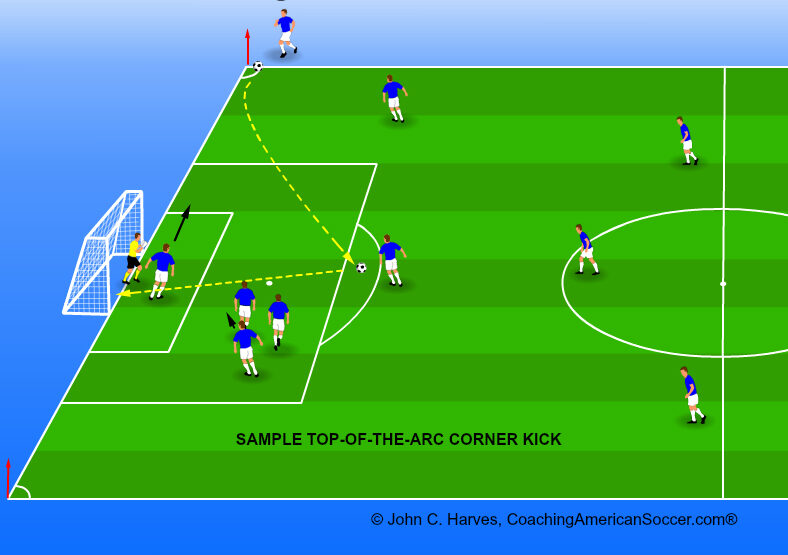
9. The Corner Arc
At each of the four corners of the field, a quarter-circle with a 1-meter (1 yard) radius is drawn inside the field. This arc marks where the ball must be placed for a corner kick. The corner flagpost must be placed at the exact point where the touchline and goal line meet, and it cannot be removed. The ball is inside this arc for the kick.
The center mark is the point at the very middle of the halfway line. The ball is placed on this spot for kick-offs. It is the anchor point for the entire center circle. While not a “line,” its location is fundamental to starting and restarting the game fairly.
How Field Size Changes the Game
The Laws allow a range: touchlines 90-120 meters long, goal lines 45-90 meters long. For international matches, the range tightens to 100-110m x 64-75m. FIFA recommends 105m by 68m. This variability is not arbitrary.
A longer, wider field favors teams with high stamina and speed, stretching the game and creating space for wing play. The touchlines and goal lines feel miles apart. A compact, narrow pitch favors physical, defensive teams where contact is constant and space is premium. The journey from the best football cleats for grass to the best turf football shoes for artificial surfaces starts with understanding this canvas. The lines are the same, but the distances between them dictate strategy.
I once played a cup final on a pitch that was barely 90 meters long and maybe 50 wide. Our game plan, based on switching play to the wings, collapsed. The touchlines were so close that every cross was basically a shot, and the penalty area felt crowded on every attack. We lost 1-0 to a set-piece. The dimensions changed everything.
For youth soccer, the fields are smaller. You might even see a “build-out line” between the halfway line and penalty area, used to encourage playing out from the back. This is not part of the official Laws but a developmental tool. Always check the local regulation soccer pitch markings for the age group.
Rules, Violations, and the Referee’s Eye

The lines are passive until a player or the ball interacts with them. Then, they trigger very specific outcomes.
A player making an unauthorized mark on the field to fake a penalty spot or a throw-in line will be cautioned for unsporting behavior. The integrity of the markings is sacrosanct. If the crossbar breaks and cannot be fixed, the match is abandoned—the goal frame is the ultimate extension of the goal line.
The most frequent line violations are procedural.
– Throw-ins: Both feet must be on or behind the touchline. A toe on the field is an illegal throw, resulting in a turnover.
– Penalty Kicks: An attacker encroaching into the penalty arc or area before the kick is taken forces a retake if a goal is scored. A defender doing the same forces a retake if the goal is missed.
– Goal Kicks: The ball must be stationary and inside the goal area. Place it outside, and the kick is retaken.
Referees use the lines as their primary visual guide. Assistant referees keep their eyes glued to the touchline and goal line to judge offside and ball-out-of-play. In the modern game, Goal-Line Technology (GLT) and VAR use high-speed cameras to determine with millimeter precision whether the ball has wholly crossed the goal line. The line’s definition has not changed, but the technology enforcing it has.
TL;DR: Respect the lines. They are the law’s physical manifestation on the pitch. Disrespect them, and you give away free restarts, get booked, or concede goals.
Equipment and the Field’s Foundation
The lines themselves must be of uniform width, not exceeding 12 centimeters (5 inches). They are usually white. On artificial turf, other lines for different sports are allowed only if they are a different color and clearly distinguishable. This prevents confusion during a match.
The goals, placed on the center of each goal line, are part of the field’s definition. The posts and crossbar must be white, with the same width and depth as the field lines. Their placement solidifies the two most important points on the goal line. Whether you’re filming the action with the best sports camera or just watching, the frame of the goal is your visual anchor.
Portable goals are permitted if they are safe and anchored. The tragedy of tip-over goals is why federations mandate strict safety glasses for sports protocols and equipment checks. The field is a workplace. Its markings and equipment must not be dangerous.
| Symptom | Likely Cause | Official Consequence |
|---|---|---|
| Ball hits net but referee waves play on | Ball did not wholly cross goal line between posts | No goal. Play continues from goalkeeper’s possession or a goal kick. |
| Throw-in is whistled, turnover awarded | Thrower’s foot was over the touchline | Opposing team gets the throw-in from the same spot. |
| Penalty kick is ordered retaken | Defender encroached into penalty arc before kick | Kick is retaken, regardless of the initial outcome. |
| Player receives yellow card during stoppage | Player scuffed penalty mark with heel before opponent’s kick | Caution for unsporting behavior. |
For a complete look at the official specifications, always refer to the IFAB Laws of the Game pitch specifications. That document is the final word.
Frequently Asked Questions
What is the difference between a goal line and a byline?
The goal line is the entire line from one corner flag to the other. The term “byline” specifically refers to the sections of the goal line that extend beyond the goalposts on either side. A ball crossing the byline results in a goal kick or corner. A ball crossing the goal line between the posts results in a goal.
Why is there a ‘D’ shaped arc at the top of the penalty box?
The penalty arc, or “the D,” ensures all players except the penalty taker and goalkeeper remain at least 9.15 meters (10 yards) from the penalty mark during a penalty kick. It is an extension of the distance rule beyond the penalty area’s rectangular boundary.
Can a player be offside if they are on their own half of the field?
No. A player cannot be in an offside position if any part of their head, body, or feet is in their own half of the field. The halfway line is the determining marker for this rule.
What happens if the ball hits the corner flag and stays in bounds?
Play continues. The corner flag is considered part of the field. If the ball strikes the flag and remains inside the touchline and goal line, it is still in play. The flag must not be removed for any reason during play.
Are soccer field dimensions the same everywhere?
No. While professional and international matches have strict dimensions (100-110m x 64-75m), local and youth fields can vary within the Laws’ broader ranges (90-120m x 45-90m). Smaller fields are common for youth games to suit physical development.
What is the purpose of the center circle?
The center circle’s only function is to enforce the 9.15-meter distance rule during a kick-off. Opposing players must remain outside the circle until the ball is kicked and moves forward. It serves no other purpose during active play.
Before You Go
Knowing that the long sides are touchlines and the short ends are goal lines is just the start. The real knowledge is understanding that the penalty arc has one job, the goal area is for restarts, and every millimeter of chalk is part of the territory it defines. These lines are not passive decorations. They are active officials in every match, dictating where a goalkeeper can use their hands, where a penalty is awarded, and ultimately, where a goal is scored.
Use this guide next time you watch a match. Follow the ball’s relationship to the touchline. Watch where players stand at a penalty. Notice the size of the pitch and how it affects the flow. The game happens within these painted boundaries. Now you know exactly what to call them and why they matter. For a deeper dive into how these markings compare to other sports, explore the key American football vs. soccer field distinctions.
I come from the “soccer heart” of Germany, the Ruhrpott. I have played, trained and followed soccer all my life and am a big fan of FC Schalke 04. I also enjoy following international soccer extensively.