Brazil World Cup History: Full Tournament Record and Stats
Brazil’s World Cup history is a record of unparalleled success, defined by five tournament victories and participation in every edition since 1930. Their legacy includes 76 wins from 114 matches, 237 goals scored, and a national story of genius, reinvention, and immense pressure spanning 94 years.
Brazil’s World Cup history and record is defined by five championships, participation in every single tournament since 1930, and a collection of statistical records no other nation approaches. Their 114 matches have yielded 76 wins, 237 goals, and a legacy built on two distinct golden eras separated by a 24-year drought.
Most summaries list the titles and stop. They treat the record as a static monument. The mistake is missing the narrative, the two-decade gaps of frustration, the tactical reinventions, and the national trauma that forged the obsession with winning. This isn’t just a trophy case. It’s a 94-year story of pressure, genius, and occasional catastrophe.
This guide maps Brazil’s complete journey. We’ll break down the unassailable numbers, relive the golden eras, dissect the painful lows, and explain how their soccer culture produced this unmatched dynasty.
Key Takeaways
- Brazil is the only nation to qualify for every World Cup without playoffs, a streak of 22 tournaments and counting.
- Two distinct golden eras defined their success: the flair-driven 1958-1970 period (3 wins) and the pragmatic 1994-2002 period (2 wins, 3 finals).
- The 1950 loss to Uruguay at the Maracanã (“Maracanazo”) remains a national trauma that deepened the country’s psychological need to win.
- Beyond Pelé, individual records are held by Cafu (most appearances, 20) and Ronaldo (most goals, 15).
- Their tactical identity evolved from pure “Joga Bonito” attacking flair to incorporate European defensive discipline, especially in the 1994 triumph.
The Unbreakable Records: Brazil by the Numbers
The raw statistics border on absurdity. They are not just leading categories; they own them. According to the comprehensive Wikipedia page on Brazil’s World Cup record, the Seleção’s lead in key metrics is often larger than the gap between second and fifth place.
Brazil’s all-time World Cup record stands at 114 matches played, 76 wins, 19 draws, 19 losses, 237 goals scored, and 108 conceded. This yields a win rate of 66.7% and a +129 goal difference, both tournament records.
The consistency is the foundation. Missing a World Cup is unthinkable. While other giants like Italy, Germany, and Argentina have failed to qualify, Brazil’s machine never breaks. This relentless accumulation of matches is why their record totals are so untouchable.
| Record Category | Brazil’s Stat | Why It’s Unmatched |
|---|---|---|
| Titles | 5 | Two more than any other nation (Germany, Italy have 4). |
| Tournament Appearances | 22 (all) | Only team with a perfect attendance record since 1930. |
| Total Wins | 76 | 18 more than second-place Germany (58). |
| Total Goals Scored | 237 | 31 more than second-place Germany (206). |
| Consecutive Wins | 11 (2002-2006) | A streak spanning two tournaments. |
| Undefeated Tournament Finishes | 7 | Won 5, finished 3rd twice without a loss. |
TL;DR: Brazil’s record isn’t about peaks; it’s about sustained, century-long dominance. Their attendance streak built an insurmountable statistical lead.
The Two Golden Eras: 1958-1970 and 1994-2002
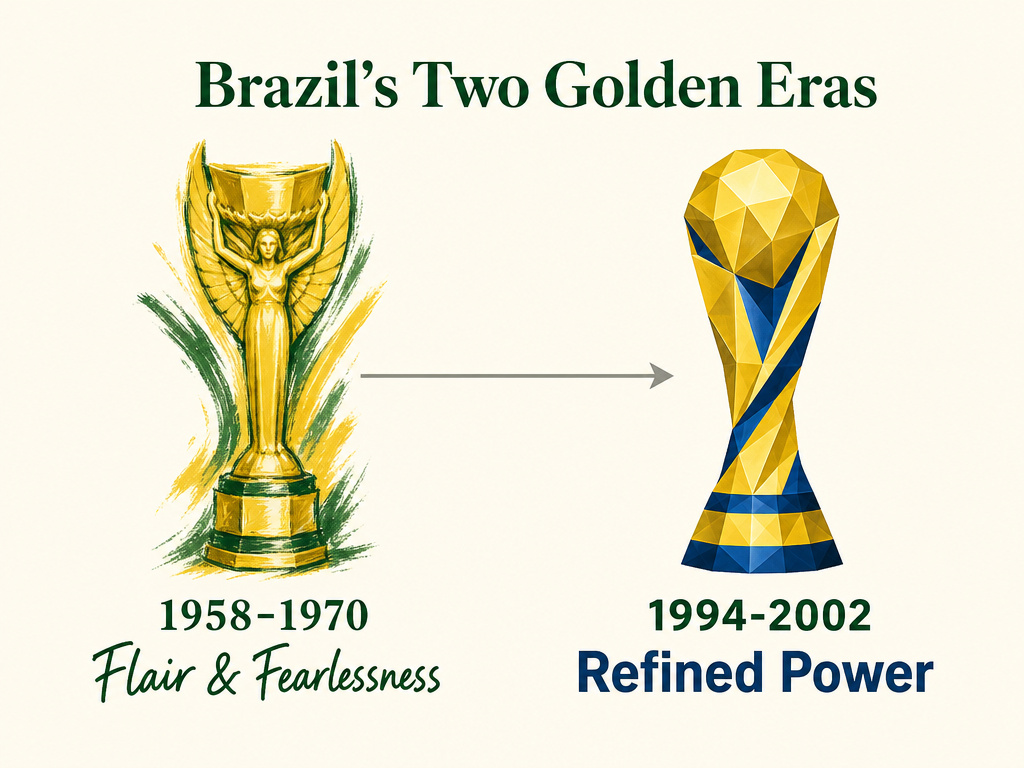
Brazil’s success isn’t a steady drip. It arrived in two concentrated waves of brilliance, each with a distinct personality. The first was raw, inventive talent. The second was refined, tactical power.
The First Golden Era: Flair and Fearlessness (1958-1970)
This era invented the global myth of Brazilian soccer. It started with redemption for 1950 and ended with a team many call the greatest ever assembled.
In 1958, a 17-year-old Pelé announced himself. The team played a 4-2-4 formation that was audaciously attacking. Garrincha’s dribbling was unplayable. They won in Sweden, becoming the first and only team to win a World Cup outside their continent, a feat they’d repeat four more times.
The 1962 title is often called “Garrincha’s World Cup.” Pelé was injured in the second match. The winger took over, dragging Brazil to a second title with a performance that cemented his status among the true Brazilian soccer legends.
Then came 1970. The pinnacle. The team featured Pelé, Jairzinho (who scored in every match), Tostão, Gérson, Rivellino, and Carlos Alberto. Their 4-3-3 was fluid, their passing sublime. The final 4-1 victory over Italy was a masterpiece. That team didn’t just win; they defined an aesthetic ideal.
I’ve watched the 1970 final tape two dozen times. The fourth goal, finished by Carlos Alberto, isn’t just a goal. It’s a six-pass move involving every outfield player that sliced Italy open. No team since has made winning look that beautiful under that pressure.
The Second Golden Era: Pragmatism and Power (1994-2002)
After the 1970 win, Brazil entered a 24-year drought. No finals, frequent disappointment. The 1994 team, led by coach Carlos Alberto Parreira, broke the cycle with a different blueprint. It was pragmatic. Defensively solid with Dunga marshaling the midfield, and lethal up front with Romário and Bebeto.
They won the final against Italy on penalties. It was efficient, not exhilarating. In Brazil, that team is respected but not romanticized like 1970.
The era peaked with the 2002 team. Ronaldo, returning from injury, was unstoppable. He scored eight goals, including two in the final against Germany. Rivaldo and Ronaldinho provided magic. This team blended the pragmatism of 1994 with flashes of the old flair. It cemented a run of three consecutive finals, 1994, 1998, 2002, a feat matched only by Germany (1982-1990).
TL;DR: Brazil won with artistic genius (1958-1970) and then won again with disciplined, modern efficiency (1994-2002). The second era proved they could adapt.
The Shadow of Maracanazo: 1950 and National Trauma
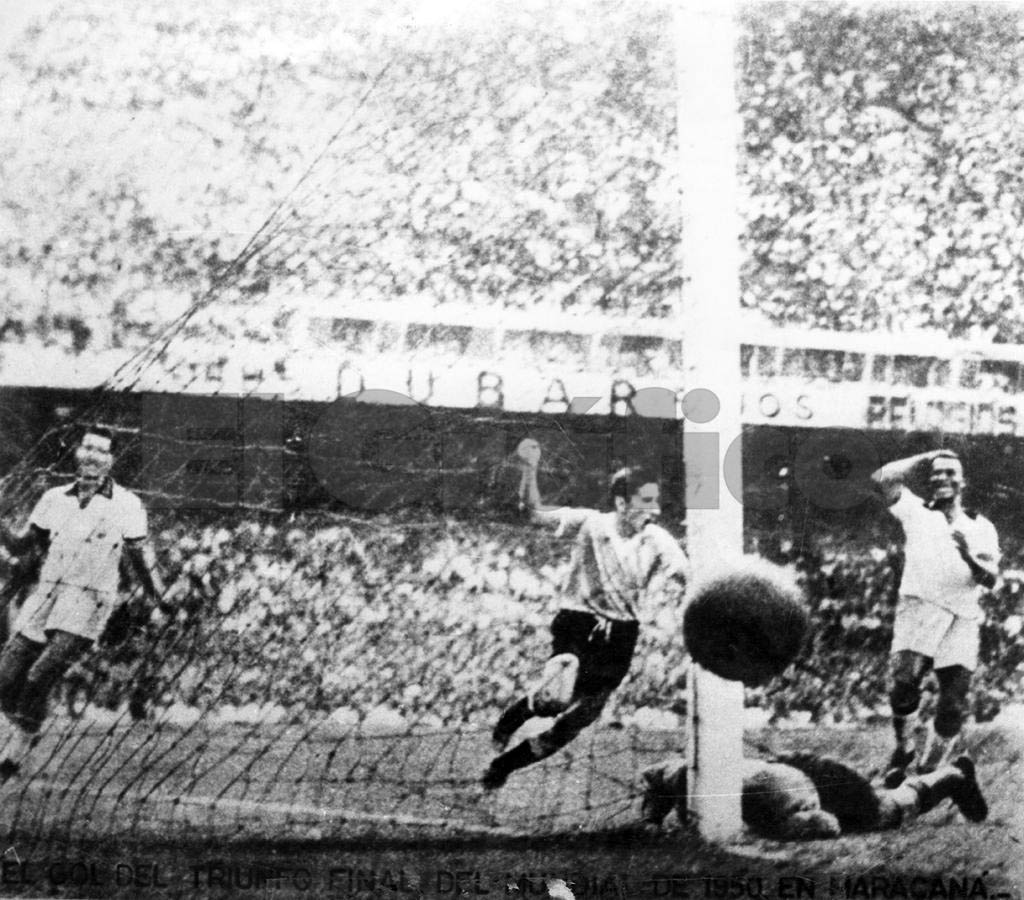
Photo: Unknown authorUnknown author / Wikimedia Commons / Public domain
To understand Brazil’s World Cup obsession, you must start with the loss, not the wins. The 1950 tournament was the first post-war World Cup. Brazil built the colossal Maracanã stadium and hosted. They needed only a draw in the final group match against Uruguay to win.

They led 1-0. Uruguay scored twice. The silence that fell over the 200,000 spectators was described as “the loudest silence in the world.” The event, “Maracanazo,” is a national wound.
Common mistake: Thinking 1950 was just a lost final. It was a national catastrophe that shaped Brazilian football’s psychology. Winning became a necessary therapy, not just a sport.
That loss created a pressure cooker. It made every subsequent World Cup campaign a mission of national redemption. The joyful style of 1958 was, in part, a conscious rejection of the fear that gripped the 1950 team. This trauma is the dark foundation upon which all the golden joy was built. The entire history of the Brazil national team is framed by this event.
The Modern Era: The 7-1 and the Search for a Sixth Star
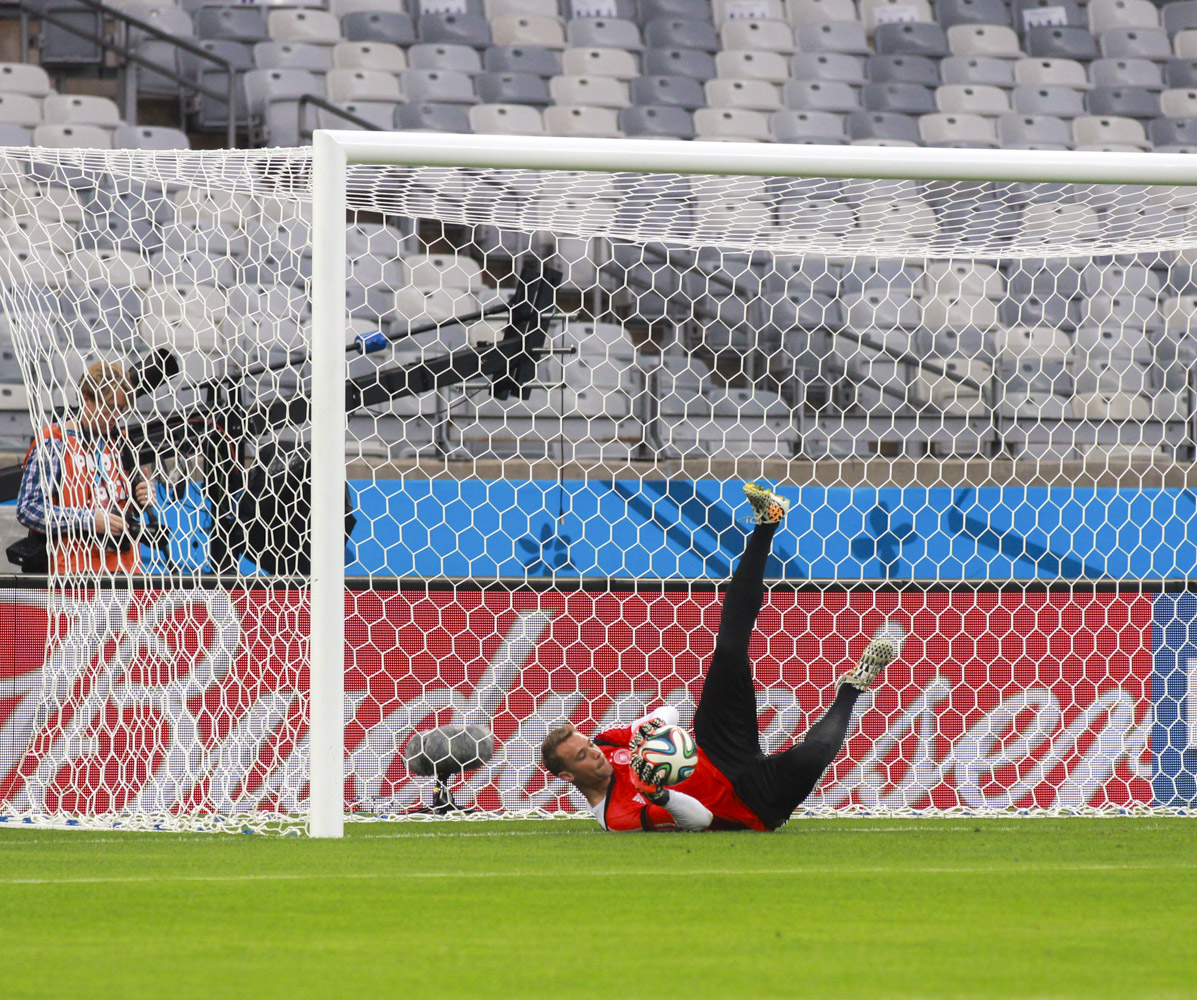
Photo: Danilo Borges/copa2014.gov.br Licença Creative Commons Atribuição 3.0 Brasil / Wikimedia Commons / CC BY 3.0
The 2002 triumph was followed by a new drought. Star-studded teams in 2006 and 2010 underperformed. Then came 2014, hosted in Brazil. The dream of winning at home, erasing 1950, was palpable.
.jpg)
The semi-final against Germany in Belo Horizonte became a new kind of national trauma. Germany led 5-0 within 29 minutes. The final score was 7-1. It was the most shocking result in World Cup history, breaking Brazil’s 62-match unbeaten home competitive streak dating to 1975.
This wasn’t just a loss. It was a systemic collapse broadcast to the world. It laid bare a generation’s tactical deficiencies and psychological fragility. Like 1950, it will be a reference point for decades.
Since then, Brazil has sought stability. The 2018 and 2022 campaigns ended in quarter-final defeats to European sides (Belgium, Croatia). The quest for “Hexa” (the sixth title) continues, now laden with the weight of two historic traumas and the brilliance of modern soccer legends from other nations.
Brazil’s World Cup Legends: Beyond Pelé
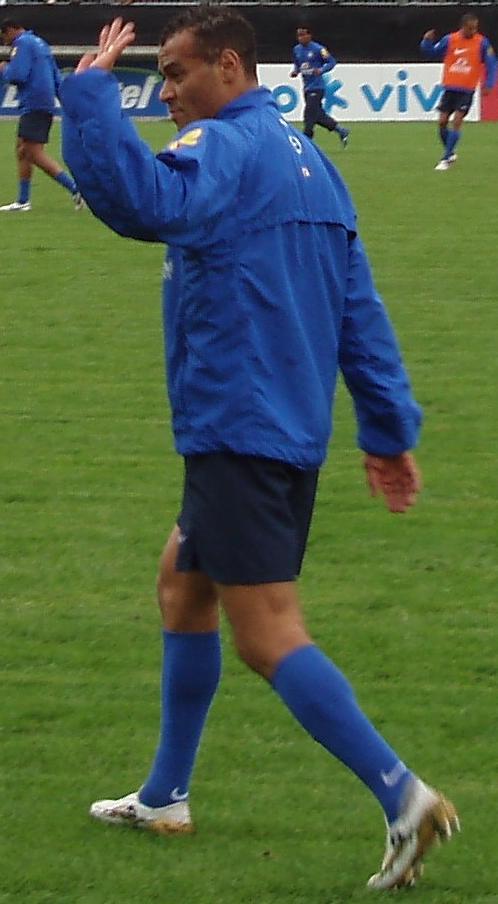
Photo: Florian K / Wikimedia Commons / CC BY-SA 3.0
Pelé’s shadow is vast, but the pantheon is crowded. The records are held by other icons.

Cafu holds the appearance record with 20 World Cup matches. He’s also the only player to appear in three consecutive finals (1994, 1998, 2002), a testament to longevity and elite performance.
Ronaldo is Brazil’s all-time top scorer at the World Cup with 15 goals. His eight-goal campaign in 2002, culminating in that final brace, is the signature performance of the second golden era. His journey began young, part of a system that produces child prodigies with relentless focus.
Other key figures include Garrincha, the dribbling wizard of 1958 and 1962. Romário, the lethal finisher of 1994. Ronaldinho, whose free-kick against England in 2002 announced a new magician. Each era had its engine room, too, players like Dunga (1994) and Gilberto Silva (2002) who provided the steel that allowed the stars to shine, a crucial part of successful soccer tactics.
| Player | Primary Role | Defining Contribution |
|---|---|---|
| Pelé | Forward | Only player with 3 winner’s medals (1958, 1962, 1970). Symbol of the beautiful game. |
| Cafu | Right-back | Record 20 WC apps. Played in 3 finals. Embodied relentless endurance. |
| Ronaldo | Striker | Record 15 WC goals. Carried 2002 team to title with 8-goal tournament. |
| Garrincha | Winger | Won 1962 almost single-handedly after Pelé’s injury. Unmatched dribbler. |
| Romário | Striker | Tournament’s best player in 1994. Scored 5 crucial goals for pragmatic champions. |
The Tactical Evolution: From 4-2-4 to Pragmatic 4-4-2
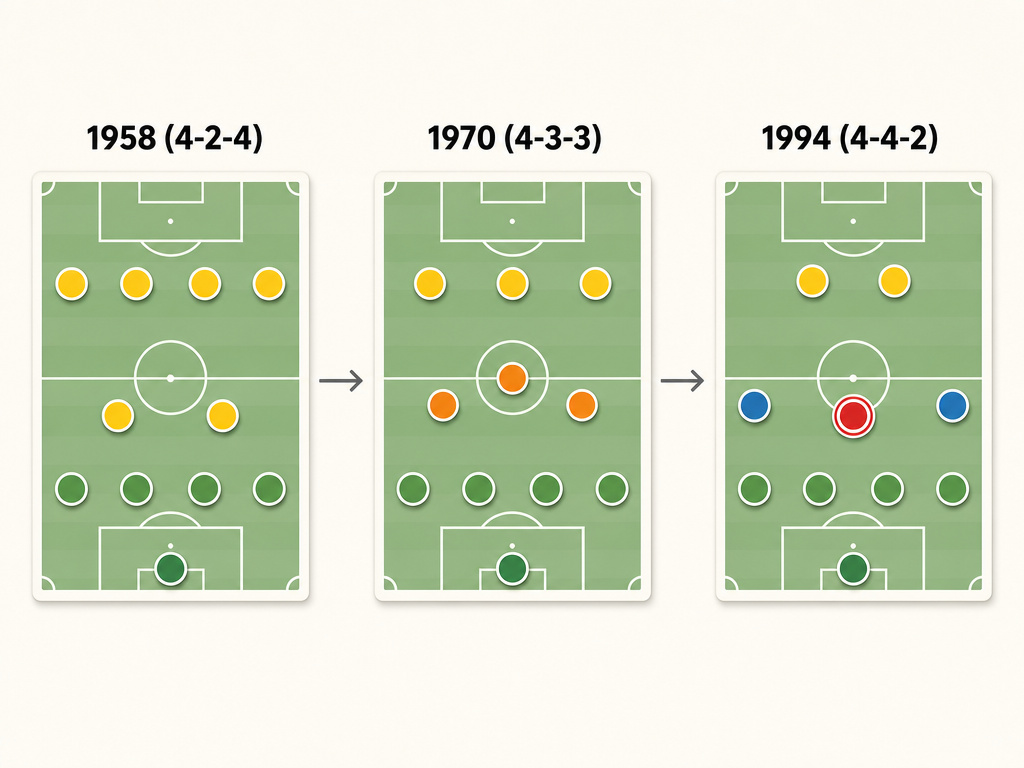
Brazil’s tactical journey mirrors their historical arc. The early days were about overwhelming offense. The 1958 team’s 4-2-4 was revolutionary, four pure attackers. It was bold, naive, and successful because of unparalleled individual talent.
By 1970, they refined it to a 4-3-3 with more midfield control (Gérson) and overlapping full-backs (Carlos Alberto). This became the template for “Joga Bonito.”
The 24-year drought forced a rethink. The 1994 champions used a 4-4-2. It was compact, disciplined, and built around a defensive midfielder (Dunga) breaking up play. This was a direct adaptation to European football’s growing physicality and organization. They traded some flair for resilience.
The 2002 team used a 3-5-2/3-4-3 hybrid that allowed Roberto Carlos and Cafu to fly forward from wing-back positions. It was a synthesis, tactically secure but designed to unleash individual brilliance. This tactical evolution shows Brazil learning. They absorbed lessons from painful defeats, particularly by European sides, without abandoning their creative core.
Common mistake: Believing Brazil just “turns up and plays.” Since 1994, their World Cup successes have been built on detailed tactical planning and defensive structure, often overlooked in favor of the highlight-reel moments.
Frequently Asked Questions
Which Brazilian player has the most World Cup appearances?
Cafu holds the record with 20 World Cup matches played across three tournaments (1994, 1998, 2002). His consistency and fitness as an attacking right-back are unmatched in Brazilian history.
How many times has Brazil won the World Cup?
Brazil has won the FIFA World Cup five times: in 1958, 1962, 1970, 1994, and 2002. This makes them the most successful nation in the tournament’s history.
Has Brazil ever missed a World Cup?
No. Brazil is the only national team to have qualified for and participated in every single FIFA World Cup since the inaugural tournament in 1930. This streak of 22 consecutive appearances is a core part of their record.
What was Brazil’s biggest World Cup defeat?
Brazil’s biggest defeat is the 7-1 loss to Germany in the 2014 semi-final. It was their first competitive home loss in 62 matches and stands as one of the most shocking results in the sport’s history, a stark contrast to their usual historic scorelines.
Who is Brazil’s all-time top scorer in the World Cup?
Ronaldo, the striker known as “Il Fenomeno,” is Brazil’s top scorer with 15 World Cup goals. He scored four in 1998 and a tournament-leading eight in their 2002 championship run.
How does Brazil’s record compare to Argentina’s?
Brazil leads Argentina in titles (5 to 3), total wins, goals, and appearances. The rivalry is intense, but Brazil’s statistical dominance is clear. Argentina’s modern success has been heavily driven by Lionel Messi, while Brazil’s is built on broader systemic depth.
The Bottom Line
Brazil’s World Cup history is a story of unparalleled achievement punctuated by profound heartbreak. The five stars on their jersey represent not just victory, but a century-long project of national identity played out on the global stage. Their records, the titles, the goals, the sheer consistency, may never be matched.
Yet, the legacy is more than numbers. It’s the joy of 1970, the pain of 1950 and 2014, and the constant evolution in between. Understanding Brazil means understanding that their quest for a sixth star is driven by the ghosts of Maracanã and Belo Horizonte as much as the memory of Pelé’s smile. The history is complete. The record is still being written.
I come from the “soccer heart” of Germany, the Ruhrpott. I have played, trained and followed soccer all my life and am a big fan of FC Schalke 04. I also enjoy following international soccer extensively.