Defensive vs Attacking Heading in Soccer: Key Differences
Defensive heading and attacking heading in soccer are distinguished by intent, body mechanics, and risk profile. Defensive heading is a reactive clearance or interception, often performed under pressure with the head tilted back, generating high vertical force. Attacking heading is a proactive finish or pass, requiring precise timing and a snapping forward motion to redirect the ball downward with pace. The attacking header’s need for accuracy often leads to greater head acceleration if technique falters.
Most players and coaches lump all headers together. They see a player meet the ball with their head and think the skill is universal. This is a tactical and physical mistake. Training a center-back to head like a center-forward breeds poor clearances and unnecessary risk. The biomechanics are not the same.
This guide breaks down the differences you can see on the pitch and the ones you can’t, the forces measured in labs. We will cover the specific body positions, the data on head acceleration, the latest safety protocols, and how to train each header type correctly.
Key Takeaways
- Defensive headers prioritize power and height for clearance, often from a stationary or backpedaling jump, while attacking headers demand precise redirection and timing, usually from a forward-moving leap.
- Ball speed is the single largest factor in head impact force, making long goal kicks and driven crosses the most dangerous scenarios for both header types.
- Studies of FIFA World Cup matches show women perform fewer controlled headers, use their foreheads less, and engage their upper body less than men, which may increase their relative risk.
- Neuromuscular neck training, teaching the neck to brace reflexively, is more effective at reducing head acceleration than pure strength training alone.
- Current guidelines for professional football recommend limiting high-force headers (from long passes, crosses, corners) to a maximum of ten per training week.
The Core Mechanical Difference
Forget intent for a moment. Look at the body. A defender clearing a looping cross from their six-yard box plants, leans back, and launches the ball up and out with their forehead. The power comes from the core and a stiff, thrusting neck. An attacker meeting a driven cross at the penalty spot leaps forward, often with their back arched, and snaps their head and upper torso downward to direct the ball into the corner. The power comes from the lat muscles and a whipping neck motion.
The primary biomechanical difference lies in the direction of force transfer. A defensive header transfers momentum upward through the cervical spine to project the ball away. An attacking header transfers momentum forward and downward, using the head as a guiding surface to change the ball’s existing trajectory.
The attacking version is technically harder. It requires meeting the ball at its exact descending apex. Miss that timing by a tenth of a second, and you make contact with the top or side of your head. That mishit multiplies the rotational forces on the brain. A 2023 systematic review in the PMC systematic review on heading factors confirms that impact location is a key variable in head acceleration.
TL;DR: Defensive headers push up; attacking headers snap down. The attacking header’s complexity makes proper forehead contact more challenging under match pressure.
Why Ball Speed Changes Everything
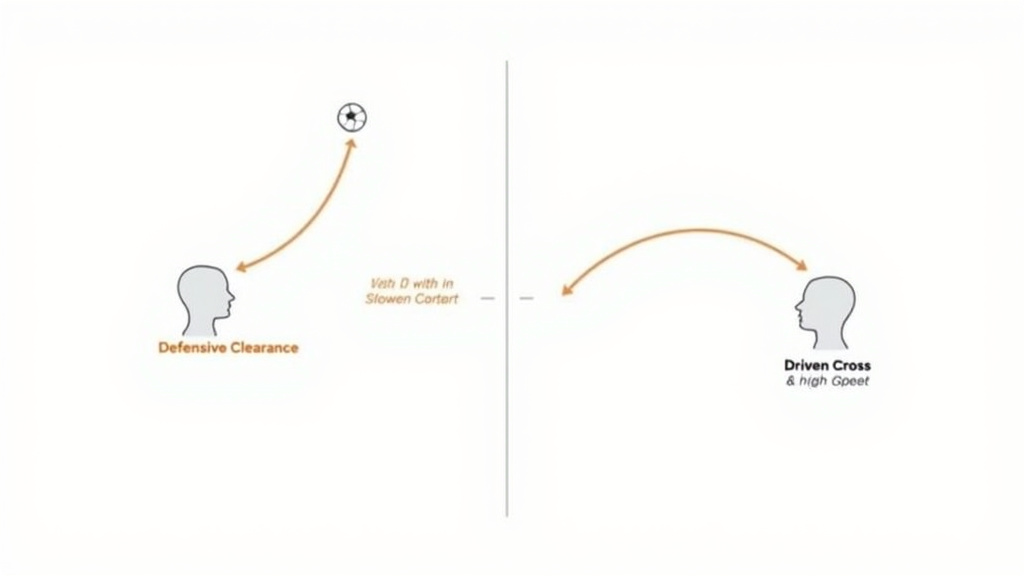
You can have perfect technique. If the ball is moving too fast, your body cannot decelerate it safely. Research is clear: ball speed outweighs ball mass or stiffness in determining the force transferred to the head. A goal kick struck at 70 mph imposes a different physical reality than a lofted 40-yard pass.
This is where the tactical source of the header dictates its danger. Defensive headers frequently originate from long, high balls, goal kicks, clearances from the opposition. These balls have high hang time but may lose speed as they descend. Attacking headers often come from whipped crosses or cut-back passes. These balls travel lower and faster, sometimes exceeding 50 mph when they meet the head.
| Header Scenario | Typical Ball Speed | Primary Risk Factor |
|---|---|---|
| Goal Kick Clearance | High initial, lower on descent | Extended hang time leads to misjudgment and neck strain from looking up. |
| Driven Cross (Attacking) | Very High | Short reaction time increases chance of poor forehead contact. |
| Corner Kick (Both) | High | Crowded, contested leap often results in off-balance contact. |
| Free-Kick Delivery | Variable | Unexpected deflections can cause unbraced impacts. |
The data suggests that for player protection, reducing the speed of the ball when it is headed is the most effective intervention. This underpins trials in youth football that limit heading from long-range kicks.
Position, Frequency, and Unseen Risk
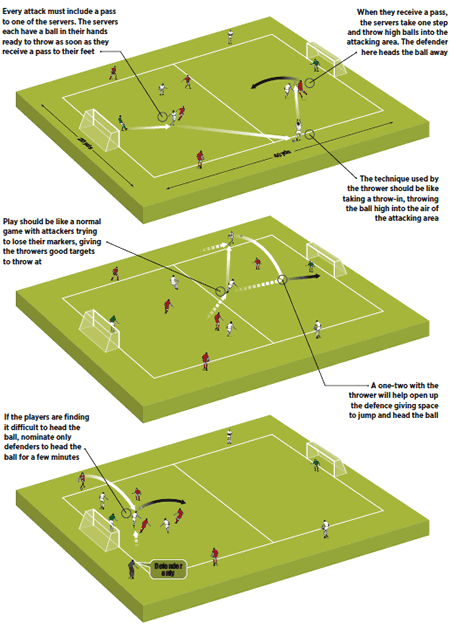
Not all players head the ball equally. In men’s elite football, central defenders account for over a third of all heading events. Their headers are overwhelmingly defensive. Forwards and attacking midfielders head less frequently, but a higher proportion of their headers are attacking attempts in the penalty area. This positional breakdown matters for training load and injury risk management.
A prospective study analyzing heading events in 687 matches found heading rates increase steadily with age, from 0.17 headers per minute at U9 level to 0.88 headers per minute in senior professionals. The study also recorded “unintended head impacts”, collisions with other players or the ground during a heading duel. These are rare (less than 1% of events) but carry a much higher concussion risk. Senior players had the highest incidence.
Common mistake: Training heading in isolation without opposition. This builds technical confidence but fails to prepare players for the jostling, off-balance reality of a match duel, where unintended impacts occur.
For a defender, mastering the defensive jockeying and body positioning that precedes a clearance header is as important as the header itself. It creates the half-yard of space needed to execute a clean, powerful contact.
TL;DR: Central defenders head the most, but often with more time and space. Attacking headers are rarer but occur in high-traffic, high-speed scenarios where technique easily breaks down.
Gender, Technique, and a Data Gap
The conversation about heading is incomplete without addressing gender. Analysis of the 2022 Men’s and 2023 Women’s FIFA World Cups revealed stark technical differences. Women were less likely to perform controlled headers (73% vs. 83%), used their foreheads less, engaged their upper body less, and were more likely to close their eyes earlier before contact.
These are not statements about ability. They are observations of technical output at the elite level, likely stemming from different historical training volumes, coaching emphasis, and physiological factors like neck strength and girth. The consequence is measurable: female players tend to sustain greater head accelerations than males from similar impacts.
This creates a specific training imperative for women’s football. Emphasizing proper heading technique, forehead contact, engaged core, eyes open, is even more critical. It also strengthens the case for gender-specific guidelines, such as further limiting high-force header practice for female athletes during training cycles.
Training Them Separately for Safety and Skill
Because the headers are different, they must be trained differently. A one-size-fits-all heading drill is worse than useless; it ingrains motor patterns that fail under specific match conditions.
Defensive Header Training Priorities:
- Power from Stability. Practice clearing headers from a standing jump and a running jump, focusing on a strong, stable neck and core engagement at the moment of contact. The ball should travel upward on a steep angle.
- Backward Movement. Introduce drills where the player must head a ball while dropping backward, simulating the pressure of a long ball over their shoulder. This trains the neck’s eccentric strength.
- Integration with Defensive Shape. Drill headers as the culmination of a defensive transition phase, where winning the ball back quickly is the objective.
Attacking Header Training Priorities:
- Accuracy over Power. Use cones or small goals in the corners of the net. Reward precise placement, not just power. Start with gently tossed service to perfect the snapping motion and forehead contact.
- Timing the Run. The majority of attacking header power comes from the body’s momentum. Use crossing drills that force the attacker to time their near-post, far-post, and penalty-spot runs without telegraphing the move.
- Contested Leaps. Gradually add passive, then active, opposition from defenders to simulate the physical challenge of winning the header in the box. This bridges the gap to match intensity.
For both types, the foundation is a prehabilitation program for the neck. This isn’t about building massive muscles. It’s about neuromuscular training, teaching the neck muscles to fire rapidly and in coordination to stabilize the head before impact. Simple resisted band exercises, focusing on both flexion and extension with controlled speed, build this reflex.
Navigating Modern Guidelines and Restrictions
The sport’s governing bodies are implementing rules to mitigate risk, especially for young players. In the United States, heading is banned outright for players under 10. The English FA has trialed removing deliberate heading in matches for U12s and below. For professional players, the current guidance is pragmatic: limit high-force header training.
These rules acknowledge the spectrum of header danger. A child heading a gently thrown ball is not the same as a professional defender meeting a 60-yard driven pass. The guidelines aim to eliminate the highest-risk exposures while the brain is developing and to manage cumulative load in adults.
This regulatory shift makes technical coaching more important, not less. With potentially fewer repetitive headers in youth training, each coached repetition must be of higher quality. The focus must be on flawless correct heading biomechanics from the first session. Understanding the distinct dangers of heading for each type also helps coaches design smarter, safer sessions that build essential skills without undue risk.
Frequently Asked Questions
Are defensive headers or attacking headers more dangerous?
Biomechanically, attacking headers often present a higher risk. The need for precise, downward redirection makes proper forehead contact more difficult, and they frequently involve faster-moving balls from crosses. However, defensive headers from long goal kicks also generate high linear forces. The danger is scenario-dependent, not strictly type-dependent.
What is the single most important safety tip for heading?
Use your forehead every single time. The flat, hard frontal bone is designed to absorb and distribute impact. Contact on the top or sides of the head dramatically increases rotational force on the brain, which is linked to a higher risk of concussion and long-term neurological issues.
How does neck strength help?
Raw neck strength is less important than neck stiffness and bracing reflex. The goal is to have the cervical muscles contract milliseconds before impact to create a stable platform, preventing the head from snapping backward or forward. This neuromuscular conditioning is trainable and is shown in studies to reduce head acceleration more effectively than strength training alone.
Why are there different rules for youth heading?
The adolescent brain is still developing and is considered more vulnerable to repetitive subconcussive impacts. The myelination process, which insulates neural pathways, continues into a person’s mid-20s. Restrictions aim to minimize cumulative trauma during this critical developmental window while still allowing the skill to be introduced safely later.
Do protective headbands work?
The evidence is mixed. Some studies show they can reduce the force of linear impacts (straight-on collisions), but they are less effective at mitigating rotational forces, which are particularly damaging to brain tissue. Most federations do not mandate them, viewing proper technique and rule changes as more effective primary interventions.
The Bottom Line
Defensive and attacking heading are two skills under the same name. One is a powerful clearance, the other a precise finish. Their execution demands different body mechanics, and the data shows they exist on a risk spectrum influenced by ball speed, technique, and player demographics.
Smart coaching now means training them separately. It means prioritizing neuromuscular neck preparation over sheer power. It means understanding that a well-timed jump and a braced neck are as crucial as forehead contact. The modern game requires this granularity. You can respect the skill’s necessity while honestly confronting its risks. That balance is how the sport evolves.

I come from the “soccer heart” of Germany, the Ruhrpott. I have played, trained and followed soccer all my life and am a big fan of FC Schalke 04. I also enjoy following international soccer extensively.