What Is a Give and Go in Soccer? The Complete Player’s Guide
A give and go in soccer is a fundamental two-player passing combination used to beat a defender. One player passes (gives) to a teammate and immediately runs (goes) into space to receive a return pass. Also called a wall pass or one-two, it’s a core tactic for advancing the ball and creating scoring chances.
Most players learn the move but butcher the timing. They pass and then stand still, or they make the run too late. The defender isn’t fooled; they just intercept the lazy return ball. The move dies before it starts.
This guide breaks down the give and go from its street-soccer roots to its place in modern tactics. You’ll learn the exact footwork, the non-negotiable timing, and how this simple idea shaped entire football philosophies.
Key Takeaways
- The give and go requires the first passer to sprint immediately after releasing the ball. Hesitation kills the space.
- The return pass must be a crisp, first-time ball played into the runner’s path, not to their feet. A soft pass lets the defender recover.
- It originated as a “wall pass” in urban football, where players used actual walls as passing partners.
- The tactic is the foundation of Arthur Rowe’s “push and run” style at Tottenham, a direct precursor to Total Football.
- Introduce the concept early, even to U8 players. Use the “wall” analogy and demonstrate the roles yourself.
What Is a Give and Go in Soccer?
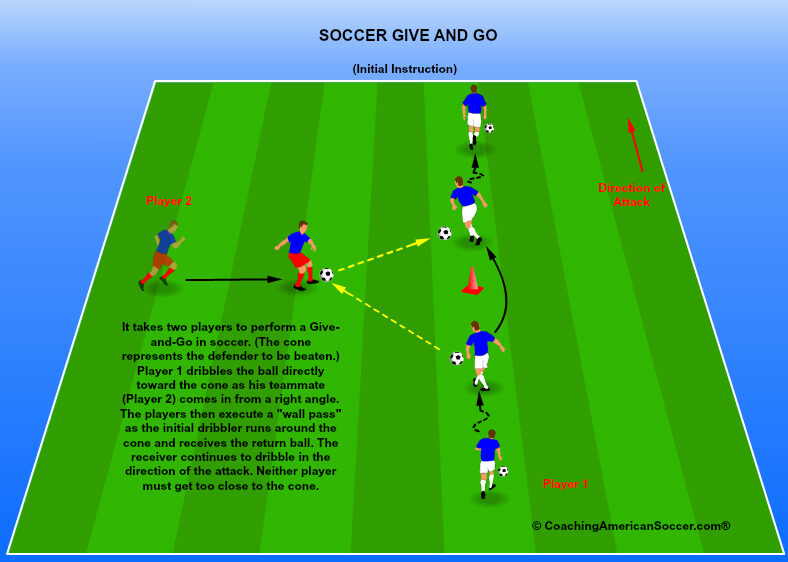
A give and go is a coordinated attack against a single defender using two quick passes. The first player draws the defender in, passes to a supporting teammate, and sprints past the defender to receive an immediate return. The supporting teammate acts as a “wall,” bouncing the ball back with one touch. This creates the illusion of playing off a static surface, hence the alias “wall pass.”
The move’s entire purpose is to change the angle of attack and bypass pressure. You trade a risky dribble for a safe pass and a penetrating run. It is not a fancy trick. It’s a functional solution to a crowded midfield or a packed defensive line.
The give-and-go is recognized by FIFA as a core grassroots practice for players aged 8 to 12, emphasizing its status as a foundational building block for team play and spatial understanding.
You see it everywhere once you know the pattern. A midfielder plays a simple square pass to a winger and darts forward between the lines. A striker lays the ball off to a number 10 and spins behind the last defender. The principles are identical. This move is a cornerstone of most fundamental soccer tactics, teaching players to move after they pass.
TL;DR: It’s a two-pass combo where you use a teammate as a rebound wall to get behind a defender. The first pass is the “give,” the run is the “go,” and the return is the reward.
How to Execute a Perfect Give and Go: The 4-Step Sequence
Executing a give and go looks simple on a whiteboard. On grass, with a defender closing down, it demands precision. Miss one component and the sequence collapses.
Step 1: The Initiating Dribble and Eye Contact
The player with the ball must dribble with purpose directly at the defender. This commits the defender. A passive dribble to the side gives the defender time to adjust and cover the passing lane. As you approach, make eye contact with your intended “wall.” A nod or a sharp “one-two!” call signals intent.
If you don’t commit the defender, they can hedge between you and your teammate. The pass becomes predictable and easy to intercept. The dribble sells the fake.
Step 2: The First Pass (“The Give”)
Pass the ball firmly to your teammate’s feet just before you enter the defender’s tackling radius. A soft, looping pass gives the defender time to change direction. A bullet pass is harder for your teammate to control. Aim for the foot furthest from the defender to make the return easier.
The pass must be accurate. Your teammate should not have to stretch or adjust their body significantly. They need to be ready to play the return in one fluid motion.
Common mistake: Passing too late — you are already within the defender’s reach, so they can stick a foot out and block the initial pass. The move ends before it starts.
Step 3: The Immediate Run (“The Go”)
This is the step most players get wrong. The run must begin the instant the ball leaves your foot. Do not pause to see if the pass is completed. Turn your shoulder and explode past the defender at an angle, into the space behind them.
The angle is critical. Running straight forward puts you in the defender’s shadow. Running at a 45-degree angle opens a clear passing lane for your teammate. Your run creates the opportunity; the return pass is the payoff.
Step 4: The Return Pass (“The Wall”)
The receiving teammate is now the “wall.” Their job is to control and return the ball in one or two touches. The return pass is not played to where the runner is, but to where they will be. Lead them into the space.
A one-touch pass is ideal. It maintains speed and surprises the defender. A two-touch pass (control, then pass) is acceptable for younger players, but it gives the defense a crucial extra second to recover. The return must have enough pace to reach the runner before a recovering defender can intercept.
TL;DR: Dribble at the defender, pass crisply, sprint on an angle, receive a first-time return into space. The timing between the pass and the run is everything.
The Give and Go in Football History: From Streets to Systems
The give and go isn’t just a drill. It’s a piece of football DNA with a clear lineage. Its story starts in the city and ends up defining how entire teams play.
The “Wall Pass” Origin
The term “wall pass” is literal. In the tight confines of urban street soccer, players had no constant teammates. A brick wall became a reliable passing partner. You would kick the ball against the wall and run around your opponent to collect it on the rebound. This improvised solo practice taught the core principle: use a surface to change the angle and beat a man.
That street instinct was formalized on the pitch. A teammate replaced the wall, but the mechanics were identical. This is why the move feels so intuitive; it mimics a fundamental problem-solving pattern from the game’s roots.
Push and Run: The Give and Go as a Philosophy
In the late 1940s, Tottenham Hotspur manager Arthur Rowe built a tactic entirely around this concept. He called it “push and run.” The idea was brutally simple: pass the ball (push) and immediately move into a new position (run). It was the give and go scaled to an entire team’s mentality.
Rowe’s Spurs won the English First Division in 1951 playing this fluid, passing style. It was a revolution against the static, kick-and-rush football of the era. The system demanded high technical skill and relentless movement. Every player was expected to be both a passer and a runner.
| Aspect | Traditional Play (Pre-1950s) | Push and Run (Tottenham, 1950s) |
|---|---|---|
| Passing Mindset | Hold possession, wait for options | Pass and move immediately |
| Player Movement | Mostly static after passing | Constant repositioning |
| Tactical Foundation | Individual dribbling, long balls | Short, quick combination play |
| Team Shape | Rigid positional roles | Fluid, interchanging positions |
The Bridge to Total Football
Rowe’s assistant was Vic Buckingham. Buckingham later managed Ajax and Barcelona, where he implanted the principles of quick passing and movement into a young Johan Cruyff. The “push and run” ethos—pass and move, use space, interchange positions—became a direct precursor to Rinus Michels’ Total Football in the 1970s.
The give and go, therefore, is a microcosm of football’s tactical evolution. It’s the seed from which styles emphasizing tactical flexibility and attacking transitions grew. When you execute it, you’re participating in a history that reshaped the sport.
TL;DR: It started as a street trick using a literal wall, became Arthur Rowe’s “push and run” team philosophy at Tottenham, and influenced the development of Total Football.
Why the Give and Go is a Coaches’ Favorite (And How to Teach It)

Coaches from youth leagues to professional academies drill the give and go. The reasons are layered. It develops individual technique, fosters teamwork, and builds football intelligence simultaneously.
The Multilayer Benefits
First, it teaches players to look up. The initiator must spot the defender, the teammate, and the space all at once. Second, it reinforces the most important habit in football: moving after you pass. Static players are easy to defend.
Third, it builds passing accuracy under pressure. The first pass must be precise. The return pass requires vision and weight. Finally, it rewards unselfish play. The “wall” player facilitates the attack without directly advancing the ball themselves. This selflessness is the glue of any successful team, whether playing a classic 4-4-2 or a more modern 3-4-3 formation.
A Practical Teaching Progression
You cannot just explain it and expect execution. Break it down.
- Demonstrate Without a Defender. Be the “wall” yourself. Have a player dribble toward you, pass, and run around you as you return the ball. Use the phrase “I am your wall.” This makes the abstract concrete.
- Add a Passive Defender. Introduce a cone or a player who shadows but doesn’t tackle. Focus on the timing of the run.
- Live Repetition. Set up a 2v1 to a small goal. The two attackers must use at least one give-and-go before shooting. This adds consequence and links the move to shooting accuracy drills.
- Conditioned Games. In a small-sided scrimmage, award double goals for any goal scored directly from a give-and-go. This incentivizes players to look for the opportunity in real play.
I introduced this to an U10 team that held the ball too long. For two weeks, every possession ended with a dribble into traffic. We drilled the give and go relentlessly. The breakthrough came when a central midfielder, under pressure, finally played a simple pass and sprinted. The return put him clean through. He didn’t score, but the team’s reaction was electric. They saw the possibility. Their entire approach to possession changed in that session.
The move also serves as a fantastic diagnostic tool. A player who consistently fails the “go” part likely lacks confidence in their teammate’s ability to return the pass. A player who botches the “wall” role needs work on first-touch passing. You fix more than just a passing combo.
TL;DR: Coaches love it because it trains technique, movement, and mindset in one drill. Teach it by being the wall first, then progressively add pressure.
Give and Go Variations and Related Concepts

The basic give and go has cousins. These variations adapt the core principle to different situations on the pitch.
The Overlap and the Underlap
These are give and go patterns with specific positional rules. In an overlap, a player (usually a full-back) passes to a winger and runs around the outside of them to receive the return. It stretches the defense wide.
The underlap is the opposite. The passer (often a central midfielder) passes to a forward and runs inside them, between the forward and the central defenders. This is a more penetrative run against compact defensive formations. Both are predicated on the same trust and timing as the basic wall pass.
The Third-Man Run
This is a give and go with an extra player. Player A passes to Player B. Player B then passes to Player C, who is the “third man” making the penetrating run. Player A, who started the move, is now the “wall” for Player B. It’s a sophisticated rotation that breaks lines against organized defenses. Understanding this requires a grasp of more advanced tactical principles.
The “Bounce Pass” in Basketball and Hockey
The give and go is a universal concept in invasion sports. In basketball, it’s often called a bounce pass or a hand-off and go. In hockey, it’s a drop pass. The mechanics differ—a puck vs. a ball—but the cognitive pattern is identical: commit a defender, transfer possession, move into space, get it back. This cross-sport relevance underscores its foundational logic.
| Variation | Key Difference | Best Used When |
|---|---|---|
| Basic Give and Go | Direct 2-player combo | Beating an isolated defender in midfield |
| Overlap | Runner goes outside the receiver | Exploiting space on the wing, against a narrow defense |
| Underlap | Runner cuts inside the receiver | Breaking through a congested central channel |
| Third-Man Run | Involves 3 players, 2 passes | Unlocking a deep, organized defensive block |
TL;DR: The overlap, underlap, and third-man run are complex extensions of the same idea. They show how a simple 2-man move can evolve into a team’s attacking signature.
Drills to Master the Give and Go
Knowledge is useless without repetition. These drills ingrain the muscle memory and decision-making needed to execute the give and go in a game.
1. The Gate Drill (For Timing)
Set up two small gates (cones 2 yards apart) about 15 yards apart, with a passive defender in the middle. Two attackers start at one gate. They must perform a give and go to progress through the opposite gate. The defender can move but not tackle aggressively. Focus on the passer’s first step after the ball is released. This drill isolates the run timing.
2. 2v2+1 to Small Goals
Play in a 20×15 yard grid with two small goals. It’s a 2v2 game with a neutral “joker” player who always plays for the team in possession. The condition: any goal scored after a give and go with the joker counts for two points. This forces players to recognize the “wall” opportunity in a chaotic, game-like environment. It directly improves player agility and quick decision-making under pressure.
3. Position-Specific Pattern Play
Integrate the move into your team’s shape. For example, have your left-back and left-winger practice a give and go that ends with a cross. Have your striker and attacking midfielder practice a give and go that ends with a shot. This connects the technique to your team’s actual strategic soccer systems and formation structure.
Run these drills until the movement feels automatic. Then, run them tired. The real test is whether a player will still make that demanding sprint in the 85th minute when the game is tight. That’s when drilled instinct wins matches.
Frequently Asked Questions
What’s the difference between a give and go and a wall pass?
There is no difference. “Give and go” describes the action (I give the ball, I go). “Wall pass” describes the method (I use my teammate like a wall). “One-two” describes the rhythm (pass, return). They are three names for the same fundamental soccer passing technique.
At what age should players learn the give and go?
Introduce the concept as early as U8 (7-8 years old). The execution will be messy—expect two-touch returns and confused runs. That’s fine. The goal is to plant the idea of “pass and move.” By U12, players should be able to execute a clean one-touch give and go against light pressure. This early foundation is part of a complete soccer player quiz to assess developing skills.
Can you do a give and go by yourself?
Not in a match, but the solo “wall pass” drill is a fantastic training tool. Kick the ball against a wall at an angle, run around a cone, and receive the rebound. It trains first touch, timing, and sharpens your footwork coordination without needing a partner.
Why does my give and go always get intercepted?
The problem is usually the return pass. It’s either too soft, too late, or played directly to the defender’s feet. The return must be firm and into the space ahead of the runner. If the runner has to check back or reach behind them, the defender has already won.
Is the give and go only an attacking move?
Primarily, yes. Its purpose is to progress the ball and create chances. However, the principle of “pass and move” is universal. Even defenders use short give and go combinations to play out from the back under pressure, a key component of many modern 3-5-2 formation builds.
Who invented the give and go?
No single person invented it; it emerged naturally from the game. However, Tottenham Hotspur manager Arthur Rowe was the first to build an entire team strategy around it in the late 1940s, calling it “push and run.” This historical soccer strategy guide documents how Rowe’s philosophy formalized the move into a system.
Before You Go
The give and go is football in its simplest, purest form. It is cooperation over individualism, movement over stagnation, intelligence over force. It works on a muddy park pitch and in a Champions League final because the geometry never changes.
Remember the three non-negotiables: a committed dribble to draw the defender, an immediate sprint after the pass, and a crisp return into space. Drill it until it’s a reflex. Then, watch the game open up. You’ll start seeing passing lanes you never noticed before, and you’ll understand why this move is the heartbeat of so many 11v11 formations and attacking plans. It’s more than a skill. It’s a way of thinking.

I come from the “soccer heart” of Germany, the Ruhrpott. I have played, trained and followed soccer all my life and am a big fan of FC Schalke 04. I also enjoy following international soccer extensively.