A Complete Guide on How to Play Out From the Back in Soccer
Playing out from the back in soccer means building attacks from your own defensive third, using the goalkeeper and defenders to draw the opponent forward and exploit the space they leave behind. It requires specific player movements, a calm goalkeeper, and a collective understanding of when to play short or go long.
Most teams fail at this because they treat it like a passing drill. They move the ball sideways between the center-backs and goalkeeper, waiting for a perfect moment that never comes. The real game is about provoking the press, creating a numerical advantage in your own half, and then breaking through it with one decisive pass.
This guide breaks down the five non-negotiable movements, the goalkeeper’s new role, and the drills that build the unshakable composure you need when a striker is closing you down in your own six-yard box.
Key Takeaways
- The goalkeeper must act as an eleventh outfield player, starting attacks with their feet and dictating the side of the build-up.
- Creating a numerical overload (like a 3v2 or 4v3) in your own defensive third is the single most important tactical goal of playing out from the back.
- Full-backs provide the essential width, but their first touch must always be forward and into space, a backward touch kills the momentum.
- You must have a pre-planned “out ball”, a long pass to a dropping forward or a switching pass to a winger, for when the short option is closed.
- Losing the ball during build-up requires an immediate, coordinated 6-8 second counter-press from the entire team to prevent a dangerous turnover.
The Goalkeeper’s Role: More Than Just Hands
Your goalkeeper is the first playmaker. This isn’t about shot-stopping anymore. A modern keeper in a build-out system reads the game like a deep-lying midfielder. Their first job is to decide which side the attack develops on, a concept often detailed in a comprehensive soccer tactics guide.
If the opposition’s press is strong on the left, the keeper signals and plays to the right center-back. Their passing range needs both a 15-yard roll to a full-back’s feet and a 40-yard driven pass to a dropping #9. I’ve seen young keepers panic with the ball at their feet, launching it out of play under zero pressure. That instinct takes months to unlearn.
A goalkeeper’s distribution under a high press decides the next five passes. A rushed kick to nowhere resets the opponent’s defensive shape. A calm, short pass to a marked center-back, however, commits two opposing forwards and opens a lane elsewhere.
The best keepers for this system are quiet and efficient. They don’t need to be Neuer-esque sweepers, but they must be comfortable receiving a back-pass with a striker three yards away. That pressure is a gift. It means the striker is out of the game if you beat them.
TL;DR: Your goalkeeper sets the tempo and direction. Train them to pass, not just clear.
The 5 Non-Negotiable Player Movements
Playing out from the back is a choreographed dance. If one player is static, the whole structure collapses. These five movements are not suggestions, they are the system.
1. Center-Backs Split Wide and Offer Angled Passing Lanes
The two center-backs cannot stand side-by-side. As the goalkeeper collects the ball, they must split to the edges of the penalty box. This creates a wide base and, crucially, provides angled passing lanes back to the keeper. A pass straight back to the keeper’s hands is useless. An angled pass to their stronger foot allows for a one-touch switch to the other side.
2. The Pivot (#6) Drops Between the Center-Backs
This is the most important movement. Your deepest midfielder, often the #6, must drop between the two split center-backs, forming a back three. This creates the numerical overload. Now, against a two-man forward press, you have a 3v2 advantage. The pivot must receive on the half-turn, with their body shape already opened to the field ahead. Receiving square-on is a death sentence.
3. Full-Backs Provide Maximum Width
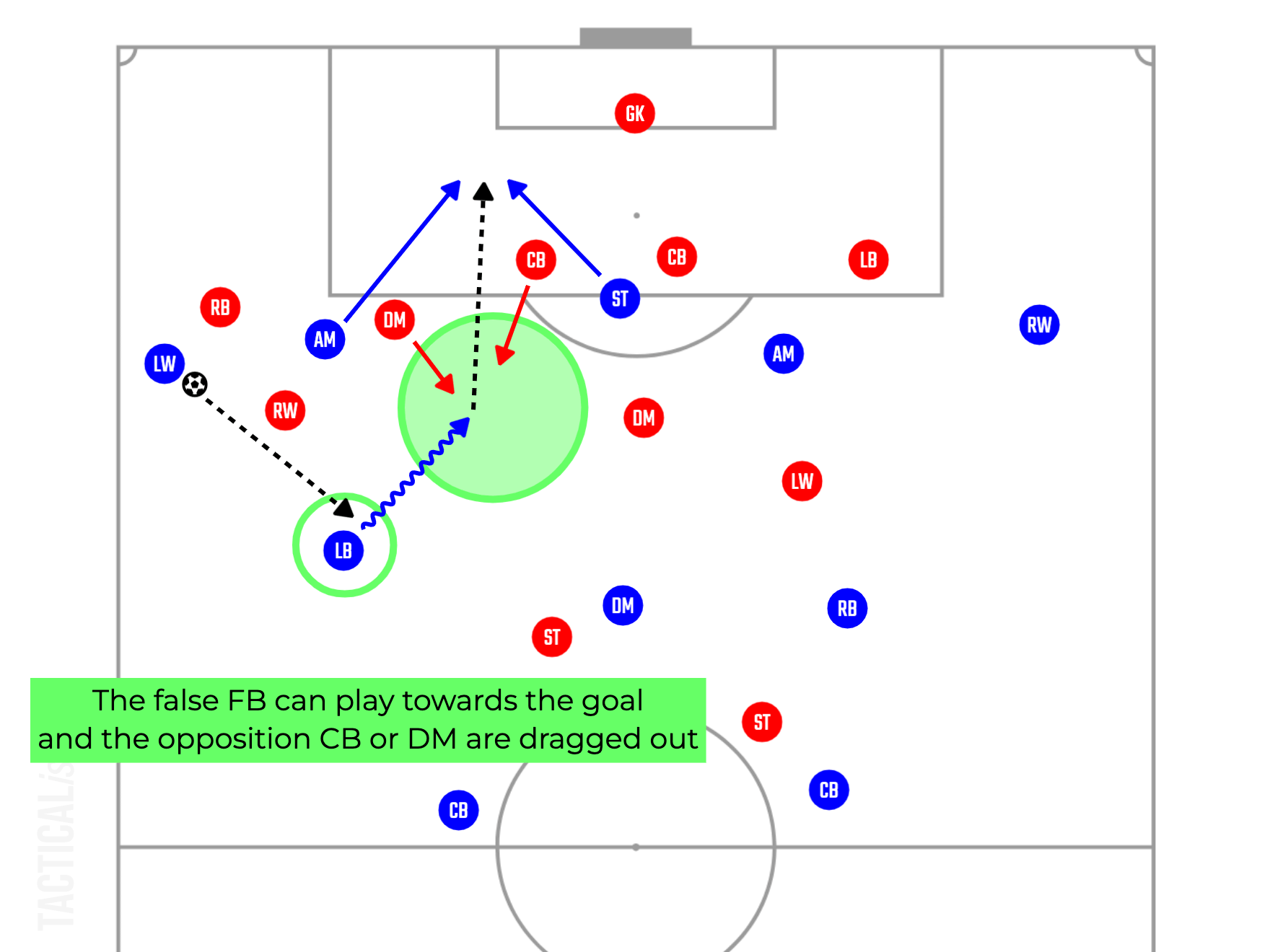
As soon as a center-back receives the ball, the corresponding full-back must sprint into the wide channel. They are not an option for a five-yard pass. They are the outlet to stretch the pitch vertically and pull an opposition winger out of position. Their first touch? It must be forward, into the space ahead. A full-back who takes their first touch back toward their own goal has killed the attack. This principle of using width is a cornerstone of the modern 3-5-2 formation, where wing-backs are the primary outlets.
4. A Midfielder or Forward Drops Into the “Pocket”
If the opponent marks your pivot, you need another solution. One of your #8 midfielders or your #9 striker must drop into the space between the opposition’s lines, the “pocket.” This drags a center-back out of position or creates a free player. The pass into them must be crisp and to their back foot, away from pressure.
5. The “Third Man” Makes the Blindside Run
This is the advanced move. When the ball goes into the dropping forward, a winger or opposite #8 must make a run in behind the defender who has stepped out to press. This “third-man run” is how you break the last line. It’s not about individual skill; it’s about timing and knowing your teammate will find you.
| Movement | Player | Key Coaching Point | Risk If Skipped |
|---|---|---|---|
| Split Center-Backs | Central Defenders | Create angles, not just width. | Goalkeeper has no passing option, forced to go long. |
| Drop the Pivot | Defensive Midfielder (#6) | Receive on the half-turn, back to goal. | Build-up stagnates between center-backs, press wins ball. |
| Provide Width | Full-Backs / Wing-Backs | First touch must be forward into space. | Play gets compressed, no vertical outlet, easy to defend. |
| Drop into Pocket | Attacking Midfielder (#8/10) or Striker (#9) | Check shoulder before receiving, know next pass. | Pivot is marked, no central progression, ball goes sideways. |
| Third-Man Run | Winger or Opposite Midfielder | Timing is everything—run as the pass is played. | Attack reaches final third but has no penetration, breaks down. |
TL;DR: These five movements are a synchronized system. Drilling them in isolation is pointless; they only work together.
Beating the High Press: Your Tactical Toolkit
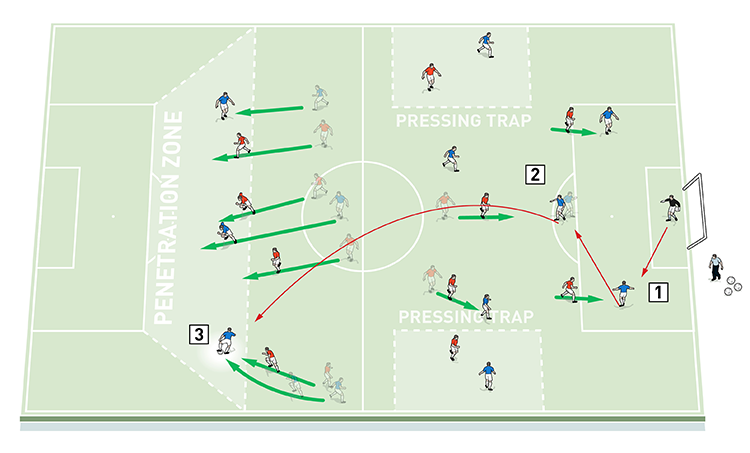
Opponents will try to suffocate you. A coordinated high press aims to trap your players and force a mistake. Your job is to bait them and then break their structure. Here’s how.
First, recognize the press. Are they man-marking or using a zonal system? A man-marking press is beaten by movement, if their forward follows your dropping #6, space opens elsewhere. A zonal press is beaten by passing through the zones quickly before they can shift.
Common mistake: Playing safe, square passes between your center-backs when pressed. This allows the pressing team to shift their entire block and close every lane. You must play through a line of pressure within three passes, or you lose.
The most effective tool is the switching pass. If the press overloads your right side, your goalkeeper or left center-back must hit a diagonal, driven pass to your right winger or advanced full-back. This changes the point of attack and forces the opponent to sprint across the pitch. Their energy drops after three or four of these switches.
Another is the disguised pass. Your pivot receives with their body shaped to play left, but uses the outside of their foot to play right. It buys that extra half-second. In a tight 3-4-3 formation, where the wide players are high, these disguised passes into the wing-backs are how you escape.
Finally, have your “out ball.” Sometimes, the short option is completely closed. Your pre-agreed signal, a long pass to your physically strong #9 or a diagonal to your pacey winger, is not a failure. It’s a strategic release valve that punishes a team for overcommitting. This is a classic tactic in the 4-4-2 formation, using a target forward to hold up play and bring others into the game.
TL;DR: To beat a high press, you must play forward with purpose. Square passing is surrender.
The 4-3-3 vs. 3-5-2: Which Formation Works Best?
The shape of your team dictates how you build. There is no “best” formation, only the best one for your players.
The 4-3-3 formation offers natural width and a single pivot. It’s the standard for a reason. The full-backs provide the wide outlets, the #6 drops between center-backs, and the wingers stay high to pin back the opposition full-backs. The risk? If your full-backs are caught high, you’re vulnerable to counters down the flanks. Your center-backs must be comfortable covering that space.
The 3-5-2 formation (or 5-3-2 when defending) provides a built-in back three. You don’t need a midfielder to drop, you already have three center-backs. The wing-backs provide extreme width, and you often have two strikers to drop and link play. The trade-off is less control in central midfield unless your wing-backs are phenomenally fit. This system is detailed in our guide on attacking transitions within a back-five framework.
| Formation | Best For | Key Build-Up Strength | Primary Vulnerability |
|---|---|---|---|
| 4-3-3 | Teams with athletic full-backs and a playmaking #6. | Natural width, clear roles, easy overloads on one side. | Exposed flanks on turnover if full-backs are high. |
| 3-5-2 | Teams with three technically sound center-backs. | Built-in back three, two strikers to link play, solid base. | Can be outnumbered in central midfield if wing-backs don’t tuck in. |
| 4-2-3-1 | Teams that want a double pivot for security. | Two deep midfielders offer passing options and cover. | Can lack a single forward target for long “out balls.” |
| 4-4-2 Diamond | Teams that dominate central areas. | Central overloads, multiple players between the lines. | Lack of natural width, reliant on full-backs for all flank play. |
Choosing a formation isn’t about trends. It’s about whether your center-back can hit a 40-yard diagonal pass, or if your #6 has the turning circle of a truck. Fit the system to the players, not the other way around.
Training Drills That Build Real Confidence
You can’t learn this under no pressure. Start with unopposed patterns, then add passive pressure, then live pressure. Here is a progression that works.
- The Rondo Grid (5v2): Set up a 10×10 yard grid. Five attackers keep possession against two defenders. The rule: every pass must be forward-facing or into space. This trains quick, forward-thinking one-touch play.
- Positional Build-Out (7v0): Set up your game formation from the goalkeeper. Move the ball from back to front with no opponents. Focus entirely on the timing of the movements: when does the #6 drop? When does the winger make the run? Freeze play to correct body shape.
- The 4-Gate Game (7v4): Place four small goals (gates) around the halfway line. Your team of 7 must build from their goalkeeper and pass through any gate to score a point. The 4 defenders try to win it and score on a large goal. This rewards vertical, line-breaking passes.
- Conditioned Game (11v11 with a build-out zone): Mark a zone 30 yards from your goal. The rule: if your team wins the ball in this zone, you must make 5 consecutive passes before you can attack. This forces the team to practice under real match pressure.
The jump from Drill 3 to Drill 4 is where most teams fail. The pressure feels real, and players revert to hoofing the ball. That’s the moment to stop, reset, and remind them of the movements. This kind of focused, scenario-based training is as crucial as any soccer workout plan for building the specific fitness and mental resilience required.
I once watched a talented youth team master these drills on a Tuesday. On Saturday, under the first sign of a high press, their center-back booted the ball into touch every time. The coach screamed the patterns from the sideline. It didn’t matter. Game-speed decision-making is a different muscle. It takes six weeks of consistent, pressured repetition to become instinct.
TL;DR: Train under progressive pressure. If your drills don’t mimic game stress, your players will panic when it matters.
Common Mistakes and How to Fix Them
Even with the right plan, execution fails. Here are the cracks that appear and how to seal them.
Mistake 1: The goalkeeper always goes short. This makes you predictable. Fix: Designate a trigger. If the opposing forward closes down your center-back at an angle, that’s the signal for the keeper to go long to the opposite winger. Practice this read.
Mistake 2: The full-back receives, then stops. This kills momentum. Fix: The first touch rule is non-negotiable. In training, any full-back who takes their first touch backward does 10 push-ups. It sounds harsh, but it rewires the instinct.
Mistake 3: Players hide behind opponents. They don’t want the ball in a dangerous area. Fix: Use conditioned games where the only way to score is by a player receiving between the lines. Reward the bravery.
Mistake 4: No plan for losing the ball. This is the biggest error. Fix: Implement a 6-second counter-press rule. The moment possession is lost, the nearest three players must aggressively hunt the ball. If they win it back within 6 seconds, they get a bonus point. This turns a risk into a weapon. A player’s ideal soccer position is often defined by their ability to execute in these high-pressure transition moments.
Frequently Asked Questions
What if my defenders aren’t good enough on the ball to play out from the back?
Then don’t do it. Seriously. Forcing a system onto players who can’t execute it is a recipe for disaster and lost confidence. Start by improving their basic technical skills under pressure in small-sided games. You can also modify the system, maybe your goalkeeper goes long more often, or you use a back-three so your best ball-playing defender is always in the middle. The system serves the players, not the other way around.
How do I convince my players to stay calm under pressure?
You can’t convince them. They have to experience success under pressure. Use the progressive drill system outlined above. Start without pressure, then add it slowly. Celebrate the moments they do it right in a game, even if the final pass is off. Confidence is earned through repeated, small successes. This mental aspect is as vital as player conditioning for peak performance.
Is playing out from the back worth the risk?
Absolutely, but the risk must be calculated. The reward is total control of the game’s tempo, exhausting the opponent, and creating higher-quality chances. The risk is a turnover in a dangerous area. The calculation is this: if your team is well-drilled in the movements and the counter-press, the reward vastly outweighs the risk. If you’re just winging it, the risk will bury you.
What’s the biggest tactical benefit?
It draws the opponent out of their defensive block. Most teams are comfortable defending in a low, compact shape. Playing out from the back forces them to come forward and press, which creates space behind them for your faster players to exploit. It’s a proactive way to break down a defensive team, a key concept in any advanced tactical principles playbook.
How does weather or pitch condition affect this style?
Massively. On a wet, slick pitch, short passes zip faster, you can play more one-touch football. On a dry, bumpy pitch, you need to take an extra touch to control the ball, which gives the press more time to close you down. In those conditions, your “out ball” becomes more important. You might play more direct initially to settle into the game. Adaptability is a sign of a mature team.
Before You Go
Playing out from the back isn’t a passing philosophy. It’s a war of attrition. You are inviting pressure to create space, trusting your technique, and betting that your collective understanding is sharper than the opponent’s aggression.
The teams that do it well make it look easy. It isn’t. It’s hundreds of hours of repetitive drilling, of yelling about body shape, of watching video where you lost the ball in your own box. But when it clicks, when you draw a team in and slice through them with three passes, it’s the most controlled, dominant form of soccer there is. Start with the movements, drill the patterns, and build the nerve. The space you’re trying to find is as much in your players’ heads as it is on the pitch.
I come from the “soccer heart” of Germany, the Ruhrpott. I have played, trained and followed soccer all my life and am a big fan of FC Schalke 04. I also enjoy following international soccer extensively.