The Center Circle in Soccer: Its Purpose and Official Uses
The center circle in soccer is a 9.15-meter radius zone from the center mark. Its official purpose is to enforce a mandatory 10-yard distance from the ball for opponents during a kick-off and to contain all non-kicking players during a penalty shootout.
The center circle in soccer is used to enforce a mandatory 10-yard (9.15-meter) distance between the ball and opposing players during a kick-off, and to contain all non-participating players within its boundary during a penalty shootout. Its 9.15-meter radius is measured from the center mark on the halfway line, creating a visible zone for referees to manage player positioning at these two critical restart moments.
Most people see the circle and think it’s just decorative, a neat symmetrical line in the middle of the pitch. They watch the kick-off, see players standing around it, and never question why it’s exactly that size. The confusion starts when the game is flowing and the circle seems irrelevant. It only matters when the ball is dead and the game is restarting from the absolute center.
This guide breaks down the two official uses, the exact dimensions from the IFAB Laws of the Game, and the historical quirk of how it got its first name. You will learn how referees use it, why its size is non-negotiable, and the one common mistake players make at every level.
Key Takeaways
- The circle’s 9.15-meter radius exists solely to enforce the 10-yard distance rule at kick-offs, a law established in 1863, with the visual marking added in 1891.
- During a penalty shootout, it acts as a holding pen. Every player except the two goalkeepers and the active kicker must stay inside it.
- Only players from the team taking the kick-off may stand inside the circle before the ball is played. All opponents must be outside it.
- The line itself must be continuous and no wider than 12cm (5 inches). Any extra, unauthorized marks inside it can result in a player caution.
- Its unofficial first name was the “Smith Circle,” named after early referee Robert J. Smith, who is often credited with proposing the visible marking.
Why the Center Circle Exists: The 10-Yard Rule
The circle is a solution to a simple problem: preventing a pile-on at the kick-off. In the original 1863 Laws of the Game, Law 8 stated that “no player is allowed to be within ten yards of the ball when it is kicked off.” For 28 years, referees had to estimate that distance. Imagine trying to pace out ten yards in the mud with 21 other players jostling for position. It was a guess.
The centre circle is a pitch marking with a radius of 9.15 m (10 yds) from the centre mark. Its sole function during normal play is to provide a visual guide for enforcing the requirement that opposing players be at least 10 yards from the ball at a kick-off, as stipulated in Law 8 of the IFAB Laws of the Game.
The 1891 update added the painted circle as a referee’s aid. Every point on that line is exactly 10 yards from the center spot. The referee now has a perfect, unchanging reference. If an opponent’s foot is on or inside the line when the ball is struck, it’s encroachment. The restart is a re-kick.
TL;DR: The circle is a painted measuring tape. It ensures the kicking team gets 10 yards of space to start play fairly, a rule that’s been in place for over 160 years.
How Referees Enforce It Today
The enforcement is binary. When the whistle blows for kick-off, the referee’s eyes scan the perimeter of the circle. Any part of an opposing player’s body breaking the plane of the line means they are encroaching. It is one of the easiest calls for an official to make because the evidence is painted on the grass.
I have seen youth coaches drill their players to “toe the line,” placing their cleats right up against the outside of the circle without touching it. They are teaching spatial awareness from the first whistle. In a professional match, you will see players casually standing a full yard outside the line. They know the margin for error is zero. Touch the line, get called, and you’ve handed the opposition a free re-kick and a moment of mental advantage.
The team taking the kick-off has no such restriction. They can be anywhere, including inside the circle. This allows for set-piece tactics. One player taps the ball forward a few inches to a teammate who is standing just inside the circle, who then turns and launches it long. Without the circle, defenders could be in that second player’s face immediately.
Common mistake: Thinking the entire kicking team must start inside the circle — only the player taking the kick needs to be near the ball. Teammates can start anywhere in their own half, which opens up tactical options for short kick-offs.
This rule is a cornerstone of fair play and is consistent across every organized match worldwide, from the Champions League final to a local Sunday league game. It is one of the first things checked when verifying official pitch dimensions before a match.
The Second, Rarer Purpose: Penalty Shootouts
The circle’s secondary job arrived almost a century later, born from chaos. When penalty shootouts were formally adopted in the 1970s, organizers needed a way to control the players not currently involved. Letting 20 emotionally charged athletes roam the pitch behind the goal was a recipe for intimidation, distraction, and outright interference.
The solution was simple: borrow an existing, unused marking. Law 10 now mandates that during a shootout, “all players, except the player taking the kick and the two goalkeepers, must remain within the centre circle.” It becomes a holding area. A referee’s assistant often stations themselves nearby to monitor compliance.
This rule serves two critical functions. First, it isolates the drama to the 18-yard box, allowing the kicker and goalkeeper a clear mental space. Second, it prevents mass confrontations. By containing the teams, it reduces the chance of a player from the scoring team rushing to celebrate directly in front of the opposing bench, or a player from the losing team trying to dispute a call from halfway across the field.
| Situation | Who Must Be Outside the Circle? | Who Must Be Inside the Circle? | Consequence of Violation |
|---|---|---|---|
| Kick-off | All opposing players | Only the team taking the kick-off may have players inside | Re-kick; repeated encroachment can lead to a yellow card |
| Penalty Shootout | The two goalkeepers and the current kicker | All other players from both teams | Caution (yellow card) for unsporting behavior |
The physical experience is tense. Twenty-two players cram into a space 18.3 meters wide. There’s nervous energy, muted cheers, and collective groans—all contained within that ring of paint. It is one of the most visually striking scenes in sports, and it only happens because of this secondary, rarely invoked rule. This containment is as much a part of the shootout procedure as the match duration is to the game itself.
Dimensions and Markings: The Non-Negotiable Specs
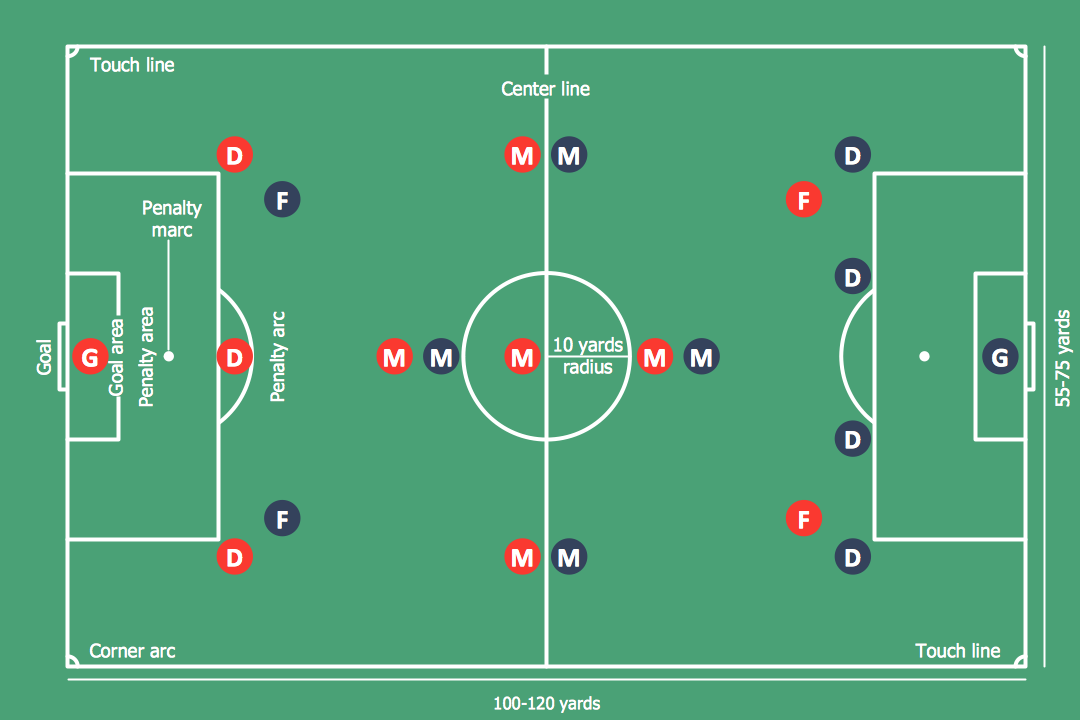
The center circle is not a suggestion. Its specifications are laid out in Law 1 of the IFAB Laws of the Game. The radius is 9.15 meters. This converts to 10 yards, maintaining the sport’s historical use of imperial measurements. The circle is drawn around the center mark, which is a small point at the exact midpoint of the halfway line.
The line itself must be continuous and of uniform width. The maximum width allowed is 12 centimeters (5 inches). Most professional pitches use the minimum visible width, often around 10-12cm. The line is part of the field of play, meaning if the ball is on top of the line, it is still in play.
Unauthorized marks inside the circle are forbidden. A player who scuffs a personal mark or digs a hole with their cleat to place the ball for a kick-off can be cautioned for unsporting behavior. The integrity of the field of play markings is taken seriously because it affects the roll of the ball and the consistency of the playing surface.
The “Smith Circle”: A Naming Rights Story
Before it was just the center circle, it had a namesake. In the late 19th century, it was unofficially known as the “Smith Circle” after Robert J. Smith, an early football referee and umpire. Smith is frequently credited with proposing the idea of painting the circle as a practical aid for officials.
This bit of trivia highlights the sport’s grass-roots, problem-solving evolution. The rule (10 yards) existed for decades. Smith’s contribution was the simple, elegant tool to enforce it. His name has faded from common use, but his practical solution is visible on every pitch in the world. This historical footnote is a reminder that the game’s laws often evolve from the practical needs of those managing the players on the field.
Tactical and Psychological Nuances
Beyond the black-and-white rules, the circle influences the game in subtle ways. The kick-off is the only time in open play where a team is guaranteed structured, uncontested space. Smart teams use it.
A common tactical setup involves one player tapping the ball back to a midfielder stationed just inside the circle, who is facing their own goal. This draws the opposing team forward, creating space behind them for a long, switched pass to the opposite wing. The 10-yard cushion is the catalyst. Without it, that receiving midfielder would be under immediate pressure.
Psychologically, the shootout use of the circle creates a “theater-in-the-round” effect. The contained players become a unified audience, their reactions magnified. The isolation of the kicker is absolute. They walk from that crowded circle into a vast, empty space. The rule physically manifests the mental transition from teammate to solitary performer. This dramatic staging is a direct result of a simple marking rule, adding a layer of spectacle that defines the modern shootout, a ultimate test after the standard match time has expired.
I once watched a regional cup final go to penalties. A player, frustrated after missing his kick, stormed out of the circle to argue with the referee. The assistant referee immediately flagged, and the player was shown a yellow card before the next kick was even taken. The circle’s boundary was treated as a literal rule of containment. He compromised his team’s focus for a pointless argument. They lost.
Frequently Asked Questions
Can the goalkeeper be inside the center circle on a kick-off?
Yes. The restriction only applies to opposing players. Since the goalkeeper is usually on the team taking the kick-off, they can position themselves anywhere within their own half, including inside the circle. An opposing goalkeeper must start outside it.
What happens if a player crosses into the circle too early on a kick-off?
Play is stopped, and the kick-off is retaken. The referee will warn players for repeated offenses, and persistent encroachment can result in a yellow card for unsporting behavior. It is considered a minor but clear violation of the restart procedure.
Is the center circle used in other set-piece situations, like free kicks?
No. The 10-yard rule applies to many free kicks, but the circle itself is only the official marker for that distance on kick-offs. For free kicks elsewhere on the pitch, the referee paces out or estimates the 10 yards, and defenders form their own wall. The circle is not a universal measuring tool.
Do youth leagues use a smaller center circle?
Sometimes. While the official laws specify 9.15 meters, smaller-sided youth games (e.g., 7v7 on a smaller pitch) often use a proportionally smaller center circle. However, the fundamental rule remains: opponents must stay outside it until the ball is in play. Always check the specific competition rules.
Why is the radius 9.15 meters and not a round number like 9 or 10 meters?
It is a round number—just in yards. The 9.15 meters is the exact metric conversion of 10 yards (1 yard = 0.9144 meters). Soccer’s laws originated in England using imperial measurements, and the metric equivalent is a precise conversion to maintain consistency with the original 1863 rule.
Does the ball have to leave the center circle on a kick-off for play to start?
No. The ball is in play the moment it is kicked and moves. It can be passed backwards to a teammate who is standing inside the circle. The key requirement is that it moves forward from the center mark. It does not need to fully exit the circular area.
The Bottom Line
The center circle is a perfect example of soccer’s blend of simple rules and deep tradition. It solves two very specific problems—managing distance at kick-offs and containing chaos during shootouts—with one unassuming ring of paint. Its 9.15-meter radius is a direct link to the sport’s 19th-century origins, a measurement that has not changed because it does not need to.
You will see it at the start of every half, after every goal, and at the climax of every knockout match that goes the distance. It is a tool for referees, a stage for drama, and a fixed landmark on the green rectangle where the fundamental goal of the game plays out. Now you know it is far from just a decoration. It is law, made visible.
I come from the “soccer heart” of Germany, the Ruhrpott. I have played, trained and followed soccer all my life and am a big fan of FC Schalke 04. I also enjoy following international soccer extensively.