History of Soccer vs Football Terminology: The Real Story
The history of soccer is the story of a game codified in 19th century England, while football terminology is the global language that grew from it. The modern sport was formally born on October 26, 1863, with the founding of The Football Association in London. The terms ‘soccer’ and ‘football’ represent a linguistic split, where ‘soccer’ is a British-derived abbreviation that stuck in a few nations, while ‘football’ became the dominant global term spread by the British Empire.
Most people get this wrong because they hunt for a single inventor or a clean origin story. They argue about China versus England, or get tangled in the soccer versus football debate without understanding the shipping lanes that carried the words.
This guide maps the game’s messy evolution from ancient rituals to a regulated sport, and explains how its specialized language, from “hacking” to “gegenpress”, was built layer by layer.
Key Takeaways
- Modern association football is directly descended from rules standardized by English public schools in the 1800s, not from ancient ball games, though those games existed independently.
- The 1863 split at the Freemasons’ Tavern, which created the FA, was fundamentally over “hacking”, the deliberate kicking of opponents’ shins, and this created the separate sports of football and rugby.
- The term “soccer” comes from the British upper-class slang “assoc.” (short for “association football”) and was common in the UK until around the 1970s, when “football” reasserted itself.
- The global spread of the term “football” is a direct result of British imperial trade, education, and naval networks in the late 19th and early 20th centuries.
- Today’s complex football terminology, including tactical terms like “false 9” and metrics like “xG,” evolved from the basic Laws of the Game to describe an increasingly analytical sport.
The Ancient Games That Came First
Look for the first soccer game and you will find a crowd. China’s Han Dynasty had cuju, a kicking game used for military training. Mesoamerica had the rubber-ball spectacle of ullamaliztli, played on over 1,300 stone courts where players used their hips. These were real, sophisticated team sports.
But they are not the ancestors of the game we watch today. There is no continuous thread of rules or tradition connecting a Mayan ball court to the Etihad Stadium. These ancient games are precursors in concept only, proof that humans have always kicked objects towards targets. The direct lineage starts much later, in the muddy fields of English boarding schools.
Common mistake: Claiming soccer was “invented” in China or Mesoamerica, this confuses independent invention with direct cultural lineage. The modern sport’s rules, governing bodies, and global spread are uniquely and undeniably products of 19th century Britain.
The real significance of these ancient games is that they dispel the myth of a single, genius inventor. They show that the impulse for this type of play is universal. The Wikipedia soccer history entry documents this well, noting these early activities while anchoring the modern sport’s development in England.
TL;DR: Ancient ball games existed worldwide, but the modern sport’s rulebook and global institutions are purely a 19th century British creation.
Codification Chaos: How English Schools Built the Rulebook

Before 1863, “football” was a loose category for mob games with local rules. At Eton, you could handle the ball. At Rugby School, you could run with it. At Sheffield, they played with their own code. This wasn’t a sport yet. It was a collection of regional arguments waiting to happen.
The push for standardization came from a very practical problem: students from different schools couldn’t play each other. If you learned the game at Charterhouse, you were lost on a Rugby field. The need for a common rulebook moved from the playing fields to the meeting halls of London.
The Sheffield FA rules, used in the north of England from the 1850s, were particularly influential. They introduced concepts like free kicks for fouls and the crossbar. When the national FA was formed, it absorbed many of these Sheffield ideas. This was a process of competitive rule-making, not a single decree.
| School/Club | Key Rule Feature | Legacy in Modern Game |
|---|---|---|
| Rugby School | Running with the ball in hand | Led to the split and creation of Rugby Football |
| Eton College | Early use of referees and “umpires” | Established the concept of neutral officiating |
| Sheffield FA | Introduction of the crossbar and free kicks | Directly absorbed into the early FA laws |
| Cambridge University | Attempted 1848 unification rules | Showed early desire for a national standard |
The 1863 Split: When Football and Rugby Officially Parted Ways
The meeting at the Freemasons’ Tavern on October 26, 1863, wasn’t about creating a sport. It was about choosing which version of a sport would become the standard. Twelve London clubs showed up. The big fight was over “hacking.”
Hacking meant kicking an opponent in the shins. For clubs like Blackheath, it was a fundamental, manly part of the game. For others, it was barbaric and would limit the sport’s appeal. The vote went against hacking. Blackheath’s representative, Francis Campbell, argued passionately for its retention, calling its removal “a travesty of the game.” He lost.
The withdrawal of Blackheath FC and other rugby clubs from the FA in December 1863 directly led to the formation of the Rugby Football Union in 1871. This single meeting created two distinct sports with two distinct futures.
That meeting produced the first 13 Laws of the Game. They banned handling the ball (except for catching it on the fly for a “fair catch”), banned hacking and tripping, and defined the goal. The ball was in play. The English football history Wikipedia page details this pivotal schism. It was a divorce over philosophy, and from it, association football got its name and its identity.
TL;DR: The FA’s founding meeting in 1863 explicitly banned hacking (shin-kicking), causing a split that permanently separated football from rugby.
Soccer vs Football: A Tale of Two Names
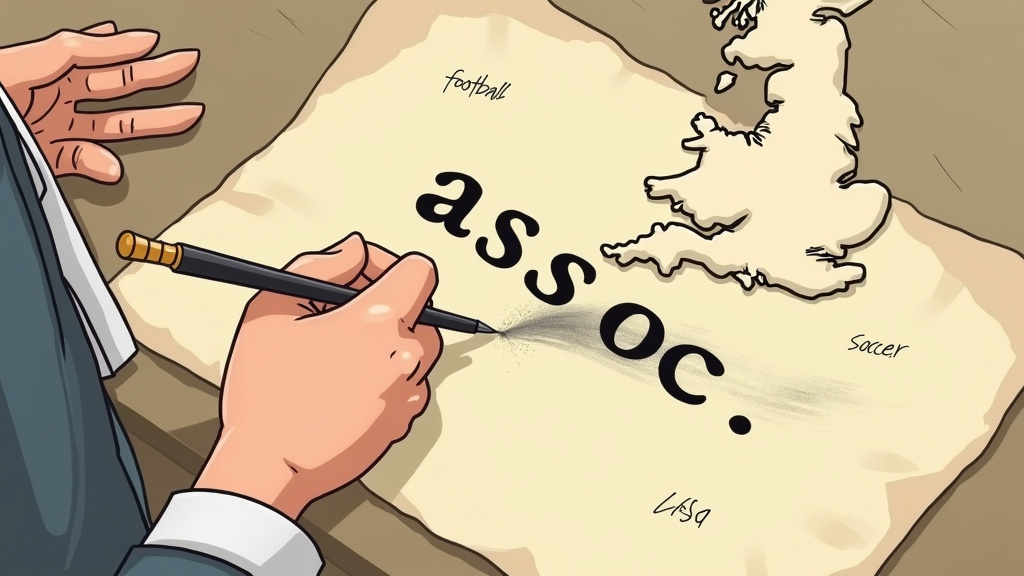
The word “soccer” is not an American invention. It is a British one. In the late 19th century, it was fashionable at Oxford and Cambridge to add “-er” to shortened words. Rugby was “rugger.” Association football became “assoc.” which quickly slurred into “soccer.” It was common, even preferred, in the UK for decades.
So why did “football” win in Britain and “soccer” stick in America, Canada, and Australia? The answer is timing and cultural space. In the UK, “football” was the dominant term among the working classes who played the sport. As the game professionalized and grew popular, “football” became the people’s word. “Soccer” began to sound like an upper-class relic and faded after the 1970s.
In the United States, “football” was already claimed by the growing sport of American football by the early 20th century. When association football arrived, it came with its British nickname “soccer” already attached, and that name had clear space to occupy. This divergence from British English was a historical accident, not a rebellion.
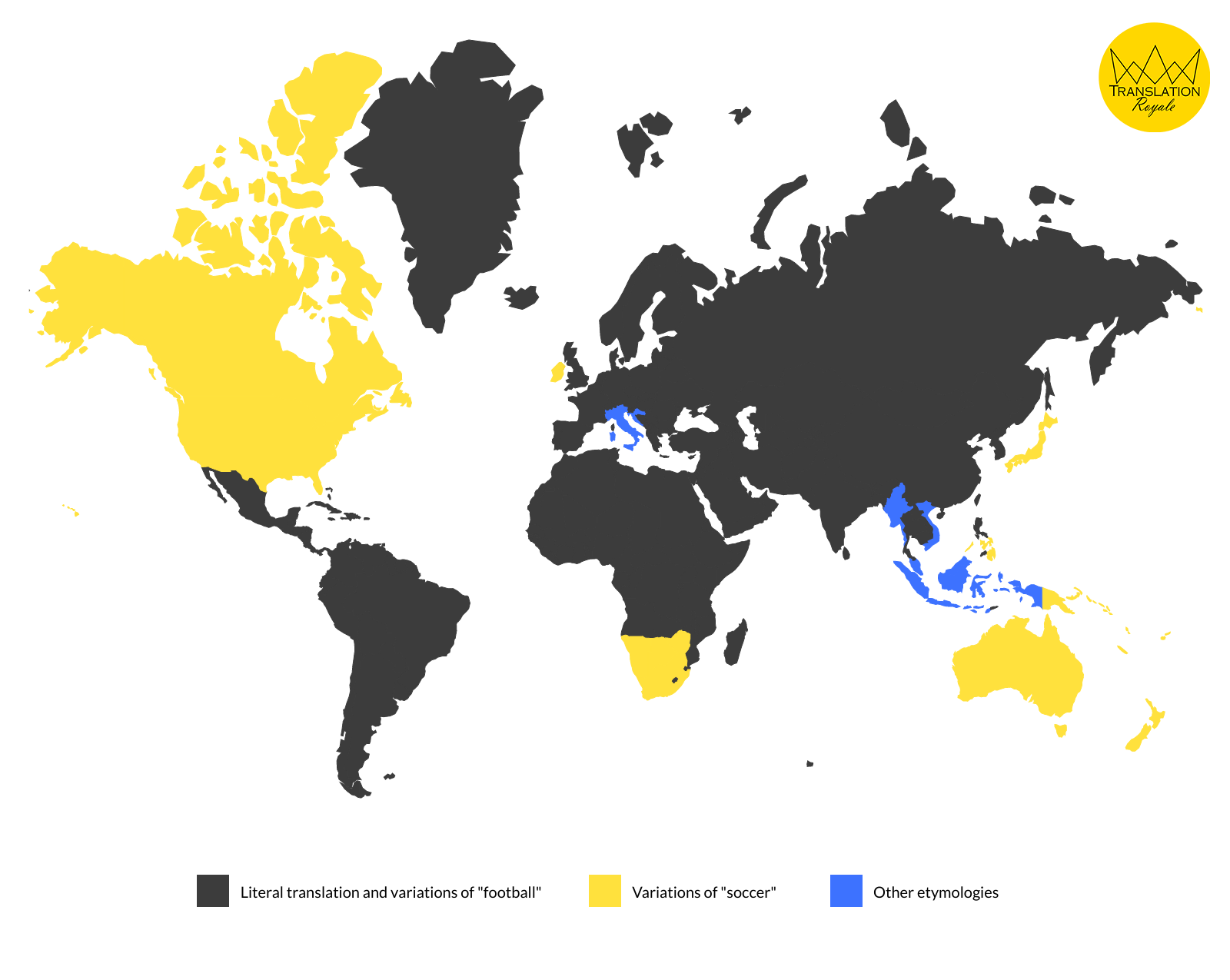
The global picture is a map of British influence. Most of the world calls it “football” (fútbol, Fußball, futbol) because that was the term exported through the British Empire’s vast networks. Countries with strong American cultural influence or competing football codes sometimes use “soccer.” Our guide on global terminology guide breaks this down country by country.
| Term Used | Primary Regions | Key Reason for Usage |
|---|---|---|
| Football | Europe, South America, Africa, most of Asia | Direct adoption via British colonial trade, education, and naval links. |
| Soccer | United States, Canada, Australia, South Africa | Needed to differentiate from other dominant “football” codes (American, Australian Rules). |
| Both | Ireland, New Zealand, Japan | Context-dependent use due to multiple popular football codes in the same culture. |
The Empire’s Game: How Football Conquered the World
The ball didn’t spread by magic. It traveled in the kit bags of British engineers building railroads in Argentina, with Scottish schoolteachers in Brazil, and on the ships of the Royal Navy. Port cities like Buenos Aires, Montevideo, and Genoa were the first footholds.
This wasn’t a formal policy. It was a cultural side effect of the world’s largest empire. British workers formed the first clubs abroad, like the Buenos Aires Football Club (1867). Local elites, educated in England, brought the game home. The global diffusion of soccer was a bottom-up process, adopted and adapted by locals who made it their own.
The formation of FIFA in 1904 by seven European nations was the logical next step. If the game was global, it needed a global regulator. FIFA’s job was to standardize international matches, but the real power over the rules stayed with the International Football Association Board (IFAB), a body still controlled by the four British home nations.
This spread cemented the terminology. The words for positions, goalkeeper, defender, midfielder, forward, traveled with the rules. The basic lexicon of the game was set in English and then translated, which is why a German Stürmer and an Italian attaccante mean the same thing.
Building the Language: From Positions to PPDA
The first football terms were simple and descriptive. They named what you could see: a goal, a kick, a handball. The early Laws of the Game were a glossary of prohibitions. As tactics evolved, so did the language.
The back-and-forth between Sheffield and London FA rules in the 1860s introduced terms like “free kick” and “crossbar.” The formalization of positions in the 2-3-5 “pyramid” formation gave us “centre half,” “inside forward,” and “winger.” You can trace the evolution of modern soccer through this expanding vocabulary.
The term “false 9” only makes sense if you know what a traditional “number 9” centre-forward is supposed to do. The new term is defined by its deviation from the old, established term. This is how football terminology grows, by reference to its own history.
The 21st century brought a data revolution and a new lexical layer. Metrics like Expected Goals (xG) and Passes Per Defensive Action (PPDA) are now part of the professional lexicon. They exist to quantify what was once only described qualitatively. A “good chance” becomes “a 0.45 xG opportunity.” This shift mirrors the game’s own shift towards hyper-analysis.
TL;DR: Football terminology has evolved from basic rule definitions to complex tactical and analytical concepts, each new layer building on the last.
Why This Distinction Matters Today
Understanding this history kills lazy arguments. Knowing that “soccer” is a British export stops the myth that Americans renamed the sport out of ignorance. It was a gift, not a theft.
For coaches and analysts, knowing the origin of a term reveals its original tactical intent. A “wing-back” is a hybrid position that only exists because the roles of “full-back” and “winger” were already defined. The history of the words is a history of tactical problem-solving. The debate over a single inventor is meaningless next to this continuous process of collective innovation.
For fans, it enriches the spectacle. When you hear a commentator mention the “Sheffield rules,” you now know they’re referencing that 1850s northern code that gave us the crossbar. The game carries its entire history in its language. The Wikipedia soccer terminology article serves as a living document of this evolution.
Finally, it settles identity. Is it the same sport if the field is different? Absolutely. The American football field dimensions define a different sport with a shared linguistic root. The words help us draw the family tree, showing how rugby, American football, and association football are cousins, not clones.
Frequently Asked Questions
What’s the oldest form of soccer?
The oldest recorded ball-kicking game is China’s cuju, dating to the Han Dynasty (206 B.C.–220 A.D.). However, it has no direct connection to the modern sport. The oldest direct ancestor of today’s global game is the variety of football played in English public schools, which was codified into the modern Laws of the Game in 1863.
Why do Americans say soccer and not football?
Americans say “soccer” because that was the common British term for the sport when it was introduced to the U.S. in the late 19th and early 20th centuries. The word “football” was already claimed by the developing American gridiron sport, so “soccer” provided a clear distinction. It’s a preserved historical artifact, not an American invention.
Did one person invent soccer?
No. Modern soccer was not invented by a single person. It evolved from various English school games into a standardized sport through a series of meetings, most notably the 1863 founding of The Football Association in London. The rules were a collective creation, influenced by clubs from Rugby, Eton, Sheffield, and others.
What was the main reason football and rugby split?
The split was primarily over the rule of “hacking”, the deliberate kicking of an opponent’s shins. At the 1863 FA meeting, clubs who wanted to retain hacking (like Blackheath) left the association when the practice was banned. These clubs later formed the Rugby Football Union, formalizing the separation between the two sports.
How did football spread so quickly around the world?
Football spread globally through the networks of the British Empire. British sailors, engineers, traders, and schoolteachers introduced the game to port cities and colonies worldwide. Local populations adopted and adapted the sport, often using it as a form of cultural expression or resistance, leading to its deeply rooted local traditions.
What does “soccer” mean in British slang?
“Soccer” originated as Oxford University slang in the 1880s. It is a shortening of “Association football,” with the “-er” suffix added in the same pattern as “rugger” for Rugby football. It was a common, neutral term in Britain for most of the 20th century before “football” regained dominance in everyday speech.
The Bottom Line
The history of soccer is a 19th century British project. The terminology is its 150-year-old global echo. You cannot pull the two apart. Every time you hear “offside,” you are invoking a rule debated in London pubs. Every time you debate “soccer vs. football,” you are re-enacting a linguistic split that traveled on British ships.
The game’s true origin story is not a lightning bolt of invention. It is a slow, contentious process of standardization, of choosing one set of rules over another, one name over another. The language we use today, from basic positions to advanced analytics, is the living record of that process. It is the syntax of the world’s game.

I come from the “soccer heart” of Germany, the Ruhrpott. I have played, trained and followed soccer all my life and am a big fan of FC Schalke 04. I also enjoy following international soccer extensively.