Explaining How Premier League Promotion Works From EFL
Premier League promotion works through the EFL Championship. The top two teams in the Championship table after 46 matches are promoted automatically. Teams finishing 3rd, 4th, 5th, and 6th enter a knockout playoff tournament, with the winner of the final at Wembley Stadium claiming the third and final promotion spot.
Most people think the playoff is just an extra game for the teams that didn’t win the league. They miss the brutal economics. A club that loses the playoff final stays in the Championship, where the median revenue is around £30 million. The winner jumps to the Premier League and immediately adds over £100 million to its balance sheet. That gap decides which clubs survive and which fade.
This guide walks through the automatic spots, the playoff format, the financial stakes, and what happens to the teams that come up.
Key Takeaways
- Automatic promotion is reserved for the top two Championship finishers; everything else is playoff chaos.
- The playoff involves four teams (3rd–6th) in two-legged semi-finals and a one-off final at Wembley Stadium.
- Winning the playoff final is often called the “richest game in sports” because it unlocks over £100 million in new revenue.
- Relegated Premier League clubs receive parachute payments, but their revenue still drops by about 60–70% the first year back in the Championship.
- From the 2026/27 season, the playoff will expand to include teams finishing 3rd through 8th, adding two extra knockout rounds.
The Automatic Promotion Spots Are Simple
The first two places in the EFL Championship table are the only guaranteed tickets to the Premier League. No playoffs, no extra matches. Finish first or second after 46 games, and your club moves up.
The two automatic promotion places are awarded solely on final league position after the full Championship season. There is no additional qualification round or points threshold.
The 2024/25 season saw Coventry City win the title and Ipswich Town finish second. Both were promoted. Coventry’s campaign was built on a solid defense and Frank Lampard’s tactical shift mid-season. Ipswich’s was a relentless attacking press that wore down opponents by March. Their styles were different, but the outcome was identical.
TL;DR: Finish first or second in the Championship after 46 matches. You’re in.
The Championship Playoff Format
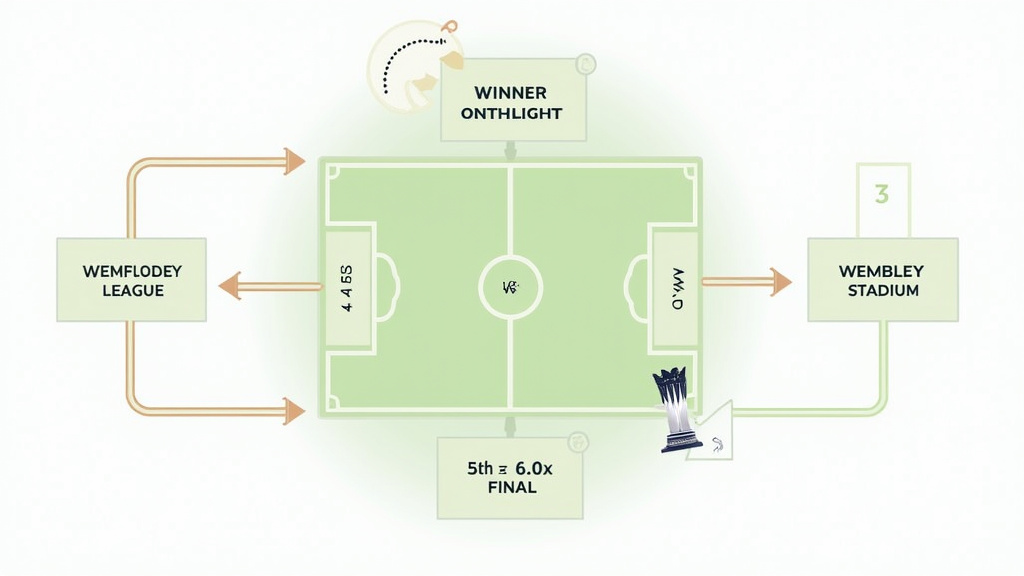
This is where the drama lives. Teams that finish 3rd, 4th, 5th, and 6th enter a knockout tournament for the final promotion place.
The structure is fixed.
– Semi-finals: 3rd vs 6th and 4th vs 5th.
– Each semi-final is played over two legs, home and away.
– The higher-ranked team always hosts the second leg.
– The winner of each semi-final advances on aggregate score.
– The two semi-final winners meet in a single match at Wembley Stadium.
– If the final is level after 90 minutes, extra time and then penalties decide it.
For the 2024/25 playoffs, that meant Millwall (3rd) faced Hull City (6th), and Southampton (4th) faced Middlesbrough (5th). Southampton, having just been relegated from the Premier League the previous season, carried the experience, and the financial cushion, of a top-flight club. Middlesbrough’s historical playoff record is poor; they’ve lost more finals than they’ve won since 1988.
Common mistake: Assuming the higher-seeded team always wins the playoff semi-final, momentum and squad fatigue in May often override the table position. A 6th-place team with fresh legs and a hot striker can beat a 3rd-place team that’s been grinding since August.
The playoff isn’t a mini-league. It’s a cup competition crammed into three weeks. That intensity changes everything.
| Playoff Position | Advantage | Historical Challenge |
|---|---|---|
| 3rd & 4th | Host second leg of semi-final | Often fatigued from automatic-promotion chase |
| 5th & 6th | Fresher, less pressure | Must overcome higher-seeded opponent’s home advantage |
TL;DR: Four teams, two semi-final ties, one final at Wembley. The winner goes up.
Why the Playoff Final Is the “Richest Game in Sports”
The label comes from the immediate financial uplift. Promotion to the Premier League triggers a minimum guaranteed revenue increase of about £100 million. That figure combines central broadcast payments, increased commercial deals, and higher matchday income.
A Championship club’s median annual revenue sits around £30–40 million. A mid-table Premier League club pulls in over £200 million. The gap isn’t gradual. It’s a cliff.
Winning the playoff final at Wembley is a financial lifeline. The promoted club’s revenue multiplies by five or six overnight. That cash rebuilds squads, expands stadiums, and pays debts that would otherwise cripple a Championship budget.
The flip side is brutal. The loser stays in the Championship. Their budget stays flat. Their best players get offers from Premier League clubs. The manager often leaves. I’ve watched clubs like Brentford and Huddersfield win the playoff final and then stabilize in the top flight for years. I’ve also seen clubs like Derby County lose it and spiral into administration within five seasons.
This financial reality explains why the playoff often feels more tense than the automatic promotion race. The top two celebrate. The playoff four fight for survival.
What Changes in 2026/27

The Premier League and EFL agreed on an expanded playoff format starting in the 2026/27 season. More teams, more chaos.
The new system adds two extra knockout rounds.
– Playoff qualification expands to six teams: 3rd through 8th.
– The first round involves one-off matches: 5th vs 8th and 6th vs 7th.
– The winners of those matches advance to face the 3rd and 4th placed teams in the semi-finals.
– The semi-finals and final remain two-legged and single-match respectively.
| Old Format (2024/25) | New Format (2026/27) |
|---|---|
| 4 teams (3rd–6th) | 6 teams (3rd–8th) |
| 5 matches total | 7 matches total |
| Straight semi-finals | Preliminary round + semi-finals |
The logic is simple. It gives more clubs a shot at promotion, which the EFL argues increases competitive balance. It also creates two extra high-stakes televised games, which means more broadcast revenue for the league.
I think it will favor the 5th and 6th placed teams more than the 3rd and 4th. The 3rd and 4th placed teams now must wait for the preliminary round winners, losing their rhythm. The 5th and 6th placed teams get a direct route to the semi-final if they win their one-off game. Momentum matters more than seeding in May.
The Relegated Clubs’ Path Back
Teams that drop from the Premier League into the Championship receive parachute payments. These are reduced broadcast revenue shares designed to soften the financial blow. The payments last for three seasons, decreasing each year.
A relegated Premier League club’s revenue drops by roughly 60–70% in its first Championship season, even with parachute payments. That shock forces squad sales, contract terminations, and often a managerial change within six months.
Southampton’s 2024 relegation and immediate 2025 playoff push is the classic case. They kept most of their Premier League squad, used the parachute money to cover wage gaps, and leveraged their top-flight experience to finish 4th. Their relegation process was a financial reset, but not a collapse.
Other relegated clubs, like Leeds United a few seasons back, hemorrhaged players and finished mid-table. The parachute payments only delay the reckoning. A club must either bounce back quickly or rebuild entirely within the Championship’s tighter budget.
This creates a two-tier Championship: clubs with recent Premier League money and clubs without. The playoff often pits one against the other.
How Promotion Shapes the Premier League
Three new clubs enter the Premier League each season. Their impact is immediate.
They bring different styles. Coventry City under Frank Lampard played a pragmatic, defensive system. Ipswich Town under Kieran McKenna ran a high-press, high-energy game. The playoff winner, often a team like Millwall or Middlesbrough, brings a physical, direct approach that top-flight clubs haven’t faced for months.
The financial gap also dictates their strategy. A newly promoted club’s first Premier League transfer budget is usually £30–50 million. That’s about one-third of what a mid-table club spends. They can’t buy stars. They must find bargains, develop youth, and pray their style holds up.
Common mistake: Assuming a promoted club will spend its new £100 million revenue on players immediately, most of that cash is locked into infrastructure debt, stadium upgrades, and covering the Championship wage bill they carried over. The actual transfer kitty is smaller.
The first season is about survival. Stay up, and the second season’s budget grows. Go down, and the parachute payments begin. That first-year fight is why promoted clubs often start the season with a defensive, counter-attacking setup. It’s not pretty. It’s necessary.
Frequently Asked Questions
What happens if the playoff final ends in a draw?
The match goes to 30 minutes of extra time. If still level, a penalty shootout decides the winner. There is no replay.
Do points from the regular season carry over into the playoffs?
No. The playoff is a separate knockout tournament. League position only determines seeding, who plays who and who hosts the second leg of the semi-final.
Can a team that finishes 6th really win promotion?
Yes. Hull City finished 6th in 2024/25 and entered the playoffs. The format gives them a chance. History shows 6th-place winners are rare, but possible. The pressure is lower, and fatigue is less.
What are parachute payments, and who gets them?
Parachute payments are reduced Premier League broadcast revenue shares paid to clubs relegated to the Championship. They last three years, decreasing annually, and aim to cushion the financial impact of relegation.
How does promotion work in other major European leagues?
Most top European leagues, like La Liga and the Bundesliga, also use promotion and relegation between their top division and second division. The formats differ. Spain’s La Liga promotion system involves a playoff for 3rd to 6th places, similar to England. Germany’s Bundesliga promotion playoff pits the 16th-place Bundesliga team against the 3rd-place 2. Bundesliga team in a two-legged tie.
The Bottom Line
Premier League promotion is a two-track system. The top two spots are a meritocratic reward for a 46-game season. The playoff is a three-week cup tournament that reshapes a club’s future.
The financial jump is the real story. Winning the playoff final adds more than £100 million to a club’s revenue. Losing it keeps them in the £30 million world. That difference decides which clubs become stable Premier League sides and which fade into the lower tiers of the English football pyramid.
The new format arriving in 2026/27 will add two more teams and two more games. It will create more drama, more revenue for the EFL, and more chances for a club to make that jump. But the core remains the same: finish first or second, or win three knockout games in May. Everything else is just the Championship.

I come from the “soccer heart” of Germany, the Ruhrpott. I have played, trained and followed soccer all my life and am a big fan of FC Schalke 04. I also enjoy following international soccer extensively.