Explaining the English Soccer League System: Pyramid Guide
The English soccer league system is a hierarchical pyramid of interconnected leagues, governed by promotion and relegation. At the top is the 20-team Premier League. Below it are three divisions of the English Football League (EFL): the Championship, League One, and League Two. The system then extends through the FA-administered National League System down to regional amateur leagues, encompassing over 5,000 clubs.
Most people think the system ends with the 92 professional clubs. They see the Premier League and the EFL on television and assume everything below is just local parks football. That view misses the entire point.
This guide maps the entire structure, from the global spectacle at the top to the community heartbeat at the bottom. You will learn how clubs move, where the money runs out, and why this system is unique in world football.
Key Takeaways
- The system is a true pyramid of over 20 tiers, linking the Premier League to village parks via promotion and relegation.
- The 92 clubs in the Premier League and EFL are fully professional; the National League System (Levels 5-10) is governed by the FA and mixes professional, semi-pro, and amateur clubs.
- Promotion requires more than winning; clubs must pass strict ground grading and financial tests to move up.
- Below Level 6, the structure becomes intensely regionalized, with geography dictating a club’s path as much as performance.
- The system includes clubs from Wales, Guernsey, Jersey, and the Isle of Man, not just England.
How the English Soccer League System Works: The Pyramid Explained
Forget a simple ladder. The structure is a vast, interconnected pyramid. The Wikipedia entry on the English football pyramid outlines its scope, but the lived reality is more granular. Each level, or “step”, contains leagues that feed into the one above. A club’s performance decides if it climbs or falls, but its location decides where it goes next, especially deeper down.
The system’s magic is its theoretical openness. A club formed today in a local park has a defined, if astronomically long, path to the Premier League. This isn’t just theory. Clubs have traveled it.
The English football pyramid is a single, unified structure of over 5,000 clubs, administered by The Football Association (FA). Promotion and relegation link all levels, with movement contingent on both sporting merit and compliance with off-field regulations covering facilities, finance, and administration.
TL;DR: It’s one giant pyramid, not separate silos. Winning gets you considered for promotion, but passing the league’s rules gets you in.
The Professional Core (Levels 1-4)
This is the part you know. Four divisions, 92 clubs, all full-time professional. The money, the TV deals, and the global attention live here.
The Premier League stands alone at Level 1. Its 20 clubs operate under a multi-billion pound television contract. The bottom three teams each season face Premier League relegation to the Championship. This drop is not just sporting; the financial impact of relegation can exceed 50 million pounds in lost revenue overnight.
Beneath it sits the English Football League (EFL), a collective name for Levels 2, 3, and 4.
| Division | Level | Clubs | Promotion Spots | Relegation Spots |
|————–|———–|———–|———————|———————-|
| Championship | 2 | 24 | 3 (Top 2 auto, 1 via playoffs) | 3 to League One |
| League One | 3 | 24 | 3 (Top 3 auto) | 4 to League Two |
| League Two | 4 | 24 | 4 (Top 3 auto, 1 via playoffs) | 2 to National League |
The Championship is famously brutal. The playoff final for the third promotion to the Premier League is the richest single match in global football, worth over 150 million pounds. The physical toll is just as real. The 46-game season, plus cups, demands a squad depth most clubs can’t afford. Burnout by March is a standard feature, not a bug.
The National League System (Levels 5-10)
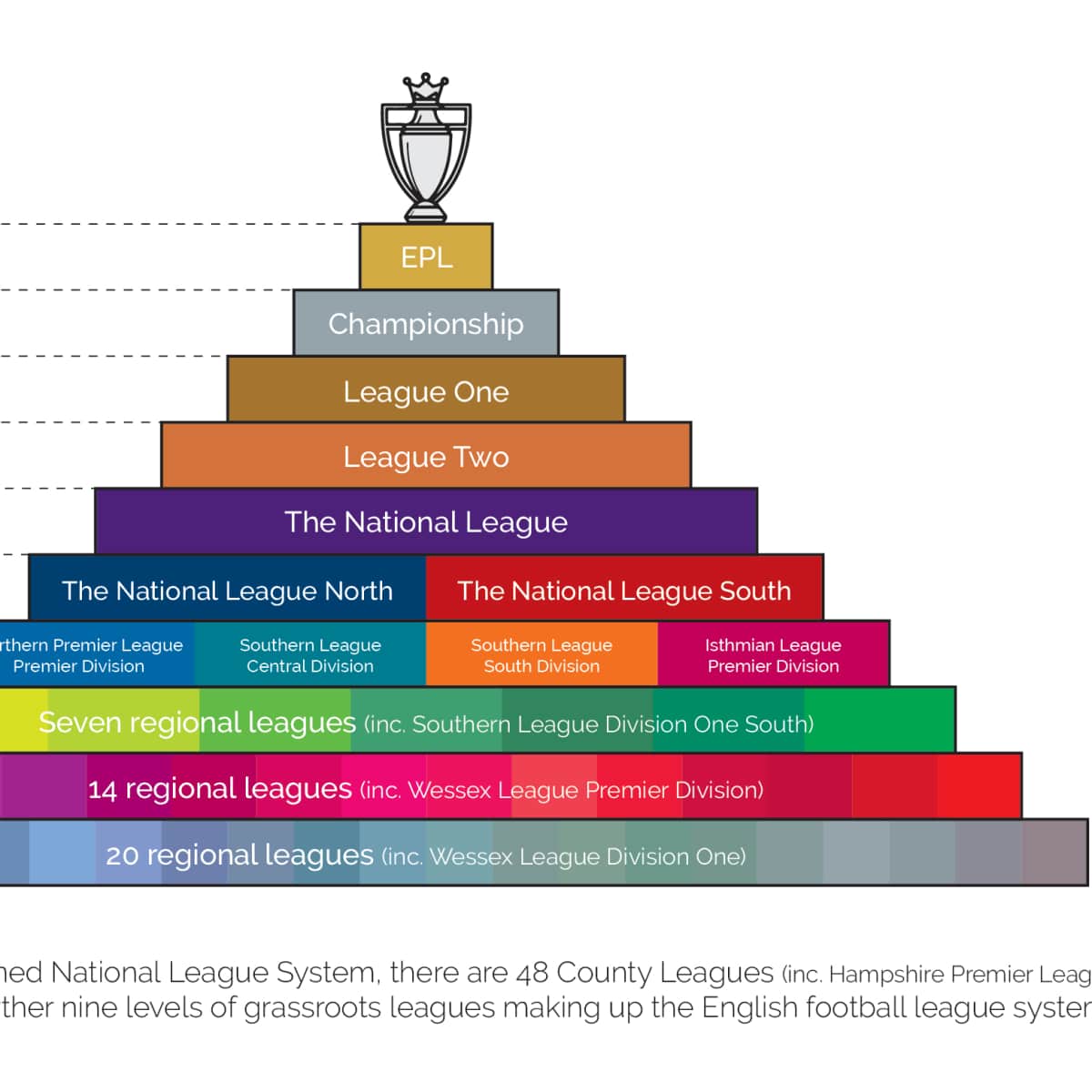
Step outside the EFL and you enter “non-League” football, administered directly by the FA’s National League System (NLS). This is where full-time professionalism begins to blend with part-time work and pure amateur passion.
Level 5 is the National League. It’s a single division of 24 clubs. Don’t call it amateur. Most teams here are fully professional. The champion goes up to League Two automatically. Teams finishing second through seventh contest a playoff for one more spot. The bottom four go down.
Level 6 splits geographically into the National League North and National League South. Each has 22-24 clubs. One champion from each division goes up automatically, with another promoted via playoffs from each. This is the last nationwide level. Below here, you need a map.
Common mistake: Calling all “non-League” football amateur — the National League is a professional competition. The shift to semi-pro and amateur happens gradually across Levels 6, 7, and 8.
From Level 7 (Step 3) downward, the pyramid fragments. Four regional leagues feed into Level 6: the Northern Premier League Premier Division, the Southern League Premier Division Central, the Southern League Premier Division South, and the Isthmian League Premier Division. The mobile Wikipedia page on league system details this complex web.
Promotion isn’t a straight shot up. A club’s geographical location determines which of the Level 6 divisions it enters. The system constantly rebalances to keep travel sensible and league sizes even. This regionalization only intensifies as you go down.
TL;DR: The FA runs Levels 5-10. Level 5 is professional, Level 6 splits north/south, and below that it’s a regional maze where your postcode matters as much as your points.
Promotion, Relegation, and the Brutal Reality

The romantic idea is simple: win and you go up, lose and you go down. The machinery behind it is anything but.
Sporting success is just the entry ticket. To be promoted, a club must satisfy the ground grading criteria of the higher league. For a National League team aiming for the EFL, this means a stadium capacity of at least 5,000, with a minimum of 2,000 covered seats. They must also pass a financial viability test. I’ve seen clubs win the league on the pitch but be denied promotion because their main stand was 50 seats short. The disappointment is a physical thing in the boardroom.
The process works in reverse, too. Relegation is often decided on the final day, creating the dramatic relegation battle narratives. But the real drama starts the Monday after. Staff are laid off. Player contracts with relegation clauses see wages slashed by 40% or more. The consequences of relegation are a year-long scramble for survival.
The system is meritocratic, but it’s a harsh meritocracy. It doesn’t care about your history. Just ask Oldham Athletic, a founding Premier League member who now plays in the National League.
How Deep Does the Pyramid Really Go?

Officially, the “National League System” ends at Level 11 (Step 7). This is the base of the FA’s structured pyramid. Over 780 clubs compete here in leagues like the Yorkshire Amateur League Supreme Division.
But the football doesn’t stop. Below Level 11 are the Regional Feeder Leagues, run by county FAs. These leagues continue the pyramid’s logic down to Level 18 and beyond. The Yorkshire Amateur League itself has eight divisions stretching down to Division Five.
At these depths, football is purely amateur. Players pay match fees. Managers wash the kits. The grounds are public parks with roped-off pitches. The connection to the Premier League seems absurd. Yet the link exists. A club winning its Level 11 league can be promoted into the NLS at Level 10. The path, while unimaginably long, is technically open.
This depth is what separates the English system from most global league structures. In a closed league model like MLS, there is no such pathway. Your town either has a franchise or it doesn’t.
I followed the rise of a local club in NRW back in Germany, which felt monumental. Then I learned about AFC Wimbledon. Formed by fans in 2002 after their club was stolen, they started in the Combined Counties League (Level 9). Through six promotions in 14 years, they fought back into the EFL. That story isn’t just promotion. It’s restoration. It’s why the pyramid matters.
Famous Journeys Through the Ranks

The pyramid isn’t a static chart. It’s a history of movement. These clubs prove the theory works.
Luton Town is the modern benchmark. In 2014, they were in the National League (Level 5). Five promotions later, they reached the Premier League for the 2023/24 season. They did it without a billionaire owner, upgrading their cramped Kenilworth Road ground piece by piece to meet each league’s grading rules.
AFC Wimbledon’s rise, as noted, is a story of fan power. Fulham, Manchester City, Brighton, and Swansea have all completed the journey from the old Fourth Division (now League Two) to the Premier League within the last 25 years.
The journeys down are equally instructive. Oldham Athletic’s fall from the Premier League to the National League is a cautionary tale about financial mismanagement. Notts County, the world’s oldest professional club, now resides in the National League, a testament to how the pyramid provides a landing place, however humble, for fallen giants.
These stories are the system’s heartbeat. They provide the narrative that connects the FA Cup giant-killings to the weekly grind in the Northern Premier League.
How It Compares to Other Major Leagues
The English model is the exception, not the rule. Understanding this highlights its uniqueness.
Most major European leagues, like the Spanish league system or the Italian Serie A, operate smaller pyramids. They have promotion and relegation between their top two or three divisions, but the lower tiers are often separate, regional structures without a single unified path to the top. The connection feels more administrative than aspirational.
The French Ligue 1 sits above a pyramid, but its depth and regional complexity don’t match England’s. The true contrast is with North America. Major League Soccer employs a franchise system with no promotion or relegation. Expansion is a multi-million dollar fee, not a sporting achievement. There is no path for a local team to play its way in.
This difference defines football culture. In England, every match matters because survival is at stake. In a closed system, only playoff positions carry that weight for most of the season. The threat of relegation creates a tension that doesn’t exist in the EFL Cup or even most European top divisions.
Frequently Asked Questions
How many levels are in the English football pyramid?
The structured National League System goes down to Level 11 (Step 7). However, regional feeder leagues continue the pyramid’s logic down to Level 18 and beyond, encompassing thousands more clubs. For practical purposes, most references consider the “pyramid” to be the 11 steps of the NLS.
Can a team from Level 10 make it to the Premier League?
Yes, in theory. The system is designed so that consecutive promotions could take a club from the lowest levels to the top. In practice, the financial, logistical, and infrastructural hurdles make such a journey extraordinarily rare. The climb from semi-professional to professional status alone is a massive barrier.
What is the difference between the Football League and the National League?
The Football League (EFL) comprises the Championship, League One, and League Two (Levels 2-4). The National League is the top division of the separate National League System (Level 5). While the EFL is a self-contained body, the National League System is directly administered by The Football Association.
Do clubs get money for being in a higher league?
Absolutely. The financial disparity is the system’s most defining feature. Premier League clubs earn over 100 million pounds per season from television rights alone. Championship clubs earn about 10-15 million. By the time you reach the National League, central funding is in the low six figures. This gradient is what makes promotion so lucrative and relegation so devastating.
Why are there Welsh clubs in the English system?
Several clubs from Wales (like Cardiff City, Swansea City, and Newport County) and the Crown Dependencies (Guernsey, Jersey) have historically played in the English system, often because they were founded before a structured Welsh league existed or due to geographical proximity. They are full members of the English pyramid.
The Bottom Line
The English soccer league system is a sporting ecosystem. It connects the global brand of the Premier League to the local pride of a village team through the relentless mechanics of promotion and relegation. Its depth is unmatched, its history written by clubs like Luton Town and AFC Wimbledon. To understand English football is to understand this pyramid—not just its glamorous peak, but its vast, passionate, and unforgiving base. Every Saturday, from Manchester to Middlesbrough, it proves that every game, at every level, truly matters.

I come from the “soccer heart” of Germany, the Ruhrpott. I have played, trained and followed soccer all my life and am a big fan of FC Schalke 04. I also enjoy following international soccer extensively.