La Liga Relegation and Promotion System Explained
The La Liga relegation and promotion system relegates the three lowest-placed teams in the 20-team table to the Segunda División each season. In turn, the top two teams from the Segunda División earn automatic promotion, with a third team promoted via a playoff between the clubs finishing 3rd through 6th. The system uses head-to-head results, not overall goal difference, as its primary tie-breaker.
Most fans think a better goal difference saves you. It doesn’t. In Spain, your fate against the teams around you matters more than your total goals. That single rule turns the final matchday into a chaotic puzzle where a 1-0 win against a direct rival is worth ten goals elsewhere.
This guide breaks down the exact mechanics of dropping down and climbing up in Spanish football. We’ll cover the critical tie-breaking rules that define seasons, the structure of the Segunda División promotion playoff, and the financial realities clubs face when moving between divisions.
Key Takeaways
- Three teams are relegated from La Liga each season, replaced by three promoted teams from the Segunda División.
- Head-to-head results are the first and decisive tie-breaker for teams level on points; overall goal difference is a distant third criterion.
- The Segunda División promotion playoff is a six-team knockout tournament where the 3rd-placed team holds a significant home-advantage edge.
- Newly promoted clubs must immediately comply with La Liga’s stringent financial control regulations, which dictate squad spending limits.
- The system creates a uniquely dramatic and unpredictable final month, as outcomes depend on specific match-ups between rivals.
The Core Structure: Three Down, Three Up
La Liga operates a classic European pyramid model with a direct exchange of three clubs between its top two tiers. The league’s 20-team format means each club plays 38 matches. At the season’s end, the teams finishing in 18th, 19th, and 20th positions are relegated to the Segunda División, also known as La Liga 2.
The system’s stability is mandated by the Royal Spanish Football Federation (RFEF) statutes, which govern the structure of Spain’s professional football pyramid and ensure a clear path between divisions.
This direct swap maintains competitive pressure across both leagues. For a club like Valencia or Sevilla, a bad season doesn’t just mean missing Europe, it triggers a fight for literal survival in the top flight. The threat is constant. Conversely, the promise of promotion fuels an intense nine-month battle in the second division, where the difference between 2nd and 7th place is a playoff lottery ticket.
The promoted clubs replace the relegated ones directly in the following season’s La Liga fixture list. There’s no American-style draft or protected status. You earn your place, and you keep it by outscoring at least 17 other teams over 38 games.
TL;DR: Three go down, three come up. It’s a pure, unforgiving meritocracy.
How the La Liga Relegation Tie-Breaker Works
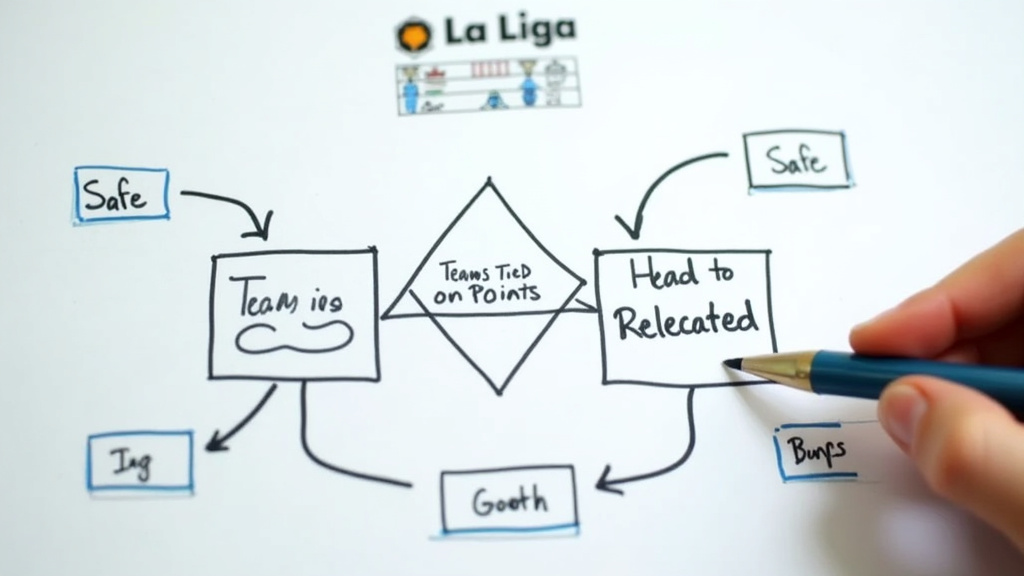
Forget everything you know about goal difference deciding fates. La Liga’s tie-breaking rules are a different beast. When two or more teams finish the season level on points, the league consults the results from the matches played specifically between those tied clubs.
Here is the official sequence:
- Points in head-to-head matches.
- Goal difference in head-to-head matches.
- Goals scored in head-to-head matches.
- If still tied, apply points 1-3 again, but only among the still-tied clubs.
- Overall goal difference in all league matches.
- Overall goals scored in all league matches.
This means a 1-0 win against a rival you’re tied with is infinitely more valuable than a 5-0 win against a team already safe in mid-table. The rule manufactures drama. On the final day, fans aren’t just watching their own match, they’re conducting frantic mental arithmetic on the “mini-league” involving three or four other clubs.
Common mistake: Assuming a superior overall goal difference will save you, it only matters if every head-to-head metric is perfectly equal, a rarity that often leaves teams confused and furious.
The system’s complexity shines in a multi-team scramble. Imagine Levante, Mallorca, and Elche all finish on 41 points. The league doesn’t look at their full season records first. It creates a mini-table using only the Levante-Mallorca, Mallorca-Elche, and Elche-Levante matches. The team with the most points in that specific three-way series stays up. If two remain tied, it reverts to their direct head-to-head result.
I’ve seen this play out. A few seasons back, a team thought they were safe because their opponent needed a four-goal swing on the final day. They lost 1-0 but their rival’s result in a different fixture created a three-way tie. Their head-to-head record against one of those other clubs was worse. They went down on a day they didn’t even play. The stadium was silent for ten minutes after the announcement.
| Tie-Breaker Scenario | First Criterion | Why It Matters |
|---|---|---|
| Two teams tied on points | Head-to-head points between the two | Makes the two league matches between them a knockout tie. |
| Three or more teams tied | Mini-league points among all tied teams | A win against one rival can outweigh losses to two others. |
| All head-to-head metrics equal | Overall goal difference | The classic tie-breaker, but rarely reached. |
The Segunda División Promotion Path
Escape from the second division is a brutal marathon with a sprint finish. The Segunda División, a 22-team league, offers three tickets to La Liga. The path for those tickets is clearly defined and heavily contested.
The top two teams at the end of the 42-match season earn automatic promotion. No playoffs, no caveats. This rewards consistency and often creates a fierce two-horse race at the summit, separate from the playoff chaos below.
The final promotion spot is decided by a six-team knockout playoff. Teams finishing in 3rd, 4th, 5th, and 6th place enter this tournament. The format is designed to reward higher league placement:
- 3rd place vs 6th place and 4th place vs 5th place in two-legged semi-finals.
- The two semi-final winners meet in a two-legged final.
- The winner of that final is promoted.
The advantage for finishing 3rd is massive. They play the 6th-placed team, theoretically the weakest playoff qualifier, and host the decisive second leg at home in both the semi-final and final. That’s a huge psychological and logistical edge. Finishing 4th or 5th means a harder route and always playing the second leg of the final away from home.
I prefer this playoff format over a single-match final at a neutral venue. The two-legged ties test a team’s tactical adaptability over 180 minutes. The away goals rule used to add another layer, but even without it, the structure feels more authentic than a coin-flip final.
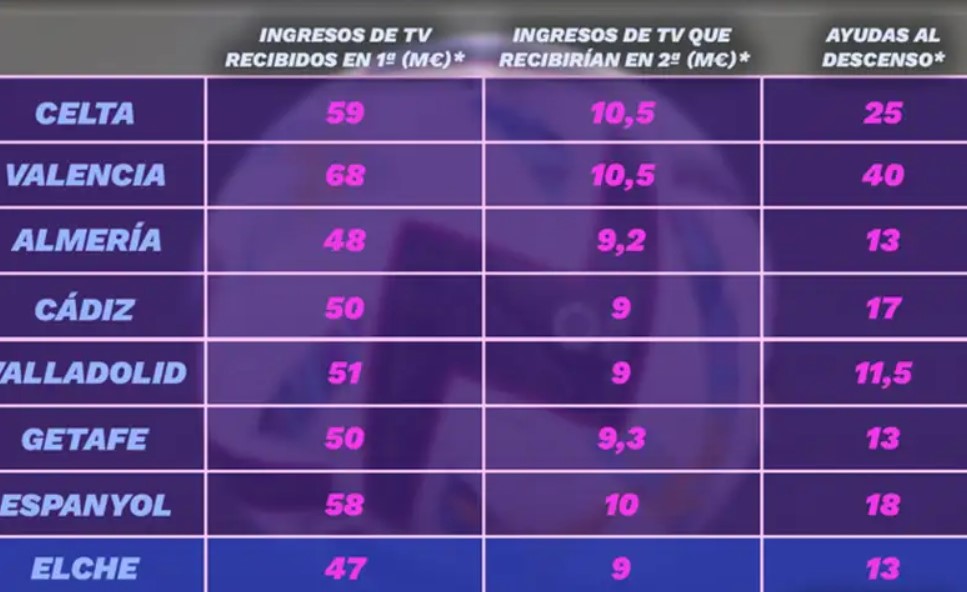
The playoff is a unique pressure cooker. A team that finished 15 points behind the automatic promotion spots can, over two weeks, leapfrog them. It keeps the season alive for almost half the league until the very end. The financial incentive is astronomical, promotion to La Liga guarantees television revenue exceeding €50 million, a sum that transforms a Segunda División club’s future.
Financial Regulations: The Invisible Barrier
Promotion isn’t just a sporting achievement; it’s a financial audit. La Liga operates one of Europe’s strictest financial control systems, akin to Financial Fair Play. The moment a club secures promotion, it must submit a detailed budget to La Liga for approval.
These regulations, outlined in La Liga’s own governance documents, set a squad cost limit for each club. This limit is calculated based on the club’s revenues, equity, and debts. For a newly promoted team, this often means their allowed spending on player wages and transfers is a fraction of that of established top-flight clubs.
The consequences of relegation are severe because of this system. A relegated club’s revenue plummets, but its squad cost limit for the Segunda División is based on its new, lower income. This frequently forces a fire sale of players to avoid sanctions, which can include points deductions.
Clubs promoted from non-professional categories to the Segunda División face specific budgetary preparation standards and deadlines, per La Liga’s official regulations. This ensures they have the financial infrastructure to compete professionally.
This creates a brutal cycle. A team must invest to compete in La Liga, but its spending is capped by its historically smaller revenue. It’s a tightrope walk. Some clubs, like Eibar for years, mastered it with shrewd signings and a clear identity. Others overshoot, breach their limit, and face punitive measures that hamper their survival bid before a ball is kicked. Understanding this global soccer league structures helps contextualize why Spain’s model is both admired and feared.
La Liga vs Other Top European Leagues
The Spanish system has distinct flavors compared to its rivals. While the principle of promotion and relegation is nearly universal in Europe, the mechanisms differ.
The most direct comparison is with the English Premier League promotion system, which also promotes three teams. The key difference is the tie-breaker: the Premier League uses overall goal difference as the first criterion, not head-to-head. This changes tactical approaches on the final day completely. A team needing a result in England might chase goals relentlessly. In Spain, they might prioritize a narrow win or even a specific scoreline from an earlier fixture.
Germany’s Bundesliga promotion playoff involves only one direct promotion/relegation playoff match between the 16th-placed Bundesliga team and the 3rd-placed 2. Bundesliga team. It’s a higher-stakes, one-off showdown compared to Spain’s six-team tournament.
Italy’s Serie A season format is similar to La Liga’s in promoting three teams, but its tie-breaking rules also prioritize head-to-head records, creating a similar final-day dynamic. France’s Ligue 1 competition format is slightly different, often promoting two teams automatically and using a playoff for the third spot, but with variations.
This patchwork of rules across the continent, from Italy’s Serie A league to the English soccer pyramid, is what makes following European football so rich. The same core idea, sporting merit deciding placement, is expressed through different competitive dialects.
The Drama and Unpredictability of Final Day

The combination of a three-team drop zone and the head-to-head tie-breaker makes the final month of a La Liga season uniquely tense. It’s rarely a simple case of one team being adrift. More often, a pack of five or six clubs are separated by a handful of points.
Because the head-to-head rule prioritizes specific match-ups, the fixture list becomes a character in the drama. A team might have a “good” run-in against top sides, which is less dangerous than facing direct relegation rivals. Losing to Barcelona is expected; losing to the team one point below you is catastrophic.
The 2025-26 season saw five teams. Mallorca, Girona, Elche, Osasuna, and Levante, enter the final matchday separated by just three points. The permutations involving mini-leagues and head-to-head records were dizzying, a classic example of the system at its most dramatic.
Fans and players must become amateur statisticians. Calculators are out. The stadium screens flash other scores, and the crowd’s roar changes not just for goals, but for the specific timing of goals elsewhere that alter the mini-league math. This systemic unpredictability is a feature, not a bug. It guarantees that every match matters, maximizing television interest and keeping stadiums full until the very end.
The system is brutal, logical, and deeply compelling. It protects the sanctity of the league as a true competition where every position is earned. There are no safety nets.
Frequently Asked Questions
How many teams get relegated from La Liga each year?
Three teams are relegated from La Liga each season. These are the clubs that finish in 18th, 19th, and 20th place in the 20-team table after 38 matches.
Does goal difference matter in La Liga relegation?
Overall goal difference is only used as a tie-breaker after head-to-head criteria are exhausted. If two or more teams are tied on points, their results against each other (points, then goal difference in those games) are compared first. This makes matches against direct rivals disproportionately important.
What is the ‘mini-league’ tie-breaker?
When three or more teams are tied on points, La Liga creates a separate mini-table using only the matches played between those specific clubs. The team with the most points in this mini-league ranks highest. This can mean a team with a worse overall record stays up because they performed better in the crucial head-to-head fixtures.
How does promotion from Segunda División work?
The top two teams in the 22-team Segunda División earn automatic promotion to La Liga. Teams finishing 3rd, 4th, 5th, and 6th enter a two-round playoff. The 3rd-placed team plays the 6th-placed team, and 4th plays 5th in two-legged semi-finals. The winners meet in a two-legged final, with the victor claiming the third and final promotion spot.
Do promoted teams get financial help?
No. Promoted teams do not receive parachute payments or special subsidies. Instead, they must immediately adhere to La Liga’s strict financial control regulations, which set a squad spending limit based on the club’s audited revenues. This often forces careful budgeting and can make the first season back in the top flight a significant challenge.
The Bottom Line
The La Liga relegation and promotion system is a masterclass in sustained tension. By sending three teams down and using head-to-head results as the primary tie-breaker, it ensures the battle for survival is a tactical, multi-dimensional puzzle. The reward for escaping the Segunda División is immense, but so is the financial and sporting gauntlet that awaits.
It’s a system that respects the purity of the league table while understanding that drama is built on specificity, not just how many points you have, but exactly where you took them from. That’s what makes the final whistle in May more than an ending; it’s the solution to a season-long equation.

I come from the “soccer heart” of Germany, the Ruhrpott. I have played, trained and followed soccer all my life and am a big fan of FC Schalke 04. I also enjoy following international soccer extensively.