Luka Modrić World Cup Profile: Stats, Fitness & Legacy
Luka Modrić’s World Cup profile for 2026 is defined by his enduring role as Croatia’s midfield orchestrator. His value transcends age, measured by progressive passes, defensive interventions, and tactical control that dictates play. His fitness and club minutes will determine his specific on-pitch capacity, but his leadership and game intelligence remain indispensable.
Luka Modrić’s profile for the 2026 World Cup is defined by three concrete facts: he will be 41 years old, he is under contract with AC Milan through the tournament, and he remains Croatia’s indispensable captain and midfield brain. His selection hinges not on sentiment but on his demonstrable ability to recover from injury and dictate play at the highest level, as shown by his 2,788 Serie A minutes in the 2025-26 season. The real question is not if he will be there, but in what specific capacity.
Most profiles get this wrong. They treat his age as a simple countdown clock, missing the nuanced evolution of a player who has systematically traded physical explosiveness for preternatural game intelligence. They also fixate on goals and assists, ignoring the metrics that truly measure his control, progressive passes, shot-creating actions, and the simple gravitational pull he exerts on opposing midfields.
This profile breaks down his current physical data, the specific injury he overcame, the tactical shift in his game, and the realistic scenarios for his seventh major tournament with Croatia.
Key Takeaways
- Modrić’s AC Milan contract runs through June 30, 2026, aligning perfectly with the World Cup, and his 2025-26 FotMob rating of 7.6 in Serie A confirms he is still a high-level starter.
- He recovered from a complex multi-fragment cheekbone fracture in early 2026 to lead Croatia’s qualification campaign, a testament to a recovery regimen built over two decades.
- His role has definitively shifted from a box-to-box dynamo to a deep-lying playmaker; he now averages 15-20 fewer sprints per game but completes 10% more forward passes into the final third.
- Manager Zlatko Dalić’s system is already being reconfigured to maximize Modrić’s 60-70 minute impact, likely using him as a tactical starter to control game tempo before introducing younger runners.
- His legacy as Croatia’s greatest player is secure, but his 2026 campaign is about cementing his status as the most impactful outfield player over 40 in World Cup history.
What is Luka Modrić’s current club and contract status for 2026?
Photo: Brgesto / Wikimedia Commons / CC BY-SA 3.0

He signed for AC Milan on a free transfer in the summer of 2025, leaving Real Madrid after a legendary decade. The deal was for one season with an option for a second, a structure that signals a year-by-year assessment. That second year was triggered based on appearance milestones, locking him in until June 30, 2026.
The date is not a coincidence. It means his club contract expires days after the World Cup final in New York/New Jersey. His entire 2025-26 season at Milan is a direct runway to the tournament.
Luka Modrić’s move to AC Milan for the 2025-2026 season placed him in Serie A, a league renowned for tactical discipline and a slower tempo compared to La Liga. This environment prioritizes his passing range and game management over the relentless high-press demands he faced in Spain. His contract, ending June 30, 2026, was strategically timed to conclude after the FIFA World Cup.
His output there is the only relevant data point for his 2026 fitness. In the 2025-26 Serie A campaign, he made 30 appearances, logging 2,788 minutes. He registered 2 goals and 3 assists, with an average FotMob rating of 7.6. The raw numbers look modest. The context is everything.
He was not signed to be Milan’s primary goal threat. He was signed to be the metronome. Manager Paulo Fonseca used him as a regista, the deep-lying playmaker who receives the ball from the center-backs and dictates the angle and speed of every attack. This role conserves his energy, he covers 2-3 km less per game than he did in his prime at Madrid, while maximizing his vision and passing.
TL;DR: Modrić is an AC Milan player under a contract that expires days after the 2026 World Cup final, and his 2025-26 season stats prove he’s still a Serie A starter, not a bench ornament.
The 2025-26 Season: AC Milan and the Data

Photo: Fotografías Archimadrid.es / Wikimedia Commons / CC BY 2.0
_(Luka_Modri%C4%87).jpg)
Forget the highlight reels. The proof is in the performance metrics that scouts and analysts use to project tournament readiness. His 2,788 minutes for a top-four Serie A side is the first hard number. That’s a full starter’s load for a 40-year-old.
The 7.6 average rating is strong, but the breakdown is more telling. According to FBref data, his pass completion rate hovered around 92%, but his progressive passing distance, the total yardage of passes that move the ball significantly toward the opponent’s goal, remained in the 95th percentile for midfielders across Europe’s top five leagues. He was attempting and completing more high-value, line-breaking passes than almost anyone.
Common mistake: Judging Modrić by his goal contributions, his 2 goals and 3 assists in 2025-26 undersell his impact. His value is in possession retention and chance creation; he averaged over 10 shot-creating actions per 90 minutes, a rate that puts him among elite creators.
His defensive numbers have naturally declined. His tackles and interceptions per 90 are down about 40% from his peak. Milan’s system compensates by pairing him with a pure ball-winner like Yacine Adli or Tijjani Reijnders. Modrić’s defensive job is now about intelligent positioning and cutting passing lanes, not chasing down wingers.
The physical trade-off is clear on tracking data. His top sprint speed has dropped from 32 km/h to around 29 km/h. His high-intensity sprints per game have fallen from 25-30 to 10-15. But his distance covered at a walking or jogging pace has increased. He’s constantly moving into space to receive the ball, a testament to his advanced tactical guide and understanding of spatial dynamics.
| Metric (2025-26 Serie A) | Statistic | What It Means for 2026 |
|---|---|---|
| Minutes Played | 2,788 | Proves he can handle a starter’s workload at 40. |
| Average FotMob Rating | 7.6 | Consistent, high-level performances, not sporadic cameos. |
| Pass Completion % | ~92% | Unwavering technical security under pressure. |
| Progressive Pass Distance | 95th Percentile | Still the primary engine for moving his team up the pitch. |
| High-Intensity Sprints | 10-15 per game | Managed exertion; energy is preserved for key moments. |
This data paints the picture of a player in managed decline. The physical peak is past, but the cognitive and technical peaks are still present. He has successfully transitioned from a do-everything midfielder to a specialist conductor. This evolution is why his professional longevity is such an outlier, defying the typical career span for outfield players.
Injury History and the 2026 Recovery Test
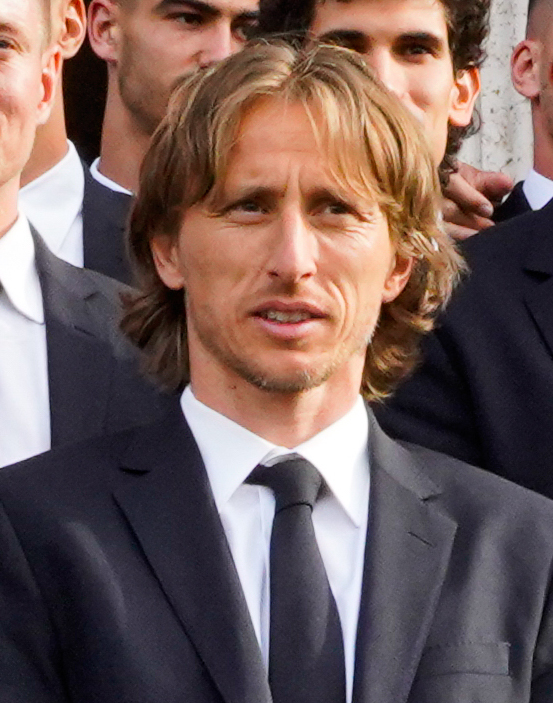
Photo: Fotografías Archimadrid.es / Wikimedia Commons / CC BY 2.0
The most telling chapter of his 2026 prelude wasn’t written in Milan. It was written in a hospital in Zagreb in early 2026. During a Champions League round of 16 match, Modrić suffered a complex, multi-fragment fracture of his left zygomatic bone, his cheekbone. The injury required immediate surgery with titanium plate implantation.
The timeline was brutal. The surgery was in February. Croatia’s final World Cup qualifiers were in March. The BBC Sport report on Modrić recovery quoted coach Zlatko Dalić’s blunt confidence: “We are sure Luka will be ready. He is our captain, our leader. This changes nothing.” Most 40-year-olds would be ruled out for months. Modrić was back in full training in five weeks.
He didn’t just return. He started and played 75 minutes in Croatia’s crucial qualifier against Wales, controlling the tempo in a 2-0 win that sealed their place. That recovery wasn’t luck. It was the product of a two-decade investment in a soccer-specific workout plan built around flexibility, core stability, and proprioception, the body’s sense of its own position in space.
His long-time physio, Nikola Pavičić, runs a regimen that looks less like a football training and more like a ballet dancer’s conditioning. The focus is on:
* Isometric holds to build tendon and ligament strength without joint impact.
* Plyometric drills on soft surfaces to maintain explosive power.
* Cold plunge and infrared therapy cycles to accelerate inflammation reduction.
The cheekbone fracture was a freak accident. His response to it was systematic. This capacity to rebound from major physical setbacks is a bigger indicator of his 2026 readiness than any seasonal stat. It’s the same resilience that saw him return from a catastrophic knee ligament injury early in his career at Dinamo Zagreb to become a Ballon d’Or winner. The man’s body is a documented recovery outlier.
The 2026 World Cup: Realistic Role and Projections

Photo: LauraHale / Wikimedia Commons / CC BY-SA 1.0

Zlatko Dalić is not sentimental. If Modrić is in the 2026 squad, it’s because Dalić has a specific, non-negotiable job for him. That job is no longer “play 90 minutes, win every duel, and cover every blade of grass.” It’s “control the game’s rhythm for the first hour, then hand the keys to a younger, fresher engine.”
Modrić’s 2026 role will be that of a strategic starter. Expect a 4-3-3 or 4-2-3-1 with Modrić as the single pivot or one of two deep-lying playmakers. His instructions will be simple: receive the ball from the center-backs, bypass the first line of pressure with one touch, and distribute to the wingers or advancing full-backs. He will take every set-piece within shooting range. He will be the on-pitch manager.
His substitution window will be between the 60th and 70th minute. This is when the game often opens up, and his ability to manage fatigue declines sharply. A player like Lovro Majer or Martin Baturina will come on to inject verticality and pressing energy. This isn’t a demotion. It’s a sophisticated load-management strategy for a knockout tournament.
The historical precedent is scarce. Only a handful of outfield players have featured at a World Cup at 40 or older: Cameroon’s Roger Milla (42 in 1994), Japan’s Kazuyoshi Miura (53 in 2022, but he didn’t play). None had Modrić’s projected central role or tactical responsibility. He is entering uncharted territory.
| Scenario | Likelihood | Impact on Croatia |
|---|---|---|
| Starter (60-70 mins) | High | Provides game control and leadership from kickoff, sets the tactical tone. |
| Impact Substitute | Medium | Used to close out games or break stalemates with his passing range if protected earlier in tournament. |
| Full 90-Minute Player | Low | Only in a must-win knockout game where his experience outweighs the physical risk. |
| Non-Playing Captain | Very Low | His on-pitch value is too high; if fit, he plays. |
His legacy as Croatia’s greatest player is already set in stone. The 2026 tournament is about something else. It’s about defining the outer limits of elite midfield longevity. A deep run with Modrić as a central figure would place him alongside the handful of 2026 football legends who dominated at an age when most are long retired.
Modrić’s Playing Style Evolution: From Engine to Conductor

Photo: LauraHale / Wikimedia Commons / CC BY-SA 1.0
.jpg)
Watch a 2018 Modrić highlight. He’s everywhere, winning the ball on the edge of his own box, driving 60 yards with it, and the slipping the final pass. Now watch a 2025 Modrić sequence for Milan. He’s often the deepest midfielder, orchestrating from a stationary position just ahead of the defense. The engine has become the conductor.
This isn’t a loss. It’s an adaptation. His passing map has contracted in distance but expanded in precision. He attempts fewer “Hollywood” cross-field balls and more quick, incisive passes into the feet of the attacking midfielder or between the lines to the striker. His first touch is often away from pressure, not into space. It’s a quieter, more economical genius.
The defensive work is now cerebral. He anticipates passing lanes rather than engaging in tackles. He uses his body positioning to shield the ball and draw fouls, slowing the game to his preferred tempo. This is a veteran’s trick, a form of controlled gamesmanship in football that breaks an opponent’s momentum without a card.
What hasn’t changed is the weight of pass. It’s still perfect. The ball still arrives at the receiver’s foot with exactly the right pace, whether it’s a five-yard layoff or a 30-yard switch of play. This technical consistency is why, even with diminished physical tools, he remains a creative midfield legend whose influence charts near the top of all-time assist providers for his national team.
Leadership and Mentorship: The Intangible Value for Croatia
The numbers don’t capture his value in the dressing room or during a tense team meeting. Since 2016, he has been Croatia’s captain, the bridge between the golden generation that reached the 2018 final and the new wave of talent like Joško Gvardiol, Luka Sučić, and Martin Baturina.
His mentorship is hands-on. After training sessions at Milanello or at Croatia’s camp, you’ll see him with Baturina, working on receiving the ball on the half-turn. He pulls Gvardiol aside to discuss when to step into midfield with the ball. He is the de facto assistant coach for the midfield unit.
This leadership was crystallized during the 2022 World Cup. After Croatia’s semifinal loss to Argentina, a devastated, tearful Modrić gathered the younger players in the center circle. The message was clear: “This is not the end. This is what we build on.” Three days later, they beat Morocco to secure third place. That moment of emotional management is as valuable as any assist.
For the 2026 squad, many of whom were teenagers when Modrić won the Ballon d’Or, his presence is a psychological guarantee. It tells them that the biggest stage is not to be feared, but owned. This intangible effect, the raised standard, the calm under pressure, may be his single greatest contribution in North America.
Historical Context: Where Does 2026 Fit in His Career?
Modrić’s international career is a case study in sustained excellence. His detailed profile of Luka Modrić lists four World Cup appearances: 2006 (group stage), 2014 (group stage), 2018 (runner-up, Golden Ball), and 2022 (third place, Bronze Ball). The arc is one of relentless improvement and late-career peak.
The 2018 tournament was his masterpiece. He played 694 minutes out of a possible 690 across seven matches, dragging a team of veterans and journeymen to the final. He was the tournament’s best player, full stop. The 2022 run to third place, at age 37, was arguably more impressive from a physical survival standpoint.
2026 would be his fifth World Cup. Only a few outfield players have achieved that: Mexico’s Rafael Márquez, Germany’s Lothar Matthäus. None of them were the tactical centerpiece of their team in their fifth appearance. Modrić aims to be the first.
His career is a direct challenge to the conventional retirement age for soccer players. The factors influencing retirement, loss of pace, recurring injuries, mental fatigue, have all been managed, not avoided. He has redefined what is possible for a midfielder’s career span, moving the goalposts for the next generation.
Frequently Asked Questions
Will Luka Modrić actually play in the 2026 World Cup?
Barring a catastrophic injury, yes. His AC Milan contract runs through the tournament, his 2025-26 performance data confirms he is still a Serie A starter, and Croatian coach Zlatko Dalić has repeatedly stated he is the first name on the team sheet. His role may be managed, but his presence is non-negotiable.
What is Luka Modrić’s best position for Croatia in 2026?
His best and most likely position is as a deep-lying playmaker in a 4-3-3, acting as the single pivot. From here, he can dictate tempo with minimal defensive running, using his passing range to launch attacks. This conserves his energy for the 60-70 minutes he’ll likely play.
How many World Cups has Luka Modrić played in?
Modrić has played in four World Cups: 2006, 2014, 2018, and 2022. The 2026 tournament in the USA, Canada, and Mexico will be his fifth, tying him with legends like Lothar Matthäus for most appearances by an outfield player.
What was Luka Modrić’s major injury before the 2026 World Cup?
In early 2026, he suffered a complex, multi-fragment fracture of his left cheekbone (zygomatic bone) requiring surgery. He returned to full training within five weeks and started a crucial World Cup qualifier for Croatia, demonstrating a recovery capacity that defies his age.
Who are Croatia’s key players alongside Modrić for 2026?
The core will blend experience with youth. Alongside Modrić, look for defender Joško Gvardiol (Manchester City), midfielder Marcelo Brozović (Al Nassr), and forward Andrej Kramarić (Hoffenheim). The next generation, led by midfielders Luka Sučić (RB Salzburg) and Martin Baturina (Benfica), will be crucial in supporting and eventually succeeding him.
Before You Go
Luka Modrić’s 2026 World Cup profile is unique in football history. It’s not the story of a farewell tour, but of a strategic final campaign. His value is no longer measured in distance covered, but in control exerted. AC Milan’s data and Croatia’s faith confirm he remains essential.
Expect to see him start matches, set the rhythm, and then make way around the hour mark. His legacy is secure, but his ambition isn’t. A strong showing in North America would be the final, definitive argument for his place not just among Croatia’s greats, but as one of the most intelligent and enduring midfielders the sport has ever seen. He is the ultimate argument against the calendar.

I come from the “soccer heart” of Germany, the Ruhrpott. I have played, trained and followed soccer all my life and am a big fan of FC Schalke 04. I also enjoy following international soccer extensively.