MLS Soccer Season End Date: Full Schedule and Playoff Info
The 2026 Major League Soccer season ends with MLS Cup on Friday, December 18. The regular season concludes earlier, on Saturday, November 7, with Decision Day. This schedule is unique due to a seven-week break for the FIFA World Cup and marks the last December final before the league shifts to a summer-spring calendar.
Most fans asking “when does the soccer season end” get tripped up by the two-part answer. They find the regular season finale but miss the month-long playoff gauntlet that follows. Or they don’t see the massive World Cup-shaped hole in the middle of the schedule. The 2026 campaign isn’t just another season; it’s a logistical pivot point for the entire league.
This guide maps every critical date from kickoff to the trophy lift. You’ll get the playoff format, understand the impact of the World Cup break, and see exactly how MLS is changing its calendar forever.
Key Takeaways
- The 2026 MLS regular season ends on Saturday, November 7 (Decision Day). The entire season concludes with MLS Cup on Friday, December 18.
- A mandatory seven-week break for the 2026 FIFA World Cup runs from May 25 to July 16, splitting the season in two.
- This is the last season concluding in December. A new summer-spring calendar starts in 2027, moving the championship to May.
- Nine teams from each conference make the playoffs. The top seven get a bye to a Best-of-3 series; seeds 8 and 9 face a single-elimination Wild Card game.
- The team with the better regular-season record hosts every playoff round, including MLS Cup.
When Does the 2026 MLS Season Start and End? (Key Dates)
Forget a simple start-and-finish line. The 2026 Major League Soccer schedule is a three-act play with an intermission. Act one runs from the late-February kickoff until late May. The second act is the FIFA World Cup. Act three picks up in mid-July and races through to a December climax.
The league’s official 2026 MLS schedule announcement locks in the critical markers. You need to track these four dates above all others.
Opening Weekend (Late February 2026): The 31st MLS season begins its 34-match slate. Each of the 30 clubs plays 17 home and 17 away games.
World Cup Break (May 25 – July 16): All MLS competition stops for approximately seven weeks. This isn’t a suggestion; it’s a mandatory FIFA fixture window. The MLS season structure is literally built around this gap.
Decision Day (November 7): The regular season ends. Every match kicks off simultaneously to decide the final playoff standings and the Supporters’ Shield winner. This intensity is a hallmark of the modern Major League Soccer experience.
MLS Cup 2026 (December 18): The championship final. It will be the last MLS Cup played in December for the foreseeable future.
The 2026 MLS regular season comprises 34 matches per club, interrupted by a mandatory 52-day hiatus for the FIFA World Cup. Competition resumes on July 16-17 with dedicated rivalry matches before concluding the playoff-qualification phase on November 7.
The return from break on July 16-17 is clever scheduling. The league forces immediate engagement by programming rivalry matches like the Hudson River Derby or El Tráfico. There’s no warm-up period. The playoff race resumes at full intensity.
Why the 2026 Schedule Is a Historic Anomaly
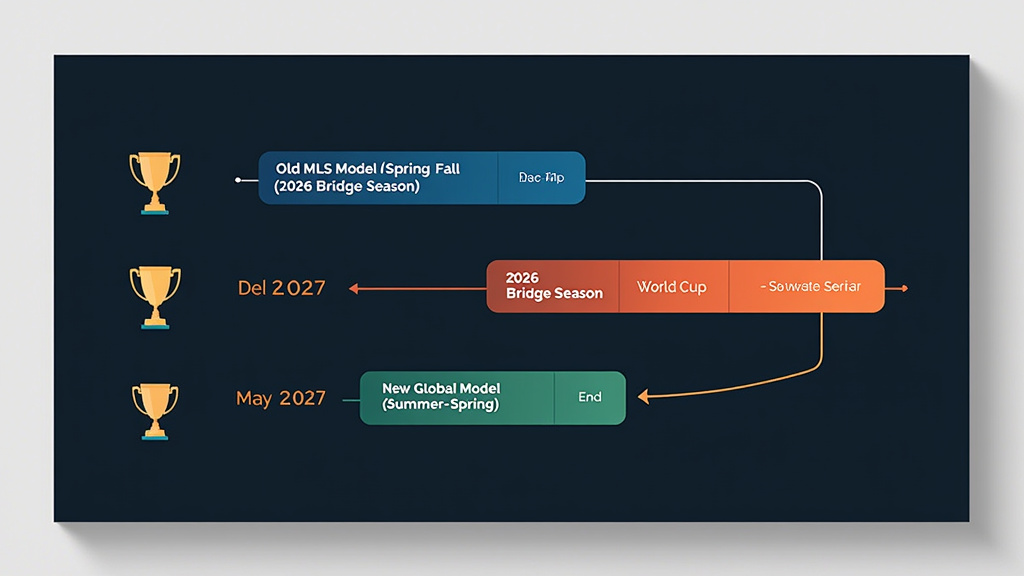
Two forces collide this year: a global tournament and a league reinventing its calendar. The World Cup break is the obvious disruption. Most top US league schedules don’t include a two-month pause. Player fitness arcs get broken. Tactical momentum vanishes.
The deeper shift is the calendar. MLS has always operated on a spring-to-fall schedule, clashing with the global summer transfer window and leaving a long offseason. Starting in 2027, it flips to a summer-spring format, aligning with Europe and most of the world.
2026 is the bridge. It’s the final season of the old model, stretched and modified to accommodate the World Cup. Think of it as a farewell tour for December finals. The subsequent 2027 “transition season” will be a shortened 14-game sprint from February to May, a weird hybrid to shift the cycle. By July 2027, the new normal begins: a regular season starting in mid-summer and ending with playoffs and MLS Cup in late May 2028.
This realignment has massive downstream effects. It changes when teams conduct preseason, how they integrate new signings from European leagues, and how they manage player fatigue across a winter break. For fans, it means the rhythm of the football year changes completely.
TL;DR: 2026 is weird because of the World Cup break. It’s also the last hurrah for the old calendar before MLS joins the global summer-spring schedule in 2027.
The 2026 MLS Playoff Roadmap to MLS Cup

Decision Day tells you who’s in. The MLS playoff format that follows is a brutal, month-long elimination tournament. The Audi 2026 MLS Cup Playoffs guidelines outline a format designed to maximize drama and reward regular-season success.
The bracket is conference-based. Nine teams from the East and nine from the West qualify. The stakes for finishing in the top seven are huge.
| Playoff Round | Format | Dates (2026) | Key Rule |
|---|---|---|---|
| Wild Card | Single-elimination match | Wednesday, Nov. 18 | #8 seed hosts #9 seed in each conference. Winner advances. |
| Round One | Best-of-3 series | Nov. 20 – Dec. 2 | Higher seed hosts Games 1 & 3 (if needed). No aggregate score. |
| Conference Semifinals | Single-elimination | Dec. 5 – Dec. 6 | Hosted by the higher-seeded team. |
| Conference Finals | Single-elimination | Dec. 11 – Dec. 12 | Hosted by the higher-seeded team. |
| MLS Cup | Single-elimination | Friday, Dec. 18 | Hosted by the finalist with the better regular-season record. |
The Best-of-3 series in Round One is a grind. It’s not about goal differential; it’s win or go home, twice. This format tests squad depth and a coach’s ability to adjust between games in a way a single match doesn’t. It heavily favors the higher seed, who gets two potential home games.
Home-field advantage is the ultimate prize. From the Wild Card game to MLS Cup, the team with the better regular-season record always hosts. This makes every point from February to November matter. A team fighting for 2nd place over 3rd isn’t just playing for pride—they’re playing for the right to host a potential conference final.
Common mistake: Assuming the playoffs start right after Decision Day. The league builds in a November FIFA international window, so the first playoff games aren’t until mid-November. Mark your calendar for November 18, not November 8.
This structure means a team could play as few as two playoff games (if they lose the Wild Card) or as many as seven (if they go to a third game in Round One and make the final). Managing that physical toll is a core part of a champion’s soccer tactics guide.
How the World Cup Break Changes Everything

The seven-week stop isn’t a vacation. It’s a complex logistical nightmare that resets the season. Coaches hate it. It fractures tactical continuity and forces two separate preseason-like training blocks within one campaign.
Players not going to the World Cup face a unique challenge. They get an extended mid-season break, but must stay fit without competitive matches. It’s easy to lose sharpness. Teams often arrange closed-door friendlies, but the intensity isn’t the same. Meanwhile, the league’s most valuable MLS players away on international duty are pushing their bodies to the limit in the world’s biggest tournament.
Then, everyone reconvenes in July. The team that was flying in May might be stale. The struggling team gets a massive reset button. The league attempts to manage this chaos by scheduling those headline rivalry matches immediately upon return. The idea is to guarantee high intensity from the first whistle back, but it’s a gamble.
From a fan’s perspective, the break is a drag. Momentum dies. Storylines go cold. You spend June and early July watching other leagues while yours is paused. The return feels like a new season starting, and it takes a couple of weeks for the narrative to regain its heat.
What Happens After 2026? The MLS Calendar Revolution
December 18, 2026, is the end of an era. The league has already announced its move to a summer-spring calendar, aligning with the global football calendar. This is the single biggest change to the Major League Soccer rhythm in its history.
The transition is awkward. 2027 will be a “transition season”: a truncated 14-game regular season from February to early May, followed by playoffs and an MLS Cup in late May. Then, the true new format begins in mid-to-late July 2027. That season will run until May 2028, incorporating a winter break from mid-December to early February.
Why do this? The benefits are long-term. Alignment with the global transfer windows (July-August and January) simplifies signing players. It reduces fixture congestion for MLS teams in the Concacaf Champions Cup, which runs in the spring. It also potentially improves the quality of play, avoiding the bitter cold of March and November playoff games in northern cities.
The downside is direct competition with the NFL and college football in the fall. MLS is betting that its solidified fanbase and unique summer schedule position can withstand that. It’s a calculated risk for greater global integration.
Frequently Asked Questions
Does the MLS season have promotion and relegation?
No. Major League Soccer is a closed league with no promotion or relegation. The 30 clubs are franchise-based. Competition is focused on playoff qualification and the Supporter’s Shield for the best regular-season record.
How many teams make the MLS playoffs?
For the 2026 season, 18 total teams qualify: the top nine from the Eastern Conference and the top nine from the Western Conference. The format includes Wild Card games and a Best-of-3 first round.
What is “Decision Day” in MLS?
Decision Day is the final, simultaneous matchday of the regular season. All games kick off at the same time to decide the final playoff seeding and qualifiers. In 2026, it falls on Saturday, November 7.
Will there be an MLS All-Star Game in 2026?
Yes. The 2026 MLS All-Star Game is scheduled for July 29, shortly after the league resumes from the World Cup break. The opponent and location are typically announced a year in advance.
Where can I find the full 2026 MLS schedule?
The full match-by-match schedule for the 2026 season will be released in late 2025. The key dates and structure are already confirmed on the league’s official website and the Wikipedia MLS Cup 2026 page.
The Bottom Line
Circle two dates: November 7 and December 18. The 2026 MLS season is a marathon with a two-month halftime break for the World Cup. Its playoff format rewards regular-season consistency with home-field advantage at every stage. This year is a historical pivot, serving as the final chapter of the old fall-finale model before the league aligns itself with the global football calendar. Understanding this schedule is the first step to following one of the most unique seasons in North American sports history.

I come from the “soccer heart” of Germany, the Ruhrpott. I have played, trained and followed soccer all my life and am a big fan of FC Schalke 04. I also enjoy following international soccer extensively.