What Does MLS Stand For in Soccer? The Full Explanation
MLS stands for Major League Soccer. It is the acronym for the top-tier professional men’s soccer league in the United States and Canada, founded in 1993 with its first season in 1996. The league operates under a unique single-entity structure and a closed competition format without promotion or relegation.
Most people stop at the acronym. They hear “MLS” and think it’s just another league name. The confusion starts when they try to apply European soccer logic to it and find nothing matches. The schedule is different. The champion is crowned differently. Even the way teams make money is built on a completely different rulebook.
This guide explains the letters, the history behind them, and the specific American sports model that makes MLS both familiar and utterly unique in the global soccer landscape.
Key Takeaways
- MLS is an acronym, not an initialism, you say the letters “M-L-S,” not the word “mils.”
- The “Major League” part intentionally aligns it with other U.S. leagues like the NFL and NBA, cementing its status as the premier division.
- Its core business model is a single-entity structure, where the league owns all player contracts and teams are investor-operated franchises.
- The competition is a closed league with no promotion or relegation, following the North American sports franchise model.
- The season runs from late February to early December, culminating in the MLS Cup playoffs to decide the champion, separate from the Supporters’ Shield for the best regular-season record.
What Does MLS Stand For? The Literal Answer
MLS is the acronym for Major League Soccer. You pronounce it by saying each letter: “M-L-S.” This is not an initialism like “FIFA” where you say a word. The “Major League” component is a direct lift from the American sports lexicon, placing it alongside Major League Baseball (MLB) and the National Football League (NFL, though it uses “National,” the concept is identical).
The league’s full name was chosen to signal ambition and top-tier status from its inception in 1993. The founders needed a brand that communicated “this is the big one” to a U.S. audience accustomed to franchise-based leagues. It worked. For the definitive overview of the league’s founding and evolution, the Wikipedia entry on Major League Soccer provides a detailed chronology.
Major League Soccer (MLS) is a professional men’s soccer league sanctioned by the United States Soccer Federation. The league comprises 29 teams, 26 in the U.S. and 3 in Canada. It operates as a single-entity structure where the league, not individual clubs, holds all player contracts.
This structure is the first major departure from the global soccer norm. In most of the world, clubs are independent businesses that contract players directly. In MLS, the league is the employer. This model was adopted for financial stability, allowing for centralized control over salaries and player movement to prevent the spending wars that contributed to the collapse of its predecessor, the North American Soccer League (NASL).
TL;DR: MLS means Major League Soccer, an acronym for a single-entity league designed from the ground up as a stable, franchise-based North American sports operation.
The “Major League” Designation and Its American Context
Calling it a “Major League” does more than just sound important. It legally and culturally positions MLS within the U.S. sports ecosystem. This term is understood by fans, broadcasters, and sponsors as denoting the highest level of professional competition in a given sport. When you say “Major League Soccer,” you are telling an American sports fan exactly where it sits on the pecking order.
This is why you won’t see a “Major League Soccer 2” with promotion to the top flight. The major league is the only league in that franchise model. The pyramid is flat. Teams enter through expansion fees, exceeding $500 million for recent additions, not sporting merit from a lower division. This closed system provides franchise owners with guaranteed top-flight status, a key element for securing stadium investments and long-term business planning.
The league’s structure, including its MLS season schedule, is built around this stability. A team knows it will play a set number of games against conference rivals every year, building local derbies and guaranteed broadcast inventory.
| U.S. “Major League” | Sport | Founded | Closed League? |
|---|---|---|---|
| Major League Soccer (MLS) | Soccer | 1993 | Yes |
| Major League Baseball (MLB) | Baseball | 1869 | Yes |
| National Basketball Association (NBA) | Basketball | 1946 | Yes |
| National Football League (NFL) | Football | 1920 | Yes |
The table shows the company MLS keeps. The closed-league model is the standard, not the exception. This context is critical for understanding why MLS doesn’t and likely won’t adopt promotion/relegation. The entire financial architecture is built against it.
TL;DR: “Major League” is an American sports term of art that guarantees franchise stability and commercial appeal, fundamentally shaping the league’s closed, no-relegation format.
MLS vs. Other Global Soccer Acronyms
The world of soccer is a alphabet soup of governing bodies and leagues. MLS fits into this list with a distinctly American flavor.
Where “EPL” stands for the English Premier League and “Bundesliga” is simply the German league’s name, “MLS” explicitly includes the “Major League” branding. Other top leagues are often named after their country or a descriptive term (Serie A, La Liga). MLS’s name is a direct statement of its intended stature within its own market, not a geographic identifier.
This leads to a common point of confusion: the acronym itself. According to the Cambridge Dictionary definition of MLS, it is officially listed as the abbreviation for Major League Soccer. In everyday use, it’s treated as an acronym. This is a small but telling detail about its integration into the language.
Common mistake: Assuming MLS operates under the same rules as the Premier League or La Liga, the single-entity model and salary budget rules create a completely different competitive environment where a deep-pocketed owner cannot simply spend their way to a title.
The difference is structural, not just semantic. A fan used to the global league structures of Europe will find MLS’s roster rules. Designated Players, General Allocation Money, Targeted Allocation Money, to be a unique and complex layer governing competition. These mechanisms are direct results of the single-entity system, designed to maintain competitive balance in a closed league.
TL;DR: Unlike geographic league names, MLS’s acronym broadcasts its commercial ambition. Its associated roster rules are a unique ecosystem born from its single-entity foundation.
How MLS Differs From European Soccer
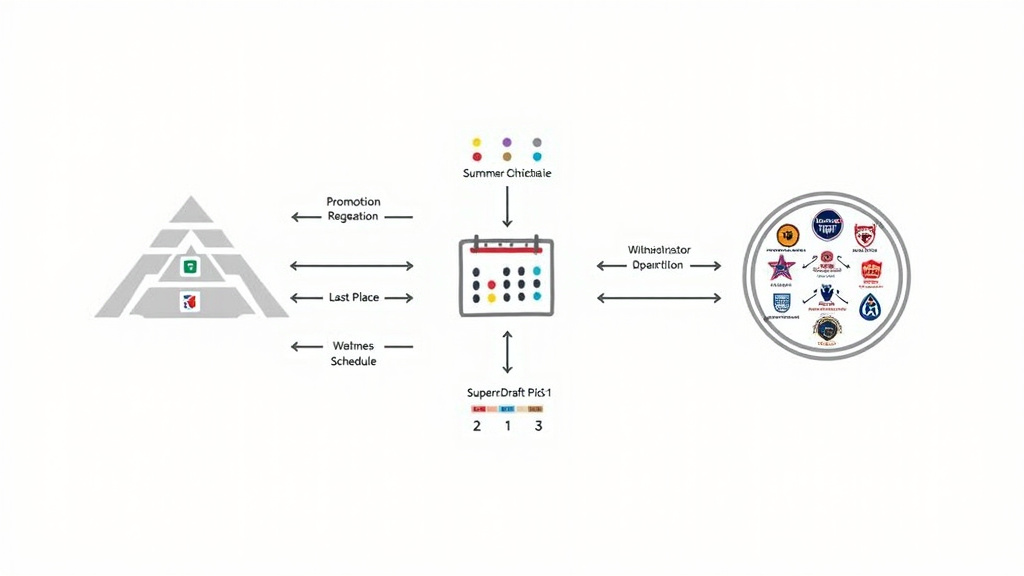
This is where casual observers get lost. The acronym is simple. The soccer it represents plays by a different book.
The most glaring difference is the absence of promotion and relegation. In England, the team that finishes last in the Premier League drops to the Championship. In MLS, the team that finishes last gets the first pick in the SuperDraft and tries again next year. This closed system is the bedrock of the North American franchise model, providing the financial predictability that attracted investors to build the MLS stadiums we see today.
The season structure is a hybrid. Like Europe, there’s a regular season where teams accumulate points for the Supporters’ Shield. Unlike Europe, that shield doesn’t make you the sole champion. The champion is decided through a postseason MLS Cup playoffs tournament, much like the NBA or NHL. This creates two parallel races: one for the best overall record, and one for the hot team that gets healthy and peaks in November.
I learned this difference the hard way talking to a friend from Dortmund. He asked me which Bundesliga team I followed, and I explained I followed the MLS competition format. He nodded. Then I mentioned the playoffs. He was confused. “So the team with the most points after 34 games might not be champion?” Exactly. That’s the American twist. It prioritizes dramatic, high-stakes knockout games for casual audiences, even if it sometimes feels unfair to purists.
The calendar is also inverted. The MLS season kicks off in late February or early March and runs through the MLS season end date in early December, with the playoffs concluding around then. It plays through the summer, avoiding direct competition with the NFL for television eyeballs in the fall. This summer schedule creates its own challenges with heat and humidity in cities like Houston and Orlando, factors rarely considered in a European autumn-to-spring campaign.
TL;DR: MLS is a closed league with a playoff championship and a summer schedule, built for the North American sports market and media landscape, not the European football calendar.
The Single-Entity Structure: MLS’s Secret Engine
If you remember one thing beyond the acronym, let it be this: MLS is a single-entity league. This isn’t just jargon; it’s the DNA that defines everything from MLS player salaries to why a star like Lionel Messi could only join one specific team.
In a single-entity structure, the league itself is the sole entity that holds all player contracts. Individual teams, like the Seattle Sounders or Atlanta United, are not independent clubs in the traditional sense. They are investor-operators, or franchises, of the league. You own a share in the league and the right to operate a team in a specific city.
This model was a direct response to the failure of the NASL. By centralizing control, MLS could enforce strict cost controls (a salary budget), manage player allocation, and ensure no single team could outspend others into bankruptcy. It turned soccer from a risky business into a manageable investment.
| Aspect | Traditional European Club | MLS Franchise (Single-Entity) |
|---|---|---|
| Player Contracts | Held by the independent club. | Held by the MLS league office. |
| Financial Risk | Borne solely by the club. Owners can spend freely. | Shared and controlled by the league. Strict salary budget. |
| Team Movement | Enter through promotion; can be relegated. | Enter through expansion fee; no relegation. |
| Player Acquisition | Transfers negotiated between clubs. | Governed by league allocation rules (Draft, Discovery, Allocation Order). |
The system has clear trade-offs. It provides stability and has prevented club failures. It also creates a complex web of roster rules that can frustrate fans. A team can’t just identify a transfer target and pay a fee. They must often use league-created mechanisms like General Allocation Money (GAM) to fit the player under the salary budget. The MLS single-entity model is a fascinating deep dive into these mechanisms.
The Designated Player Rule, the “Beckham Rule”, is the famous exception that proves the rule. It allows teams to sign up to three players whose salaries exceed the budget charge, letting marquee stars like Messi join. But even that signing required league approval and a deal that benefited the entire league’s profile. The league, as the single entity, always has the final say.
TL;DR: Single-entity means the league is the boss. It creates parity and stability through complex salary rules, fundamentally shaping how teams are built and how stars enter the league.
Common Points of Confusion for New Fans
The acronym is the gateway. The confusion waits inside. Here are the questions I hear most often after explaining what MLS stands for.
First, the champion question. The team with the most points after the regular season wins the Supporters’ Shield. This is a real trophy with history. But the league champion is the winner of the MLS Cup, the playoff final. This means a team can finish 5th in its conference, get hot, win the playoffs, and be crowned champion. It happens. It frustrates supporters of the Shield winner every time.
Second, the calendar clash. MLS is playing its playoffs when European leagues are in mid-season. This means the most valuable MLS players are unavailable for their national teams during FIFA windows in October and November, a constant tension for coaches of the U.S. and Canadian men’s teams.
Third, the “farm system” myth. MLS does not have minor league affiliates in the same way MLB does. Its player development pathway is primarily through the MLS Next academy system and MLS Next Pro, a reserve league. The college draft is still a source of talent, but its importance is diminishing compared to homegrown signings from academies.
I once spent an entire halftime explaining the allocation order to a new season ticket holder. He thought his team could just buy a player from Brazil. I had to draw the flowchart of Discovery Claims, Allocation Money, and International Roster Slots on a napkin. He looked at it, sighed, and said, “So it’s not just soccer.” It’s not. It’s MLS.
Finally, the constant comparison to Europe. Is MLS as good as the Premier League? No. The technical quality, depth of squads, and history aren’t there yet. But is it more competitive? Arguably, yes. The salary budget rules create parity. The MLS vs Premier League format difference means last year’s champion can be this year’s cellar-dweller. That unpredictability is a feature, not a bug.
TL;DR: New fans must grasp the playoff champion vs. Shield winner distinction, the awkward calendar, a unique development path, and a parity-driven competitiveness that differs from European soccer hierarchies.
Frequently Asked Questions
Is MLS only in the United States?
No. While most teams are based in the United States, Major League Soccer also includes three Canadian clubs: Toronto FC, CF Montréal, and the Vancouver Whitecaps FC. The league is sanctioned by both U.S. Soccer and the Canadian Soccer Association.
Why is there no promotion or relegation in MLS?
The league was founded as a single-entity, franchise-based league to ensure financial stability. Team owners invest hundreds of millions in expansion fees and stadiums with the guarantee of top-flight status. Introducing promotion/relegation would undermine this business model and is not currently under consideration.
What is the difference between the Supporters’ Shield and the MLS Cup?
The Supporters’ Shield is awarded to the team with the best regular-season record (most points). The MLS Cup is awarded to the winner of the postseason playoff tournament. They are separate honors, though winning both, the “double”, is a rare and prestigious achievement.
How many teams are in MLS?
For the 2025 season, MLS has 29 teams: 26 in the United States and 3 in Canada. The league is divided into an Eastern Conference (15 teams) and a Western Conference (14 teams). Further expansion to 30 teams is planned.
Does MLS have a salary cap?
Yes, but it’s a complex system. MLS uses a salary budget, often called a salary cap, but with many exceptions. The most notable is the Designated Player Rule, which allows teams to sign up to three players whose salaries exceed the maximum budget charge.
Who is the commissioner of MLS?
Don Garber has been the Commissioner of Major League Soccer since 1999. He has overseen the league’s massive expansion from 10 teams, the introduction of soccer-specific stadiums, and landmark media rights deals.
Before You Go
MLS stands for Major League Soccer, but it represents a specific idea: top-flight professional soccer built for the American market. Its single-entity structure and closed league format are non-negotiable foundations, not accidents. These choices created the stability that allowed the league to survive its rocky early years and grow into a 29-team operation with passionate local followings.
The league will always be compared to Europe, but that’s the wrong benchmark. Judge it on its own terms, its growing academy output, its increasing average salaries, and its ability to create dramatic, unpredictable competition from February to December. Understanding the acronym is step one. Accepting the unique system behind it is what turns a casual observer into a real fan.

I come from the “soccer heart” of Germany, the Ruhrpott. I have played, trained and followed soccer all my life and am a big fan of FC Schalke 04. I also enjoy following international soccer extensively.