Your Guide to World Cup Tiebreaker Rules and FIFA Rankings
World Cup 2026 tiebreaker rules are a sequential six-step process applied when two or more teams finish group play with equal points. The first criteria are head-to-head results between the tied teams (points, then goal difference, then goals scored). If those don’t separate them, overall group goal difference, then goals scored, then Fair Play points, and finally the FIFA World Ranking are used. The drawing of lots has been removed for 2026.
Most people think overall goal difference is the first decider. It’s not. That misconception has fans celebrating early goals in a final group match that might not matter if their team lost the head-to-head battle weeks prior. The real drama starts with the mini-league between the tied sides.
This guide walks through the official FIFA rules for the expanded 48-team tournament. You’ll see exactly how head-to-head gets reapplied for three-way ties, why a yellow card could send a team home, and how the eight best third-place teams are secretly ranked in their own parallel competition.
Key Takeaways
- Head-to-head results trump overall goal difference every time. Win your direct matches.
- For ties involving three or more teams, FIFA re-applies the head-to-head criteria to the still-tied subset after the first check.
- Fair Play points are real and decisive. Japan advanced over Senegal in 2018 because they had fewer yellow cards.
- The final tiebreaker is now the FIFA World Ranking, not drawing of lots. This is a new rule for 2026.
- The eight best third-place teams are ranked using a separate, slightly different five-step criteria list.
The 2026 Tournament Format: Why Tiebreakers Matter More
The 2026 World Cup is bigger. Forty-eight teams split into twelve groups of four. Each team still plays three matches. The top two from each group advance automatically. That’s 24 teams. The new twist is the Round of 32. To fill those extra eight slots, the eight best third-placed teams from across all twelve groups also qualify.
This makes the math intense. More groups mean more potential for identical records. The fight for third place, previously about pride, now has a tangible prize. Understanding the tiebreaker sequence isn’t just for first place; it’s the rulebook for that last-chance playoff spot. A team’s entire tournament tactics in the final group match could hinge on whether they need a draw to win the head-to-head or a big win to boost overall goal difference.
The tiebreaker rules for the 2026 FIFA World Cup are applied in a strict sequence. If two or more teams are level on points, the first criterion is points obtained in the matches between those teams. If still tied, goal difference in those matches is used, followed by goals scored in those matches. Only if all head-to-head criteria are exhausted does the system move to overall group goal difference.
TL;DR: The 48-team format creates more tie scenarios. The rules decide not just who wins the group, but which third-place teams get a second life.
The 6-Step Tiebreaker Sequence
Photo: Hossein Zohrevand / Wikimedia Commons / CC BY 4.0
The process is a ladder. You only move to the next rung if the current one doesn’t produce a clear ranking. The official FIFA regulations leave no room for choice.

Step 1-3: The Head-to-Head Mini-League
This is the most misunderstood part. FIFA isolates the tied teams and creates a separate table just from their matches against each other.
- Points in head-to-head matches. Did Team A beat Team B? Those three points count here, even if Team A lost its other match.
- Goal difference in head-to-head matches. Only goals scored and conceded in the games between the tied teams matter.
- Goals scored in head-to-head matches. If goal difference is level, who scored more in those specific games?
Common mistake: Celebrating a big win in your final match to boost overall goal difference — if you lost the head-to-head to the team you’re tied with, your big win is irrelevant until step four.
The head-to-head focus rewards teams that perform in the direct clashes. It turns every group match into a potential tiebreaker. A pragmatic 1-0 win against a direct rival is often more valuable than a 4-0 win against the group’s weakest side, because those three points are locked in for this first and most important check.
What Happens With Three or More Tied Teams?
This is where it gets chess-like. The system first applies the head-to-head criteria (points, GD, goals) to all tied teams. If that doesn’t rank them all, it takes the subset of teams that are still tied and reapplies the same head-to-head criteria only to them.
Imagine Teams X, Y, and Z are tied on points. X beat Y, Y beat Z, and Z beat X. They all have 3 points in the head-to-head mini-league. Goal difference between them is also 0. They remain tied. The system then moves to Step 4 for all three. It does not eliminate anyone after the first head-to-head pass.
Step 4 & 5: Overall Group Performance
If the head-to-head battle ends in a stalemate, the net widens.
- Overall goal difference in all group matches. This is the classic metric. Every goal for and against in all three games counts.
- Overall goals scored in all group matches. If goal difference is identical, the more prolific team advances.
This is where those big wins finally matter. A team that parked the bus for two 0-0 draws but won its head-to-head match 1-0 could be overtaken here by a team that played expansive, attacking soccer and racked up a +5 goal difference. It shifts the team strategy calculus for managers.
Step 6: Fair Play Points (The Conduct Score)
Discipline is quantified. It’s not a vague concept; it’s a strict points system where you want a higher score (fewer deductions).
| Offense | Point Deduction |
|---|---|
| Yellow card | -1 |
| Indirect red card (second yellow) | -3 |
| Direct red card | -4 |
| Yellow card followed by a direct red card | -5 |
The team with the higher (less negative) conduct score ranks higher. This is not a tiebreaker of last resort. In the 2018 World Cup, Japan and Senegal finished with identical points, head-to-head points (they drew), goal difference, and goals scored. Japan advanced because they had -4 Fair Play points to Senegal’s -6. Two yellow cards made the difference.
This rule turns every cynical, tactical foul into a potential tournament-ender. It directly impacts the physical nature of soccer and decisions around breaking momentum.
The Final Step: FIFA World Ranking
For the 2026 World Cup, the drawing of lots is gone. The final tiebreaker is the most recently published FIFA/Coca-Cola Men’s World Ranking before the tournament. The higher-ranked team advances.
This is a significant change. It replaces the pure luck of a draw with a merit-based, if pre-existing, metric. It also makes pre-tournament friendlies and ranking points more consequential. In the extremely unlikely event that tied teams have the exact same ranking points, FIFA will use the next most recent ranking, and so on.
| Tiebreaker Step | Criteria | Scope |
|---|---|---|
| 1. Head-to-Head Points | Points earned in matches between tied teams | Only tied teams |
| 2. Head-to-Head Goal Difference | GD from matches between tied teams | Only tied teams |
| 3. Head-to-Head Goals Scored | Goals scored in matches between tied teams | Only tied teams |
| 4. Overall Goal Difference | GD from all three group matches | All group matches |
| 5. Overall Goals Scored | Goals scored in all three group matches | All group matches |
| 6. Fair Play Points | Team conduct score (fewer deductions = higher) | Entire group stage |
| 7. FIFA World Ranking | Most recent FIFA ranking before tournament | Global ranking |
TL;DR: The sequence is absolute: head-to-head, then overall stats, then discipline, then ranking. Skipping a step is not an option.
How the Eight Best Third-Place Teams Are Ranked
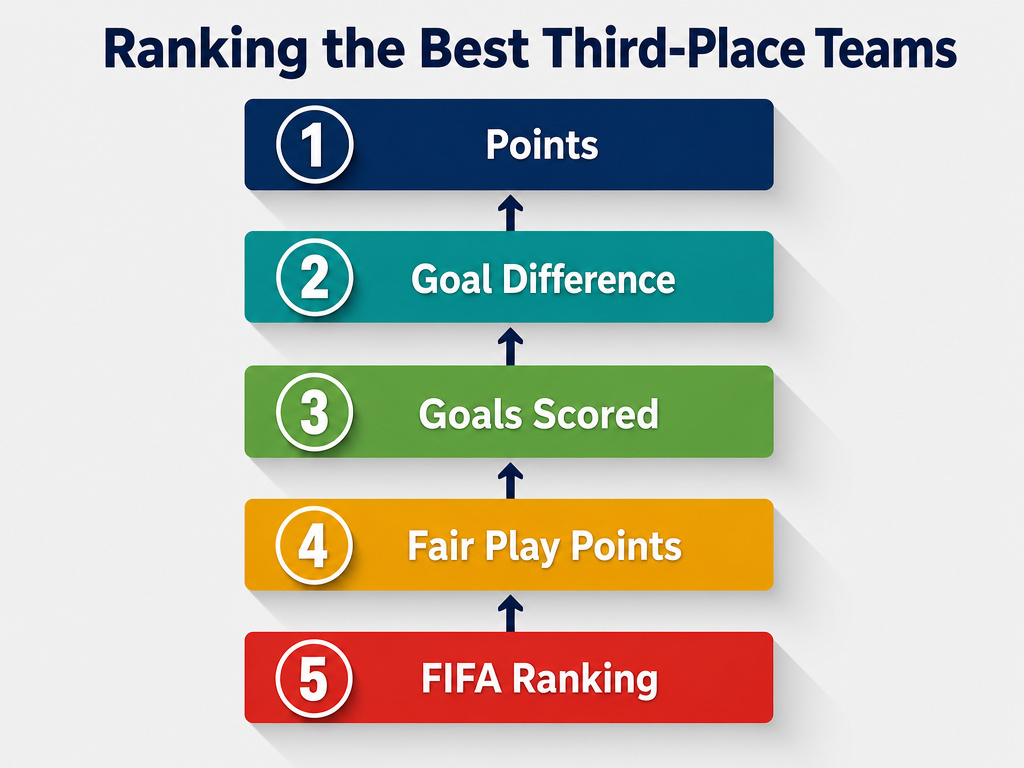
This is a separate, parallel competition. After the top two from each group are decided, the remaining third-place teams are lined up. They are not compared to the top teams in their groups, only to each other. FIFA uses a similar, but shorter, five-step list to rank them from 1 to 12.
- Points obtained in the group stage.
- Overall goal difference in the group stage.
- Overall goals scored in the group stage.
- Team conduct score (Fair Play points).
- FIFA World Ranking.
Notice the absence of head-to-head criteria. This makes sense because these third-place teams never played each other. Their ranking is purely statistical and disciplinary. This system incentivizes third-place teams to fight for every point and goal until the final whistle, as a 0-0 draw with 2 points might not be enough, while a 3-2 loss with 1 point could see them through on goals scored.
The battle for these spots will create some of the most nerve-wracking final matchdays, with teams calculating not just their own result, but the scores in other groups. It demands a global view of the tournament tactics at play.
Historical Precedent and the 2026 Changes
The 2018 Japan-Senegal example is the textbook case for Fair Play. It proved the rule has teeth. Teams now train with this in mind. Coaches drill into players that a needless yellow in match one could be the reason they fly home after match three.
The switch from drawing of lots to the FIFA World Ranking is the key update for 2026. While a drawing of lots decided group placement in the 1990 World Cup (Ireland and the Netherlands), FIFA has moved toward a more deterministic system. The ranking tiebreaker, while not perfect, is based on years of competitive results. It also adds a layer of pre-tournament strategy, where federations might schedule friendlies to protect or improve their ranking ahead of the finals.
These rules shape how the game is played. The emphasis on head-to-head makes every group match a potential cup final. The Fair Play rule penalizes reckless tactical fouls. The expansion means more teams will be playing under this precise mathematical microscope than ever before. Understanding it is the first step to appreciating the high-stakes drama of the group stage.
Frequently Asked Questions
What is the first tiebreaker if teams have the same points?
The first tiebreaker is points earned in the matches between the tied teams. FIFA creates a mini-league table from just those games. Only if that doesn’t separate them do they look at goal difference from those specific matches.
Does overall goal difference come before head-to-head?
No. This is the most common mistake. Head-to-head results (points, then goal difference, then goals scored between the tied teams) are always checked first. Overall goal difference is the fourth step in the sequence.
How are third-place teams ranked for the Round of 32?
The eight best third-place teams are ranked using a separate five-step list: 1) Points, 2) Overall goal difference, 3) Overall goals scored, 4) Fair Play points, 5) FIFA World Ranking. Head-to-head is not used because these teams come from different groups.
What is the final tiebreaker for the 2026 World Cup?
The final tiebreaker is the FIFA/Coca-Cola Men’s World Ranking. The higher-ranked team advances. The drawing of lots, used in past tournaments, has been removed for the 2026 edition.
Can Fair Play points really decide who advances?
Absolutely. It decided the Group H runner-up in 2018, sending Japan through over Senegal. Every yellow card carries a -1 point deduction, and these points are the sixth step in the tiebreaker sequence, before the FIFA ranking.
The Bottom Line
Forget the old assumption that goal difference is king. In the 2026 World Cup, the direct duel is everything. Winning your head-to-head matches is the single most powerful thing you can do to control your destiny. After that, every goal for and every clean sheet matters, followed by the discipline to avoid costly cards.
The new format guarantees complexity. With more teams and a lifeline for third-place finishers, these rules will be invoked constantly. They transform the group stage from a simple points race into a layered strategic puzzle. Watch for the managers who understand this—they’ll be the ones whose teams survive on goal difference, advance on Fair Play, or sneak into the knockouts because they knew the rules better than anyone else.

I come from the “soccer heart” of Germany, the Ruhrpott. I have played, trained and followed soccer all my life and am a big fan of FC Schalke 04. I also enjoy following international soccer extensively.