Breaking Down World Cup Group D Qualification Possibilities
To understand World Cup 2026 Group D qualification scenarios, you must know three numbers: 2, 8, and 12. The top two teams in the group advance. Eight of the twelve third-placed teams from across the tournament also advance. This 48-team format turns every draw into a lifeline and every narrow loss into a potential disaster.
Most fans look at the group table and only see first and second place. They treat third place as a failure. That instinct is wrong now. In 2026, finishing third with four points is a ticket to the Round of 32. Finishing second with six points might land you a harder knockout match than the group winner gets.
This guide breaks down the exact paths for the USA, Türkiye, Australia, and Paraguay. We will map the fixtures, explain the brutal new tie-breakers, and show you which single result could send shockwaves through the entire knockout bracket.
Key Takeaways
- The USA vs. Türkiye match on June 25th is the group decider. The loser is likely battling for second or third, not first.
- Four points (one win, one draw) virtually guarantees a third-place team advances. Three points puts you on the bubble, where goal difference and fair play cards decide your fate.
- Head-to-head results only matter for breaking ties within Group D. Ranking the eight best third-placed teams across the tournament uses overall goal difference first.
- The Group D runner-up faces the Group G runner-up (likely Spain or Brazil). The Group D winner gets a theoretically easier match against a third-place qualifier.
- Australia and Paraguay’s direct clash on June 25th is a playoff for third place. A draw helps neither; a winner takes a massive step toward the last 32.
How the 2026 Qualification Rules Change Everything
The old 32-team World Cup punished third-place finishers. They went home. The new format offers a backdoor. With 12 groups, taking the eight best third-placed teams means 66% of them survive. This reshapes team psychology from the first whistle.
Before you start: The tie-breaking rules for third-place teams across different groups do NOT use head-to-head results. This is the most common misconception. Ranking those eight spots uses: 1) Points, 2) Goal Difference, 3) Goals Scored, 4) Fair Play Points, 5) Drawing of lots.
A team can lose its opener and still control its destiny. The calculation shifts from “we must win” to “we must not lose badly.” A 1-0 defeat is a setback. A 4-0 collapse wrecks your goal difference, which is your currency for surviving in third place. Coaches will manage games differently in the final minutes if a one-goal loss protects their differential.
This is not filler football. It is bracket math in cleats.
TL;DR: Surviving in third place requires at least three points and a positive goal difference. Four points is the safe target.
The Group D Combatants: Strengths and Liabilities
You need to know the four pieces on the board before you predict how they will move.
United States (Co-Host)
The USA qualifies automatically as a host. Their recent history shows knockout-round appearances in four of the last six tournaments since 1994. The home advantage is real, but the pressure is a unique beast. The crowd in Los Angeles and Inglewood will be a 12th man, but it also amplifies every mistake. Their high-pressing, athletic system can overwhelm teams in the summer heat. The liability is a historical tendency to freeze in momentous matches. The opener against Paraguay is a must-win to settle nerves.
Türkiye
This is their first World Cup since 2002. They finished second to Spain in UEFA qualifying, a serious credential. In Arda Güler and Kenan Yıldız, they possess the kind of creative, technical talent that can unlock a deep defense. Their strength is European tournament pedigree and individual flair. Their weakness is potential inconsistency; they can look world-beaters one half and disjointed the next. They are the group’s great variable.
Australia
The Soccerholes topped their initial AFC qualifying group and finished runner-up to Japan in the final round. They are perpetually underestimated. Their strength is a relentless, physical team ethos and set-piece proficiency. They are hard to break down and even harder to beat convincingly. The liability is a lack of a consistent, elite goal-scorer at this level. They grind out results, but grinding might only get you three points in this group.
Paraguay
They seized the sixth and final automatic spot from CONMEBOL, South America’s brutal qualifying league. They beat Brazil and Argentina in that campaign. Let that sink in. Their strength is a gritty, organized defense and lethal counter-attacks led by players like Miguel Almirón. The weakness is scoring volume; they win tight, low-scoring games. In a format where goal difference is king, that is a dangerous way to live.
| Team | Primary Strength | Critical Liability | X-Factor Player |
|---|---|---|---|
| USA | Home-crowd energy & high press | Handling monumental pressure | The #10 playmaker in form |
| Türkiye | Technical creativity in attack | Defensive organization | Arda Güler (midfield creation) |
| Australia | Team cohesion & set pieces | Lack of clinical striker | The goalkeeper’s form |
| Paraguay | Disciplined defense & counters | Low goal-scoring output | Miguel Almirón (counter speed) |
The Group D Fixtures and What They Mean
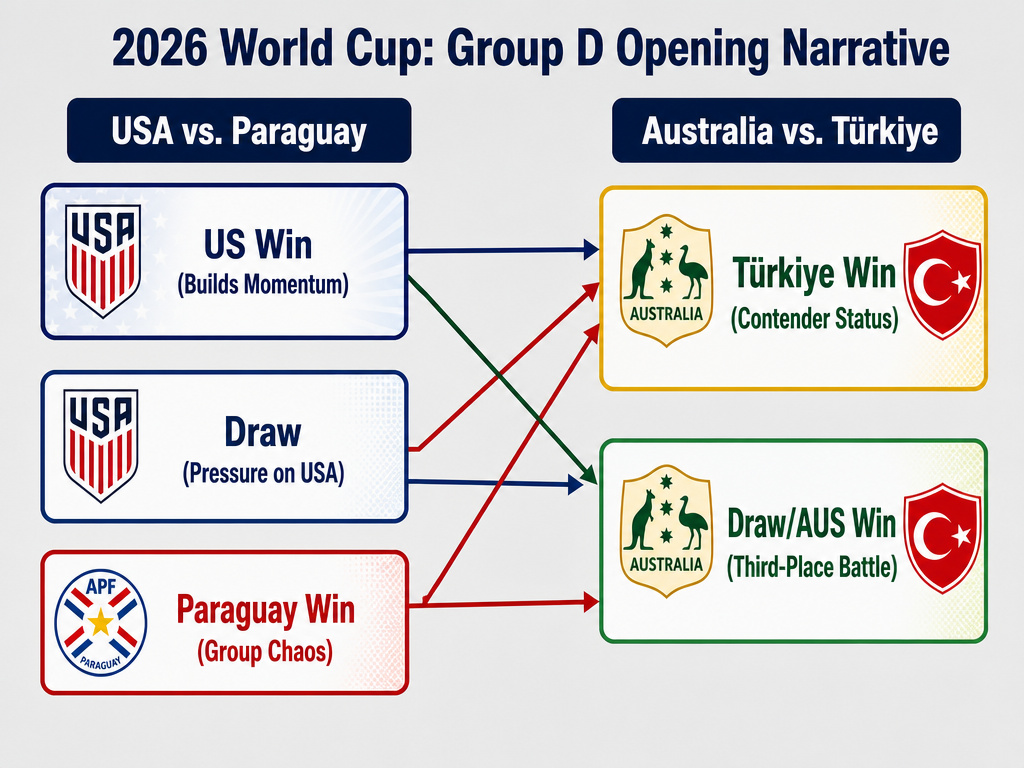
The schedule is not random. It creates a narrative.
-
June 13, 2026: USA vs. Paraguay (Los Angeles Stadium)
The tournament opens for the hosts. Paraguay’s deep block and counter-attack are a nightmare first opponent. A US win builds huge momentum. A draw feels like a loss for the USA and immediately puts them under pressure. A Paraguay win would be a seismic upset that throws the group into chaos. -
June 14, 2026: Australia vs. Türkiye (BC Place, Vancouver)
A massive clash for third-place prospects. If Türkiye is a contender for the top, they must win here. Australia’s entire campaign hinges on getting something from this game. A draw is a decent result for both, but it makes their final matches desperate. -
June 25, 2026: Türkiye vs. USA (SoFi Stadium, Inglewood)
This is the group final. By most projections, this match decides first place. The atmosphere will be electric and tense. The loser likely faces a scramble for second, with goal difference suddenly paramount. For the USA, navigating this tactical battle is the ultimate test of their modern soccer tactics. -
June 25, 2026: Paraguay vs. Australia (Levi’s Stadium, Santa Clara)
Running simultaneously, this is the third-place playoff. If both teams lost their openers, this is a straight elimination match. The winner likely finishes on three points and stays alive. The loser is almost certainly going home. Expect a brutally physical, tense affair.
The USA’s match against Türkiye is scheduled for the same time as Paraguay-Australia. This prevents any collusion based on the other game’s result. Both matches will be played with pure, desperate uncertainty.
Qualification Scenarios: Mapping Every Path
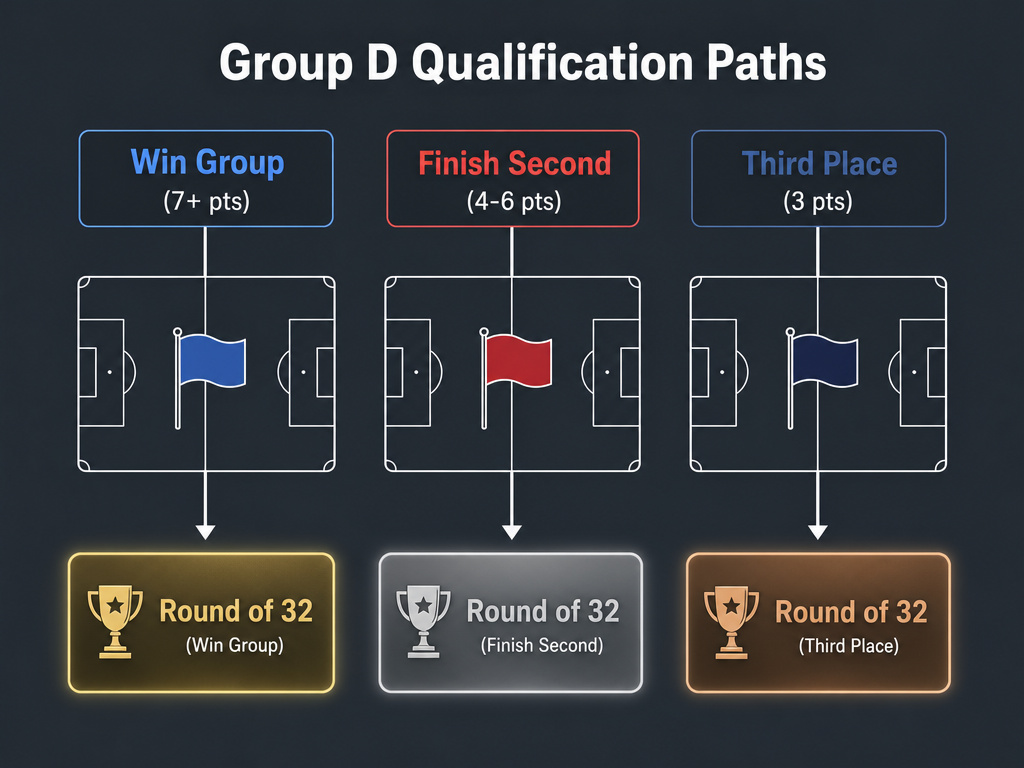
With the new rules, you think in points first, position second. Here is what each team needs.
Scenario 1: Winning the Group (Target: 7+ Points)
To win Group D, a team almost certainly needs a result against Türkiye and the USA. The group winner avoids other group winners in the Round of 32, facing a third-place qualifier instead. This is a massive incentive. For the USA, winning the group is the minimum expectation at home. For Türkiye, it’s a statement of arrival.
Scenario 2: Finishing Second (Target: 4-6 Points)
The runner-up faces the Group G runner-up. Given Group G contains Spain, Brazil, and two others, that is a horrifying prospect. Finishing second might be a tougher path than finishing third. A team might aim for a specific team formation to secure a draw and protect goal difference, rather than risk everything for a win that still lands them in a brutal knockout match.
Scenario 3: Finishing Third and Advancing (Target: 4 Points Safe, 3 Points Possible)
This is the new calculus. Four points—achieved by a win and a draw—will almost always be enough to be a top-eight third-place team. Three points requires help. You need a positive goal difference and for other groups to produce mediocre third-place finishers. This is where fair play points (yellow and red cards) become decisive. A late, frustrated red card could literally send your team home.
Common mistake: Assuming a 0-0 draw is a safe result for two teams battling for third. A goalless draw gives each team one point and a zero goal difference. That is often the worst possible outcome, leaving both short of points and with no differential boost. Someone has to risk losing to try winning.
The eight best third-placed teams are ranked in a single table. The cut-off line is volatile. In simulations, the difference between the 8th and 9th best third-place team routinely comes down to a single goal or one fewer yellow card.
| Third-Place Points | Probability of Advancing | Critical Factor |
|---|---|---|
| 4 Points | >95% | Almost guaranteed unless goal difference is severely negative. |
| 3 Points | ~50% | Comes down to goal difference vs. other third-place teams. |
| 2 Points | <10% | Requires multiple groups to have catastrophically bad third-place teams. |
| 1 Point | 0% | Effectively eliminated. |
Tie-Breakers and the Fair Play Nightmare
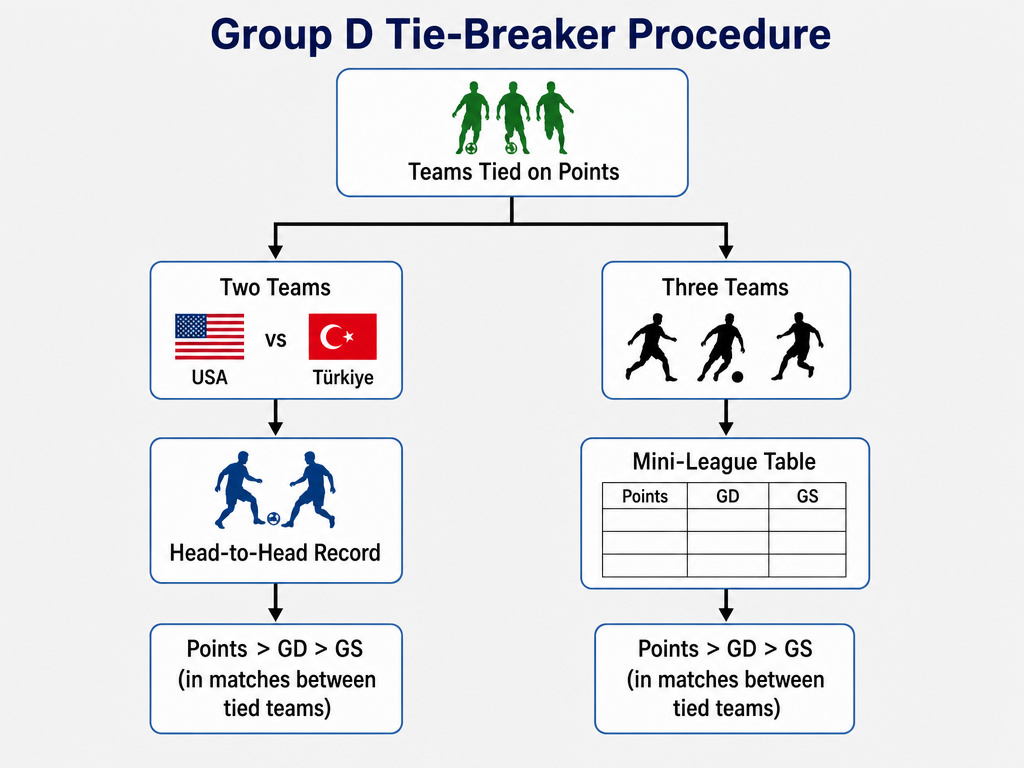
When points are equal, the rules decide fates. Within Group D, head-to-head record is the first tie-breaker after points. If the USA and Türkiye finish level on points, the result of their direct match decides who tops the group.
If three teams are tied on points, a mini-league between those three is created. Points, then goal difference, then goals scored in the matches among the tied teams are used. This makes every goal in every intra-group match critical.
For the best third-placed teams, the process is different and more chaotic.
- Points
- Goal Difference
- Goals Scored
- Fair Play Points
Fair play points are calculated as: -1 point for a yellow card, -3 points for an indirect red (second yellow), -4 points for a direct red card. A team’s tournament total is subtracted from their fair play score. The team with the higher fair play score (fewer deductions) ranks better.
Imagine this: Australia and a third-place team from Group F both finish on 3 points and a +1 goal difference. Australia has -5 fair play points (five yellows). The other team has -3 fair play points (three yellows). The other team advances. A cynical tactical foul in the 89th minute of a match you are winning could be the reason your World Cup ends.
TL;DR: Discipline is no longer just sportsmanship. It is a direct qualification metric. Coaches will be drilling this into players daily.
Potential Round of 32 Opponents and Why It Matters
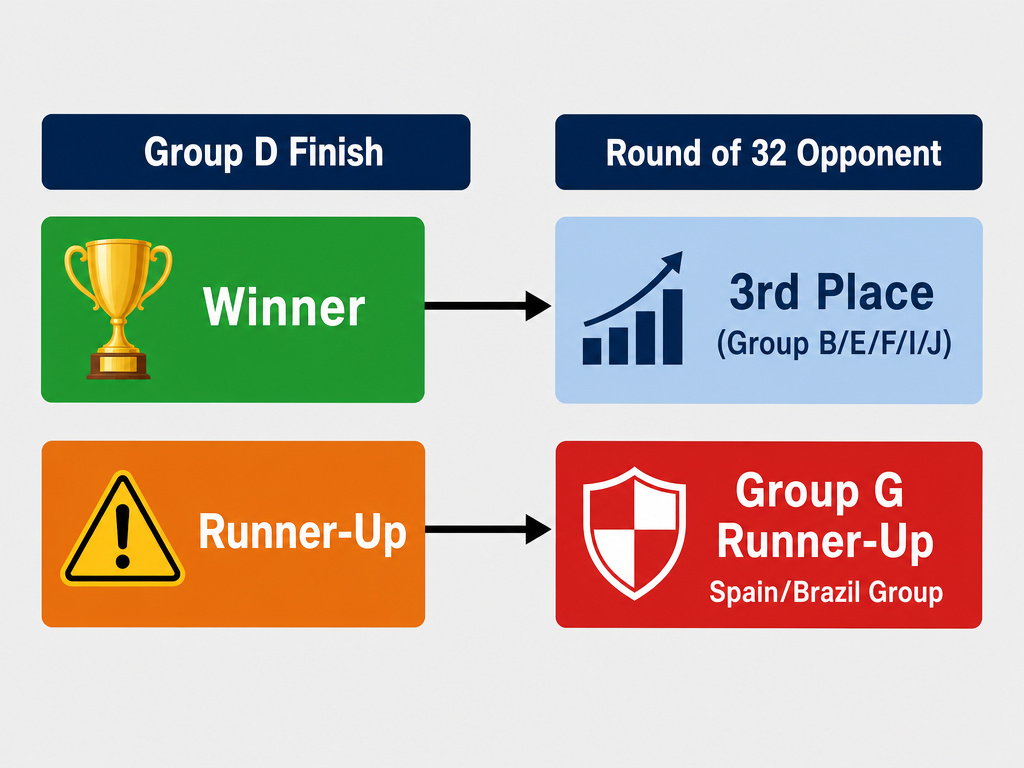
Where you finish dictates who you play. This is not just about advancing; it is about surviving the next round.
- Group D Winner: Faces a third-place finisher from Group B, E, F, I, or J. This is the prize. On paper, this is the easiest possible Round of 32 match. It could be a team that scraped through with three points and a negative goal difference.
- Group D Runner-Up: Faces the Group G Runner-Up. Group G contains Spain and Brazil. This is the punishment. Finishing second likely means facing a titan in your first knockout game. A team might genuinely prefer a defensive formation to secure third place with a good goal difference rather than second.
- Group D Third-Placed Qualifier: Could face the winner of Group K or Group I. This is a wildcard. You could draw a group winner that is a genuine contender, making your “achievement” of advancing short-lived.
This incentive structure will lead to real-time tactical adjustments during the final group matches. If a team knows a draw gives them second place and a date with Brazil, but a 1-0 loss might see them finish third with a chance to advance, what do they do? This ethical and strategic dilemma is new to the World Cup.
Every Team’s Path to the Knockout Rounds
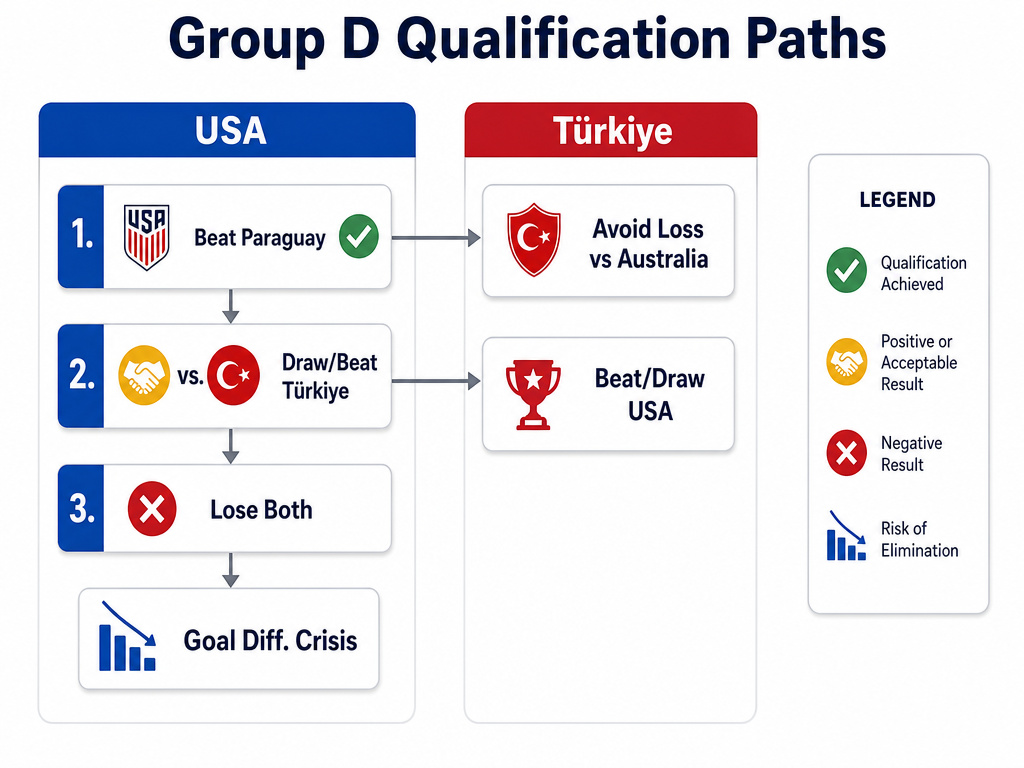
Let’s get specific. What must each nation do?
USA’s Path
- Beat Paraguay. A non-negotiable start to manage pressure.
- Draw or beat Türkiye. A win wins the group. A draw likely still wins it unless goal difference suffers.
- Worst-case: Lose to both Paraguay and Türkiye. This would require a result against Australia and hoping three points and goal difference is enough for third. This scenario is a national crisis.
Türkiye’s Path
- Avoid defeat against Australia. A loss puts them behind the eight-ball immediately.
- Beat or draw the USA. This is their championship match.
- Key: Score goals. Their technical talent must translate to a strong goal difference as a safety net for any scenario.
Australia’s Path
- Get a point against Türkiye. This is their most important match.
- Beat Paraguay. This is their “final” for third place.
- Reality: They are not expected to beat the USA or Türkiye. Their campaign is built on the result against Paraguay and limiting damage elsewhere. Their classic 4-4-2 system might be deployed to frustrate and counter.
Paraguay’s Path
- Shock the USA or get a draw. Stealing a point in the opener changes everything.
- Beat Australia. This is their only probable win.
- Problem: Their defensive style risks low-scoring games. A 1-0 win and two 1-0 losses gives them 3 points and a -1 goal difference. That might not be enough. They need to attack more than they are comfortable with.
I once watched a German youth team in a tournament with a similar “best third-place” rule. Needing a draw to finish second and face a strong team, the coach subtly instructed players to protect a one-goal deficit in the final minutes. They lost, finished third with a respectable goal difference, advanced, and won the whole thing. The moral calculus was ugly, but the format invited it. Expect to see this debate in 2026.
Frequently Asked Questions
Can all four teams from Group D advance to the knockout stage?
No. Only the top two are guaranteed to advance. A maximum of three teams could advance if the Group D third-place team finishes as one of the eight best third-placed teams across all groups. It is impossible for all four to move on.
What is more important for a third-place team: points or goal difference?
Points are the primary driver. However, at the three-point threshold, goal difference becomes the decisive factor. Four points with a zero goal difference is safer than three points with a +3 difference. Always chase the point first.
Do yellow cards really matter that much?
Absolutely. In the tie-breaking procedure for the best third-placed teams, fair play points are the fourth criterion after goals scored. If two teams are identical on points, goal difference, and goals scored, the team with fewer yellow and red cards advances. A single needless yellow in a dead-rubber match could be catastrophic.
If the USA finishes third, could they still play knockout games at home?
Yes, but it is unlikely. The knockout stage bracket is fixed. If the USA finishes third and qualifies, their Round of 32 match would be against a group winner from another sector, likely at a predetermined venue that may not be on US soil. The advantage of hosting is primarily in the group stage.
How does this new format compare to past tournaments like EURO 2024?
The 24-team European Championship also advances third-place teams, but from six groups. The 48-team World Cup version is more complex and volatile, with 12 groups feeding into a larger pool of third-place finishers. The margin for error is slightly larger, but the tie-breaking chaos is magnified. Understanding these playoff scenarios is key for any fan.
The Bottom Line
Group D is not a straightforward death march. It is a tactical puzzle with a new set of rules. The USA must handle the weight of a nation. Türkiye must prove its talent translates to the biggest stage. Australia and Paraguay must fight for every goal, knowing that a single strike could be the difference between the round of 32 and a flight home.
Forget just watching for wins and losses. Watch the goal difference ticker. Watch the disciplinary count. The first week of the 2026 World Cup is not a warm-up. It is a brutal, mathematical scramble for survival where finishing third is no longer a consolation prize—it is a legitimate strategy. The team that understands that first will find its path through the chaos.

I come from the “soccer heart” of Germany, the Ruhrpott. I have played, trained and followed soccer all my life and am a big fan of FC Schalke 04. I also enjoy following international soccer extensively.