World Cup Time Zone Guide: Convert Kick-Off Times Anywhere
To convert World Cup 2026 match times, you must know the specific host city for each game and its local Daylight Time zone: Eastern (EDT/UTC-4), Central (CDT/UTC-5), or Pacific (PDT/UTC-7). The tournament runs entirely during North American Daylight Saving Time, so no clock changes will occur. The Final kicks off at 3:00 PM Eastern Time on July 19 at MetLife Stadium.
Most fans get this wrong by looking at the country, not the city. They see “USA” and think one time zone, then miss a kick-off because Los Angeles is three hours behind New York. The three-host-nation model spreads 16 cities across a continent, and a match in Guadalajara runs on a different clock than one in Seattle.
This guide maps every time zone, converts key matches for global fans, and gives you the tools to never miss a kick-off, whether you’re watching from Berlin or planning a multi-city trip.
Key Takeaways
- The 16 2026 host cities operate on three primary time zones during summer: Eastern Daylight Time (EDT), Central Daylight Time (CDT), and Pacific Daylight Time (PDT).
- The entire tournament falls within North America’s Daylight Saving Time period. All listed local times are “daylight” times, no mid-tournament clock changes.
- The maximum time difference between the earliest (East Coast) and latest (West Coast) host city is 3 hours. A 6 PM ET match starts at 3 PM PT.
- For international viewers, a 3 PM ET kick-off means 8 PM in the UK, 12:30 AM the next day in India, and an early 5 AM start in Sydney.
- Always verify the specific host city for each match on the official schedule. Assuming “US time” or “Mexico time” will lead to errors.
The North American Time Zones: EDT, CDT, and PDT
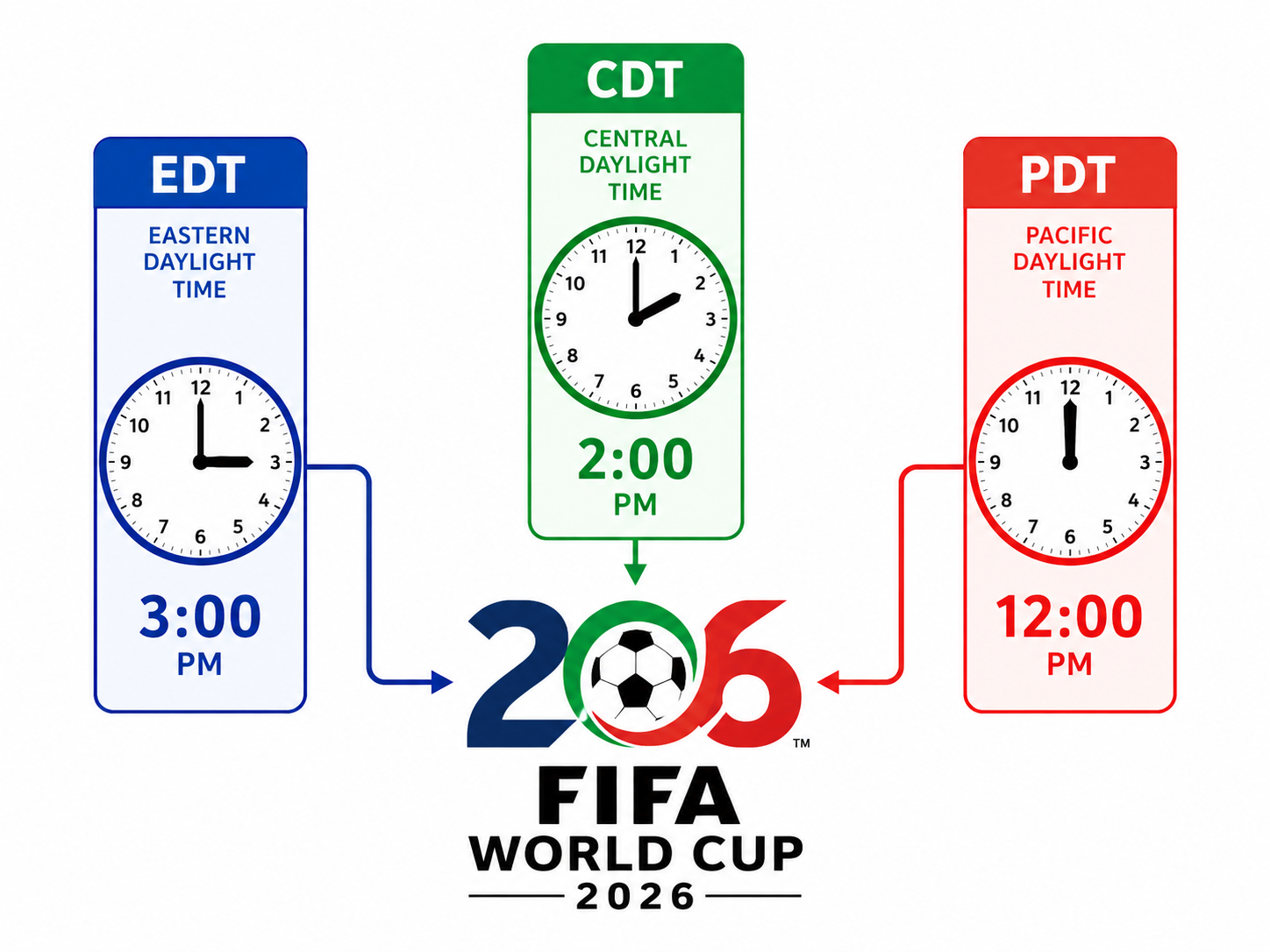
Headline match times mean nothing without the city. The expanded tournament schedule across 16 venues uses three core Daylight Time zones. Forget standard time. From June 11 to July 19, North America is on summer time.
The 2026 FIFA World Cup schedule is built around host cities in Eastern Daylight Time (UTC-4), Central Daylight Time (UTC-5), and Pacific Daylight Time (UTC-7). This three-zone framework creates a maximum 3-hour spread for any given kick-off slot, with all times fixed for the tournament’s duration under Daylight Saving Time.
Eastern Daylight Time (EDT / UTC-4) is the tournament’s anchor. It hosts the final in New York/New Jersey and many key matches in cities like Atlanta, Philadelphia, and Toronto. When a match is listed as “3:00 PM ET,” that’s Eastern Daylight Time. Central Daylight Time (CDT / UTC-5) covers Mexico’s iconic venues. Estadio Azteca, Estadio Akron, Estadio BBVA, and US cities like Dallas and Houston. Pacific Daylight Time (PDT / UTC-7) is for the West Coast: Los Angeles, San Francisco Bay Area, Seattle, and Vancouver.
The structural evolution to 48 teams means more simultaneous matches. A day could have a game in EDT Atlanta, another in CDT Guadalajara, and a third in PDT Seattle. Your viewing day stretches.
TL;DR: Matches use EDT, CDT, or PDT. The Final is at 3 PM EDT. West Coast games are 3 hours behind that.
Host City Time Zone Cheat Sheet
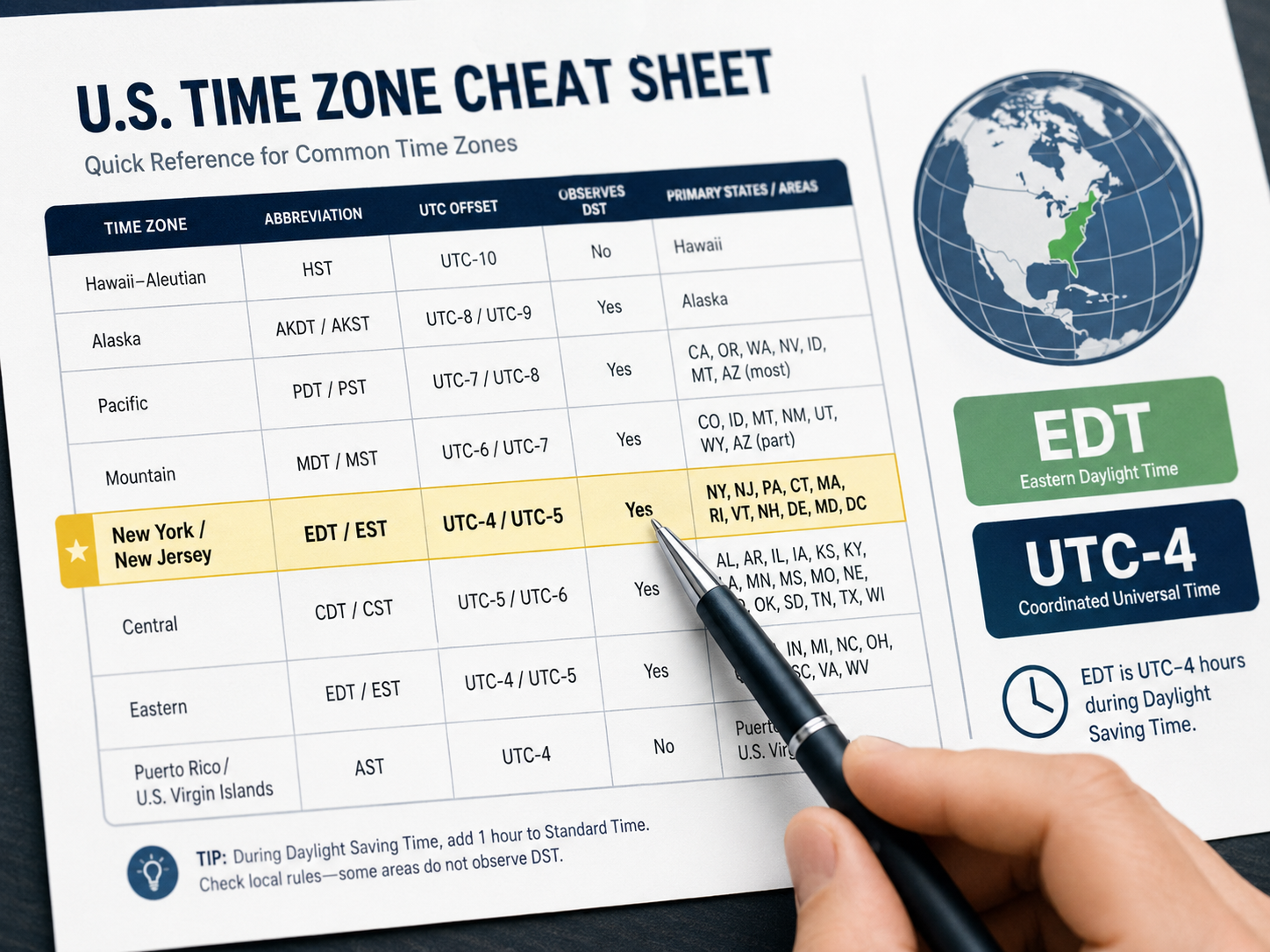
Never guess. Use this table to lock the local time zone to the stadium. This is your first stop before any conversion.
| Host City & Stadium | Country | Time Zone (June–July 2026) | UTC Offset |
|---|---|---|---|
| New York/New Jersey (MetLife) | USA | Eastern Daylight Time (EDT) | UTC-4 |
| Toronto (BMO Field) | Canada | Eastern Daylight Time (EDT) | UTC-4 |
| Philadelphia (Lincoln Financial) | USA | Eastern Daylight Time (EDT) | UTC-4 |
| Atlanta (Mercedes-Benz) | USA | Eastern Daylight Time (EDT) | UTC-4 |
| Mexico City (Estadio Azteca) | Mexico | Central Daylight Time (CDT) | UTC-5 |
| Dallas (AT&T Stadium) | USA | Central Daylight Time (CDT) | UTC-5 |
| Houston (NRG Stadium) | USA | Central Daylight Time (CDT) | UTC-5 |
| Guadalajara (Estadio Akron) | Mexico | Central Daylight Time (CDT) | UTC-5 |
| Monterrey (Estadio BBVA) | Mexico | Central Daylight Time (CDT) | UTC-5 |
| Kansas City (Arrowhead) | USA | Central Daylight Time (CDT) | UTC-5 |
| Los Angeles (SoFi Stadium) | USA | Pacific Daylight Time (PDT) | UTC-7 |
| San Francisco Bay (Levi’s) | USA | Pacific Daylight Time (PDT) | UTC-7 |
| Seattle (Lumen Field) | USA | Pacific Daylight Time (PDT) | UTC-7 |
| Vancouver (BC Place) | Canada | Pacific Daylight Time (PDT) | UTC-7 |
Notice a pattern? Major tournament locations in the US Mountain Time zone (like Denver) are not hosts. This was a deliberate scheduling choice to simplify the broadcast grid. If you live in Mountain Time, you’re always converting from a neighbor, add one hour to Pacific times, subtract one hour from Central times.
Common mistake: Assuming all Mexican hosts are on the same time as US Central, they are (CDT), but forgetting this means you’ll mix up local kick-off times for the opening event details at Estadio Azteca versus a match in Dallas.
What About Daylight Saving Time?
This is the simplest part. The entire 2026 World Cup, from the opening match on June 11 to the final on July 19, takes place during the North American Daylight Saving Time period. DST runs from the second Sunday in March to the first Sunday in November.
Therefore, every single host city time listed on the official schedule, every broadcaster’s guide, and every converter tool will use the “Daylight” variant: EDT, CDT, PDT. There is no switch back to standard time during the tournament. The clocks are fixed.
I learned this the hard way planning for a different event. I calculated times for a late-October match assuming DST, but the host city had already fallen back to standard time a week earlier. I was an hour off. Not here. The host city climate in summer guarantees stable DST across all North American hosts.
TL;DR: DST is active for all 104 matches. Every time you see is already a “daylight” time. No adjustments needed.
International Viewer’s Guide: From London to Sydney
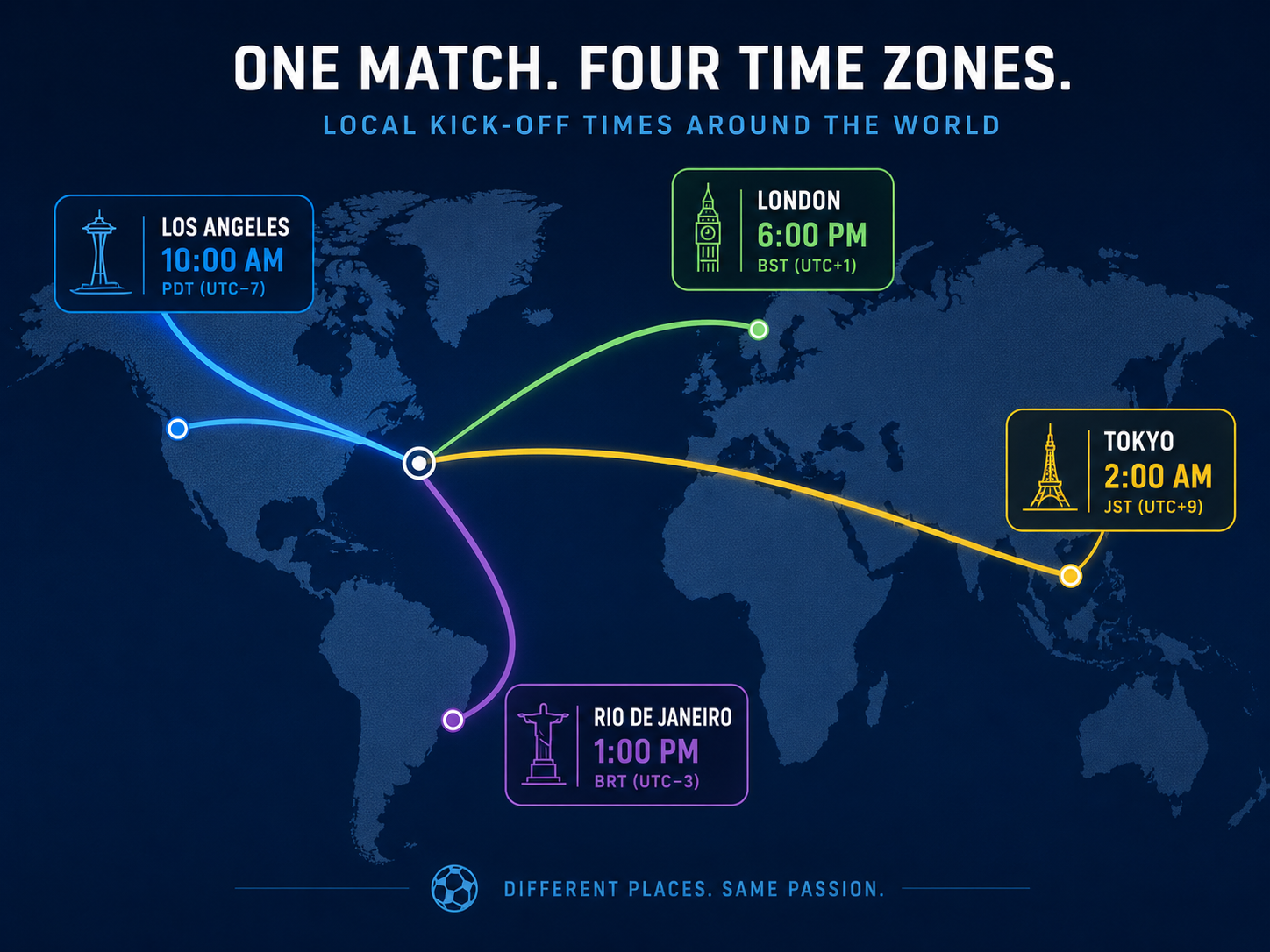
Your local kick-off depends entirely on that host city column. Let’s translate the major slots. We’ll use Eastern Time as the reference, as it’s the most common for marquee matches.
Primary Kick-off Slots (Eastern Daylight Time):
- 12:00 PM EDT (Noon)
- 3:00 PM EDT (Afternoon)
- 6:00 PM EDT (Evening)
- 9:00 PM EDT (Prime Time)
Now, here’s what that means globally. This table is your planning bible.
| Your Region | 12:00 PM EDT | 3:00 PM EDT (Final) | 6:00 PM EDT | 9:00 PM EDT |
|---|---|---|---|---|
| United Kingdom (BST) | 5:00 PM | 8:00 PM | 11:00 PM | 2:00 AM (next day) |
| Central Europe (CEST) | 6:00 PM | 9:00 PM | 12:00 AM | 3:00 AM (next day) |
| India (IST) | 9:30 PM | 12:30 AM (next day) | 3:30 AM (next day) | 6:30 AM (next day) |
| Australia (Sydney AEST) | 2:00 AM (next day) | 5:00 AM (next day) | 8:00 AM (next day) | 11:00 AM (next day) |
| Japan (JST) | 1:00 AM (next day) | 4:00 AM (next day) | 7:00 AM (next day) | 10:00 AM (next day) |
| Brazil (BRT) | 1:00 PM | 4:00 PM | 7:00 PM | 10:00 PM |
| South Africa (SAST) | 6:00 PM | 9:00 PM | 12:00 AM | 3:00 AM (next day) |
For the UK and Europe, the 3:00 PM EDT final is a perfect 8:00 PM / 9:00 PM prime-time start. The 9:00 PM EDT slot, however, pushes into the early hours. Indian fans face late nights and very early mornings, the final starts at half past midnight. Australian and Japanese supporters need to set alarms for pre-dawn viewing.
I watched the 2014 Final in Rio from Germany. A 5:00 PM local kick-off in Brazil was 10:00 PM for me. Perfect. For 2026, my fellow Europeans get that same prime-time gift for the New York final. But if your team plays a 9:00 PM ET group match in Philadelphia, you’re up until 3:00 AM. Plan your sleep schedule around the tournament locations.
For African Fans (beyond South Africa):
- West Africa (WAT, UTC+1): Add 5 hours to EDT. A 3:00 PM final starts at 8:00 PM.
- East Africa (EAT, UTC+3): Add 7 hours to EDT. A 3:00 PM final starts at 10:00 PM.
TL;DR: The UK gets prime time, India gets late nights, Australia gets early mornings. Use the table above to block your calendar.
The Final and Opening Match: Fixed Times
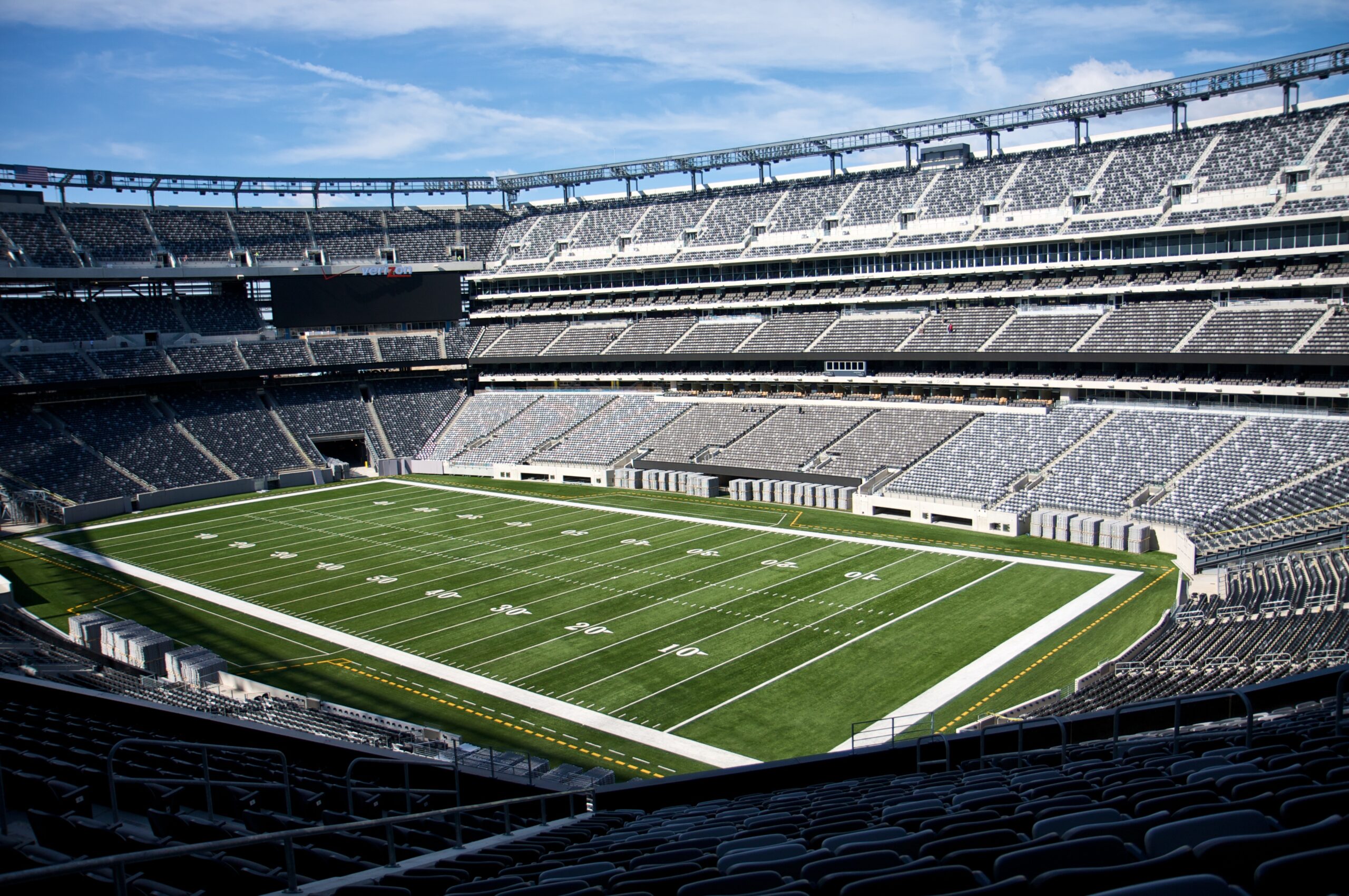
Photo: babyknight / Wikimedia Commons / CC BY 2.0

These two bookends are set. Build your schedule around them.
The championship match venue is MetLife Stadium in East Rutherford, New Jersey. The kick-off is confirmed for 3:00 PM Eastern Daylight Time (EDT) on Sunday, July 19, 2026. That’s 8:00 PM in London, 12:30 AM Monday in Mumbai, and 5:00 AM Monday in Sydney.
The tournament kickoff is on Thursday, June 11, 2026, at Estadio Azteca in Mexico City. The opener, Mexico vs. South Africa, kicks off at 10:00 PM Eastern Time. That’s 9:00 PM local Central Daylight Time in Mexico City, 3:00 AM Friday in the UK, and 7:30 AM Friday in India.
Common mistake: Converting the opening match as if it’s in US Eastern Time. It’s not. It’s in Mexico City on CDT. That one-hour difference (9 PM local vs. 10 PM ET) has tripped up many early planners I’ve spoken to.
These fixed times are your anchors. The official tournament logo will be stamped on every countdown clock using these local host-city times.
Practical Tips for Traveling Fans
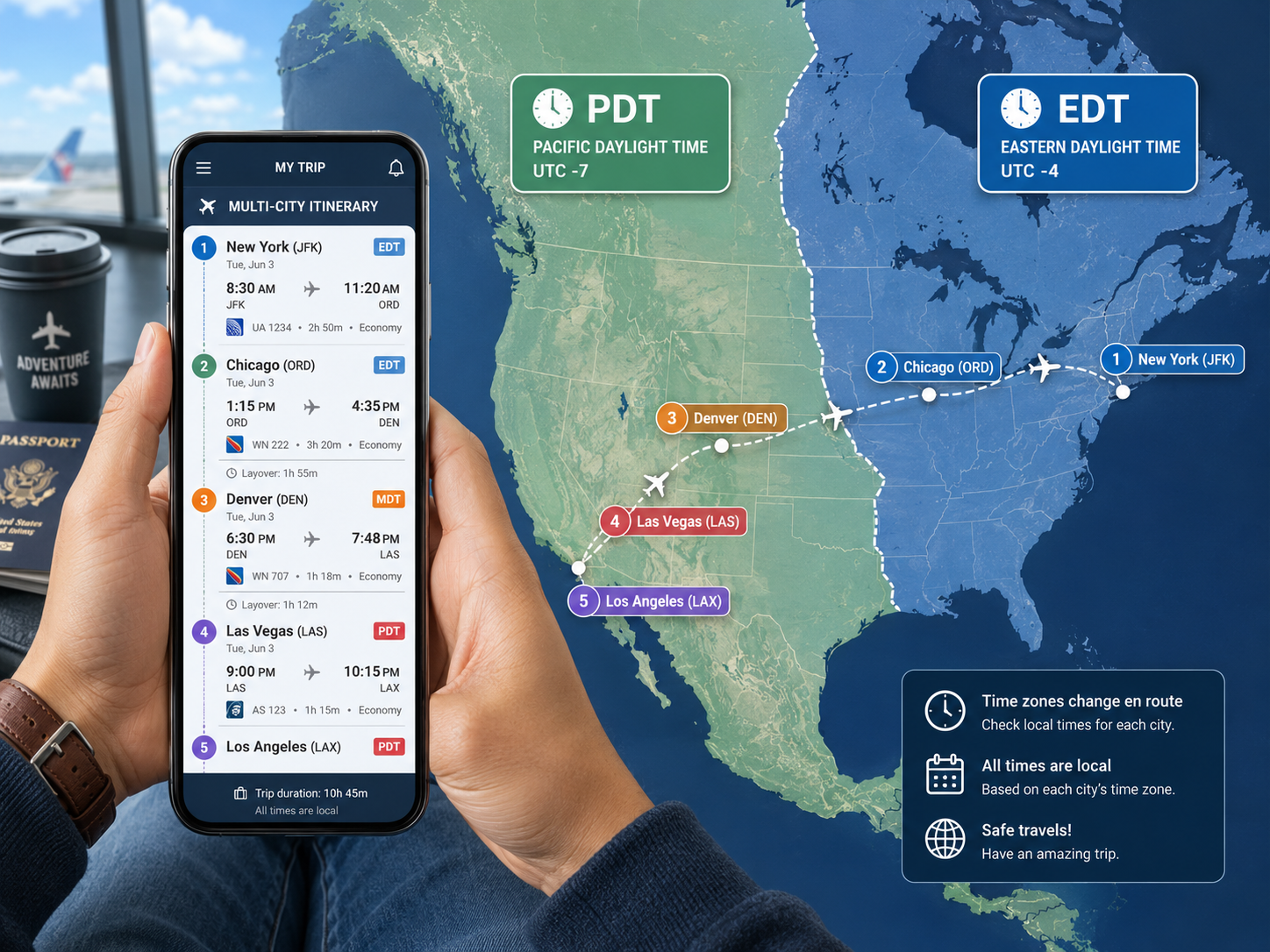
If you’re attending matches across cities, time zones are a physical reality, not just a viewing note. The regional economic impact of moving millions of fans hinges on workable logistics.
Managing a Multi-City Trip:
- Fly East to West. Start your trip on the East Coast (EDT) and work your way west to the Pacific (PDT). Your body adapts better to gaining hours later in the day rather than losing them.
- Buffer for Border Crossings. A match in Toronto (EDT) followed by one in Vancouver (PDT) isn’t just a 3-hour flight; it’s a 3-hour time zone jump plus potential immigration lines. Give yourself a full rest day between.
- Use Your Phone Wisely. Keep your phone on automatic time zone setting. The moment you land, it updates. Use a world clock widget to keep home time and next host city time visible.
- Hydrate and Nap. Jet lag is dehydration plus circadian confusion. Drink more water than you think you need on flight day. A 20-minute nap upon arrival is better than a 3-hour crash.
The key differences from 2022 in Qatar, a single, compact host nation, are stark. Here, distance and time zones are part of the challenge. Embracing that is part of the tri-nation World Cup adventure. Your internal clock will take a beating. Respect it.
Tools and Resources for Accurate Conversion
Don’t rely on mental math. Use these.
- Official FIFA Match Schedule: The source of truth. It will list the local time for the host city. Find it on FIFA.com.
- Time Zone Converter Websites: Use reputable ones like TimeAndDate.com or WorldTimeBuddy. Key tip: Always input the correct date (e.g., July 19, 2026) because some tools show standard vs. daylight time differences based on date.
- World Clock Apps: Most smartphones have a built-in world clock. Add your home city and the key host cities (New York, Mexico City, Los Angeles) for quick glances.
- Broadcaster Guides: Major rights holders like the BBC, Fox Sports, or Sky Sports will publish localized schedules as the tournament nears. These are double-checked for accuracy.
I keep a simple note on my phone: “EDT = UK+5, INDIA+9.5, AUS+15”. It’s crude, but for a quick check during a conversation, it prevents embarrassment. For precise planning, I always cross-check with a converter.
Frequently Asked Questions
What time zone will the World Cup 2026 final be in?
The final at MetLife Stadium in New Jersey will be played in Eastern Daylight Time (EDT), which is UTC-4. The kick-off is 3:00 PM EDT.
How do I convert World Cup times to Indian Standard Time (IST)?
To convert from Eastern Daylight Time (EDT) to IST, add 9 hours and 30 minutes. A 3:00 PM EDT match starts at 12:30 AM IST the following day. For Central Time (CDT), add 10.5 hours. For Pacific Time (PDT), add 12.5 hours.
Will there be a time change during the World Cup 2026?
No. The tournament runs from June 11 to July 19, entirely within the North American Daylight Saving Time period. No host city will change its clocks during the competition.
What is the time difference between the earliest and latest host city?
The maximum difference is 3 hours. When it is 6:00 PM in New York (EDT), it is 5:00 PM in Mexico City (CDT) and 3:00 PM in Los Angeles (PDT).
Are all Mexican host cities in the same time zone?
Yes. All three Mexican host cities. Mexico City, Guadalajara, and Monterrey, are in the Central Daylight Time zone (CDT, UTC-5) during the tournament.
What is the best way to watch if I live in Mountain Time (MT)?
You will be converting from either Pacific or Central time. Matches in Los Angeles (PDT) will start at 4:00 PM your time (MT is UTC-6). Matches in Dallas (CDT) will start at 2:00 PM your time. Use a converter for each specific match city.
Before You Go
Navigating the 2026 World Cup time zone guide boils down to three rules. First, always identify the specific host city, never the country. Second, remember the entire tournament uses Daylight Time (EDT, CDT, PDT) with no changes. Third, use a reliable converter for your region; don’t guess.
For European fans, the schedule is largely friendly, with the final in prime evening viewing. For fans in Asia and Oceania, prepare for late nights and early alarms. If you’re traveling, build your itinerary east to west and buffer your days. This multi-country tournament is a logistical feat, but with this map in hand, you’ll never miss a moment. Now you can plan your watch parties, or your flight connections, with confidence.
I come from the “soccer heart” of Germany, the Ruhrpott. I have played, trained and followed soccer all my life and am a big fan of FC Schalke 04. I also enjoy following international soccer extensively.