World Cup Rules & VAR Updates: The 8 Changes You Must Know
World Cup 2026 rules and VAR updates introduce eight key changes. These include VAR reviewing second yellow cards, strict five-second restart and ten-second substitution countdowns, and a mandatory one-minute off-field period for treated players. The aim is to correct clear errors while reducing tactical delays and maintaining the game’s flow.
The World Cup 2026 rules and VAR updates center on eight specific amendments to the Laws of the Game. These changes expand VAR’s scope to review second yellow cards and mistaken identity, introduce strict five-second countdowns for restarts and a ten-second limit for substitutions, and mandate a one-minute off-field period for treated players. The goal is to reduce stoppages and correct clear factual errors without slowing the game’s tempo.
Most fans focus on VAR, but the real shift is behavioral. The new countdown rules and substitution clocks are designed to punish tactical delays instantly, forcing players and coaches to adapt their in-game rhythm. The old habit of slowly walking off during a substitution is now a tactical liability.
This guide breaks down each of the eight key changes, explains the mechanics behind them, and outlines what they mean for how the 2026 tournament will look, feel, and be officiated.
Key Takeaways
- VAR can now intervene for a red card resulting from a clearly incorrect second yellow card, but not for standalone yellow card decisions.
- A five-second visual countdown will be enforced for delayed throw-ins and goal kicks. Fail to play the ball in time, and possession switches to the opponent.
- Substituted players must exit the field within ten seconds. If they don’t, their replacement must wait a full minute to enter, forcing the team to play short.
- Players who receive on-field treatment for an injury must leave the pitch for one minute after play restarts, with exceptions for carded fouls or penalty takers.
- The number of substitutes in senior international friendlies increases to eight, with up to eleven permitted if both teams agree before kickoff.
The 8 New World Cup 2026 Rules and VAR Updates (Explained)
The International Football Association Board (IFAB) publishes the definitive Laws of the Game. Their 2026/27 amendments document is the source for every change discussed here. This isn’t speculation or trial, these are the codified rules for the tournament.
The updates target three areas: factual accuracy in major decisions, reduction of deliberate time-wasting, and minor procedural clarifications. They take effect globally on July 1, 2026, but will be in force for the World Cup kicking off on June 11. Some rules are mandatory; others, like the VAR review for corner kicks, are optional for competitions to adopt.
The 2026/27 IFAB Laws of the Game amendments authorize VAR intervention for “clearly incorrect” decisions in three new situations: a second yellow card that leads to a sending-off, mistaken identity when a caution or sending-off is issued, and, as a competition option, an incorrectly awarded corner kick. The principle of “minimum interference for maximum benefit” remains the governing protocol.
1. VAR Expansion: Second Yellows, Mistaken Identity, and Corners
This is the headline change. VAR’s scope widens, but within strict lanes. It will not re-referee the game.
Second Yellow Card Reviews: VAR can now check if a second yellow card, and therefore the resulting red card, was clearly incorrect. It will not review every yellow. The threshold is high: an obvious error in fact, like a referee booking Player A for a foul clearly committed by Player B, or judging a clean tackle as reckless. This prevents a player being wrongly sent off for a non-existent second offense.
Common mistake: Thinking VAR will review all yellow cards. It won’t. It only checks the second yellow in a sending-off incident, and only if that second caution is objectively wrong. A borderline, subjective yellow for a tactical foul will not be overturned.
Mistaken Identity: This is a straightforward fix. If a referee shows a yellow or red card to the wrong player, VAR can identify the correct offender. The review is solely about the player’s identity, not the decision itself.
Corner Kick Reviews (Optional): Competitions may allow VAR to review a clearly incorrect corner kick award, but only if the error is obvious and can be corrected before the restart. If play has moved on, it’s too late. Major leagues like the Premier League have already indicated they likely won’t adopt this optional rule, so don’t expect it everywhere.
2. The 5-Second Restart Countdown for Throw-Ins and Goal Kicks
This rule aims to kill a specific time-wasting tactic. If a referee believes a player is delaying a throw-in or a goalkeeper is stalling a goal kick, they will signal for a five-second visual countdown. This countdown will be displayed on the stadium screens.
If the ball is not put into play within those five seconds, the restart switches. For a throw-in, possession goes to the opposing team for a throw-in from the same spot. For a goal kick, the restart becomes a corner kick for the attacking team.
The psychological pressure is the point. Goalkeepers can no longer amble to the ball, adjust their socks, and slowly place it. They have five seconds from the referee’s signal. This will directly impact late-game scenarios where protecting a lead often involves slowing everything down.
TL;DR: Delay a throw-in or goal kick after the referee’s countdown signal, and you lose the restart. Possession flips to the opponent.
3. The 10-Second Substitution Rule
The slow, applauding-the-fans walk-off is dead. A substituted player now has ten seconds to leave the field after their replacement is ready to enter at the halfway line.
If the outgoing player exceeds this limit, the substitute is not allowed on. The substitute must then wait until the next stoppage in play after at least one minute has elapsed. This means the team must play with ten players for that minute.
| Scenario | Old Habit | New 2026 Rule Consequence |
|---|---|---|
| Player walks off slowly | Wastes 30-45 seconds | Team plays with 10 men for 1+ minutes |
| Player stops to tie boot | Minor delay tolerated | Substitute delayed, team short-handed |
| Player argues with referee | Common time-wasting tactic | Immediate numerical disadvantage |
This changes late-game management. Coaches making a defensive substitution in added time now risk playing a man down if their player dilly-dallies. It forces professionalism and speed.
4. The 1-Minute Off-Field Rule for Treated Players
When a player goes down, receives treatment, and causes a stoppage, they must now leave the field for one minute after play restarts. The logic is simple: if you’re hurt enough to need treatment, you need a minute to recover. If you were feigning, your team pays the price.
There are four key exceptions:
1. The opposing player receives a yellow or red card for the foul.
2. A penalty is awarded.
3. The injury is to a goalkeeper.
4. The injured player is substituted.
This rule, combined with the new concussion substitute protocol, creates a layered approach to player safety and game integrity. It makes “tactical injuries” much less appealing.
5. Increased Substitutes in International Friendlies
For senior ‘A’ international friendly matches, the number of permitted substitutes rises from six to eight. Furthermore, if both teams agree and inform the referee before the match, they can increase the limit to eleven. The number of substitution opportunities (windows) remains at three, plus halftime.
This allows coaches to experiment more freely in non-competitive fixtures without the fear of running players into the ground. It’s a nod to player load management in a crowded calendar. This specific updated World Cup rules adjustment for friendlies won’t affect the tournament itself, but it’s part of the same IFAB package.
6. The Revised DOGSO (Denial of an Obvious Goal-Scoring Opportunity) Rule
The wording for DOGSO offenses has been refined. First, if a DOGSO foul is committed, advantage is played, and a goal is scored, the offending player will not receive a yellow card. The goal is considered punishment enough.
Second, the factors for judging a DOGSO now explicitly include the “location and number of attackers.” This subtle change could broaden the interpretation. Previously, the focus was often on a lone attacker versus the keeper. Now, officials may consider a pass to an unmarked teammate in a scoring position as an obvious goal-scoring opportunity, even if the fouled player wasn’t the one about to shoot.
7. The “Only the Captain” Protocol (Mandatory from 2027)
While not compulsory until July 2027, this directive is part of the 2026/27 law changes and signals the future. The rule states that only the team captain should approach the referee to discuss a decision, barring exceptional circumstances. Mass confrontations and harassment of officials will be penalized.
We will see this protocol trialled and emphasized in the lead-up to 2026. Its formal adoption in 2027 will standardize a behavior that top World Cup referees already try to enforce. It’s about restoring respect and reducing mobbing.
8. Technology and AI Integration
The IFAB has explicitly sanctioned the use of existing and new technology. This includes the now-familiar semi-automated offside technology (SAOT), goal-line technology, and VAR. New for 2026 is the option for competitions to use referee body cameras, a trial that could increase transparency.
The most significant tech story is behind the scenes. FIFA will deploy AI-powered 3D player avatars to enhance the speed and accuracy of the semi-automated offside system. This isn’t a rule change per se, but a technological evolution supporting the existing offside law. It promises faster, more precise decisions with clearer visualizations for broadcast.
How These Rules Change Game Strategy and Tempo
The cumulative effect is a game with less dead time and more immediate consequences for delay. Coaches will drill restart routines. Goalkeepers will practice quick distributions. Fitness coaches will emphasize sprinting off the pitch during substitutions.
Set-piece coaches become more valuable. With only five seconds to take a goal kick, rehearsed short-passing routines from the box become a necessity, not a luxury. The high press gains a new edge: force a rushed goal-kick error, win a corner.
Defensive time-wasting, a staple of tournament football, gets riskier. The one-minute off-field rule and the substitution clock mean faking an injury or slowly leaving the pitch directly harms your team’s shape. This aligns with the broader structural tournament updates aimed at a faster, more fluid spectacle.
Managers will also need to be sharper with their tournament fixture list planning. The increased physical and mental demand of a faster tempo in the new 48-team tournament format makes squad rotation and tactical freshness paramount.
What These Rules Mean for Fans and Viewers
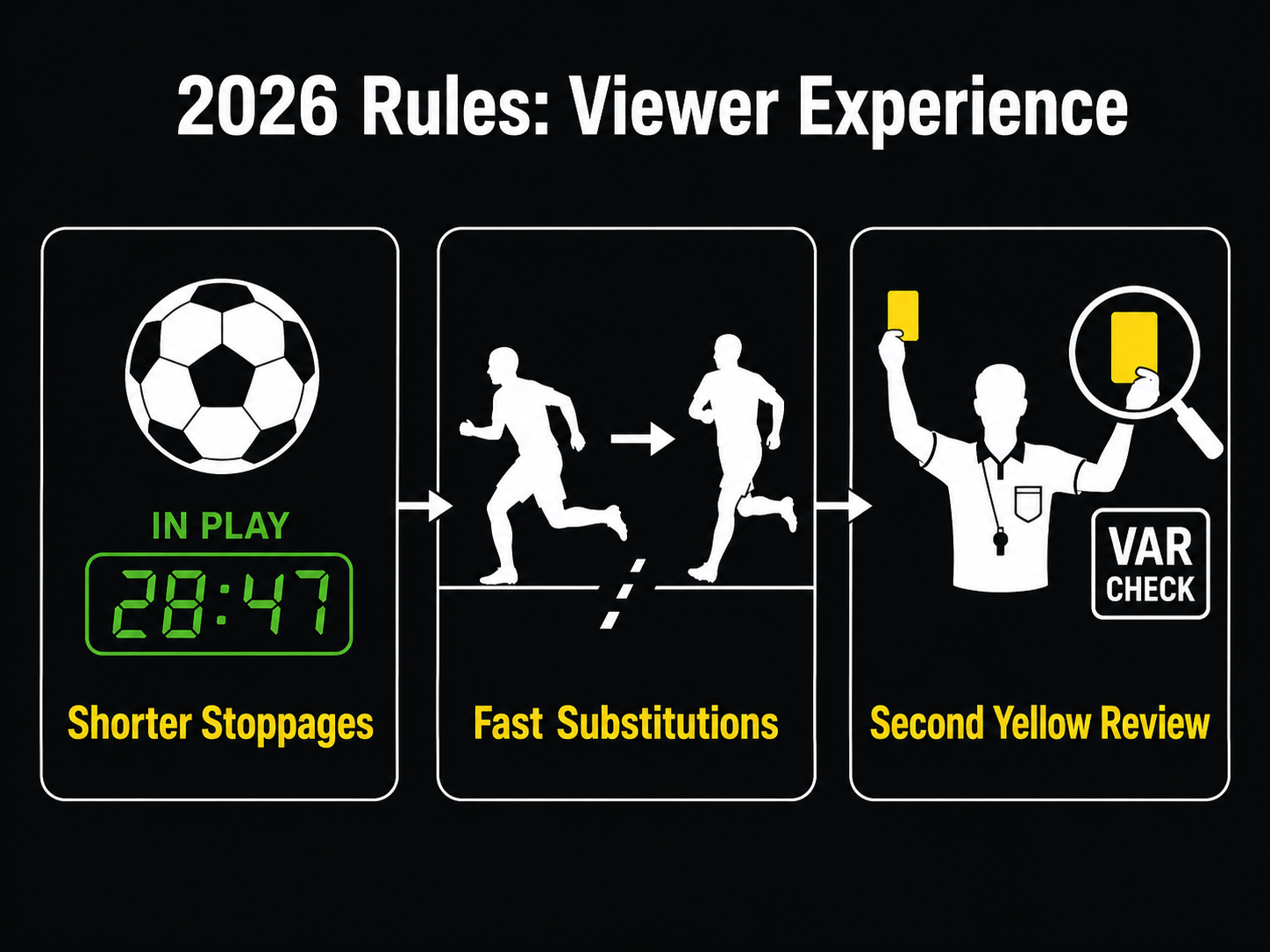
You will notice the game feels different. Stoppages will be shorter. The ball will be in play more. The dramatic, slow-motion substitution will vanish.
You’ll see new graphics: a countdown timer on screen during delayed restarts. You’ll hear commentators explaining why a substituted player is sprinting off. The VAR checks for second yellows will add a new layer of tension, did the referee get the first caution right, or just the second?
The BBC Sport football laws report provides a clear public-facing summary of these changes, noting the focus on “fewer avoidable delays” and “more visible control over player behaviour.” This is the broadcast narrative you’ll hear.
Crucially, the flow should improve. The 2022 World Cup saw huge added-time totals to compensate for time-wasting. These 2026 rules aim to prevent the waste in the first place, so the clock more accurately reflects active play.
Frequently Asked Questions
Will VAR review every yellow card at the 2026 World Cup?
No. This is a major misconception. VAR will only intervene for a red card that results from a clearly incorrect second yellow card. It will not review standalone yellow cards or subjective decisions like a tactical foul. The bar is “clear and obvious error” in a factual decision that leads to a sending-off.
What happens if a goalkeeper takes more than 5 seconds for a goal kick?
Once the referee initiates the visual five-second countdown, the goalkeeper must release the ball before it hits zero. If they fail, the restart is awarded as a corner kick to the opposing team. This is a direct punishment for time-wasting.
Can an injured player come straight back on the pitch?
No, not if their treatment caused a stoppage. With limited exceptions (like a card being shown to the opponent), a player who receives on-field treatment must leave the pitch and can only re-enter after one minute of play has elapsed. This applies to outfield players only; goalkeepers are exempt.
Are the new VAR rules for corner kicks mandatory?
No. The VAR review for an incorrectly awarded corner kick is an optional rule that individual competitions (like the Premier League or Champions League) can choose to adopt. Many may not. It will, however, be available for FIFA to use at the World Cup if they choose to implement it.
How many substitutes are allowed in World Cup 2026 matches?
For the competitive tournament matches, the number remains at the standard five substitutes from a list of fifteen players, with three substitution windows. The increase to eight (or eleven) substitutes applies only to senior international friendly matches, not the World Cup finals.
Before You Go
The 2026 rule changes are a deliberate engineering of football’s tempo and fairness. They punish delay, correct clear factual errors, and nudge behavior toward continuous play. The expanded VAR scope and strict clocks are two sides of the same coin: more accuracy, less waiting.
These amendments are not revolutionary but evolutionary. They plug specific loopholes in time-wasting and correct historical injustices like mistaken identity. Their success won’t be measured in flashpoints, but in the unnoticed flow of a game that feels brisk and decided by players, not pauses.
The traditional World Cup format is being preserved, but the experience of watching it is being refined. The 2026 tournament, with its new group stage mechanics for 48 teams, will be the ultimate test of whether these rules deliver a faster, fairer, and more engaging spectacle. The countdown to that test starts now.

I come from the “soccer heart” of Germany, the Ruhrpott. I have played, trained and followed soccer all my life and am a big fan of FC Schalke 04. I also enjoy following international soccer extensively.