Estadio Akron World Cup Matches & Full Schedule
Estadio Akron will host four group stage matches for the 2026 FIFA World Cup between June 11 and June 26, 2026. The schedule includes Korea Republic vs. Czechia (June 11), Mexico vs. Korea Republic (June 18), Colombia vs. DR Congo (June 23), and Uruguay vs. Spain (June 26). The stadium, temporarily renamed Estadio Guadalajara for the tournament, has a seated capacity of 48,000.
Most guides tell you the dates and teams. They miss the part where you show up four hours before Mexico plays Korea Republic and still get stuck in a human river moving at a snail’s pace past the security tents. The official capacity is 48,000, but the feeling is a lot more intimate when you’re shoulder-to-shoulder with 47,999 other people all trying to find Gate C.
This isn’t just a list of fixtures. It’s a plan for getting in, getting a good seat, and getting out of Zapopan with your voice intact and your wallet not completely empty. We’ll cover the matches, the temporary name change, what the stadium is actually like to visit, and how to navigate Guadalajara when it’s pulsing with World Cup energy.
Key Takeaways
- Four group stage matches are confirmed: June 11 (Korea Republic vs. Czechia), June 18 (Mexico vs. Korea Republic), June 23 (Colombia vs. DR Congo), and June 26 (Uruguay vs. Spain).
- The stadium will be called Estadio Guadalajara during the World Cup due to FIFA’s non-commercial naming rules.
- With a capacity of 48,000, it’s the smallest of the three Mexican host venues.
- Arrive at least three hours before kickoff, especially for the Mexico match, to clear security and find your seat.
- The stadium is served by Guadalajara’s Tren Ligero (metro) Line 3; driving and parking is not recommended.
Which World Cup matches will be played at Estadio Akron?
The fixture list is tight and consequential. You get two matches from Group A, one from Group H, and one from Group K, spread across two and a half weeks in June 2026. This isn’t a venue that gets a round of 16 or quarterfinal. Its role is to set the stage for the knockout drama happening elsewhere.
The opening match at the stadium is a Group A clash between Korea Republic and Czechia on Wednesday, June 11. It’s a 1:00 PM local kickoff. That early summer sun in Zapopan is no joke. If your seats are on the west side, bring a hat. A lot of sunscreen.
Common mistake: Assuming the Mexico match is the stadium’s opener — it’s actually the second fixture, a full week later on June 18. Planning your trip around the wrong date leaves you scrambling for last-minute, inflated hotel rates.
The headline event is obviously Mexico vs. Korea Republic on June 18. This is a 7:00 PM start. The entire city will shut down for this. The metro will be a solid wall of green jerseys hours before gates even open. Ticket demand for this fixture will dwarf every other event at the stadium.
The final two matches are Colombia vs. DR Congo (Group K) on June 23 and Uruguay vs. Spain (Group H) on June 26. That Uruguay-Spain game is a sleeper candidate for match of the group stage. The tactical battle between those two squads, in that atmosphere, could be special.
| Match | Date | Kickoff (Local) | Group | Stakes |
|---|---|---|---|---|
| Korea Republic vs. Czechia | June 11, 2026 | 1:00 PM | A | Early group positioning; both teams need a positive start. |
| Mexico vs. Korea Republic | June 18, 2026 | 7:00 PM | A | Mexico’s first game; massive local pressure and celebration. |
| Colombia vs. DR Congo | June 23, 2026 | 4:00 PM | K | Critical for two teams aiming to advance from a tough group. |
| Uruguay vs. Spain | June 26, 2026 | 7:00 PM | H | Likely decides the group winner; a high-level technical showdown. |
TL;DR: Four group games, headlined by Mexico vs. Korea Republic on June 18. The Uruguay vs. Spain match on June 26 is the one for the purists.
Why is it called Estadio Guadalajara for the World Cup?
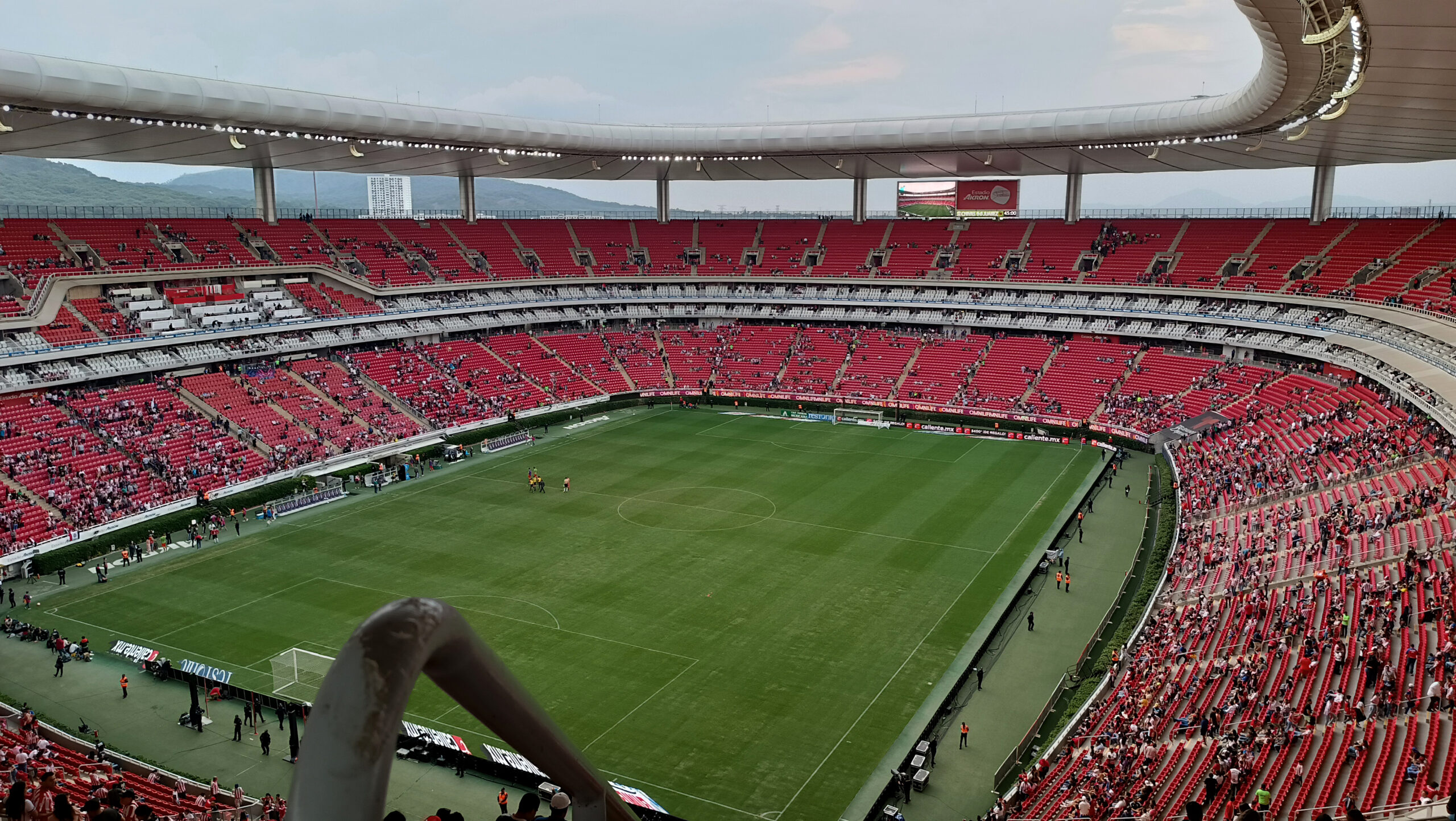
Photo: Alejan98 / Wikimedia Commons / CC0
.jpg)
FIFA has a hard rule: no commercial sponsor names on stadiums during its flagship tournament. So “Estadio Akron,” named for the tire and auto parts company, gets a temporary rechristening. For the tournament duration, all official signage, broadcasts, and ticketing will use Estadio Guadalajara.
This isn’t new. It happened in 2010 with the “FIFA World Cup Stadium Durban” (normally Moses Mabhida Stadium) and in 2014 with the “Estadio Nacional” in Brasília. The naming rights revert to Akron after the final whistle of the last match. It causes confusion every time. Your ticket, your transport app, and the local news will all say Guadalajara. The locals, and your ride-share driver, will still call it Akron.
The stadium’s official, non-commercial name for the 2026 FIFA World Cup will be Estadio Guadalajara. This is a standard FIFA protocol applied to all venues with corporate naming rights to ensure a clean, tournament-branded environment for global broadcast.
Don’t waste time arguing with a taxi driver. Use both names. I learned this the hard way in Johannesburg trying to get to “Soccer City” when everyone knew it as “FNB Stadium.” You adapt.
Inside the stadium: seating, capacity, and the view
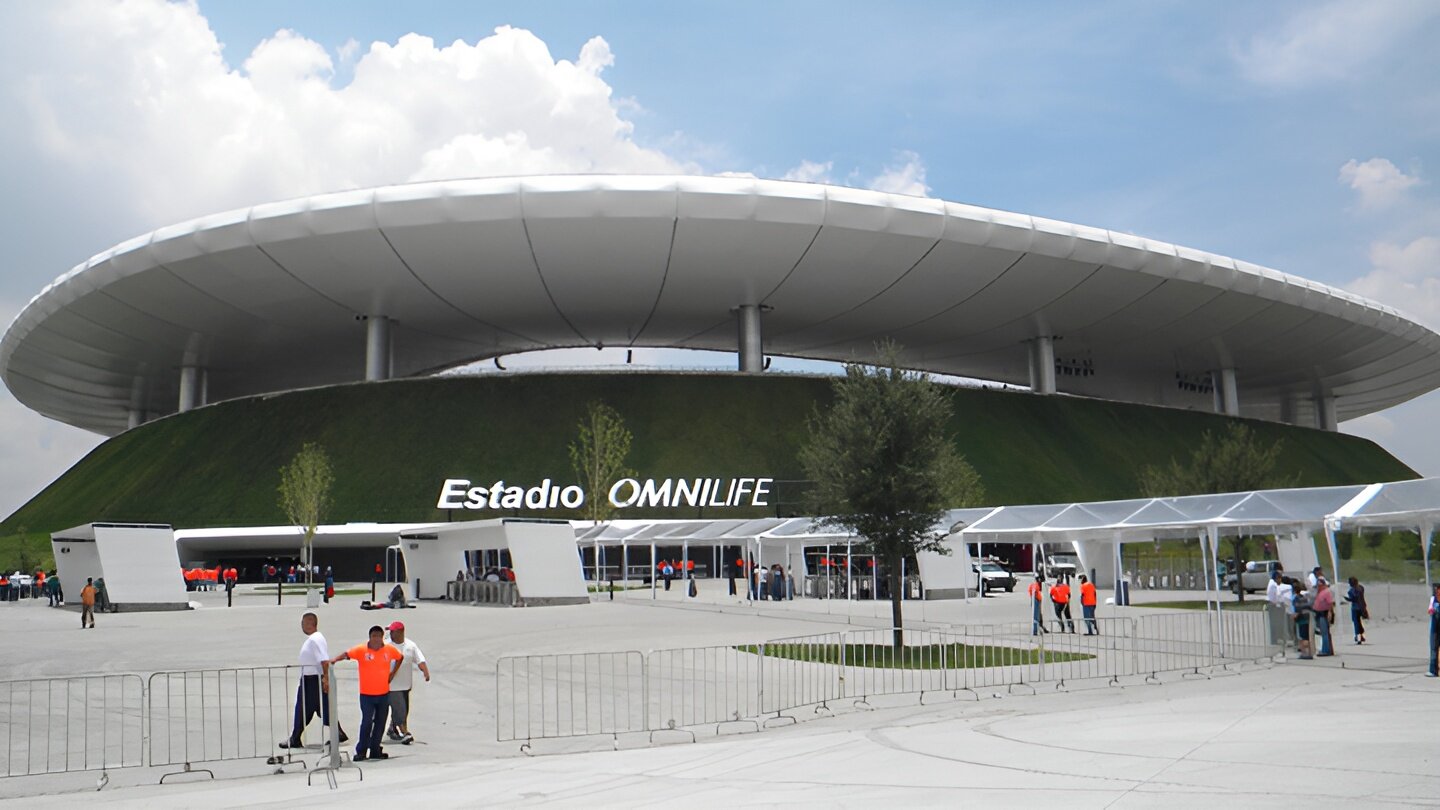
Photo: Juan Olivas / Wikimedia Commons / CC BY 2.0

Built in 2010 for Club Deportivo Guadalajara (Chivas), the stadium is modern but feels compact. The seated capacity for the World Cup is set at 48,000. That makes it the second-smallest venue in the entire tournament and the smallest of the three in Mexico. For comparison, Estadio Azteca in Mexico City holds 83,000.
The design is distinctive. A grassy berm wraps around the outside, making it look like a hill from a distance. Inside, it’s a steep, continuous red bowl. There are no obstructing columns. The sightlines are universally good because of the single-tier design on the sides and a steeper second tier behind the goals.
The roof is a lightweight, cloud-like canopy that covers most seats. It provides shade but doesn’t fully enclose the bowl, which allows for natural ventilation. On a hot June afternoon, that airflow matters. The pitch is a hybrid grass system, maintained to FIFA’s highest standards.
Where you sit changes the experience.
– Lower Tier (Sides): Best for feeling the game’s speed and hearing the players. You’re close to the pitch, but the angle can be low for seeing tactical shapes develop.
– Upper Tier (Behind Goals): The party sections. This is where the chanting is loudest and most continuous. The view is more panoramic, perfect for watching off-the-ball movement and team soccer tactics.
– Mid-Level (Corner Flags): My personal pick. You get elevation to see patterns, but you’re still close enough to feel the crowd’s energy. It’s the balanced view.
TL;DR: 48,000 seats, all with clear views. The red bowl design feels intimate. Choose sides for detail, choose behind goals for atmosphere, choose corners for the best mix.
Getting there and getting in: a matchday survival guide
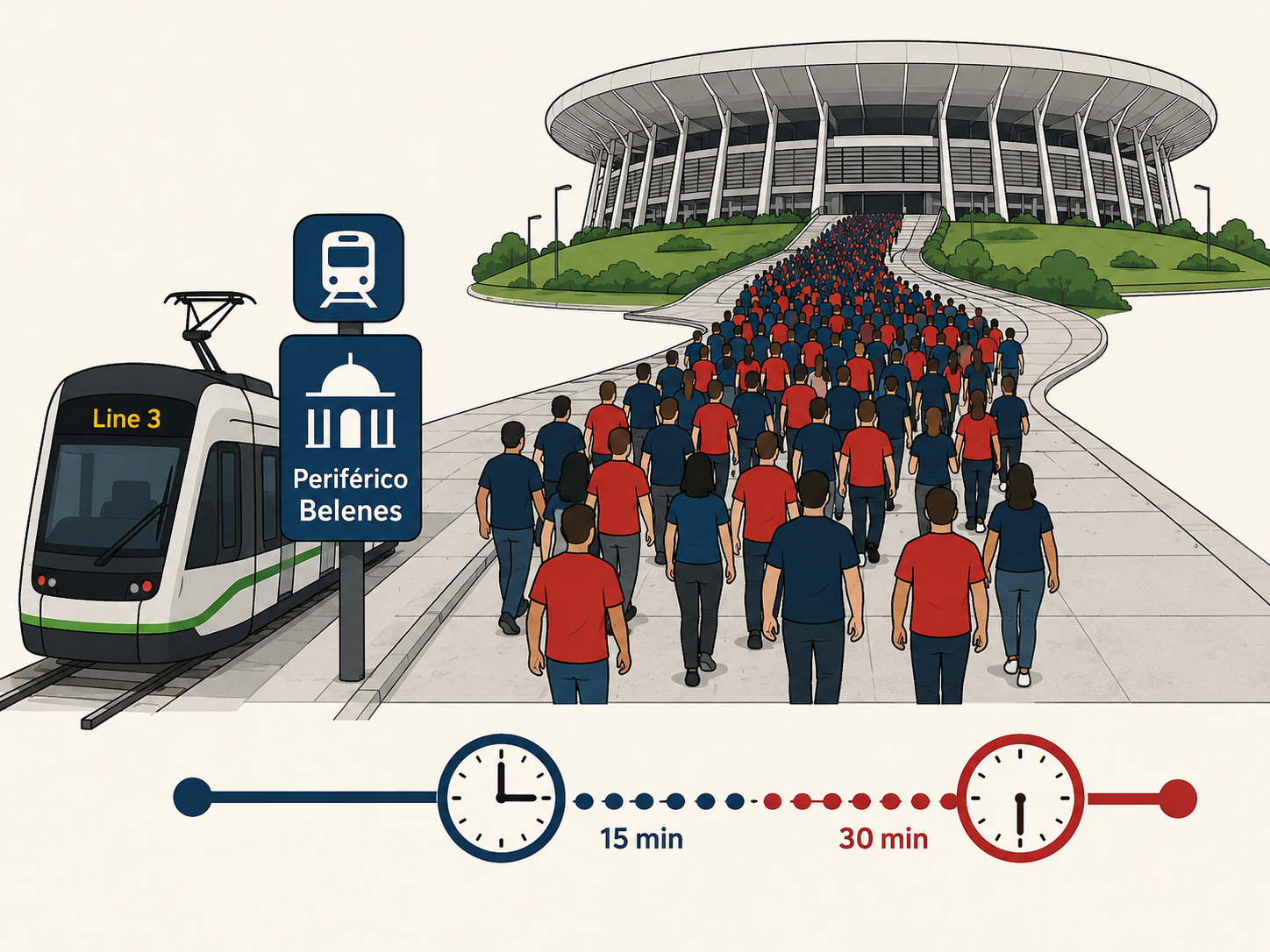
Guadalajara’s metro system, the Tren Ligero, is your best friend. Line 3 has a station (Periférico Belenes) that’s about a 15-minute walk from the stadium. On a normal day. On matchday, that walk becomes a 30-minute shuffle within a river of people. The trains will be packed solid for hours before and after the game.
If you’re driving, forget it. The dedicated parking is limited and expensive, and the surrounding streets in Zapopan are a maze of closed roads and restricted access. A rental car becomes a very expensive paperweight.
Before you start: Arrive at the stadium complex at least three hours before kickoff. Security lines for the Mexico match will stretch for blocks. Bring only a small, clear bag as per FIFA’s stadium policy — backpacks and large purses will be turned away at the gate, sending you on a long walk back to your hotel.
The bag policy is strict and non-negotiable. It’s the same one used at major events across North America. A small clutch or a clear plastic bag no larger than 12″ x 6″ x 12″. That’s it. They aren’t joking. I’ve seen people in tears at the gate after a 90-minute walk because they had a normal handbag.
Inside, the concourses are wide. The food is standard stadium fare—think tacos, hot dogs, nachos—but the beer is cold and the bathrooms are plentiful. Payment is mostly cashless. Bring a credit card or buy a stadium gift card. Vendors will not have change for large bills.
Leaving is its own project. Everyone funnels back to the Periférico Belenes station. The crowd crush can be intense. My advice? If you’re not in a hurry, find a spot in the stadium plaza, have another drink, and let the main wave pass. Or, walk 20 minutes in the opposite direction towards Zapopan centro to find a taxi.
Matchday experience in Guadalajara
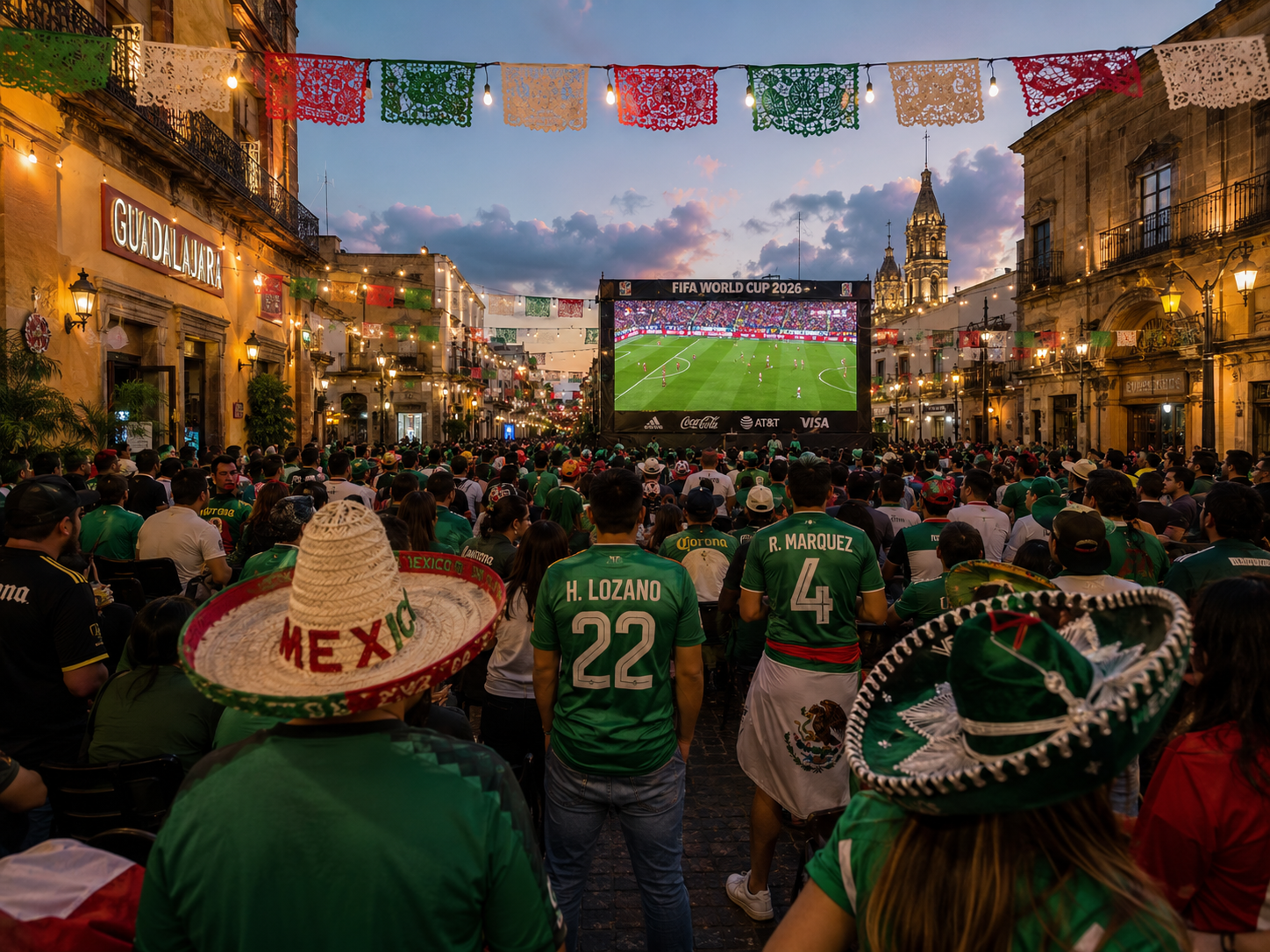
The city doesn’t just host a game; it throws a month-long festival. The entire historic center, the centro histórico, transforms. Expect fan zones with giant screens, food stalls, live music, and street performers. The atmosphere is less corporate than you’d find in the U.S. host cities and more purely about the celebration of football.
For the Mexico match, the city will be a sea of green. The energy is contagious, but it also means everything is crowded. Restaurants are packed, bars have lines out the door, and the mercados are buzzing. Book every meal reservation you can weeks in advance.
The week between matches (June 19-22) is a great time to explore. Take a day trip to Tequila. Wander the Instituto Cultural Cabañas. Eat torta ahogada until you can’t move. The city’s rhythm slows back down just enough to catch your breath before the next matchday rush.
This tournament will test a player’s athletic performance and player recovery routines, with matches in varying climates. For fans, it’s a test of endurance too. Pace yourself.
How Estadio Akron compares to other Mexican venues
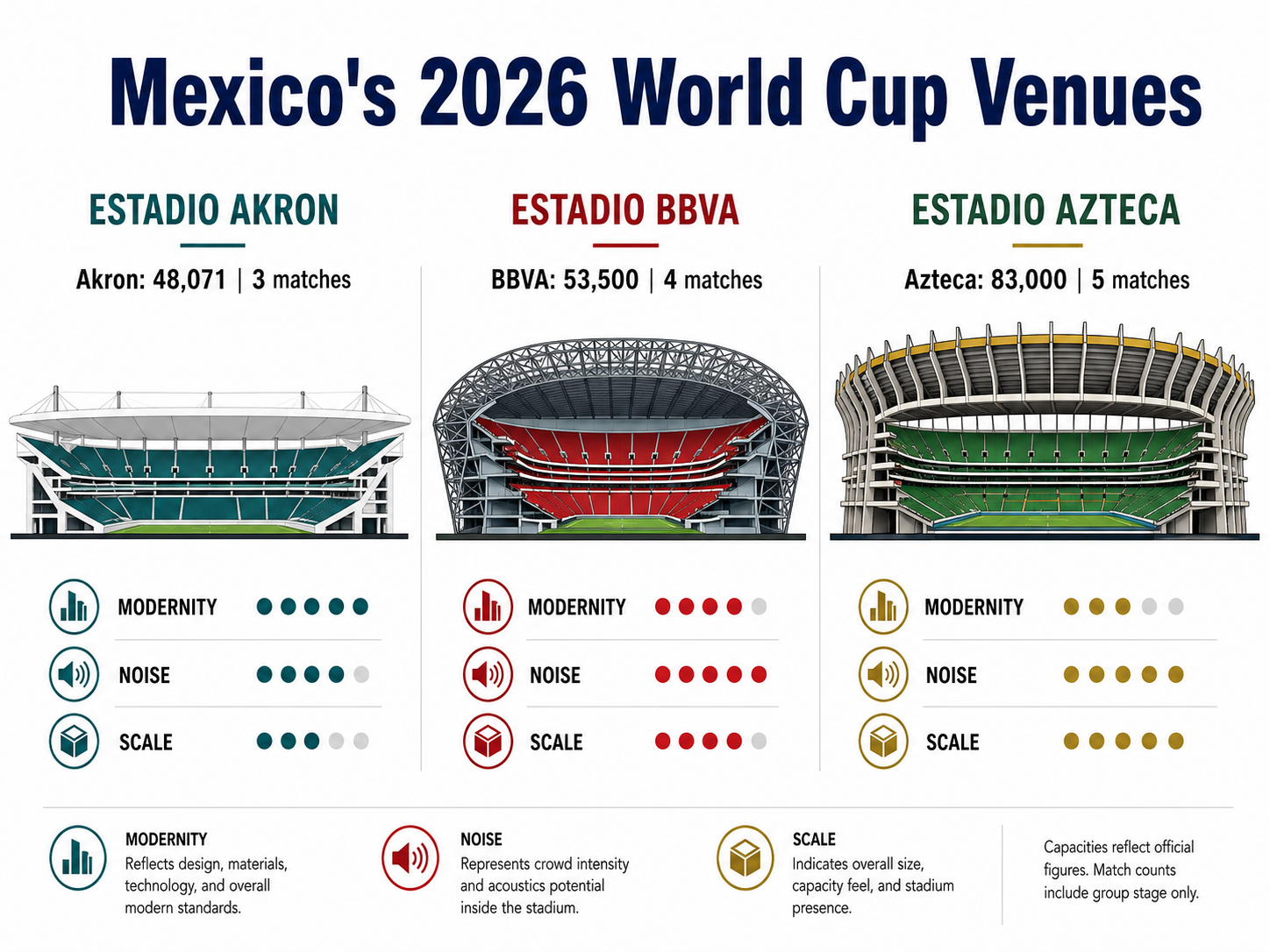
Mexico’s three host stadiums offer three different worlds. Estadio Akron is the modern, intimate, and efficient option.
Estadio BBVA in Monterrey (capacity 53,500) is the other modern venue, but with a steeper, more enclosed bowl and an industrial steel aesthetic. It gets one more match (four total, including a Round of 32 game) and will be louder, but perhaps less breezy. Its modern formations of concrete and steel feel imposing.
Then there’s the giant: Estadio Azteca in Mexico City. Capacity 83,000. History oozing from every seat. It’s getting five matches, including a quarterfinal. The altitude (7,200 feet) is a real factor that influences tournament strategies. The scale is monumental, but so are the lines and the distance from the pitch if you’re in the upper tier.
| Venue | City | WC 2026 Capacity | Matches | Vibe |
|---|---|---|---|---|
| Estadio Akron (Guadalajara) | Zapopan, Jalisco | 48,000 | 4 Group Stage | Modern, intimate, fan-friendly. |
| Estadio BBVA (Monterrey) | Monterrey, Nuevo León | 53,500 | 3 Group + 1 Round of 32 | Loud, steep, industrial modern. |
| Estadio Azteca (Mexico City) | Mexico City | 83,000 | 5 Group + Knockout | Historic, immense, high-altitude challenge. |
Choosing which venue to visit comes down to taste. Want history and scale? Azteca. Want a loud, intense cauldron? Monterrey. Want a comfortable, modern stadium where you can see the game clearly and get around easily? That’s Akron.
The legacy of hosting
For Guadalajara, this is a chance to shine on a global stage again. The city hosted matches in 1970 and 1986, but the facilities and the world have changed. The 2026 tournament will leave behind upgraded infrastructure, from the Tren Ligero to the stadium’s own broadcast and hospitality facilities.
For the stadium itself, it’s a final stamp of approval. It’s been a top-tier Liga MX venue for over a decade. Hosting the World Cup cements its status as a modern football cathedral. The grass-covered roof and sustainable design will be broadcast to billions.
Mostly, it’s about the memories. For the players, it’s another line on their career resume. For fans, it’s where they saw their national team play on the biggest stage. For a kid in Zapopan, it’s the moment football came home. That lasts longer than any temporary name change.
Frequently Asked Questions
What is the capacity of Estadio Akron for the World Cup?
The seated capacity for the 2026 FIFA World Cup will be 48,000. This makes it the smallest of the three Mexican host stadiums.
Why is it called Estadio Guadalajara for the World Cup?
FIFA regulations prohibit commercial sponsor names during its tournaments. Since “Akron” is a corporate sponsor, the venue is temporarily renamed “Estadio Guadalajara” for all official World Cup communications and signage.
How do I get to Estadio Akron on matchday?
Take Guadalajara’s Tren Ligero (metro) Line 3 to the Periférico Belenes station. From there, it’s a 15-30 minute walk with the crowd. Driving is strongly discouraged due to road closures and extremely limited parking.
Can I bring a backpack into the stadium?
No. FIFA’s clear bag policy will be strictly enforced. You can only bring a small clutch or a clear plastic/vinyl bag no larger than 12″x6″x12″. Standard backpacks, purses, and coolers are not permitted.
What time should I arrive for a match?
Plan to arrive at the stadium perimeter at least three hours before kickoff. For the Mexico vs. Korea Republic match on June 18, consider adding an extra 30 minutes due to the immense crowd and heightened security.
Will there be extra time if a match is tied?
Yes, any knockout stage match that is tied after 90 minutes would proceed to 30 minutes of extra time rules. However, Estadio Akron is only scheduled to host group stage matches, where draws are allowed and no extra time is played.
Before You Go
The four matches at Estadio Akron offer a mix of strategic group openers and one massive continental showdown with Mexico. Knowing the schedule is step one. Step two is accepting that the experience is defined by the crowd, the heat, and the city’s infectious energy.
Get your tickets early, especially for the Mexico game. Book a hotel on the metro line. Pack sunscreen, a hat, and a clear bag. Then, show up early and just go with the flow. The stadium itself is a gem—modern, loud, and with great sightlines. It’s built for this.
Guadalajara will do the rest. The food, the music, the sheer joy in the streets around the stadium is what you’ll remember long after the final whistle. Just make sure you’re not still in line when the game starts.
I come from the “soccer heart” of Germany, the Ruhrpott. I have played, trained and followed soccer all my life and am a big fan of FC Schalke 04. I also enjoy following international soccer extensively.