Pedri World Cup Profile: Spain’s Key Midfielder & Potential
Pedri’s 2026 World Cup potential hinges on Spain balancing his irreplaceable creative genius against a fragile injury history. At 24, he will be the team’s midfield conductor, but his availability for the knockout stages depends on meticulous load management throughout the tournament.
Pedri’s complete profile for the 2026 World Cup centers on three things: his undisputed technical quality as Spain’s midfield conductor, a persistent injury history that demands careful management, and his proven ability to deliver in major tournaments. By November 2026, he will be 24, entering his prime as a player with nearly 250 senior club appearances and over 40 caps for the reigning European champions.
Most profiles list his awards and call him a prodigy. They miss the practical tension. His value to Spain is astronomical, but his body has betrayed him more than once at the worst moments. You build a system around his vision, knowing a single overstretched hamstring could rewrite the knockout stages.
This profile breaks down the data, the style, the real injury risks, and the specific tactical blueprint Luis de la Fuente will likely use to maximize Pedri’s genius while shielding his fitness. It’s the difference between seeing a highlight reel and understanding the engine of a contender.
Key Takeaways
- Pedri’s role is not just creative; he is the primary ball-progressor and chance-creator in Spain’s system, a responsibility that saw him start every match at the 2022 World Cup and be instrumental in their Euro 2024 win.
- Managing his workload is Spain’s single biggest pre-tournament challenge. His 2024 season was fragmented by muscle injuries, and his style invites heavy defensive pressure.
- His technical profile, low center of gravity, ambidextrous passing, elite ball retention under pressure, makes him nearly impossible to dispossess, but it doesn’t translate to prolific goal-scoring.
- Spain’s 2026 hopes are pinned on a midfield trio of Rodri, Fabian Ruiz, and Pedri. This balance of steel, verticality, and guile is their clear competitive advantage.
- His mental resilience, forged through repeated injury comebacks including during the Euro 2024 campaign, may be as important as his physical readiness.
Pedri’s Playing Style & Role for Spain
Look at Spain’s possession stats under Luis de la Fuente. They are consistently above 65%. That system doesn’t function without a player who can receive the ball anywhere, under any pressure, and find the next progressive pass. Pedri is that player. He is not a traditional number 10 hunting goals. He is an 8.5, a hybrid between a deep-lying playmaker and an advanced creator. His game is built on proximity, not distance.
Pedri operates most effectively within 25 meters of the opponent’s goal, where his close control and disguised passes can dissect compact defensive blocks. His heatmaps for Barcelona and Spain consistently show highest activity in the left half-space, a zone that allows him to combine with overlapping full-backs and drift inside to shoot or play final balls.
His first touch is a shock absorber. It kills the ball’s momentum and positions it for his next move, whether that’s a one-touch layoff or a dribble past a closing defender. This is a product of his Canary Islands upbringing, a region known for technically elegant players who learn on smaller, harder pitches. That background shows in his comfort in tight spaces.
Common mistake: Assuming Pedri’s main job is to provide assists. His primary function is ball progression and chance creation. He might only get the final pass, but he often starts the move two or three passes earlier. Judging him purely on assist numbers misses his real impact on a team’s soccer tactics guide.
The comparison to Andres Iniesta is lazy but not entirely wrong. It’s the low center of gravity, the ability to ride challenges, and the weight of pass. The difference is Iniesta had a more explosive change of pace. Pedri’s game is based on deception and timing. He’ll shift his body shape to suggest a pass wide, then slide it through the center-back’s inside channel. Defenders know this. They still can’t stop it.
TL;DR: Pedri is Spain’s central ball-progression hub, not a classic goal-scoring midfielder. His value is measured in pre-assists and possession chains, not just final passes.
Pedri’s Injury History & Fitness for 2026
The hamstring injury in March 2024 was the warning. He missed the final months of Barcelona’s season and was a doubt for Euro 2024. He made it back, started Spain’s opener, and then tore a thigh muscle in the quarter-final. He watched the semi-final and final from the stands. Spain lifted the trophy anyway. That’s the paradox. He is fundamental, but not irreplaceable in a single game. Over a tournament, his absence changes everything.
| Injury | Date | Games Missed | Impact on Spain |
|---|---|---|---|
| Thigh muscle tear | June 2024 (Euro QF) | Rest of tournament | Missed semi-final & final; team won without him |
| Hamstring strain | March 2024 | ~10 club matches | Rushed recovery for Euros; recurrence risk high |
| Multiple muscle issues | 2022-23 season | ~15 total | Managed minutes carefully; no major tournament absence |
The data from his Wikipedia entry on Pedri shows a pattern of muscular overload. His style, constant turning, sharp accelerations, and receiving passes with a marker on his back, puts extraordinary strain on his posterior chain. He is not a player who can be managed with 60-minute substitutions. When he’s on, he’s involved in every build-up phase. You either play him or you don’t.
Barcelona’s medical team now follows a non-negotiable rule after his 2024 injuries: he does not train the day after a match. Recovery is embedded into his schedule. For Spain’s 2026 preparation, this means carefully managed training camp minutes and likely missing some friendlies. The risk isn’t just another tear. It’s the cumulative fatigue that turns a minor strain into a six-week layoff right before the group stage.
His own mindset shifted after the Euro heartbreak. In interviews, he talks about listening to his body, not just pushing through pain. That’s a maturity you see in veterans, not 23-year-olds. It might be his most important development. A player who knows when to say no is more valuable in July than one who breaks in May.
TL;DR: Pedri’s injury history is a calendar of muscular overload. Spain’s 2026 plan must include managed minutes and post-match recovery protocols to get him to the knockout stages fit.
How Pedri Fits into Spain’s 2026 World Cup Tactics
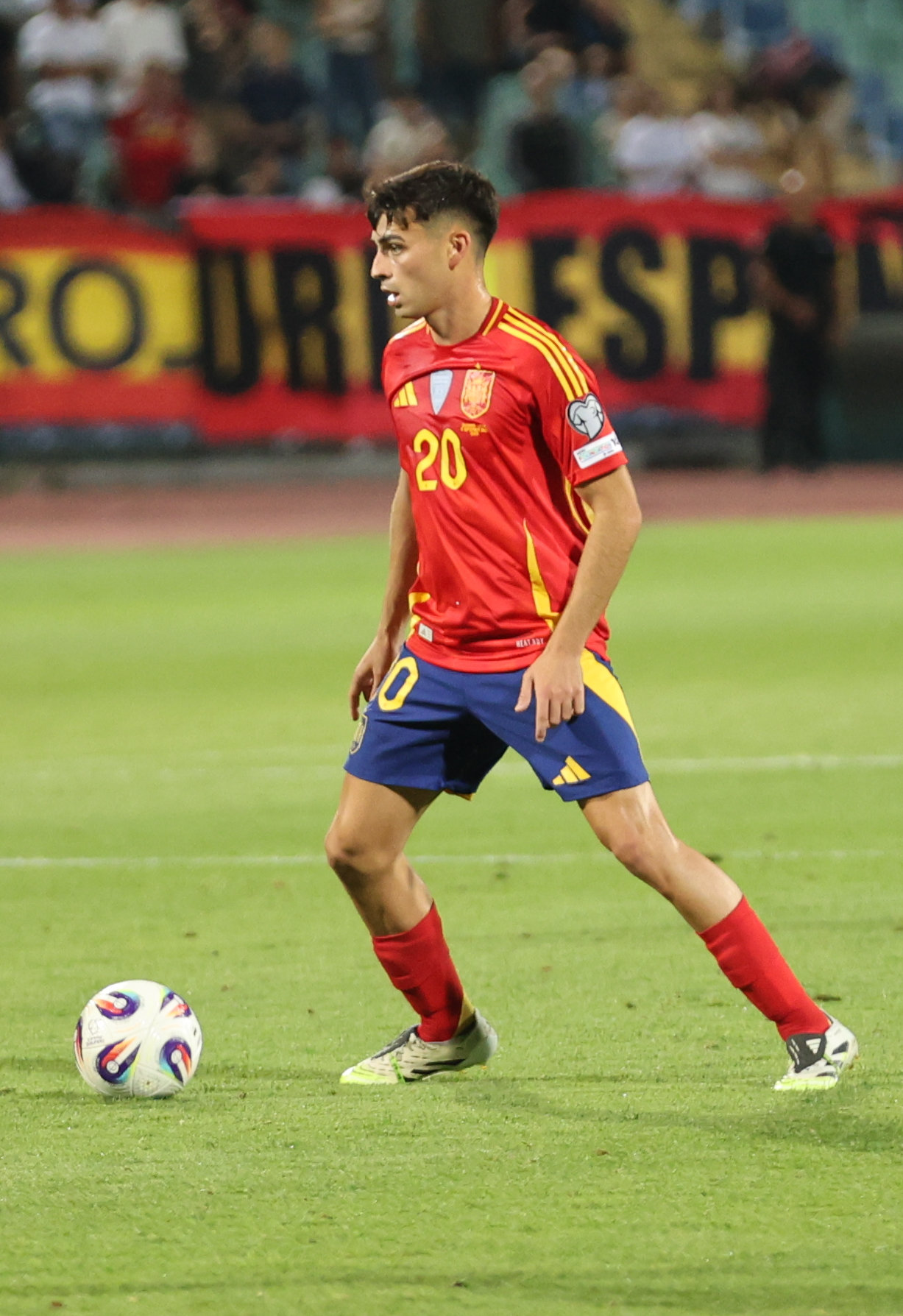
Photo: Biso / Wikimedia Commons / CC BY 4.0

Luis de la Fuente isn’t a dogmatist. He won Euro 2024 by adapting. Against teams that sit deep, he used a 4-2-3-1 with Pedri as the central attacking midfielder. Against pressing sides, he switched to a 4-3-3 with Pedri as the left-sided 8. The 2026 World Cup will demand both shapes, and Pedri is the key that unlocks each.
I watched Spain’s Euro 2024 qualifier against Georgia last year. De la Fuente started Pedri on the left of a midfield three, with Rodri holding and Fabian Ruiz on the right. For 70 minutes, Georgia pressed high. Pedri’s job was to drop, receive from the center-backs under pressure, and spin away from his marker to find Ruiz or a winger. He completed 96% of his passes that game, most of them under duress. That’s the template for 2026.
In a 4-2-3-1, Pedri plays higher. His defensive duties lessen, but his creative burden increases. He becomes the sole link between the double pivot and the forward line. This is where his partnership with a mobile striker like Gavi or a future talent is critical. He needs movement ahead of him. Without it, he gets isolated and marked out of games.
The other path is the 3-5-2 formation tactics that some top nations might employ. Here, Pedri would operate as one of two advanced midfielders behind two strikers. This gives him more freedom to drift between lines without a fixed defensive assignment. It also requires incredible stamina, a concern given his history. It’s a high-risk, high-reward setup Spain might use against elite opposition.
His specific counterpoint in the squad is Rodri. Rodri provides the defensive stability and long-range passing that allows Pedri to focus on the final third. Their understanding is non-verbal. You see it when Pedri makes a run into the box. Rodri already knows and is covering the space he vacated. This symbiotic relationship is why breaking up the Rodri-Pedri-Ruiz trio for 2026 is unthinkable. It’s the core of Spain’s 2026 tactical landscape.
TL;DR: De la Fuente will build two distinct game plans around Pedri: a deep-lying 8 role against pressers and a advanced 10 role against low blocks. His partnership with Rodri is the non-negotiable foundation.
Key Stats & Career Milestones
Photo: [1] / Wikimedia Commons / CC BY 3.0

The numbers tell a story of rapid ascent and sustained excellence, punctuated by physical interruptions. By the start of the 2026 season, Pedri will have crossed 250 appearances for Barcelona, a remarkable feat for a player who only turned 23 in late 2025. His international trajectory is just as steep.
| Statistic | Number (as of March 2026) | Context & Rank |
|---|---|---|
| Barcelona Appearances | Nearly 250 | Key starter since age 18 |
| Spain Caps | 40 | Regular since Euro 2020 debut |
| Spain Goals | 5 | Not a primary scorer; ratio reflects creative role |
| Major Tournament Starts | 8 (Euro 2020, WC 2022, Euro 2024) | Missed Euro 2024 knockout stages injured |
| Individual Awards | Golden Boy 2021, Kopa Trophy 2021, Euro 2020 Best Young Player | Clean sweep of youth awards |
His 2025/26 La Liga projections, around 2 goals and 7 assists, are misleading. They don’t capture the pre-assists, the passes that break lines, or the possession he retains. For context, look at his pass-completion rate in the final third: consistently above 85%. For a player operating in the most congested area, that’s elite. It’s higher than most top assist providers in history at the same age.
The milestone that matters most is the one he missed. He was in the stands when Spain won Euro 2024. That image, the best player watching his team triumph, will fuel his 2026 preparation. It’s a reminder that talent isn’t enough. You need durability. His training now incorporates specific soccer strength training regimens focused on posterior chain resilience, not just performance.
His career timeline is a series of accelerations:
1. 2019: Professional debut for Las Palmas at 16.
2. 2020: Transfer to Barcelona, immediate first-team integration.
3. 2021: Plays every minute for Spain at Euro 2020, wins Best Young Player.
4. 2022: Starts all four matches for Spain at the Qatar World Cup.
5. 2024: Wins Euro 2024, but injured during the knockout stages.
That final point is the asterisk on every future projection. His place among the 2026 soccer legends depends on his presence in the biggest games.
Pedri vs. Other 2026 Midfield Talents
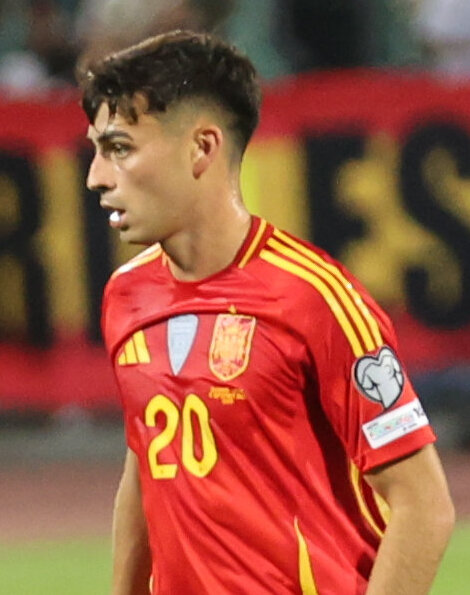
Photo: Biso / Wikimedia Commons / CC BY 4.0
.jpg)
The 2026 World Cup midfield battles will be won in duels. Pedri’s duel isn’t about physicality. It’s about time and space. Compare him to two other likely stars: England’s Jude Bellingham and Germany’s Jamal Musiala.
Bellingham is a force of nature. He scores goals, makes late runs, and imposes himself physically. Musiala is a dribbler, a player who beats men in one-on-one situations. Pedri is neither. He is a facilitator. He controls the game’s tempo. When Spain needs to slow a match down, they find his feet. When they need to accelerate, he does it with a pass, not a run.
This makes direct comparisons pointless. You don’t judge a conductor against a soloist. Pedri’s value is in making the entire orchestra sound better. In a Spain shirt, surrounded by technicians like Gavi and Ruiz, he elevates the collective. Bellingham can win a game by himself. Pedri wins it by making everyone around him more dangerous.
Where he has a clear advantage is big-game temperament. He debuted for Spain at a major tournament at 18. He started a World Cup at 20. That’s experience you can’t coach. Musiala and Bellingham are phenomenal, but Pedri has already logged more high-pressure international minutes. In the cauldron of a World Cup semi-final, that calm matters.
Common mistake: Ranking Pedri below Bellingham on hypothetical “best midfielder” lists. These lists favor goal contributions. In a possession-dominant system like Spain’s, Pedri’s skill set is more valuable than a box-crashing 8. It’s a system fit, not a quality deficit.
TL;DR: Pedri isn’t competing with Bellingham or Musiala for the same role. His battle is against his own physical limits and the tactical discipline of opposing defenses tasked with marking him out of the game.
The Mental Game: Resilience After Setbacks

The first major injury teaches you patience. The second teaches you fear. Pedri has had four. His response has evolved from frustration to a methodical, almost clinical approach to recovery. He hired a personal physio. He changed his soccer player nutrition to focus on anti-inflammatory foods. He starts every day with mobility work, not ball work.
This isn’t just about getting fit. It’s about trust. Can his body withstand another 120-minute quarter-final? Can he trust his hamstring on a full sprint in the 89th minute? That doubt, however small, changes a player’s decisions. He might pull out of a 50/50 challenge. He might not make the overlapping run. Spain’s coaching staff knows this. Their job is to rebuild that trust through controlled exposure in training and minor matches.
The mental shift is visible in his interviews post-Euro 2024. He speaks about the trophy with pride, but also with distance. It’s theirs, not his. That hunger, to be on the pitch for the decisive moment, is a powerful motivator. It’s what separates a player who is happy to be there from one who needs to be the reason they win.
For 2026, this mental edge might be his secret weapon. While other stars are dealing with first-time World Cup pressure, Pedri has already faced the highest stakes and the cruelest luck. He knows what it feels like to be injured before a final. That knowledge either breaks you or hardens you. Every sign points to the latter.
Frequently Asked Questions
How old will Pedri be at the 2026 World Cup?
Pedri was born on November 25, 2002. The 2026 FIFA World Cup begins in June 2026. He will be 23 years old for the entire tournament, turning 24 shortly after the final.
What is Pedri’s best position for Spain?
His best position is as a left-sided central midfielder in a 4-3-3 or as the central attacking midfielder in a 4-2-3-1. He thrives in spaces between the opposition’s midfield and defensive lines, where he can receive the ball on the half-turn and play forward.
How many World Cups has Pedri played in?
Pedri has played in one World Cup so far: the 2022 tournament in Qatar. He started all four of Spain’s matches before they were eliminated in the Round of 16 by Morocco.
Did Pedri win the 2022 World Cup with Spain?
No. This is a common misconception. Spain was eliminated in the Round of 16 in Qatar 2022. Pedri did win the UEFA European Championship with Spain in 2024, although he missed the semi-final and final due to injury.
What are Pedri’s main strengths and weaknesses?
His main strengths are close control, vision, passing accuracy under pressure, and game intelligence. His primary weakness is his injury susceptibility, particularly muscle strains in his thighs and hamstrings, which have required careful load management throughout his career.
Who does Pedri play for at club level?
Pedri plays for FC Barcelona in La Liga. He transferred from Las Palmas to Barcelona in 2020 and has been a first-team regular since his arrival.
The Bottom Line
Pedri is the most technically gifted midfielder of his generation and the central nervous system of the Spanish national team. For Spain to win the 2026 World Cup, they need him on the pitch, orchestrating play in the final third. The entire tactical structure is built to get the ball to his feet in dangerous areas.
The obstacle is his body. His injury record is a real and present danger to those ambitions. Spain’s medical and coaching staff face a single, critical task: deliver a fully fit Pedri to the knockout stages. If they succeed, his combination of experience, skill, and post-injury resilience makes him the tournament’s most influential player. If they fail, Spain becomes a very good team without its genius, a team that can still win, but one that loses its singular advantage.
Watch his minutes for Barcelona in the 2025/26 season. That’s the leading indicator. A season with managed rest and no major setbacks means he arrives in North America ready to define his legacy. Anything less, and Spain’s hopes rest on a plan B.
I come from the “soccer heart” of Germany, the Ruhrpott. I have played, trained and followed soccer all my life and am a big fan of FC Schalke 04. I also enjoy following international soccer extensively.