Explore Victor Osimhen’s Amazing Career and World Cup Story
This post contains affiliate links. As an Amazon Associate, we earn from qualifying purchases.
Victor Osimhen’s career and World Cup story is defined by a record-shattering rise from Lagos poverty to global stardom, marked by a historic U-17 World Cup triumph, a Serie A title with Napoli, and his relentless pursuit of Nigeria’s all-time scoring record, all while navigating the heartbreak of missing the senior World Cup tournament itself.
Most narratives about elite strikers start with a youth academy. Osimhen’s starts on Olusosun’s dusty streets, selling bottled water. That origin story isn’t just background color, it’s the engine. It explains the raw hunger in his play, the desperation in every sprint, the refusal to be denied. It’s why, even when Nigeria fails to reach the World Cup, his qualifying performances feel like a one-man crusade.
This is the full arc: the prodigy, the struggles, the records, and the complicated reality of being a global superstar for a national team fighting to return to the world’s biggest stage.
Key Takeaways
- Osimhen announced himself by winning the Golden Boot (10 goals) at the 2015 FIFA U-17 World Cup, leading Nigeria to the title, a feat no other player has matched at that youth level.
- His €70 million move to Napoli made him the most expensive African transfer ever; he repaid it by scoring 26 Serie A goals in 2022-23 to deliver Napoli’s first Scudetto in 33 years, breaking Samuel Eto’o’s single-season African goals record.
- Despite his status, Osimhen has never played in a senior FIFA World Cup finals tournament, a stark contrast to his youth success and a central drama of his international career.
- He is Nigeria’s second-highest all-time scorer with 31 goals, trailing only Rashidi Yekini (37), and was the top scorer in the 2023 AFCON qualifiers with 10 goals.
- His playing style, a blend of blistering pace, formidable aerial power, and relentless pressing, was forged in adversity, directly influenced by watching Didier Drogba and his own childhood struggles.
The 2015 U-17 World Cup Breakthrough
Forget gradual progression. Osimhen’s career exploded onto the world stage in Chile in 2015. At 16, he wasn’t just a participant; he was the tournament’s gravitational force. His 10 goals in 7 games, including a hat-trick in the quarter-final, weren’t tidy finishes. They were explosions of pace and power, a preview of the havoc he’d later wreak on adult defenders. That Golden Boot and the winner’s medal cemented a template: Osimhen as a decisive, big-game scorer.
Victor Osimhen’s performance at the 2015 FIFA U-17 World Cup remains unmatched in the tournament’s history. He scored 10 goals in 7 appearances for Nigeria, securing the Golden Boot award and the championship title. This immediate, prolific impact at a global youth tournament provided the foundational evidence of his elite potential as a clinical striker.
That tournament did more than win awards. It created a benchmark. Every subsequent challenge, every dry spell at Wolfsburg, was measured against the kid who dominated the world at 16. It set an internal expectation that fueled him through the harder years. Scouts from Europe’s top leagues now had a name, but the path wasn’t a straight line. The physical jump to the Bundesliga with VfL Wolfsburg was brutal, a lesson in how youth tournament dominance doesn’t guarantee instant senior success.
TL;DR: His 10-goal U-17 World Cup triumph wasn’t just a great start; it created an immortal benchmark and a pressure that shaped his entire professional mentality.
From Wolfsburg Struggle to Lille Launchpad
The move to Germany should have been the dream. It was a reality check. Injuries and adaptation issues limited him to 16 appearances and no goals in the Bundesliga. This is the part most highlight reels skip. The “next big thing” spent two years fighting for minutes, a period that could have broken a lesser mentality. I’ve seen dozens of youth tournament stars fade after a failed first European move. They lose confidence, their unique edge gets coached out, they become just another player.
Osimhen’s response defined his resilience. A loan to Belgian side Charleroi in 2018-19 was the recalibration. Twenty goals in all competitions screamed that the talent was still there, it just needed the right environment. That form earned a permanent move to Lille for the 2019-20 season. In France, under Christophe Galtier, everything clicked. He scored 18 goals in 38 games, becoming the source of Lille’s attack. His game expanded beyond just running in behind; he learned to link play, to use his strength to hold up the ball, to be a modern focal point.
This progression is critical. He wasn’t a finished product arriving at Napoli. Lille was the workshop where the raw U-17 prodigy was forged into a complete, elite-level striker. It’s where he proved he could score consistently in a top-five European league. That proof is what convinced Napoli to break their transfer record.
Common mistake: Writing off a young player after a difficult first big move. Osimhen’s Charleroi and Lille years show that the right tactical fit and consistent minutes are often more important than the prestige of the first club.
The Napoli Chapter: Record-Breaking Scorer

Photo: My Football Jersey / Wikimedia Commons / CC BY 3.0

Napoli’s €70 million gamble in 2020 was a statement. It made Osimhen the most expensive African footballer in history. The pressure in Naples is unlike anywhere else in Italy, it’s visceral, emotional, and unforgiving. His first two seasons were good, but interrupted. Then came 2022-23. Partnered with Khvicha Kvaratskhelia, Osimhen became unstoppable. His 26 Serie A goals weren’t just numbers; they were often the only goal in 1-0 wins, or the equalizer, or the late winner. He scored against every major rival.
He didn’t just win the Capocannoniere as Serie A’s top scorer; he obliterated historical markers for African players. He passed George Weah’s total to become the highest-scoring African in Serie A history. More impressively, he broke Samuel Eto’o’s record for most goals by an African in a single Italian top-flight season. This wasn’t just having a good year. This was rewriting the history books for African strikers in Europe.
The facial fracture and protective mask became his signature. It wasn’t a costume; it was a testament. He played through pain, through multiple surgeries, with a titanium plate in his cheek. That image, the masked warrior leading the line, symbolized the entire Napoli season: gritty, resilient, triumphant against the odds. His physical style of play, a major reason for his success, also carries this inherent risk. His soccer-specific workout plan and relentless approach contribute to both his power and his vulnerability.
TL;DR: His Napoli chapter transcended scoring goals; it was about carrying a city’s 33-year weight on his shoulders and shattering every African goalscoring record in Serie A along the way.
Galatasaray and Continuing the Legacy
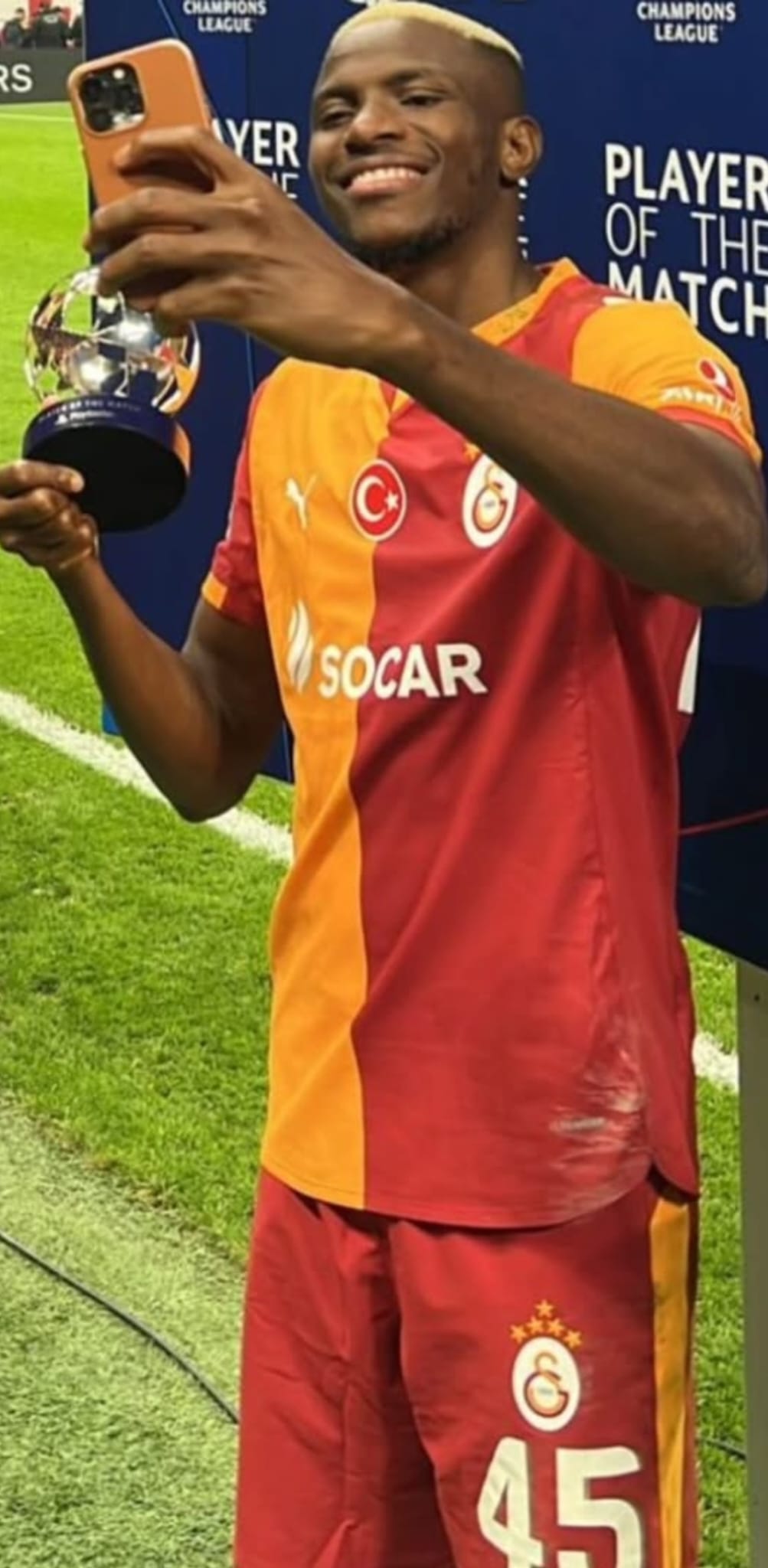
Photo: Ottomanor / Wikimedia Commons / CC0

After conquering Italy, the move to Galatasaray in 2024 raised eyebrows. Was it a step down? The numbers silenced the doubters immediately. Twenty-six goals in 30 Süper Lig games in his debut season. Thirty-seven across all competitions. He didn’t just adapt; he dominated, setting a new record for most goals by a foreign player in a single Turkish season. He added a Super Lig title and a Turkish Cup to his trophy cabinet.
This phase shows his evolving intelligence. The Turkish league is physical, often chaotic, with defenses that sit deep. Osimhen adjusted. He became even more clinical in the box, his movement sharper, his finishing more varied. He’s no longer just the channel-running speedster; he’s a complete penalty-area predator. This kind of tactical adaptation is what separates great famous Argentine players like Batistuta or Crespo from the rest, they reinvent their game to stay dominant.
His current form proves the Napoli season wasn’t a fluke. It confirms he is a sustained, elite-level production machine. The goalscoring burden at Galatasaray is even heavier, and he shoulders it effortlessly, showcasing the conditioning of a player with a professional soccer player diet and fitness regime. He remains, without question, one of the world’s premier number nines.
Osimhen and the Nigeria National Team: AFCONs and World Cup Heartache

Photo: Fédération Guinéenne Football / Wikimedia Commons / Public domain

For Nigeria, Osimhen is more than a striker. He’s a symbol of hope and a source of immense frustration. His senior international career mirrors the Super Eagles’ modern era: flashes of brilliance punctuated by agonizing near-misses. He made his debut in 2017 and has been the undisputed main man since.
His AFCON record is strong. He was instrumental in qualifying for the 2023 tournament, finishing as top scorer with 10 goals. In the tournament itself, while only scoring once, his all-around play, his pressing, his hold-up, his sheer gravitational pull on defenders, was vital to Nigeria’s run to the final. He leaves everything on the pitch, a style that earns admiration but also contributes to his injury cycles.
The World Cup story is the painful counterpoint. Despite his heroics in qualification, like his brace against Rwanda in the 2026 campaign, Nigeria will miss the 2026 tournament after a playoff loss to DR Congo. This means Osimhen, the global superstar, may never grace the World Cup stage in his prime. This absence creates a strange dissonance in his legacy. He has a World Cup winner’s medal, at U-17 level. The senior tournament, the pinnacle, remains out of reach. His comments in an ESPN story on Osimhen’s World Cup qualifiers before the playoff exuded a determined, almost desperate energy to correct this.
Common mistake: Judging Osimhen’s Nigeria impact solely on World Cup finals appearances, his qualifying performances and AFCON influence are monumental, and his pursuit of Rashidi Yekini’s all-time scoring record (31 goals and climbing) is a historic national team contribution in itself.
| Tournament | Osimhen’s Role & Achievement | The Bottom Line |
|---|---|---|
| 2015 U-17 World Cup | Tournament top scorer (10 goals), champion. | The launchpad. Proved he could dominate a world stage. |
| AFCON 2023 | Single goal, but immense all-round play; runner-up. | The leader. Carried the team tactically and emotionally to the final. |
| 2026 World Cup Qualifying | Key scorer, but Nigeria failed to qualify. | The heartbreak. Highlights the gap between individual brilliance and team success. |
TL;DR: He is Nigeria’s talisman and record-chaser, but the defining team achievement, qualifying for a World Cup, has eluded him, creating the central tension of his international story.
Playing Style, Leadership, and Legacy

Calling Osimhen just a “pacey striker” is lazy. His game is a brutal, three-part symphony. First, the explosive speed over 20 yards that terrifies defenders, placing him among the modern fastest footballers. Second, an aerial ability that defies his 6’1″ frame, making him a giant striker in the box. Third, a defensive work rate from the front that sets the tone for his entire team. He presses like his next meal depends on it, because, metaphorically, it once did.
His leadership isn’t vocal. It’s existential. He leads by exhausting every ounce of effort, by chasing lost causes, by scoring when nothing is on. Teammates see that and have no choice but to match it. This isn’t the orchestration of a classic top playmaker; it’s the relentless engine of a one-man pressure system. Didier Drogba was his idol, and you see it: the physical dominance, the big-game mentality, the carrying of a nation’s hopes.
Where does he stand among the 2026 football season elites? He’s there. The numbers at Napoli and Galatasaray prove it. The legacy he’s building is dual: as one of Africa’s greatest ever exports to Europe, and as a Nigerian legend chasing the ultimate national team records. The missing piece is that World Cup moment. Until that changes, his story remains one of glorious, relentless, but incomplete conquest.
Frequently Asked Questions
Has Victor Osimhen ever played in a FIFA World Cup?
No, Victor Osimhen has never played in the senior FIFA World Cup finals. Despite being Nigeria’s star player and performing in qualifiers, the Super Eagles failed to qualify for the 2022 and 2026 tournaments. His only World Cup experience remains his triumphant 2015 FIFA U-17 World Cup win.
What is Victor Osimhen’s goal record for Nigeria?
As of early 2025, Osimhen has scored 31 goals in 45 appearances for the Nigerian national team. This makes him the second-highest scorer in the country’s history, behind only Rashidi Yekini, who scored 37 goals. Osimhen is actively chasing that record.
Why does Victor Osimhen wear a mask?
Osimhen wears a protective mask due to multiple facial fractures suffered during his career, most notably in a collision in November 2021 while playing for Napoli. The injury required surgery and the insertion of plates and screws. The mask protects the healing bones and has become his iconic on-field accessory.
Which club did Osimhen play for before Galatasaray?
Immediately before joining Galatasaray in 2024, Osimhen played for Napoli in Italy’s Serie A from 2020 to 2024. His time there was historic, as he won the Serie A title in 2022-23 and became the league’s top scorer, breaking several African goal-scoring records.
How many goals did Osimhen score at the U-17 World Cup?
At the 2015 FIFA U-17 World Cup in Chile, Victor Osimhen scored 10 goals in 7 matches. This incredible haul won him the Golden Boot as the tournament’s top scorer and was instrumental in leading Nigeria to the championship title.
The Bottom Line
Victor Osimhen’s career is a masterclass in resilient brilliance. He rose from selling water in Lagos to breaking records in Naples and Istanbul, all while carrying Nigeria’s attacking hopes on his shoulders. His story has everything except the final, crowning World Cup chapter. That absence doesn’t diminish his achievements; it adds a layer of poignant drive to his ongoing journey. He is not just playing for goals or titles anymore. He’s playing to complete a legacy, to finally bring his unique, furious talent to the one stage that has eluded him. Every sprint, every header, every goal for club and country is a step toward that resolution.
I come from the “soccer heart” of Germany, the Ruhrpott. I have played, trained and followed soccer all my life and am a big fan of FC Schalke 04. I also enjoy following international soccer extensively.