What Exercises Improve Soccer Performance? 5 Top Workouts
What exercises improve soccer performance? The five top workouts are Speed, Agility, and Quickness drills, plyometrics for power, strength training, High-Intensity Interval Training, and Combined Training. A balanced program integrating these modalities builds the multi-directional speed, explosive strength, and endurance the sport demands.
To improve soccer performance, focus on five evidence-backed exercise categories: Speed, Agility, and Quickness (SAQ) drills for multi-directional movement, plyometrics for explosive power, traditional strength training for acceleration and vertical jump, High-Intensity Interval Training (HIIT) for aerobic and anaerobic capacity, and Combined Training to integrate these modalities. The goal is a multi-faceted program, not a single magic bullet.
Most players and coaches chase one thing, raw speed, or pure strength, or endless cardio. That’s the wrong move. Soccer demands a chaotic mix of all three, often within ten seconds. You sprint, cut, jump, hold off a defender, then sprint again. Training just one quality leaves the others underdeveloped, and that’s where injuries happen.
This guide breaks down the five exercise pillars proven by sports science to directly translate to the pitch. We’ll look at what each one does, the specific drills that work, and how to stitch them together into a weekly plan that doesn’t burn you out.
Key Takeaways
- SAQ training improves 5m, 10m, and 20m sprint times, change-of-direction speed, and dribbling agility, but it does not improve flexibility, you need separate mobility work.
- Plyometric training beats sprint interval training for boosting vertical jump, anaerobic power, and linear speed with a ball, according to a 2024 randomized controlled trial.
- Traditional strength training, like heavy squats, provides the most consistent benefit for short-distance acceleration and vertical jump height across all age groups.
- For highly trained players, ascending complex training, mixing heavy lifts with plyometrics in the same session, develops more balanced lower-limb strength than doing them on separate days.
- Age changes everything. Training effects on 30-meter sprint times diminish after early adolescence; a 16-year-old needs a different program focus than a 14-year-old.
The 5 Most Effective Soccer Exercises
Forget generic gym routines. The exercises that matter are the ones that replicate the forces and movements of the game. They build the engine and the chassis at the same time.
Research from a systematic review of SAQ training confirms it enhances sprint performance, agility, and power. But it’s just one piece. You need a foundation of raw strength, explosive power, and the stamina to repeat it all.
SAQ training involves drills that improve reaction to stimuli, acceleration, and multi-directional movement efficiency. A 2024 meta-analysis in PLOS One found it significantly improves 5m, 10m, and 20m sprint times, change-of-direction ability, and vertical jump performance in adolescent soccer players.
Here’s the breakdown of the five non-negotiable categories, ranked by their direct impact on match-winning moments.
| Exercise Category | Best For Improving | Risk If Skipped |
|---|---|---|
| SAQ Drills | Short-distance acceleration, agility, dribbling speed | Stiff, predictable movement; easily beaten in 1v1 situations |
| Plyometrics | Vertical jump, first-step explosiveness, power | Weak take-offs and landings; higher risk of knee/ankle injury on jumps |
| Traditional Strength | Maximal force production, injury resilience | Poor shielding strength; hamstring and ACL vulnerability |
| High-Intensity Intervals | Repeat sprint ability, match endurance | Gassing out after 60 minutes; slow recovery between bursts |
| Combined Training | Synergistic power development, balanced physique | Plateaued performance; overdevelopment of one quality over others |
TL;DR: You need all five. Skipping SAQ makes you slow to react. Skipping strength makes you weak in challenges. Skipping intervals means you fade late in the game.
SAQ Training: The Game-Changer for Agility
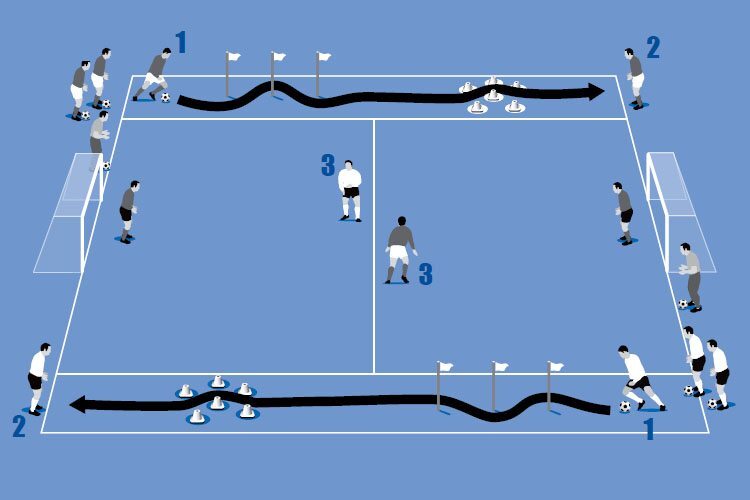
Speed ladder drills and cone work aren’t just for warm-ups. They rewire your nervous system to fire muscles faster and in more complex sequences. This is the difference between reaching a loose ball a half-step sooner and getting there second.
The key is intent. You don’t jog through a ladder. You drive your knees, punch the ground with the balls of your feet, and keep your torso quiet. Every rep should look crisp, even when you’re tired. Mix in lateral movements, backpedals, and 45-degree cuts to cover every angle you’ll see on the field.
Common mistake: Running ladder drills with heavy, flat-footed steps, this teaches slow ground contact and wastes the drill’s neural potential. Your feet should be silent.
A good SAQ session feels like a coordination puzzle, not a cardio burn. It primes your brain and body for the quick decisions needed during a speed ladder drills session. After three weeks of consistent work, you’ll notice defenders seem slower. They’re not. You’re just processing and reacting faster.
Plyometric Training: Building Explosive Power
Jumping, bounding, and hopping train your muscles to produce max force in minimal time. This is your shot power, your header reach, your explosive first step to beat a defender off the dribble.
A PMC plyometric sprint training study compared six weeks of plyometrics against sprint intervals. The plyometric group saw greater gains in vertical jump, anaerobic power, and linear speed, even with the ball at their feet. The reason is mechanical specificity. A box jump mimics the triple extension (ankle, knee, hip) of a shot or a leap more closely than a straight-line sprint does.
Start with low-impact versions like squat jumps and skater bounds. Progress to depth jumps from a 12-inch box, then 18 inches. The landing is as important as the takeoff. Absorb the force quietly through bent knees and a braced core.
- Box Jumps: 4 sets of 5. Focus on height and soft landings. Rest 90 seconds.
- Broad Jumps: 3 sets of 5. Measure your distance; try to beat it each week.
- Hurdle Hops: 3 sets of 8 hops per leg. Keep the hops continuous and low to the ground.
- Depth Drops: 3 sets of 5. Step off the box, land, and freeze, don’t rebound back up. This builds eccentric strength to prevent hamstring pulls.
Skip the soft landing, and you’re just teaching your joints to crash. That’s a one-way ticket to patellar tendonitis. Land like you’re trying not to wake up the neighbors downstairs.
TL;DR: Plyometrics build the snap in your shot and the spring in your jump. Do them fresh, land softly, and progress the height slowly.
Traditional Strength Training: The Foundation
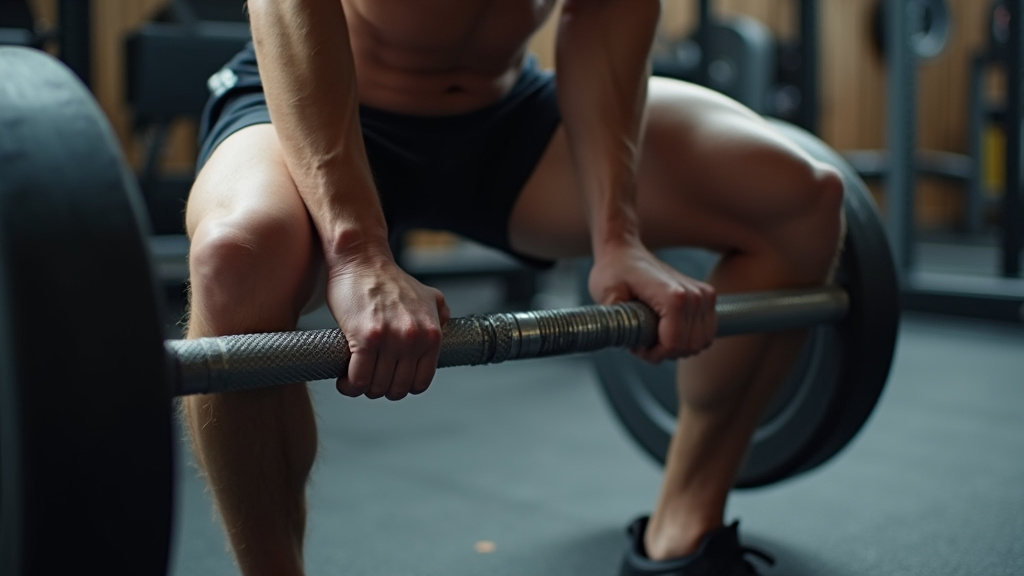
Raw strength is the platform everything else is built on. More strength means you can produce more force, which means faster accelerations, higher jumps, and harder shots. It also armors your joints against the game’s violent twists and turns.
The squat is the king here. It builds the quads, hamstrings, and glutes in the exact proportion needed for sprinting and jumping. A Springer randomized controlled training trial on neuromuscular performance found that traditional resistance training, when periodized correctly, leads to consistent improvements in short-sprint acceleration and vertical jump height.
But it’s not just about the squat rack.
– Barbell Back Squats: 4 sets of 6-8 reps. Go to parallel, not ass-to-grass. The strength transfer to sprinting happens right at parallel.
– Romanian Deadlifts: 3 sets of 8-10 reps. This hammers the hamstrings and glutes, the muscles most often torn when overstriding.
– Bulgarian Split Squats: 3 sets of 8 per leg. Unilateral work fixes imbalances and builds stabilizing strength for cutting.
Your soccer workout plan should have you lifting heavy 2-3 times a week, with at least 72 hours between lower-body sessions. Strength is a long game. You won’t feel faster after one session, but after six weeks you’ll shield the ball better and win more 50-50 challenges.
High-Intensity Interval Training (HIIT) for Soccer Fitness
The modern game is a series of intense bursts, a 30-yard sprint to close down an attacker, a recovery jog, then another sprint to join the counter. Traditional long-distance running doesn’t prepare you for that. HIIT does.
The format is simple: all-out effort followed by incomplete rest. A classic soccer HIIT session is 30-second sprints with 90 seconds of walking or jogging rest, repeated 6-8 times. This stresses both your aerobic and anaerobic systems, teaching your body to buffer lactate and recover quickly.
Research shows HIIT is superior for improving Yo-Yo Intermittent Recovery Test scores, a gold standard for soccer-specific endurance. It also boosts your repeat sprint ability, so you can make that decisive run in the 85th minute as well as the 5th.
I made the mistake of replacing HIIT with long, slow runs during one pre-season, thinking more miles equaled better fitness. My soccer running distance stats were high, but I was getting burned on every counter-attack after the hour mark. My engine was built for a marathon, but the game demanded a series of drag races. I switched back to two HIIT sessions a week and regained my pop.
TL;DR: Train for the game’s rhythm. Use HIIT to build the stamina for repeated high-intensity efforts, not just the ability to jog for 90 minutes.
How to Combine Everything Into a Weekly Plan
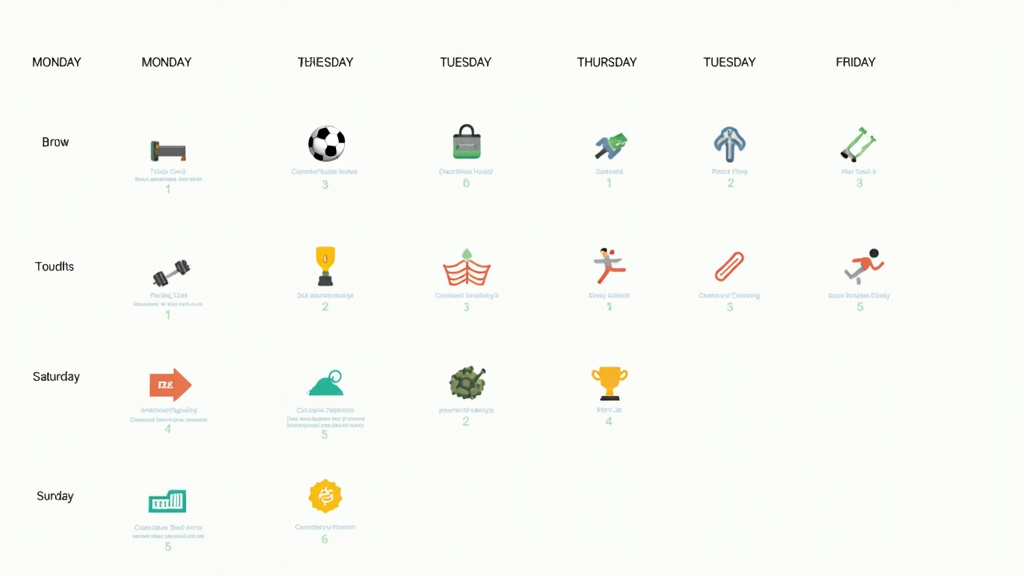
Throwing all these exercises into a single, daily gut-check will break you. The art is in the sequencing, what you do each day and how you let your body recover. A multi-modal, periodized approach is what the science recommends.
For a youth academy player training five days a week, a sample split might look like this:
– Monday: Lower-body strength (Squats, RDLs) + core
– Tuesday: SAQ drills + shooting drills
– Wednesday: Active recovery (light jog, mobility)
– Thursday: Upper-body strength + HIIT (30/90 sprints)
– Friday: Plyometrics + technical soccer rebounder training
– Saturday: Match
– Sunday: Full rest
For an older recreational player juggling other sports, the focus shifts. A study on balancing soccer with boxing and lifting found that honesty about your primary goal is key. If soccer is the priority, your heavy lifting and plyometric days should be farthest from your match day, with at least one full recovery day after them.
The age rule is critical. Training effects on pure speed, like 30-meter dash times, diminish after early adolescence. A 14-year-old will see massive gains from a basic strength training for soccer program. A 17-year-old needs more nuanced power and speed work to keep improving. Their bodies respond differently.
What About Age, Gender, and Skill Level?
The research has blind spots. Most high-quality studies focus on male professional or academy-level players. We know less about how these training principles apply to female players or adult amateurs.
For female athletes, the focus often needs to include a higher volume of injury-prevention work, targeting knee valgus and hamstring strength, due to different biomechanical and hormonal profiles. The core exercises don’t change, but the auxiliary work might.
For the weekend warrior, recovery is the bottleneck. You can’t train like a pro if you work a desk job. Your program must be condensed and your nutrition dialed in to support repair. Soccer player nutrition becomes non-negotiable, not an afterthought.
The principles of specificity and overload still apply. You just manage the dose. Two heavy strength sessions, one HIIT day, and one SAQ/plyometric day per week is a sustainable ceiling for most non-professionals. Any more and you risk overtraining, especially if you’re also playing matches.
Frequently Asked Questions
What’s the single best exercise for soccer?
There isn’t one. The squat is the most foundational strength exercise, but soccer performance requires a blend of strength, power, speed, and endurance. A program that only includes squats will leave you lacking in agility and repeat-sprint ability. You need a combination.
How often should I do plyometrics?
Start with one session per week, ideally 48-72 hours after your heaviest lower-body strength day. As you adapt, you can add a second session, but never do plyometrics on consecutive days. The high neurological and muscular stress requires full recovery to be effective and safe.
Can I get faster just by lifting weights?
Yes, but with a ceiling. Traditional strength training improves your ability to produce force, which directly translates to faster acceleration over short distances. However, raw strength won’t improve your top-end speed or agility without specific sprint and SAQ work. You need both.
Is long-distance running bad for soccer players?
Not “bad,” but inefficient. Long, slow runs build an aerobic base but do little for the power and repeat-sprint capacity the game demands. They can also interfere with strength and power gains if done in excess. Replace most of your long runs with HIIT sessions that mimic the game’s stop-start nature.
Do I need special equipment?
You can start with bodyweight. For SAQ, use chalk or tape on the ground instead of a ladder. For plyometrics, use a sturdy bench or low wall. For strength, a backpack with books works for goblet squats. However, to progress significantly, access to a barbell, weights, and plyometric boxes is necessary. Investing in proper men’s football cleats and compression shorts is also wise for performance and recovery.
How long until I see results?
Neurological adaptations from SAQ and plyometric work can be felt in as little as 2-3 weeks, you’ll feel quicker and more explosive. Measurable strength gains from a proper program take 6-8 weeks. Significant improvements in match-endurance from HIIT take 4-6 weeks of consistent training.
The Bottom Line
Improving soccer performance isn’t about finding one miracle exercise. It’s about deliberately training the five physical qualities the game demands: strength, power, speed, agility, and endurance. SAQ drills sharpen your nervous system. Plyometrics build your explosive spring. Heavy squats and deadlifts forge your foundational armor. HIIT conditions your engine for the game’s brutal rhythm.
The real work starts when you combine them into a weekly plan that fits your age, schedule, and recovery capacity. Start with two strength sessions, one power/plyo day, and one speed/HIIT day each week. Feed your body with the right performance foods, protect it with proper gear like well-fitted shin guard fitting, and give it time to adapt.
The player who commits to this multi-faceted approach doesn’t just get fitter. They become harder to play against, minute after minute, until the final whistle.

I come from the “soccer heart” of Germany, the Ruhrpott. I have played, trained and followed soccer all my life and am a big fan of FC Schalke 04. I also enjoy following international soccer extensively.