What is Interval Training for Soccer? The Proven System
Interval training for soccer is a structured method of conditioning that alternates periods of high-intensity effort with periods of lower-intensity recovery or rest. It directly mimics the stop-start, multi-sprint demands of a match to improve a player’s aerobic power, repeat-sprint ability, and on-pitch resilience. The most effective protocols are individualized using metrics like the 30-15 Intermittent Fitness Test or Anaerobic Speed Reserve, not generic distances or times.
Most coaches get this wrong. They run the same brutal shuttle runs for every player, assuming exhaustion equals progress. It doesn’t. A winger’s needs differ from a center-back’s, and a one-size-fits-all session creates uneven adaptations and hidden fatigue. You get a team that trains hard but doesn’t uniformly get fitter.
This guide breaks down the five core types of soccer interval training, the science of prescribing intensity, and the non-negotiable rules for individualizing it. You’ll learn how to use rest intervals as a precision tool and why morning sessions beat evening ones for pure physical gains.
Key Takeaways
- Forget generic distances. The gold standard for prescribing running-based intervals is the 30-15 Intermittent Fitness Test (30-15 IFT). Its final velocity (VIFT) accounts for acceleration, deceleration, and change-of-direction ability, making it soccer-specific.
- Rest intervals dictate the adaptation. Long rest periods (like a 1:9 work-to-rest ratio) boost power and jump height. Short rest periods (like 1:3) are better for building raw endurance and VO2max. You choose the rest based on the desired outcome.
- Schedule sprint work in the morning. Research shows morning sprint interval training leads to significantly greater improvements in vertical jump, 20-meter sprint time, and Yo-Yo test performance compared to identical evening sessions.
- Small-sided games are inconsistent. While great for skill, the fitness stimulus from SSGs varies wildly between players. For guaranteed, uniform cardio improvements, controlled interval running based on VIFT outperforms SSGs every time.
- Combine it with strength. In-season, one weekly session pairing heavy lower-body lifts with high-intensity intervals has been shown to improve match outcomes and reduce second-half fatigue more than either method alone.
What Interval Training Actually Does for a Soccer Player
It rebuilds your engine to match the game’s chaotic rhythm. A 90-minute match isn’t a steady jog; it’s about 700 activity changes, sprints, jogs, walks, and jumps. Your body’s energy systems need to recover rapidly between those bursts. Generic long-distance running trains the wrong pattern.
Interval training forces the specific adaptations a midfielder needs to press in the 85th minute. It elevates your VO2max, the ceiling of your aerobic system. More importantly, it improves your economy, how much oxygen you use at a given sub-maximal speed. A high VO2max with poor economy is a sports car that guzzles fuel; interval training tunes the engine for efficiency. This directly translates to covering more match distance covered while feeling less fatigued, a critical edge as the game wears on.
The other half is anaerobic. Repeated high-intensity efforts deplete phosphocreatine stores and flood muscles with metabolites like lactate. Intelligent interval training increases your tolerance to this environment and speeds up the recycling process between sprints. This is your repeated sprint ability, the difference between making that late overlapping run or getting caught flat-footed.
Interval training prescribed via the 30-15 IFT results in more consistent and significant improvements in aerobic fitness, anaerobic power, and cardiac function compared to variable small-sided games, according to a 2025 study in Scientific Reports.
TL;DR: It conditions the exact start-stop energy systems used in a match, boosting both your aerobic ceiling and your ability to repeat sprints with less decay.
The 5 Core Types of Soccer Interval Training
Not all intervals are created equal. Picking the wrong type is like using a wrench to drive a nail. Each format stresses a different physiological pathway, and your choice should be dictated by the phase of your season and the player’s positional demands.
1. Sprint Interval Training (SIT) / Short Intervals
These are all-out efforts lasting 3 to 10 seconds, with full recovery. Think 20-meter or 30-meter fly sprints. The goal here is maximal velocity and power, recruiting your fastest muscle fibers and training the ATP-PCr energy system. It’s pure speed and acceleration training. Because the efforts are so short and intense, rest must be long, often 30 seconds to several minutes. This is non-negotiable. Cutting rest turns a power session into a grueling lactic acid bath that won’t improve top speed.
When to use: Pre-season and in-season for speed maintenance. Essential for forwards and wingers.
2. High-Intensity Interval Training (HIIT) / Long Intervals
This is the classic “work-and-rest” model. Efforts range from 30 seconds to 4 minutes at an intensity between 90-100% of your Maximal Aerobic Speed. A common protocol is 4 x 4-minute runs at 90-95% of MAS, with 3 minutes of active walking recovery. This zone brutally stresses your VO2max system and is the most direct way to elevate it. It builds the aerobic and anaerobic endurance for box-to-box midfielders.
When to use: Foundational conditioning in pre-season. In-season maintenance dose once weekly.
3. Repeated Sprint Training (RST)
This is the most soccer-specific conditioning tool. It’s a series of short, maximal sprints (like 6 x 30m) with very short, incomplete rest (20-30 seconds). You start each subsequent sprint with partially depleted energy stores, mimicking the fatigue of a counter-attack sequence. It trains sprint training drills and fatigue resistance simultaneously. The quality of the first sprint is speed work; the decay across the last three sprints is specific conditioning.
When to use: In-season to maintain match-specific fitness. Crucial for full-backs and defensive midfielders.
4. Small-Sided Games (SSGs)
SSGs (e.g., 4v4 in a confined space) are the favorite of many coaches because they blend technical, tactical, and physical demands. However, they are a blunt tool for precise conditioning. Workload varies wildly: a central player might have a heart rate average of 90% max, while a wide player floats at 80%. You cannot guarantee a uniform physiological stimulus.
Common mistake: Using only SSGs for cardio conditioning, the star player might get a light day while the hard-working defender gets overcooked, leading to uneven fitness development across the squad.
When to use: For tactical integration and game-based decision-making under fatigue. Not as a primary method for elevating pure fitness metrics.
5. Circuit-Based Intervals
This integrates strength and conditioning. A station might be 5 box jumps, then a 10-yard shuttle, then 3 medicine ball slams, repeated for 45 seconds of work followed by 45 seconds of rest before moving to the next station. It builds leg strength for soccer and cardio simultaneously, and is excellent for general athletic development in youth players.
When to use: Off-season or early pre-season for multi-faceted athletic development.
| Interval Type | Primary Energy System | Best For Improving | Typical Work:Rest Ratio |
|---|---|---|---|
| Sprint (SIT) | ATP-PCr (Phosphagen) | Max Speed, Power | 1:9 (e.g., 5s sprint, 45s rest) |
| High-Intensity (HIIT) | Aerobic (VO2max) | Aerobic Capacity, Endurance | 1:1 or 2:1 (e.g., 4min run, 3min walk) |
| Repeated Sprint (RST) | Glycolytic & Aerobic | Repeat Sprint Ability, Fatigue Resistance | 1:0.5 (e.g., 6s sprint, 20s rest) |
| Small-Sided Games | Mixed | Tactical Fitness, Skill Under Pressure | Game-determined (e.g., 4min game, 2min rest) |
| Circuit | Mixed | General Athleticism, Strength-Endurance | 1:1 (e.g., 45s work, 45s rest) |
How to Prescribe Intensity: The End of Guesswork
Telling a player to run at “80% effort” is useless. Effort is subjective and unreliable. Modern soccer workout plans use objective metrics to ensure every player is working at the correct, individualized intensity. Here are the three methods that matter.
Maximal Aerobic Speed (MAS): This is the lowest speed at which you reach your maximum oxygen uptake (VO2max). It’s typically determined by a time trial, like a 1,200-meter or 5-minute all-out run. Once you know a player’s MAS (e.g., 18 km/h), you can prescribe intervals as a percentage of that (e.g., 8 x 1 minute at 105% of MAS). It’s a good start, but it’s linear and doesn’t account for agility.
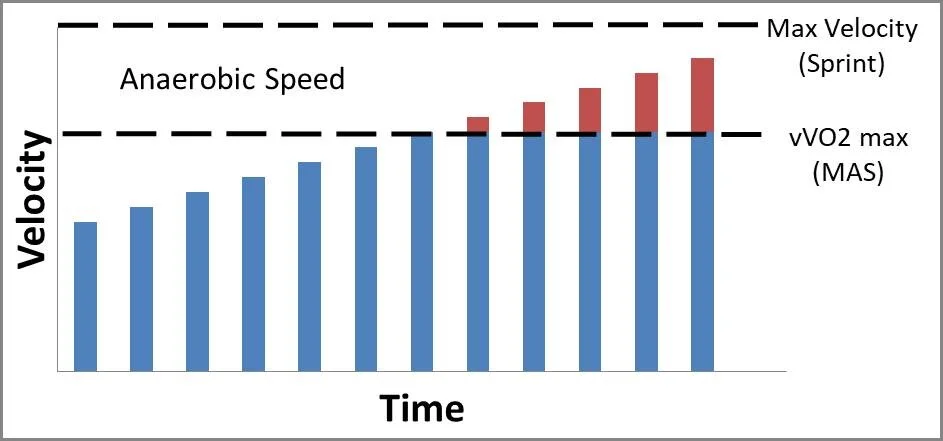
Anaerobic Speed Reserve (ASR): This is a more powerful concept. ASR is the difference between your MAS and your maximum sprint speed. It represents your “sprinting reserve.” A player with a high MAS but a low ASR is an endurance monster with no top gear. A player with a low MAS but a high ASR is a speedster who gasses quickly. Prescribing intervals within this reserve (e.g., short intervals at 70% of ASR) is more individualized than using MAS alone.
The 30-15 Intermittent Fitness Test (30-15 IFT): This is the current gold standard for team sports. Players run back and forth for 30 seconds, then walk for 15 seconds, with the required running speed increasing every 45-second stage. The test ends when they can no longer keep pace. The final completed velocity is their VIFT score. This score inherently factors in acceleration, deceleration, and change-of-direction ability, everything a soccer agility drills at home program tries to build. You then prescribe intervals as a percentage of VIFT. Research from a PMC interval training adaptations analysis shows this method yields more uniform fitness improvements across a squad with diverse player profiles.
Before you start: Never conduct maximal fitness tests like the 30-15 IFT without a proper warm-up and when players are overly fatigued. The test requires all-out effort, and performing it tired risks muscle strains and provides an inaccurate baseline, ruining your prescription data for weeks.
The Critical Details Everyone Misses
You can have the perfect interval type and the perfect prescribed speed. Get these two details wrong, and you’ll sabotage the results.
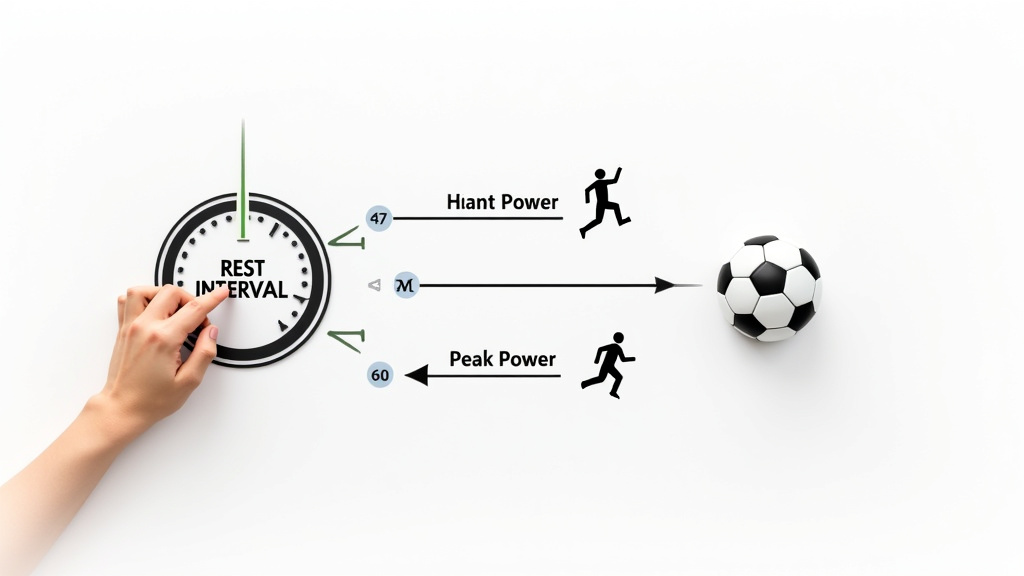
Rest Interval Length is a Dial, Not a Default. The duration of recovery between hard efforts isn’t just about catching your breath; it dictates the primary physiological adaptation. A landmark NCBI youth soccer rest distribution study made this crystal clear. For short sprint intervals (≤10 seconds), a long rest period (a 1:9 work-to-rest ratio) was superior for improving vertical jump and peak power. A shorter rest (1:3 ratio) was better for boosting VO2max and Yo-Yo IR1 performance. The rest interval is your steering wheel. Choose the destination first.
Schedule High-Intensity Work in the Morning. Your body’s circadian rhythm affects how it responds to training. A 2025 study published in Scientific Reports found that morning sprint interval training produced greater improvements in vertical jump, 20-meter sprint time, and Yo-Yo test performance than the exact same session done in the evening. The theory points to higher natural testosterone and cortisol levels in the AM, priming the body for hard neuromuscular and metabolic stress. Save your technical sessions and tactical walk-throughs for the afternoon.
Building an Effective Weekly Plan
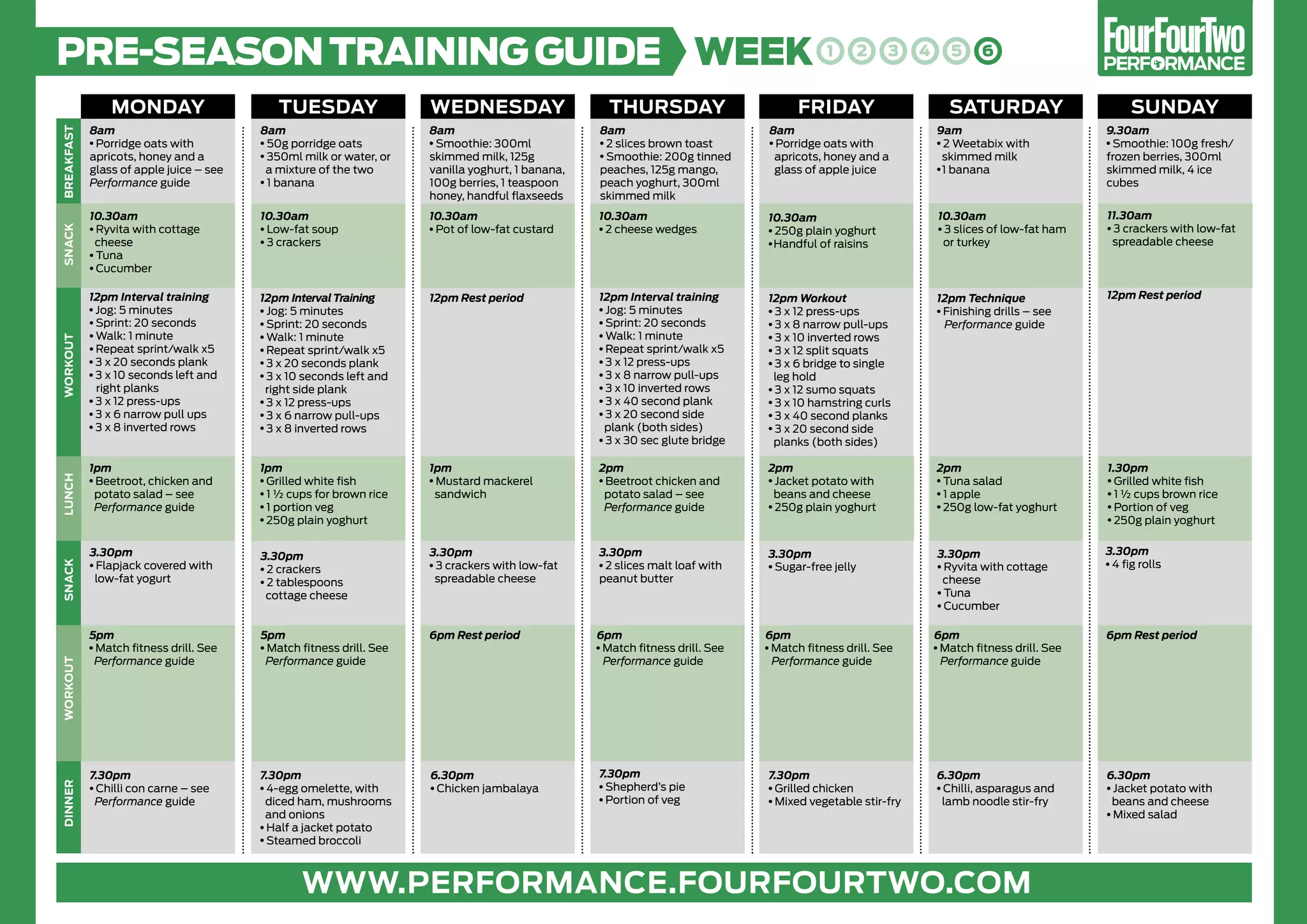
Interval training isn’t an add-on; it’s the spine of your conditioning. It must be integrated with other loads like strength work and technical training. Here’s how a typical in-season week for a professional academy player might look, based on the soccer player workout plan soccer body principle of combined training.
- Monday (Day after Match): Recovery. Light pool session or mobility work. No intervals.
- Tuesday (Quality): Morning: Sprint interval training (e.g., 8 x 30m fly sprints with 3 min rest). Afternoon: Technical possession drills.
- Wednesday (Load): Morning: Heavy lower-body strength training for soccer (squats, RDLs). Evening: High-intensity interval running based on VIFT (e.g., 4 x 4-min efforts).
- Thursday (Active Recovery): Low-intensity aerobic session (continuous jogging) or small-sided games for fun.
- Friday (Pre-Match): Short, sharp speed ladder drills and tactical rehearsal. No conditioning.
- Saturday (Match Day)
- Sunday: Off.
The key is the Tuesday-Wednesday combination. The pure speed work on Tuesday is neurologically demanding but not metabolically exhausting. The Wednesday session pairs heavy strength with cardio, a combination shown in a Sports journal study to improve in-season aerobic and anaerobic endurance and even match outcomes more than either modality alone. This approach builds a robust, resilient athlete.
Common Pitfalls and How to Avoid Them
Watching a team vomit after a session is not a badge of honor. It’s a sign of poor planning. Here are the traps.
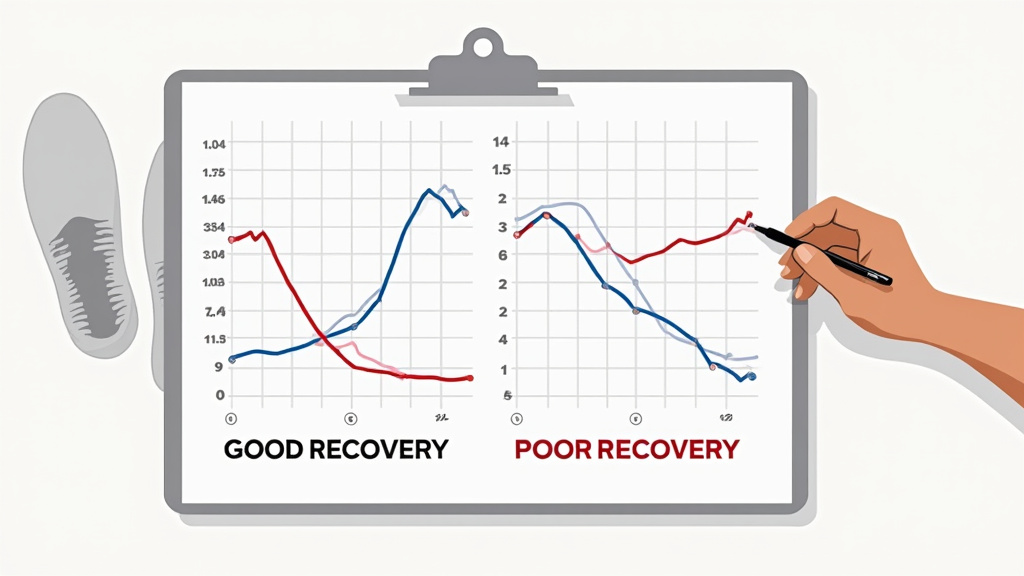
Pitfall 1: Ignoring Individual Recovery. Two players finish the same interval set. One is breathing heavily but ready for more. The other is pale and staggering. If you give them the same load next time, you’ll overtrain one and undertrain the other. Use heart rate recovery (how fast their HR drops after a set) and subjective wellness scores to tailor individual volume.
Pitfall 2: Progressing Too Fast. The impulse is to add more reps or decrease rest each week. This leads to a plateau or injury. Instead, progress by increasing the intensity (speed) while holding volume and rest constant for 3-4 weeks. Only then should you manipulate other variables.
Pitfall 3: Neglecting Strength and Power. Interval training improves the metabolic component of speed and acceleration training. But without a foundation of maximal strength and explosive power from the weight room, you cap your speed potential. The muscle is the engine; interval training tunes the fuel system. You need both.
I made this mistake early on, focusing only on running. I had a talented winger who was lightning fast over 10 meters but kept pulling his hamstring in the 70th minute. His interval scores were great. We added two days of focused Nordic hamstring curls and hip thrusts to his leg strength for soccer routine. The pulls stopped. His top speed increased because his stronger muscles could apply more force. The intervals then allowed him to repeat that new, faster speed.
Frequently Asked Questions
What’s the best interval training for a soccer striker?
Prioritize Sprint Interval Training (SIT) to maintain explosive speed for breakaways, and Repeated Sprint Training (RST) to mimic the fatigue of making multiple runs behind the defense. Their cardio should come from high-intensity intervals, not long, slow jogs.
How often should I do interval training in-season?
Once or twice a week is sufficient for maintenance. One session should be dedicated to pure speed/power (SIT), and the other can be a conditioning session (HIIT or RST). Never place a high-intensity interval session the day before a match.
Can I do interval training without a field or track?
Absolutely. Soccer fitness without a ball can be done anywhere. Use a bike or rowing machine for HIIT intervals. For sprinting in soccer simulation, find a hill for sprint repeats. The principles of work intensity and rest ratios remain the same.
What’s a simple interval workout I can start with?
For general conditioning, try the “30-30” workout: After a warm-up, run hard for 30 seconds, then walk or jog for 30 seconds. Repeat this for 10-20 minutes total. Use a landmark or cone to ensure you cover a consistent distance during each 30-second work period.
How do I know if the training is working?
Test. Use a simple benchmark like a 40-meter sprint time or a Yo-Yo Intermittent Recovery Test every 4-6 weeks. If the times are improving or the distance covered increases, your soccer performance exercises and rest are working. If not, reassess the intensity or volume.
The Bottom Line
Interval training for soccer isn’t about running until you’re sick. It’s a precision tool for building a match-ready engine. Ditch the generic shuttle runs. Start by testing, use the 30-15 IFT to get a real VIFT score for your players. Prescribe their running speeds from that number. Use long rest intervals to build power and short ones to build endurance. Schedule your hardest sprint sessions in the morning.
Most importantly, remember it’s a tool in a bigger box. Pair it with heavy strength work to build resilient athletes. This combined approach, individualized and timed correctly, is what separates teams that fade in the final minutes from those that own them.

I come from the “soccer heart” of Germany, the Ruhrpott. I have played, trained and followed soccer all my life and am a big fan of FC Schalke 04. I also enjoy following international soccer extensively.