World Cup Group L Complete Preview: Analysis & Predictions
World Cup Group L predictions hinge on three factors: England’s tactical evolution under Thomas Tuchel, Croatia’s reliance on a fading Luka Modrić, and the disruptive potential of Ghana and Panama. This analysis forecasts England topping the group, with Croatia narrowly advancing ahead of a resilient Ghana.
To preview World Cup 2026 Group L, focus on three things: England’s shift under Thomas Tuchel, Croatia’s final dance with Luka Modrić, and the disciplined underdog threats from Ghana and Panama. This group blends European pedigree with ambitious outsiders, making it the tournament’s most balanced “Group of Death.”
Most previews just list squads and guess results. They miss the tactical chess match between Tuchel and Zlatko Dalić, and they underestimate how Ghana’s new manager or Panama’s CONCACAF grit can scramble the math in a 90-minute match.
This guide breaks down each team’s real path, the specific players who will decide it, and the schedule quirks that could tilt everything. You will know exactly what to watch for when the whistle blows in Dallas and Toronto.
Key Takeaways
- England are overwhelming favorites, but Thomas Tuchel’s high-pressing system is a radical change from Gareth Southgate’s conservative shape. Watch for early tournament rust.
- Croatia’s chances hinge on managing 40-year-old Luka Modrić’s minutes. Their tournament toughness is proven, but the physical toll of three games in eleven days is a real danger.
- Ghana’s wildcard is Mohammed Kudus. If new manager Carlos Queiroz builds a functional team around him, they can upset anyone. If not, their individual talent goes to waste.
- Panama will not roll over. Their 5-4-1 defensive block conceded only four goals in eight final round CONCACAF qualifiers. Breaking them down requires patience England and Croatia have sometimes lacked.
- The group winner likely faces a third-place team in the Round of 32. The runner-up gets the Group K winner, a potentially tougher draw that adds stakes to the final matchday.
The “Group of Death” Contenders
The expanded 48-team format was supposed to kill the “Group of Death.” Group L laughs at that idea. It pairs two recent World Cup finalists with two regional powers who believe they belong in the knockout stage. This isn’t a death sentence for the favorites, but it is a guaranteed gauntlet where every point will be contested.
Group L at the 2026 FIFA World Cup features England, Croatia, Ghana, and Panama. England qualified with a perfect record (8 wins, 0 goals conceded). Croatia amassed 22 points from a possible 24 in UEFA qualifying. Ghana topped their CAF group unbeaten with 25 points. Panama reached the finals of the 2023 Gold Cup and 2025 CONCACAF Nations League.
TL;DR: This is the hardest group to call after the obvious top seeds. England should advance, but second place and the best third-place spot will be a brutal fight.
England: The Tactical Revolution
Thomas Tuchel replaced Gareth Southgate after Euro 2024. That change is the single biggest variable for England. Southgate’s system was built on defensive solidity and controlled possession. Tuchel’s Chelsea and Bayern Munich teams were defined by aggressive counter-pressing and verticality.
Harry Kane remains the world-class finisher and Jude Bellingham is the complete midfield engine. The question is the structure around them. Tuchel might use a 3-4-2-1 to maximize Bellingham’s runs from deep, or a 4-2-3-1 to press higher. England’s perfect qualifying record (eight wins, 22 goals for, zero against) is impressive, but those matches were against lesser opposition. A recent 2-0 loss to Japan with an experimental lineup showed the system is still a work in progress.
The key battle is in the double pivot. Declan Rice is a lock. The spot beside him is open. Jordan Henderson’s experience versus the dynamism of a youngster like Chelsea’s Elliot Anderson. That choice defines England’s defensive stability.
Common mistake: Writing off England’s friendly losses, they used those matches to test fringe players and tactical wrinkles. Judge them on their competitive matches under Tuchel, not preseason experiments.
Croatia: The Last Dance
Zlatko Dalić has taken this team to a final and a semi-final. His core. Modrić, Mateo Kovačić, Marcelo Brozović, is now older, slower, but infinitely wiser. Modrić will be 40 during this tournament. He cannot play 270 minutes in the group stage at the same intensity.
Croatia’s qualifying was efficient (22 points from 24) but not dominant. They win by controlling midfield tempo and being ruthlessly clinical in transition. Their team tactics are based on positional discipline, not frantic pressing. This makes them a nightmare for teams that lack patience.
The concern is physical decline. If Modrić is rested, their creative spark dims. If he plays every minute, he may be exhausted for a potential knockout game. Dalić’s man-management here is as important as his coaching strategies.
| Croatia’s Aging Core | Age at 2026 WC | Critical Role |
|---|---|---|
| Luka Modrić | 40 | Tempo-setter, chance creator |
| Ivan Perišić | 37 | Wide threat, aerial target |
| Domagoj Vida | 37 | Defensive leadership, set-piece threat |
| The Succession Plan | Age at 2026 WC | Ready to Step Up? |
| Lovro Majer | 28 | Creative midfielder |
| Joško Gvardiol | 24 | Star defender |
Ghana: The Unfinished Business
Ghana fired Otto Addo after four straight losses and hired Carlos Queiroz in April 2026. Queiroz is a master of tournament organization, see his work with Iran and Colombia. His first job is to build a cohesive unit around spectacular individuals.
Mohammed Kudus is a top-10 attacking midfielder in the world. Antoine Semenyo and Iñaki Williams offer blistering pace. Thomas Partey, if fit, provides steel in midfield. The talent is there to compete with anyone. The problem has always been turning a collection of stars into a team. Missing the last African Cup of Nations was a psychological blow this group needs to overcome.
Queiroz will likely deploy a pragmatic 4-2-3-1 or a 4-4-2, prioritizing defensive shape and hitting on the counter with their fastest players. How quickly the players adapt to his rigid structure will determine their fate.
Panama: The Disciplined Spoiler
Do not mistake Panama for a happy-to-be-here minnow. Thomas Christiansen has built a tough, organized side that thrives on frustration. They reached the finals of the 2023 Gold Cup and 2025 CONCACAF Nations League. In March friendlies, they drew 1-1 and beat South Africa 2-1.
They will sit in a deep 5-4-1 block, defend the penalty area, and look for set-pieces or hopeful counters. Their center-backs, like Michael Amir Murillo, are physically strong and experienced. Breaking them down requires the kind of patient, wide play that can expose England’s occasional predictability and Croatia’s lack of sheer speed.
Panama’s goal is simple: steal a point from one of the big two, beat Ghana, and see if four points is enough for a historic advance. It is a long shot, but their defensive solidity makes them a dangerous opponent.
Match Schedule & Venue Impact
The order of games matters. A slow starter could be in crisis by matchday two. A team peaking at the right time can build unstoppable momentum.
| Matchday | Fixture | Venue | Key Narrative |
|---|---|---|---|
| June 17 | Ghana vs. Panama | Toronto Stadium | A must-win for both teams’ advancement hopes. |
| June 17 | England vs. Croatia | Dallas Stadium | The group decider? Winner takes control. |
| June 23 | England vs. Ghana | Boston Stadium | Ghana’s pace tests England’s high defensive line. |
| June 23 | Panama vs. Croatia | Toronto Stadium | Croatia’s patience versus Panama’s low block. |
| June 27 | Panama vs. England | New York New Jersey Stadium | England may need a result to secure first place. |
| June 27 | Croatia vs. Ghana | Philadelphia Stadium | Likely a straight shootout for second place. |
The venue schedule favors Panama. They play twice in Toronto, where a significant Central American diaspora could create a pseudo-home advantage. Ghana also gets a potentially favorable crowd in Philadelphia. England and Croatia, as European teams, will have strong support in the major US cities, but the atmosphere will be less partisan.
The compact schedule, three matches in eleven days, tests squad depth and fitness. Croatia’s older legs are a clear disadvantage here. A team like Ghana, with younger, athletic players, might find an extra gear in the second half of the final game.
TL;DR: The England-Croatia opener is colossal. The team that loses will feel immediate pressure in their second match. Panama gets a helpful double dose of Toronto.
Tactical Battles & Key Matchups
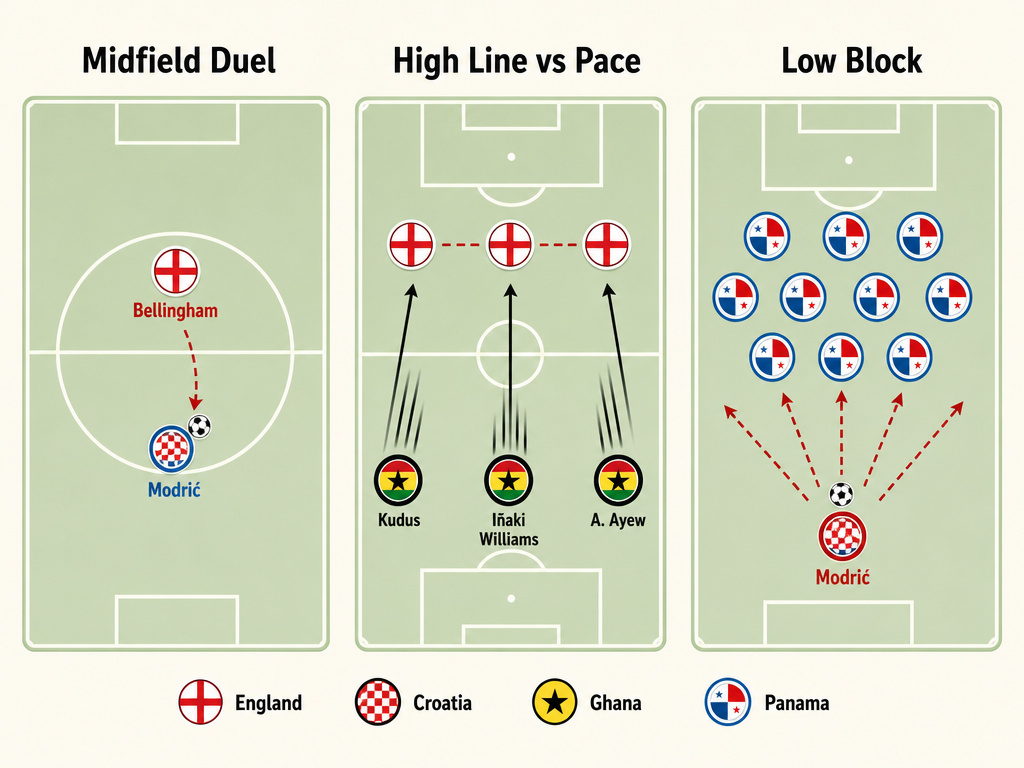
This group will be won in specific duels, not just by overall talent. Here are the individual contests that will decide points.
- Jude Bellingham vs. Luka Modrić (June 17): The passing of the torch? The young bull’s relentless energy against the old master’s guile. Whoever controls this central space controls the game.
- England’s High Line vs. Ghana’s Pace (June 23): If Tuchel pushes his defense up, runners like Iñaki Williams and Antoine Semenyo will look to exploit the space behind. England’s center-backs must have a perfect day.
- Croatia’s Patience vs. Panama’s Low Block (June 23): Croatia averages 65% possession. Panama will happily concede 75%. Can Modrić and Kovačić unpick a defense parked on the 18-yard line? This is a classic test of a tactical formation’s attacking creativity.
- Mohammed Kudus vs. Anyone: Ghana’s star is the group’s most unpredictable attacker. He will drift, dribble, and shoot from anywhere. Man-marking him might be the only solution, which opens space for others.
I would not be surprised if Ghana steals a point from England. The combination of Kudus’s magic on the break and Queiroz’s defensive organization is built for a one-off upset. England’s players will have never faced a system that compact and counter-ready in qualifying.
These matches are unlikely to be high-scoring matches. Expect tense, tactical affairs where one moment of quality, or one mistake, decides everything. The team with the best creative playmakers will thrive.
Predictions & Path to the Knockouts
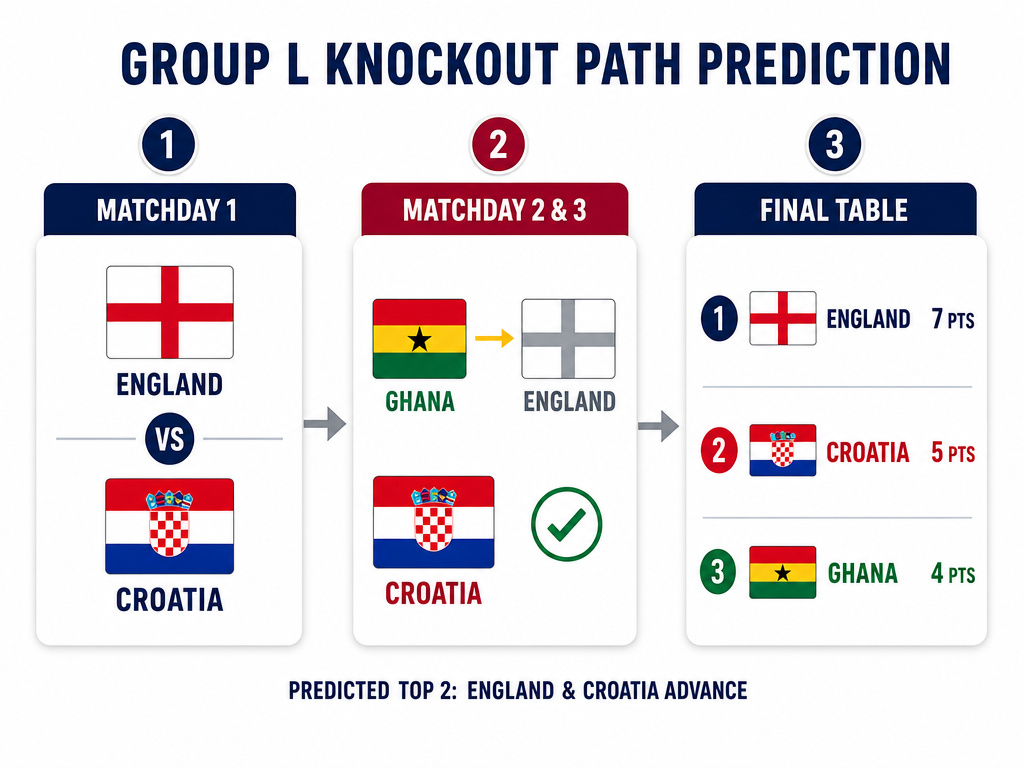
Betting markets give England a ~70% chance to win the group. Croatia is the clear second favorite. That is the safe, logical prediction. But football is not played on spreadsheets.
- England – 7 points (W vs. Croatia, D vs. Ghana, W vs. Panama). They start strong, get tested by Ghana, and finish the job.
- Croatia – 5 points (L vs. England, W vs. Panama, D vs. Ghana). They recover from the opening loss, grind past Panama, and secure a vital draw against Ghana to advance.
- Ghana – 4 points (W vs. Panama, D vs. England, D vs. Croatia). They beat Panama, shock England with a draw, and tie Croatia, which might be enough for a best third-place finish.
- Panama – 0 points (L vs. Ghana, L vs. Croatia, L vs. England). They compete fiercely but lack the final-third quality to turn defense into points.
The group winner advances to face a third-place team from Groups A, B, C, or D. That is a golden ticket to the quarter-finals. The runner-up gets the winner of Group K, which could be a heavyweight like the Netherlands or a dark horse. Finishing first is a massive prize.
Common mistake: Assuming the third-place team is eliminated. With 48 teams, the four best third-place finishers advance. A team with four points, like Ghana in this projection, has a very strong chance of moving on. Every goal matters.
This projection hinges on Ghana’s draw with England. If England wins that match, they likely get 9 points and Ghana is stuck on 3, making advancement harder. If Croatia beats England in the opener, the entire group flips upside down. That is the beauty of this draw.
Frequently Asked Questions
Who are the key players to watch in Group L?
For England, it’s Jude Bellingham, his box-to-box dominance sets their tempo. For Croatia, 40-year-old Luka Modrić remains the brain. Ghana’s hopes ride on the creativity of Mohammed Kudus. Panama’s leader is defender Michael Amir Murillo, who must organize their resistance.
What is the most important match in Group L?
England vs. Croatia on June 17 in Dallas. It is a rematch of the 2018 semi-final and will likely decide first place. The loser faces immediate pressure and a harder path to the knockout rounds.
Can Ghana or Panama realistically advance?
Yes, especially Ghana. The new 48-team format means four of the eight third-place teams advance. Ghana, with its individual talent, is a prime candidate to grab one of those spots. Panama’s path is narrower, they likely need to beat Ghana and steal a point from either England or Croatia, a tall order.
How does the venue schedule affect the teams?
Panama plays two of its three matches in Toronto, which has a large Central American community. This could provide a slight boost. The compact schedule (three games in 11 days) is a disadvantage for Croatia’s older squad and an advantage for younger, fitter teams like Ghana and England.
The Bottom Line
Group L is the 2026 World Cup’s premier tactical showcase. England’s new era under Tuchel, Croatia’s last stand, Ghana’s quest for cohesion, and Panama’s disciplined defiance create a perfect storm. The winner will be battle-hardened for the knockout stages.
Watch the midfield battle in Dallas on opening day. Watch how Ghana uses its speed against England’s high line. Watch for the moment Panama’s defense finally cracks. This group will not be won easily, and the team that emerges from it will have earned every single point. Forget the hype about other groups, this is where the real tournament begins.
I come from the “soccer heart” of Germany, the Ruhrpott. I have played, trained and followed soccer all my life and am a big fan of FC Schalke 04. I also enjoy following international soccer extensively.