World Cup Predictions: Favorites, Dark Horses & AI Odds
To make World Cup 2026 predictions, you need to triangulate three things: AI-driven data models, current betting odds, and expert analysis of squad strength and tactical trends. Right now, Spain and France are the consensus favorites, followed closely by England, Argentina, and a resurgent Brazil.
Most people look at the last winner and assume they will repeat. That’s a mistake. Argentina lifted the trophy in 2022, but the 2026 tournament is a different beast entirely, it’s bigger, spread across three nations, and features a generation of players who weren’t even in the conversation four years ago. The old rules do not apply.
This guide breaks down the favorites, the dark horses, and the unique factors that will make the 2026 World Cup the most wide-open tournament in modern memory.
Key Takeaways
- Spain is the AI’s top pick, with Opta’s supercomputer giving La Roja a 16.08% chance to win, fueled by their Euro 2024 victory and a golden generation of midfielders.
- France and England are the clear co-favorites alongside Spain, with both squads boasting unparalleled depth and game-changing superstars like Kylian Mbappé and Jude Bellingham.
- Do not sleep on the host nations. The USA, in particular, benefits from the expanded 48-team format, which reduces the pressure of qualification and grants a massive logistical and fan-support advantage.
- A key injury can upend everything. Spain’s status was shaken by Lamine Yamal’s hamstring issue in late 2024, a reminder that predictions made two years out are built on sand.
- The 48-team format is a dark horse’s dream. More group stage games and a new knockout round mean more opportunities for a disciplined, well-organized team to cause a historic upset.
The Top Contenders: Who Are the Favorites?
The conversation starts with data. Opta’s supercomputer, which simulates the tournament thousands of times, currently places Spain at the top with a 16.08% probability. This isn’t a guess. It’s a calculation based on their Euro 2024 triumph, their possession-dominant tactical system, and the emergence of players like Pedri, Gavi, and Lamine Yamal. That last point is crucial. Yamal’s hamstring injury in late 2024 caused a visible tremor in the Fox Sports 2026 World Cup odds, illustrating how fragile these projections are.
France sits just behind with a 12.78% chance. Their case is built on terrifying consistency and Kylian Mbappé. Didier Deschamps’ team has reached three of the last four major tournament finals. Their squad depth, from Mike Maignan in goal to Eduardo Camavinga in midfield, is arguably the best in the world. They don’t rebuild; they reload.
England (11.01%) and Argentina (10.02%) round out the top tier. England’s “golden generation” narrative has finally shed its tragic edge under Gareth Southgate, morphing into a team that expects to win. Argentina remains the defending champion, a squad of warriors built around Lionel Messi’s legacy, though his participation in 2026 is still a giant, unanswered question.
Spain’s 16.08% win probability, according to Opta’s AI supercomputer, is derived from over 10,000 tournament simulations factoring in Elo ratings, recent form, squad strength, and the structural advantages of the 48-team format. This data-driven approach highlights La Roja’s tactical cohesion and youth pipeline as key differentiators.
Brazil, at 6.48%, feels like a value pick. They have the single most electrifying attacker in the world in Vinicius Junior and a point to prove after their 2022 quarter-final exit. The Seleção is always a threat, but their path depends on finding a stable midfield and a manager who can harness their chaotic talent.
| Team | Opta AI Win Probability | Key Strength | Biggest Question Mark |
|---|---|---|---|
| Spain | 16.08% | Tactical system & midfield depth | Over-reliance on young wingers’ fitness |
| France | 12.78% | Tournament experience & squad depth | Can Mbappé stay healthy for one more cycle? |
| England | 11.01% | Balance and world-class talent in every line | Overcoming the final mental hurdle |
| Argentina | 10.02% | Champion mentality & collective spirit | Life after (or with) a 39-year-old Messi |
| Brazil | 6.48% | Individual brilliance in attack | Finding a coherent defensive structure |
TL;DR: Spain and France lead on data and depth, but England and Argentina are right there. Brazil is the wildcard with the highest ceiling and the lowest floor.
The Dark Horse Candidates: Who Can Shock the World?
The expanded format is the single biggest variable. With 48 teams, there are more matches, more potential for upset, and a new round of 32 that gives a Cinderella story an extra game to build momentum. This structural shift is why your 2026 tournament updates need to track nations outside the usual top 10.
Morocco is the prototype. Their run to the 2022 semi-finals was no fluke. They are organized, physically robust, and have players like Achraf Hakimi and Sofyan Amrabat who compete at the highest club level. They have already shown they can beat Spain, Portugal, and Belgium in a tournament setting. In a new 48-team structure, a team like Morocco doesn’t just hope to sneak through; they plan to.
Then there are the “one-man army” nations. Norway has Erling Haaland. That’s it. That’s the argument. In a short tournament, a striker of his caliber can win two games almost by himself, and that might be enough to reach a quarter-final. The same logic applies to Poland with Robert Lewandowski or Egypt with Mohamed Salah, should they qualify.
Japan and the United States represent the tactical dark horses. Japan’s high-pressing, technical game has troubled Germany and Spain already. The USMNT, as a host, will have a tangible home-field advantage across the 2026 host cities. A favorable group draw and the energy of home crowds could propel them past the round of 16 for the first time since 2002.
Common mistake: Writing off teams like Morocco as a “one-time wonder.” Their 2022 run was built on a defensively sound 4-1-4-1 system and elite transition play, a repeatable formula that scales perfectly in a longer tournament with more knockout rounds.
TL;DR: Morocco has the blueprint. Norway has the striker. Japan has the system. The USA has the crowds. In a 48-team field, at least one of these profiles will make a deep run.
How Predictions Are Made: AI, Odds, and Expert Eyes
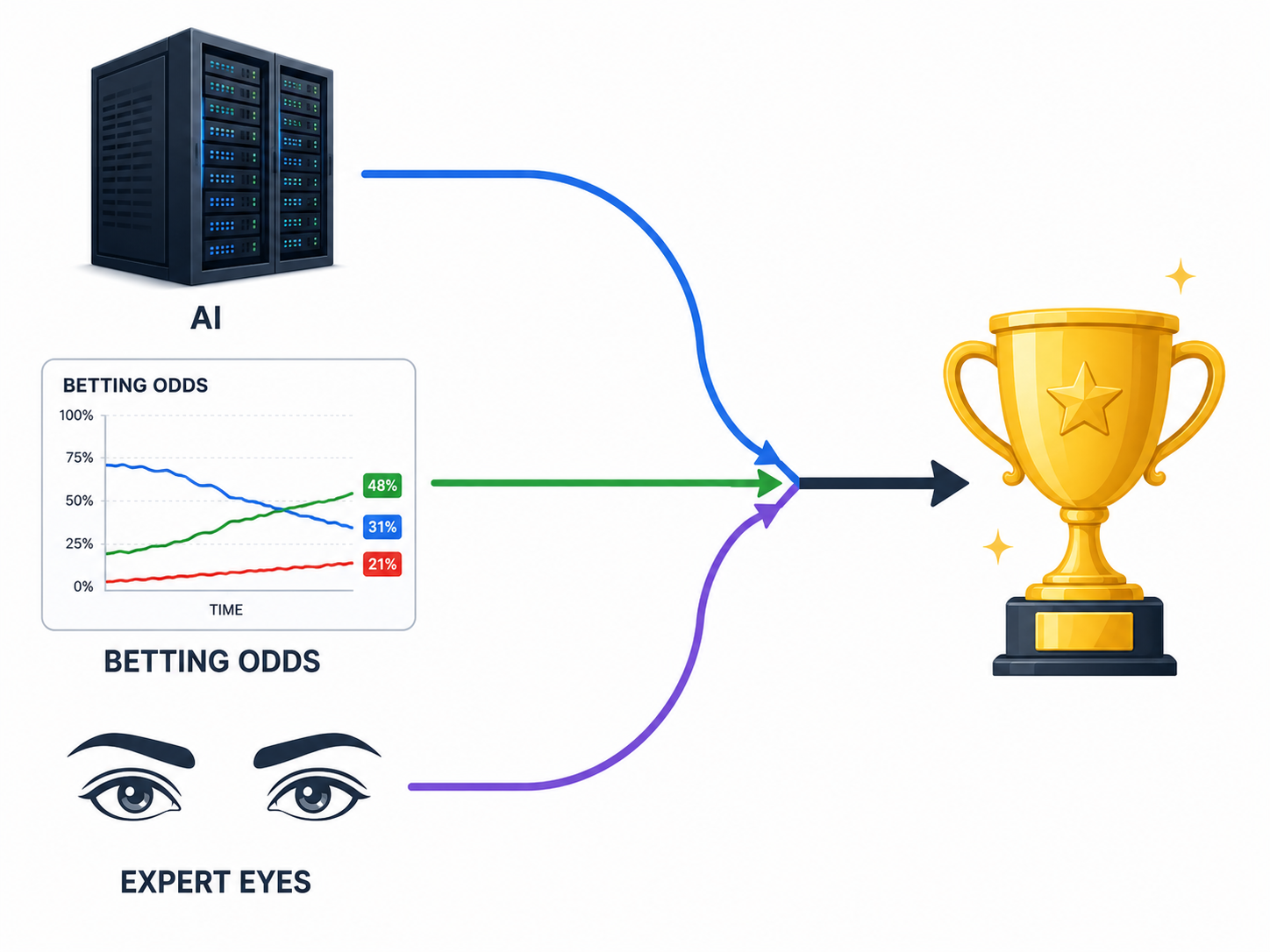
You get three different pictures depending on where you look. Blending them gives you the clearest forecast.
The AI models, like Opta’s, are pure math. They simulate the tournament over and over, using variables like FIFA ranking, recent match results, and squad market value. They are cold, logical, and have no memory. They don’t care that Germany has won four titles; they only see a team that has struggled for consistency since 2014. This is why Spain tops their list, their underlying numbers are impeccable.
Betting odds from major sportsbooks reflect the wisdom (and money) of the crowd. They are dynamic, shifting with news like injuries or managerial changes. When Lamine Yamal got hurt, Spain’s odds drifted slightly. These odds are a real-time pulse on global sentiment. Currently, they align closely with the AI, listing Spain and France as joint favorites.
Expert analysis adds the color and context the machines miss. It accounts for the intangible: a team’s tournament DNA, locker-room chemistry, or a manager’s knack for knockout games. An expert will tell you that France’s experience in finals matters, or that England’s squad has a psychological burden that the AI can’t quantify. This is where you get insights on potential historic tournament upsets before they happen.
| Method | What It Measures | Biggest Blind Spot | Best For |
|---|---|---|---|
| AI / Data Models | Statistical probability, squad strength metrics | Intangibles like pressure, team chemistry, “clutch” performance | Identifying the most consistently strong team |
| Betting Odds | Market consensus, real-money sentiment | Overreaction to short-term news (injuries, friendly results) | Seeing the real-time “price” of a team’s chances |
| Expert Analysis | Tactical trends, psychological factors, managerial impact | Personal bias, reliance on outdated “big name” reputations | Understanding why an upset might occur |
The smart move is to use the AI and odds as your foundation, then layer on expert insight for the edges. For instance, the data loves Spain. The experts will caution you about their reliance on teenage wingers in high-pressure moments. Both views are correct.
The X-Factors That Will Decide the 2026 Champion

Predictions made in 2024 or 2025 are inherently unstable. The tournament is decided by events that haven’t happened yet.
Injuries are the great disruptor. Imagine a World Cup without Kylian Mbappé, Jude Bellingham, or Vinicius Junior. The entire landscape reshapes overnight. National team physios will be the most important staff members in the lead-up to June 2026. Monitoring the 2026 qualification news isn’t just about who qualifies; it’s about how they qualify and who gets hurt in the process.
The host nation effect is real, and it’s tripled this time. The USA, Mexico, and Canada won’t face the grueling travel of a typical World Cup. Their fans will dominate the stadiums. For the USMNT, this is a once-in-a-generation opportunity. They will be aiming to surpass their 2002 quarter-final finish, and the energy in venues like SoFi Stadium or MetLife could carry them an extra round. For the latest on the venues, check our tournament venues guide.
Tactical innovation is the silent killer. The team that wins in 2026 will likely be the one that best adapts to the new 2026 regulations around squad sizes and substitutions. A manager who can effectively use five subs to control game tempo in the North American summer heat will have a massive edge. Furthermore, the introduction of the semi-automated offside system will change how teams defend high lines, potentially favoring pacey forwards even more.
Finally, there is the draw. The 2026 group stage format means the top two teams from each of the 12 groups advance, along with the eight best third-place finishers. This makes the path for a favorite slightly easier but also creates bizarrely balanced “groups of death.” A contender like Germany or Portugal could find themselves in a brutal early bracket, sapping energy before the knockouts even begin.
Frequently Asked Questions
Who is the favorite to win the 2026 World Cup?
Based on a combination of AI projections from Opta and current betting odds, Spain and France are the joint favorites. Spain’s edge comes from their cohesive style and Euro 2024 win, while France’s is built on depth and recent final appearances.
Can the USA win the World Cup in 2026?
Realistically, no. Winning requires beating at least three of the world’s top five teams in knockout games. The USA’s goal is to reach the quarter-finals or even the semi-finals, a historic achievement that would be a massive success, fueled by home advantage and the three-host-nation model.
Which player is predicted to win the Golden Boot?
Kylian Mbappé is the overwhelming favorite. He will be the focal point of a France team expected to go deep, and he takes penalties. Other contenders include England’s Harry Kane and, if Norway qualifies, Erling Haaland.
Is Argentina still a favorite without Lionel Messi?
They are a contender, but not the same favorite. Their 2022 win was built around Messi’s transcendent talent and leadership. Without him, they remain a tough, well-drilled team, but they lose the one player who could decide a game by himself. Their status depends on how their new generation develops.
How does the 48-team format change predictions?
It makes the tournament more unpredictable. More teams mean a longer path to the final, which tests squad depth. It also creates more opportunities for a disciplined underdog to advance, potentially knocking out a tired favorite in a new round-of-32 matchup. Always check the official qualifiers to see who might fill that role.
Who are the most successful nations historically?
When looking at past champions for context, the all-time champion rankings show Brazil (5), Germany (4), Italy (4), and Argentina (3) at the top. This historical pedigree often influences pre-tournament sentiment, even if current form is more important.
The Bottom Line
Throw the 2022 form guide out the window. The 2026 World Cup is a new tournament with a new shape, new rules, and a new generation of stars. Spain and France are the safest bets according to the data, but safety is an illusion in a 48-team free-for-all.
Your attention should be split. Watch the favorites for signs of stagnation or injury. But watch the edges closer, teams like Morocco, Japan, and the host nations. The expanded format was built for them. A deep run by a potential debutant nation or a shocking upset in the new round of 32 is not just possible; it’s probable.
The prediction that matters most is the one you make after the group stage draw in late 2025. Until then, view every forecast, including this one, as a snapshot of a landscape that is still being formed.

I come from the “soccer heart” of Germany, the Ruhrpott. I have played, trained and followed soccer all my life and am a big fan of FC Schalke 04. I also enjoy following international soccer extensively.