South Korea World Cup History: Appearances & Best Results
South Korea’s World Cup history spans 11 appearances, with their best result a fourth-place finish as co-hosts in 2002. Their best performance on foreign soil is reaching the Round of 16 in 2010. The Taeguk Warriors are Asia’s most consistent World Cup qualifier, known for relentless athleticism and tactical discipline that often challenges global powerhouses.
Most summaries stop at 2002. They treat everything after as a footnote to one magical summer. That misses the real story. South Korea’s history is a 70-year grind of narrow misses, heartbreaking draws, and a stubborn refusal to be just an also-ran. The 2002 run wasn’t a fluke. It was the explosive payoff for decades of systemic development.
This guide breaks down every World Cup cycle, the tactical identity that defines them, the players who built their legacy, and what comes next as the world expands.
Key Takeaways
- South Korea’s best World Cup finish is 4th place, achieved as co-hosts in 2002. Their best result on foreign soil is the Round of 16 in 2010.
- They hold the record for the longest gap between first and second World Cup appearances (32 years from 1954 to 1986), before becoming a permanent fixture.
- The legendary 2002 squad beat Italy and Spain in knockout matches, a feat engineered by coach Guus Hiddink’s high-pressing, counter-attacking soccer tactics.
- Post-2002, the team evolved from pure athleticism to a more possession-based style, yet struggled to replicate deep knockout success without home advantage.
- The core challenge for the 2026 cycle is integrating a new generation around Son Heung-min while navigating a tougher, expanded 48-team tournament format.
The Long Road: From Lone Appearance to Asian Powerhouse
South Korea’s World Cup story starts with a whimper, not a bang. Their first qualification in 1954 was less a triumph and more a default after opponents withdrew. They were thrashed 9-0 by Hungary and 7-0 by Turkey in Switzerland. Then came the silence. For 32 years, they failed to return. This drought is the crucial context often glossed over.
The turnaround began in the 1980s with heavy investment in youth football and the professional K League. Qualification for the 1986 World Cup in Mexico broke the curse. They lost all three group-stage matches, but simply being there mattered. It established a beachhead. The Wikipedia history of South Korea’s football team details this institutional build-up, which turned a sporadic participant into a continental constant.
Common mistake: Assuming South Korea was always a World Cup regular. They missed nine consecutive tournaments after 1954. Their current status as Asia’s most frequent qualifier was hard-won over three decades of systemic reform.
The 1990s cemented their reputation as tough outs. In 1994, they secured their first-ever World Cup point with a dramatic 2-2 draw against Spain. Hong Myung-bo’s iconic free-kick in that match announced Korea’s arrival as a team that could hurt anyone. By 1998, they were no longer happy just to compete; they expected results. This building pressure set the stage for 2002.
TL;DR: South Korea’s World Cup journey began with a 32-year absence. Their modern era of consistency started in 1986, built on professional league development and a growing expectation to challenge elite teams.
The 2002 Miracle: A Semifinal Run That Changed Everything
Ask any Korean football fan about 2002, and you’ll get a story. The red waves in the streets. Ahn Jung-hwan’s golden goal against Italy. The penalty shootout win over Spain. Guus Hiddink’s statue. This wasn’t just a good tournament. It was a national catharsis.
The raw numbers are staggering. As co-hosts, they topped a group with Poland, the United States, and Portugal. Then came the knockout rounds. They defeated Italy 2-1 in extra time, a victory that sent shockwaves through the football world. A week later, they beat Spain on penalties after a 0-0 draw. The semifinal loss to Germany and the 3-2 defeat to Turkey in the third-place playoff did nothing to dim the achievement. Fourth place.
The 2002 campaign was built on a physical and tactical revolution. Hiddink implemented a brutal, high-octane pressing system that European sides simply could not handle over 120 minutes. The team’s fitness data, later studied by sports scientists, showed they out-ran every opponent by a significant margin. This wasn’t luck. It was a calculated overload.
The tactical blueprint was a aggressive 3-4-3/5-3-2 hybrid. Wing-backs like Song Chong-gug ran tirelessly. Park Ji-sung, then a rising star, was the engine. Hong Myung-bo provided veteran calm. This system exploited the unfamiliarity and fatigue of traditional powers, a masterclass in modern World Cup strategies.
The legacy is double-edged. It created a generation of stars and raised expectations impossibly high. Every World Cup since has been measured against 2002. The subsequent two decades have been a search for a new identity beyond that singular, home-fueled miracle.
| 2002 World Cup Knockout Stage | Opponent | Result | Key Moment |
|---|---|---|---|
| Round of 16 | Italy | 2-1 (AET) | Ahn Jung-hwan’s golden header |
| Quarter-final | Spain | 0-0 (5-3 PKs) | Hong Myung-bo’s winning penalty |
| Semi-final | Germany | 0-1 | Michael Ballack’s 75th-minute winner |
| Third-Place Playoff | Turkey | 2-3 | Ilhan Mansiz’s golden goal |
TL;DR: South Korea’s 2002 run to the semifinals was a tactically masterminded feat, not a fluke. Wins over Italy and Spain were earned through extreme fitness and a pressing system that redefined Asian football’s potential.
The Search for Consistency: World Cup Performances After 2002
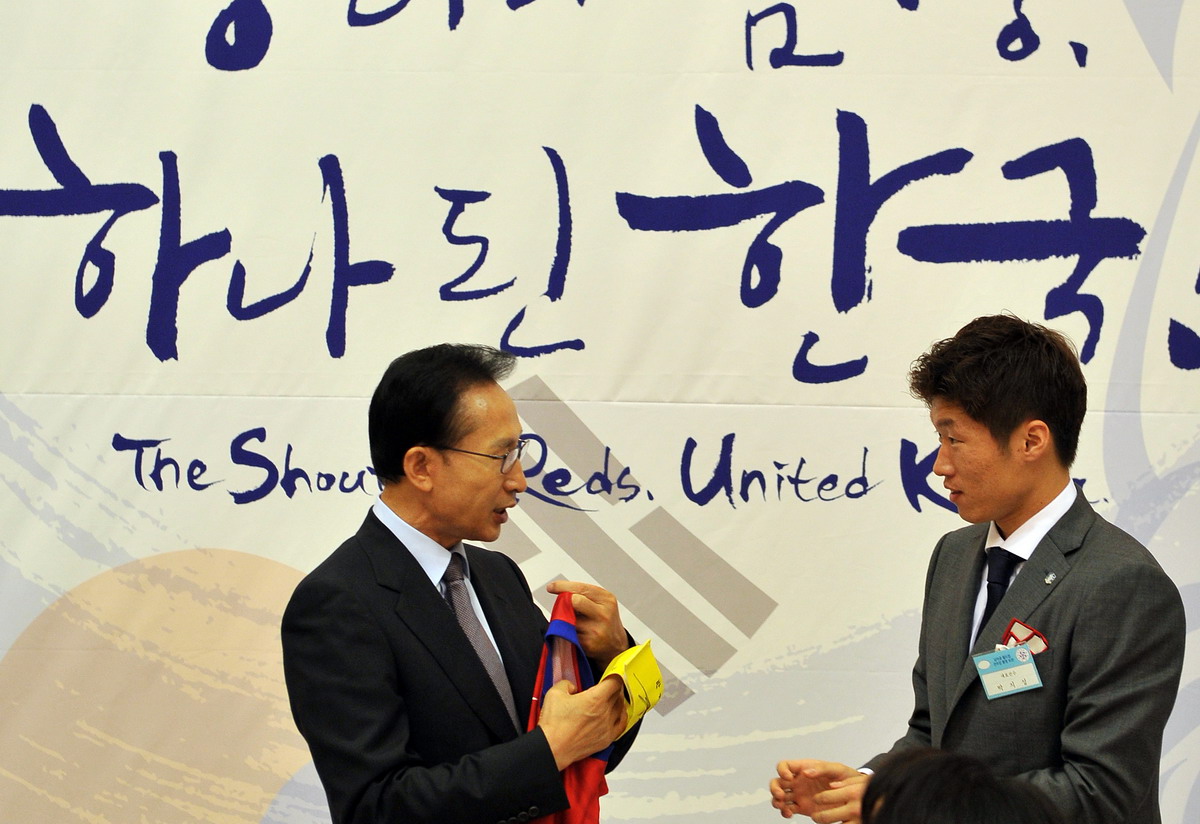
Photo: Republic of Korea / Wikimedia Commons / CC BY-SA 2.0

Replicating 2002 away from home has been the defining struggle. The team has qualified for every World Cup since, but navigating the group stage became a recurring drama. The pressure to live up to the “Miracle of 2002” has often felt like a weight.
In 2006, a transitional squad crashed out with one point. 2010 in South Africa was the answer. Led by Park Ji-sung at his peak, they finally delivered abroad. A 2-0 win over Greece was their first World Cup victory on foreign soil. A 4-1 loss to Argentina, featuring a young Lionel Messi, was expected, but a 2-2 draw with Nigeria saw them through. The Round of 16 brought a 2-1 loss to Uruguay, a dignified exit. That 2010 run is their legitimate best away result, a proof of concept.
Common mistake: Writing off South Korea’s 2010 campaign because it ended in the Round of 16. Beating Greece and drawing Nigeria to advance in South Africa was, in many ways, a more impressive and sustainable achievement than the unique, host-advantaged 2002 run.
2014 was a disaster: one point, heavy criticism. 2018 provided iconic moments, including Son Heung-min’s stunning goal against Germany to knock the holders out, but again, no knockout progress. 2022 in Qatar was a microcosm of their modern identity: a thrilling 2-1 comeback win over Portugal to advance, followed by a 4-1 dismantling by Brazil in the Round of 16. The pattern is clear: capable of spectacular one-off results, yet vulnerable to the absolute top tier.
This inconsistency often stems from a stylistic tug-of-war. Post-Hiddink, coaches have oscillated between the inherited high-press and a more conservative, possession-oriented approach. The team sometimes looks caught between two identities, a issue less common in the clear-eyed 2002 era or the pragmatic 2010 setup.
TL;DR: Since 2002, South Korea’s benchmark is the 2010 Round of 16 run abroad. Their cycle involves brilliant wins (Germany 2018, Portugal 2022) and group-stage struggles, reflecting an ongoing search for a stable tactical identity.
Key Players Who Defined Eras
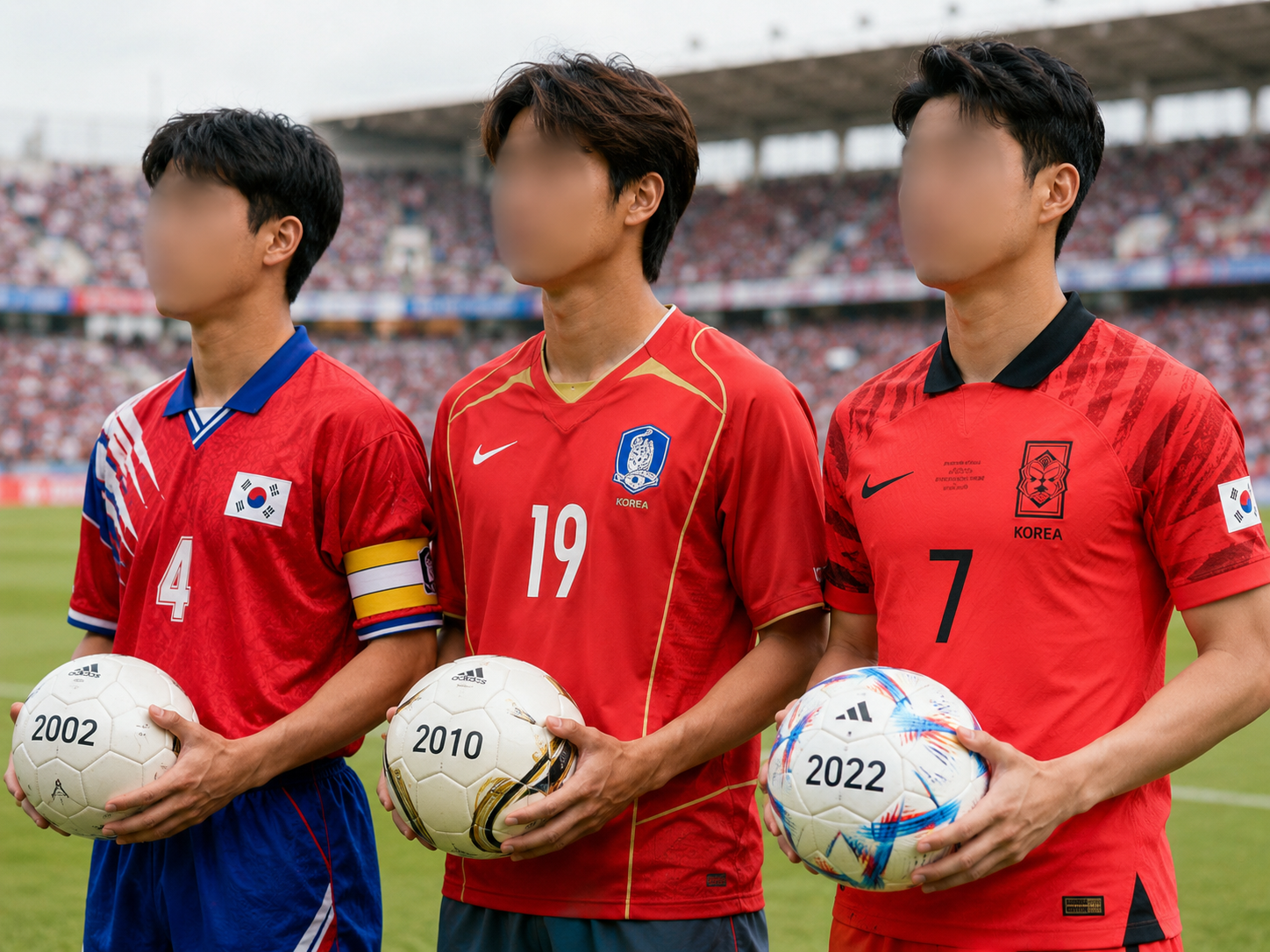
South Korea’s World Cup history is written by its stars. Each era has a face, a player who carried the team’s hopes and defined its style.
- Hong Myung-bo (1990-2002): The “Iron Foot” captain of the 2002 team. His leadership and flawless penalty in the shootout against Spain were the soul of the miracle. He bridged the gritty 1990s to the historic 2000s.
- Park Ji-sung (2002-2011): The “Three-Lung Park” personified the 2002 engine. His relentless running and big-game pedigree at Manchester United made him the global star of the post-2002 generation, leading the line in 2010.
- Son Heung-min (2014-Present): The current captain and talisman. His world-class finishing and pace define the modern attack. The goal against Germany in 2018 is a national treasure, but his tearful apology after the 2022 exit shows the immense burden he carries.
Beyond these icons, other figures shaped their journeys. Ahn Jung-hwan’s 2002 heroics made him a legend. Cha Bum-kun, though from a pre-qualification era, inspired a generation. Today, a new wave of youngest players like Lee Kang-in brings technical flair, aiming to support Son.
The evolution is physical. Early teams relied on sheer endurance. The 2002 squad added tactical discipline. Today’s players blend that work rate with the technical quality demanded in Europe’s top leagues. The modern soccer physique is a product of this decades-long progression.
TL;DR: Hong Myung-bo was the leader, Park Ji-sung the boundless engine, and Son Heung-min the world-class finisher. Each superstar defined South Korea’s approach for a generation, raising the team’s global profile.
Tactical Evolution: How South Korea Plays the Game
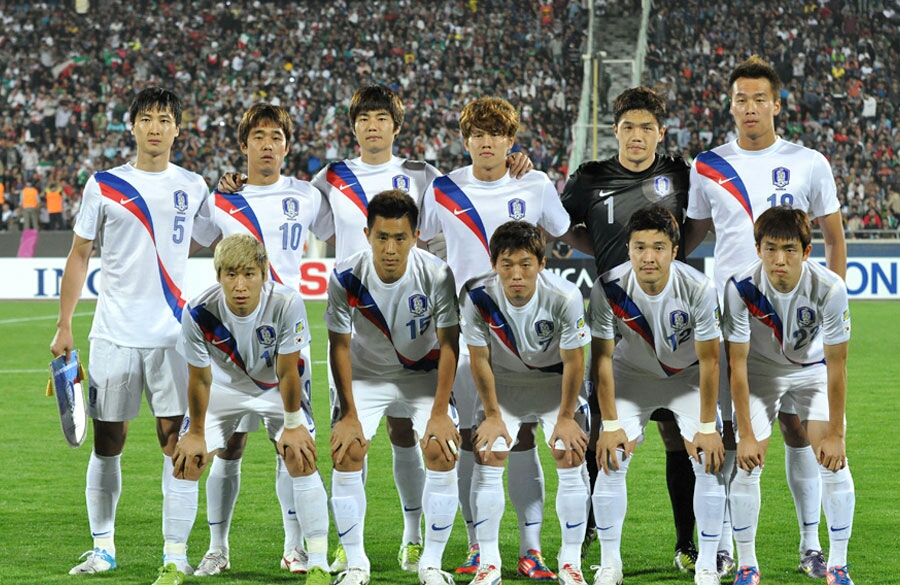
Photo: ypa.ir / Wikimedia Commons / CC BY 4.0

The Taeguk Warriors’ tactical identity has been in flux since the definitive Hiddink era. Understanding this shift explains their results.
The 2002 Blueprint was extreme. A hyper-aggressive press, a compact midfield block, and rapid transitions. It was a system built for one tournament, exhausting but devastatingly effective. You can’t play that way for 20 years.
The Post-2002 Adaptation saw attempts to control more possession. Coaches like Huh Jung-moo (2010) favored a more structured 4-4-2 or 4-2-3-1, relying on Park Ji-sung’s two-way prowess and the pace of Park Chu-young. This produced the solid 2010 run. Later coaches, like Paulo Bento (2018-2022), emphasized building from the back and patient circulation, a clear departure from the “run and fight” archetype.
I watched Bento’s Korea train before the 2022 World Cup. The focus on positional play and short passing was total. It worked against Portugal. Then they met Brazil, whose pressing and individual quality shattered that structure in 35 minutes. The lesson was harsh: technical progression is necessary, but against the very best, Korea’s historic strengths, collective spirit and athletic intensity, still need to be the foundation.
The current debate revolves around formation. Does a back-three, reminiscent of 2002’s five-man defense, provide more solidity? Or does the classic 4-4-2 formation offer the balance they need? The answer will define their 2026 approach.
| Playing Style Era | Key Characteristics | Peak Tournament | Inherent Limitation |
|---|---|---|---|
| Pre-2002 (Athleticism) | Direct play, physical duels, set-piece reliance | 1994 (First point) | Lack of technical control against elite sides |
| Hiddink Revolution (2002) | Extreme high press, rapid counter-attacks, man-marking | 2002 (4th Place) | Physically unsustainable long-term |
| Modern Hybrid (2010-Present) | Possession-oriented build-up, structured pressing, reliance on star attackers | 2010 (Round of 16) | Can be out-techniqued by top-5 nations; gap between plan and execution |
TL;DR: South Korea’s tactics evolved from pure athleticism to Hiddink’s revolutionary press, and now to a possession-based hybrid. Their challenge is blending new technical standards with their traditional, disruptive intensity.
Looking Ahead: South Korea’s 2026 World Cup Prospects
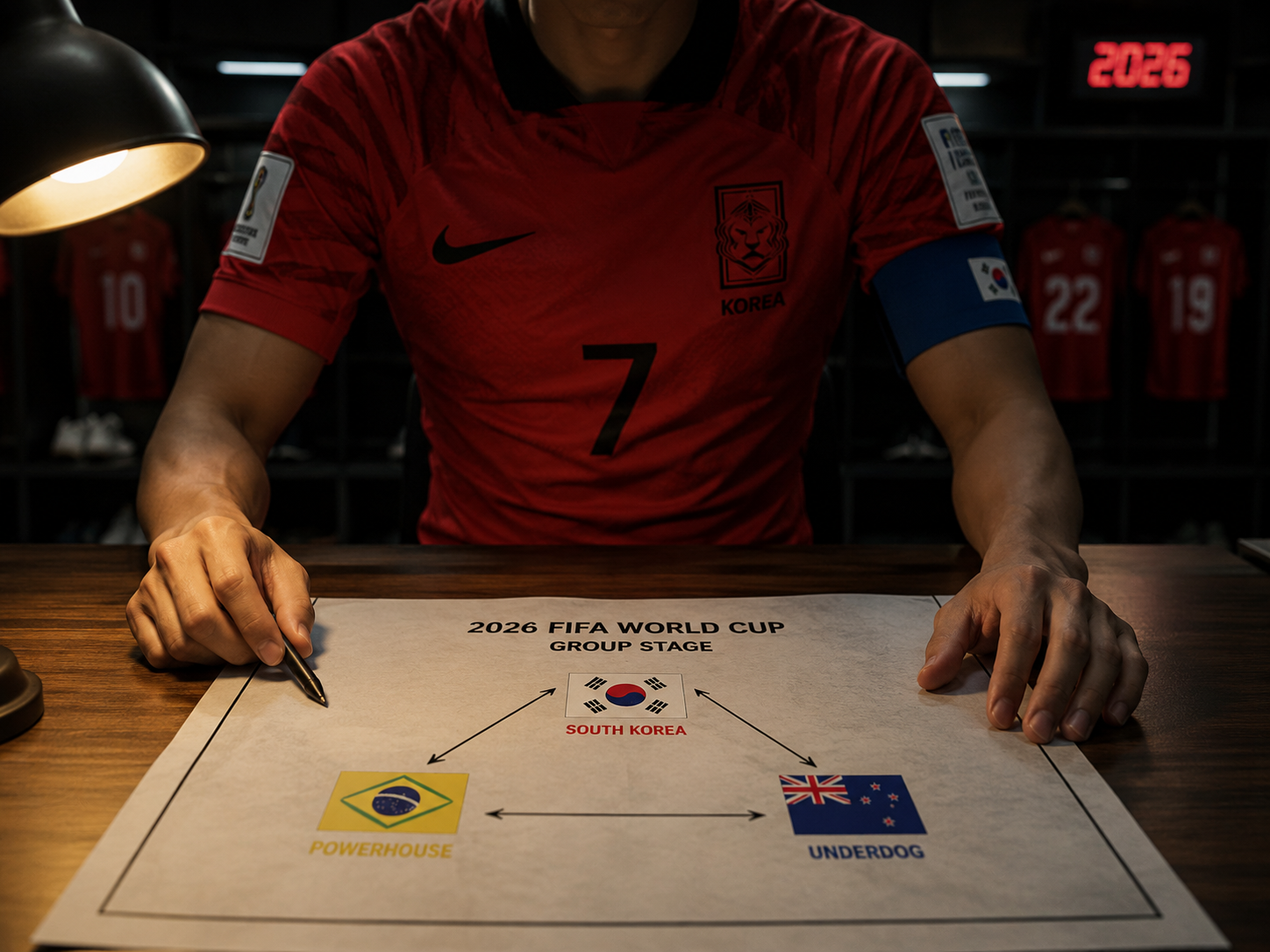
The 2026 World Cup in North America presents a unique challenge. The expansion to 48 teams means a new format: likely groups of three. The margin for error shrinks. Every match is a potential knockout.
The squad is at a pivot. Son Heung-min will be 34. His supporting cast. Kim Min-jae in defense, Lee Kang-in in midfield, must become co-leaders. The pipeline of talent is strong, but replicating Son’s once-in-a-generation quality is impossible. The system must elevate the collective.
Their group draw will be everything. Avoiding a second global powerhouse is crucial. Their goal must be to win their first match, a task that has often eluded them, and then navigate a likely win-or-go-home second game. The extra time rules in a three-team group could become a critical factor.
Realistically, the Round of 32 (the new first knockout round) is the minimum target. Reaching the Round of 16 would match their best foreign performance. Anything beyond that would require a perfect draw and career-defining performances from Son and Kim Min-jae. The expanded tournament offers more opportunity but also more potential pitfalls.
The long-term view is positive. The South Korea at the FIFA World Cup page shows a record of relentless qualification. The infrastructure and player development are now ingrained. They may never repeat 2002, but they are built to be a permanent, dangerous presence on the world’s biggest stage. The next chapter is about turning consistent attendance into consistent knockout advancement.
TL;DR: For 2026, South Korea aims for the knockout stages in an expanded format. Success hinges on Son Heung-min’s final prime years and a favorable group draw, with the Round of 16 as a realistic target.
Frequently Asked Questions
What is South Korea’s best World Cup result?
South Korea’s best World Cup result is fourth place, which they achieved as co-hosts of the 2002 tournament. They lost to Germany in the semifinals and to Turkey in the third-place playoff.
How many times has South Korea qualified for the World Cup?
South Korea has qualified for the FIFA World Cup 11 times (1954, 1986, 1990, 1994, 1998, 2002, 2006, 2010, 2014, 2018, 2022). They are the most successful Asian nation in terms of World Cup appearances.
Has South Korea ever won a World Cup knockout match outside of Asia?
No, South Korea has not won a World Cup knockout match outside of Asia. Their only knockout stage victories came on home soil in 2002 (against Italy and Spain). Their best performance abroad is reaching the Round of 16 in 2010, where they lost to Uruguay.
Who is South Korea’s all-time top scorer in the World Cup?
As of the 2022 tournament, Son Heung-min and Park Ji-sung are tied as South Korea’s all-time top scorers in the World Cup, each with 3 goals. Ahn Jung-hwan also scored 3 goals, but one was in a playoff match not counted in the official FIFA tally.
Who coached South Korea during their 2002 semifinal run?
Dutch manager Guus Hiddink coached South Korea during their historic 2002 World Cup campaign. His tactical system and leadership are credited as the primary catalysts for the team’s unprecedented success.
The Bottom Line
South Korea’s World Cup history is a tale of two truths. The first is the unforgettable, nation-altering high of 2002, a summer that proved anything is possible. The second is the gritty, persistent reality of being Asia’s most reliable contender, a team that qualifies without fail and fights in every game, often punching above its weight. Their legacy isn’t just a semifinal. It’s a 70-year project of growth, embodied by warriors from Hong Myung-bo to Son Heung-min. The future is about building a bridge between that miraculous past and a more sustainably competitive present, aiming not for another miracle, but for permanent respect.
I come from the “soccer heart” of Germany, the Ruhrpott. I have played, trained and followed soccer all my life and am a big fan of FC Schalke 04. I also enjoy following international soccer extensively.