Best Third-Placed Teams Scenarios: World Cup Survival Guide
The 8 best third-placed teams from across the 12 groups in the 2026 World Cup will join the 24 automatic qualifiers in the Round of 32. Ranking is decided by points, then goal difference, then goals scored, with head-to-head results not applying between teams from different groups.
Most fans get this wrong. They assume finishing third is a death sentence, or they think a head-to-head win over a team in another group gives them an edge. It doesn’t. The new 48-team format turns the group stage into a complex survival puzzle where goal difference isn’t just a stat—it’s your lifeline.
This guide breaks down the exact scenarios, points thresholds, and tactical shifts the 2026 World Cup will trigger. You’ll learn what your team needs to survive, why a 0-0 draw might kill them, and how the entire tournament psychology changes.
Key Takeaways
- 4 points is the safety net. A third-placed team with one win and one draw (4 points) has a near-certain chance of advancing. It’s the primary target for any squad not topping its group.
- Goal difference is the real decider. For the bubble teams on 3 points, ranking comes down to who scored more and conceded less. A single goal swing can eliminate a continent’s hope.
- Head-to-head is irrelevant for third-place ranking. That dramatic win over a rival only matters for deciding first or second within your own group. It doesn’t help you against a third-placed team from Group A when you’re in Group H.
- The format rewards conservative starts. A loss and a draw (1 point) leaves you alive, which means early group matches might see more cautious, low-risk World Cup tactics as teams avoid a knockout blow.
- Fair Play points are a silent killer. Accumulating yellow cards for tactical fouls could be the difference between advancing and going home if points, GD, and goals are level.
The 2026 Format: A Numbers Game
Forget everything you know about World Cup groups. The jump from 32 to 48 teams creates a different beast. We now have 12 groups of four. The math is simple but the implications are vast.
Twenty-four teams—the top two from each group—walk into the Round of 32. That’s the easy part. The next eight slots go to the best of the rest. The 12 third-placed teams are lined up and compared, and the top eight get a golden ticket. The bottom four third-placed teams, along with all 12 fourth-placed teams, are gone. This system, borrowed from the European Championship, creates a secondary league within the tournament.
The 2026 FIFA World Cup qualification system for the knockout stage involves a direct comparison of third-placed teams across all 12 groups. The hierarchy for ranking these teams is strictly defined: total points, overall goal difference, total goals scored, Fair Play conduct points, the FIFA World Ranking published prior to the tournament, and finally, the drawing of lots.
The chaos factor is immense. A team finishing third in a “Group of Death” with 4 points could be ranked above a third-placed team with 3 points from a weaker group. Your fate isn’t just in your hands; it’s in the hands of 11 other groups playing thousands of miles away. This makes real-time scenario tracking during the tournament a nightmare and a thrill. Your team could be celebrating a 2-0 win only to have their advancement hopes crushed by a 90th-minute goal in a match happening on another continent.
TL;DR: 12 groups, top 2 advance automatically, then 8 best third-placed teams join them. Your team’s third-place finish is judged against 11 other third-placers.
How Are the Best Third-Placed Teams Ranked?
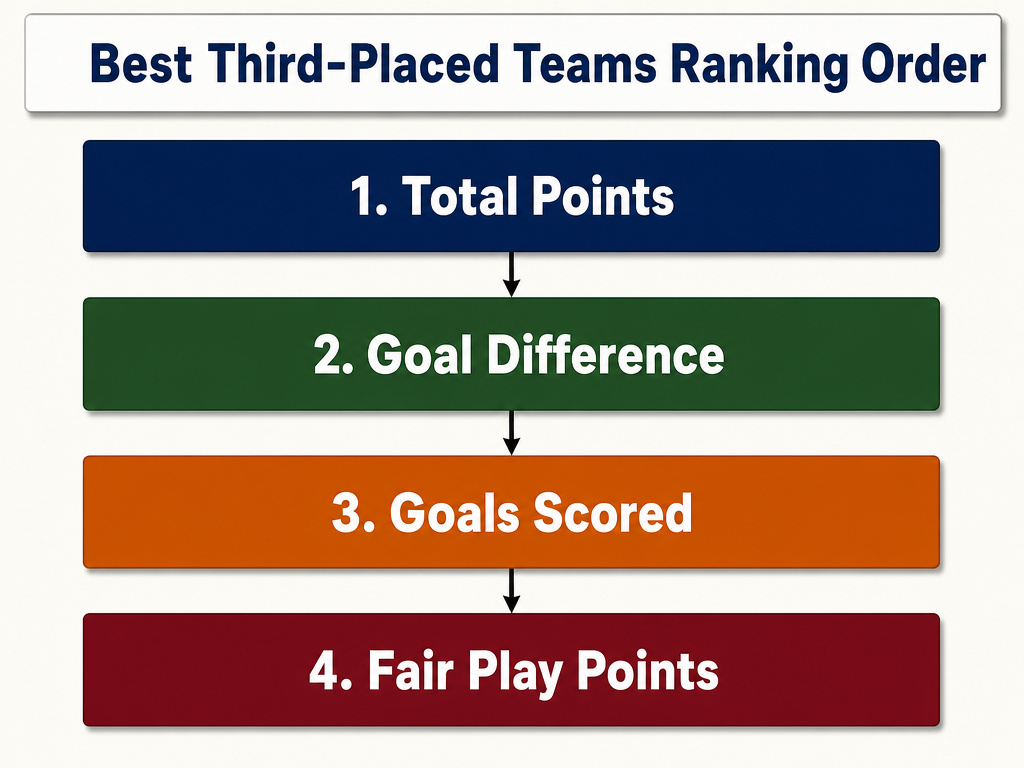
The tie-breaker list is your new bible. Memorize it. The order is absolute and head-to-head results are conspicuously absent for this specific ranking.
- Total Points: Win=3, Draw=1. Nothing else matters until this is equal.
- Goal Difference: Goals scored minus goals conceded. This is where tournaments are won and lost in the group stage.
- Goals Scored: If GD is level, the team that scored more goals advances.
- Fair Play Points: This is the sneaky one. A yellow card is -1 point, an indirect red (second yellow) is -3, a direct red is -4, and a yellow plus a direct red is -5. The team with the higher Fair Play score (fewer deductions) advances.
- FIFA World Ranking: The ranking published just before the tournament starts breaks the tie.
- Drawing of Lots: If somehow everything is still identical, FIFA officials pull a name from a bowl.
The head-to-head rule only applies to determine standings inside a single group. If Team A and Team B are tied for third in Group F, their head-to-head result decides who gets third and who gets fourth. But once Team A is designated the third-placed team from Group F, that win over Team B means nothing when comparing them to the third-placed team from Group C.
This is the most common misconception. I’ve seen fans in Dortmund pubs already arguing that a win over a specific opponent will help them later. It won’t. What helps is scoring more goals in every game you play.
| Ranking Criterion | What It Means | Why It Matters for 3rd Place |
|---|---|---|
| Total Points | The sum of points from 3 group matches (3 for a win, 1 for a draw). | The primary filter. Get 4 points and you’re almost certainly safe. |
| Goal Difference | Goals scored minus goals conceded across all 3 matches. | The main decider between teams on equal points. A single goal can be the cutoff. |
| Goals Scored | The total number of goals a team scores. | The tie-breaker after GD. Encourages attacking play even when a draw might suffice. |
| Fair Play | Points deducted for yellow and red cards. | A last-resort decider that can punish a team for cynical fouls or poor discipline. |
| FIFA Ranking | The official FIFA/Coca-Cola World Ranking published before the tournament. | An arbitrary but necessary final step before a literal draw. |
The Points Thresholds: What Actually Gets You Through
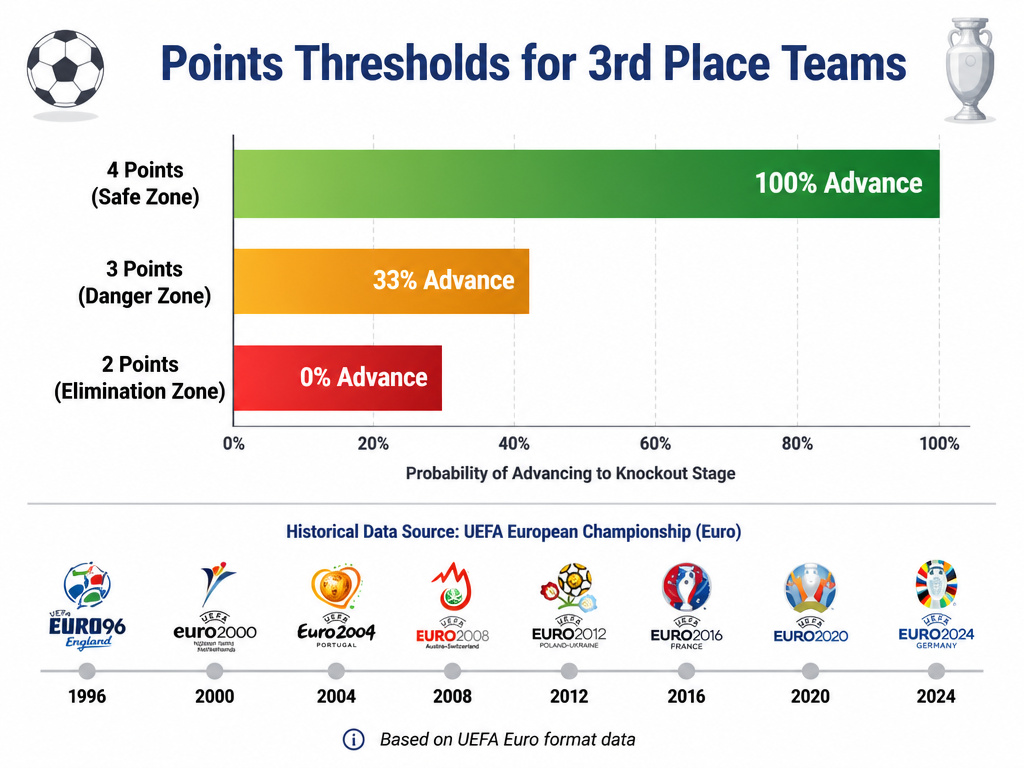
History is our guide. The European Championship has used this best third-placed system for years. The data from those tournaments paints a clear picture of what survival looks like. The 2026 World Cup will follow a nearly identical pattern.
The Safe Zone: 4 Points
A third-placed team finishing with 4 points has never failed to advance in the history of the Euros under this format. That’s one win, one draw, and one loss. It’s the magic number. Coaches will know this. The tactical shift in the final group game for a team sitting on 3 points (a win and a loss) will be stark: they will play for the draw to hit that 4-point mark. It creates a perverse incentive. A boring, defensive 0-0 draw might be celebrated as a triumph because it all but books a ticket to the knockouts.
The “Bubble” of 3 Points
This is where the heartbreak happens. Most third-placed teams with 3 points do advance, but it’s not guaranteed. Your goal difference is your life raft. In Euro 2016, the cutoff for the worst advancing third-placed team was 3 points and a goal difference of 0. In Euro 2020, it was 3 points with a -1 goal difference. That minus sign is the killer.
Common mistake: Settling for a 1-0 loss when a 2-0 loss is imminent — the second goal against could be the difference between a -1 GD and a -2 GD, which is often the line between advancing and going home.
Let’s say your team, playing a 5-3-2 formation for defensive solidity, grinds out a 1-0 win, then loses 2-0 to a group favorite. You have 3 points and a -1 GD. You’re sweating. You’re now relying on other third-placed teams to lose by bigger margins or score fewer goals. That final matchday becomes a global exercise in scoreboard watching.
The Danger Zone: 2 Points or Fewer
Two points means two draws and a loss. It’s possible to advance with this, but you need a remarkably favorable goal difference and a lot of help. One point (a draw and two losses) is virtually hopeless. It has happened only under extremely weird circumstances in the Euros. Don’t plan for it.
TL;DR: Target 4 points at all costs. Treat 3 points as a precarious ledge where every goal matters. See 2 points as a prayer.
Tactical Implications: How the “Loophole” Changes the Game
The expansion isn’t just about more teams; it’s about a different kind of tournament psychology. Academics call it the problem of “stakeless games.” The 2026 format accidentally creates more of them, but with a twist.
In the old 32-team format, a loss in your opening game was a crisis. Now, a loss and a draw (1 point) can still leave you in contention if other results go your way. This incentivizes conservative, risk-averse play in the first two matches. Why open up and risk a heavy defeat that wrecks your goal difference when a cautious 0-0 draw keeps you alive? We might see more teams adopting a low-block 3-5-2 formation early on, prioritizing defensive structure over flair.
But the flip side is the final matchday. For teams on 3 points, a draw might get them to 4 and safety. But if they’re already on 4 points, they might still need to improve their goal difference to be among the best third-placed teams. This leads to a bizarre scenario: a team that has already secured third place in its group might be pushing for goals in the final minutes against a group winner who has already qualified. The result is meaningless for the group standings but critical for the overall tournament bracket.
I remember watching Portugal in Euro 2016. They drew all three group games, finishing third with 3 points and a 0 goal difference. They scraped through as the last of the best third-placed teams. They then parked the bus all the way to the final and won it. The format rewarded their conservative start and gave them a path. Every team in 2026 will have studied that blueprint.
This system also neuters the classic “Group of Death.” So what if you get Brazil, Germany, and a strong African side in your group? Finishing third with 3 or 4 points against that caliber of opponent likely means your goal difference is still respectable, and you have a great chance of advancing. The fear is diminished.
Real-World Scenarios and Predictions
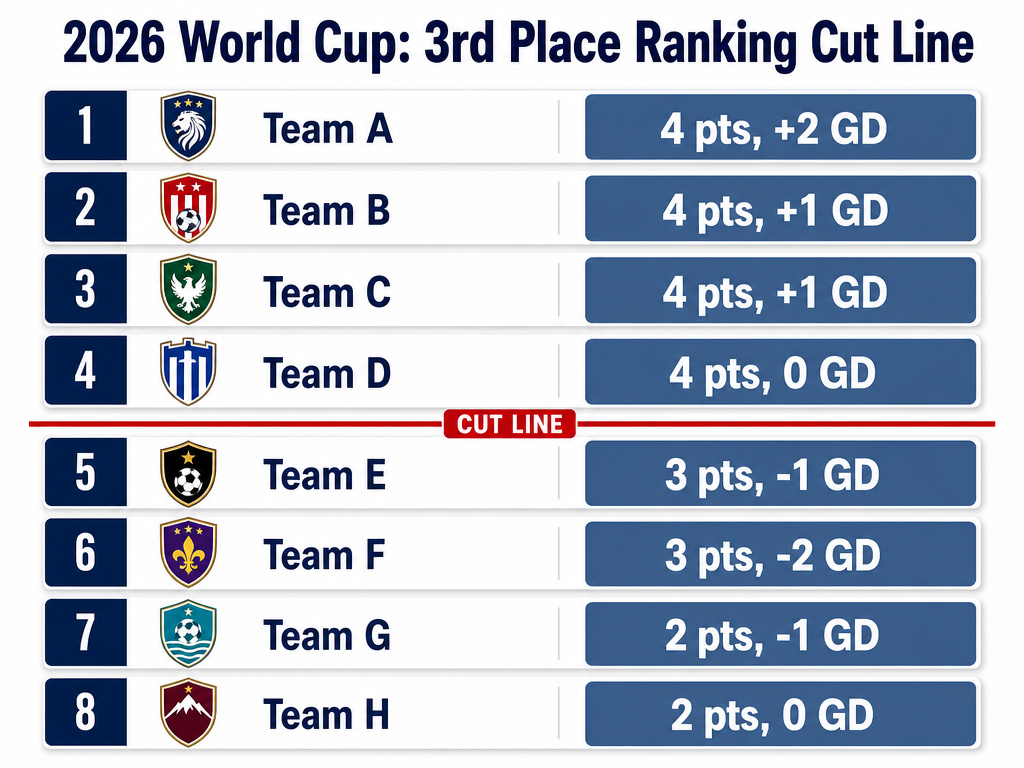
Let’s project. Based on the Euro model and the global parity in football, we can expect a tight bunching of third-placed teams between 3 and 4 points. The cut line will almost certainly be 3 points, with goal difference separating the survivors from the eliminated.
Imagine a scenario where these are the third-placed teams:
* Team A (Group B): 4 pts, +2 GD
* Team B (Group D): 4 pts, +1 GD
* Team C (Group F): 3 pts, +1 GD
* Team D (Group H): 3 pts, 0 GD
* Team E (Group K): 3 pts, 0 GD
* Team F (Group L): 3 pts, -1 GD
* Team G (Group A): 3 pts, -2 GD
* Team H (Group C): 2 pts, 0 GD
In this case, Teams A through F advance. Team G (3 pts, -2 GD) is the unlucky one going home, likely on goals scored versus Team F. Team H, with only 2 points, is out. Notice how Team F, with a negative goal difference, still advances because others were worse. That -1 is the new zero.
For coaches, this makes pre-tournament planning obsessive. You must schedule friendly matches against teams that mimic the best 11v11 formations you’ll face, but you also need to drill “goal difference management.” Do you push for a second goal when you’re winning 1-0 in the 85th minute, risking a counter-attack? The 2026 answer is a painful “it depends on the other groups.”
Frequently Asked Questions
Does a head-to-head win help a third-placed team advance?
No. Head-to-head results are only used to determine final positions within the same group. When FIFA ranks all 12 third-placed teams against each other, they never look at who beat whom. The comparison is purely based on the universal criteria: points, goal difference, goals scored, etc.
Is 3 points enough for a third-placed team to qualify?
Usually, but not always. 3 points is the most common “bubble” total. Advancement then depends entirely on your goal difference and goals scored compared to the other third-placed teams. A poor GD of -2 or worse with 3 points puts you at high risk of elimination.
What is the minimum points needed to advance in third place?
The absolute minimum is 2 points, but it requires an exceptionally high goal difference and for almost all other third-placed teams to have 1 or 2 points with worse GD. In practice, the safe target is 4 points, and the realistic fight is for 3 points with the best possible goal difference.
How does the 48-team format change team tactics?
It encourages more conservative play in the first two group matches, as even a single point keeps hopes alive. Conversely, it can encourage aggressive goal-seeking in final matches for teams needing to boost their goal difference, even if the match result itself doesn’t change their group position. It makes the classic 4-4-2 formation, built for balance, a potentially risky choice if it doesn’t generate enough attacking threat to score the goals that matter for tie-breakers.
Before You Go
The 2026 World Cup’s third-place rule is a masterclass in added complexity. It turns the group stage from a simple knockout round into a layered qualifying tournament where every goal echoes across the globe. Forget just winning; you need to win by enough, or lose by little.
Smart teams will build their entire group stage tournament strategies around hitting 4 points and managing goal difference from minute one. This system might just crown a champion who started their journey in third place, much like the 2026 standout players will be those who score the decisive goals in otherwise meaningless final group games. It’s no longer just about getting out of the group; it’s about getting out with the numbers that let you live to fight another day.

I come from the “soccer heart” of Germany, the Ruhrpott. I have played, trained and followed soccer all my life and am a big fan of FC Schalke 04. I also enjoy following international soccer extensively.