Direct vs Indirect Free Kick: The 4 Crucial Differences
The four crucial differences between a direct and indirect free kick are the scoring rule, referee signal, offenses punished, and restart procedure. A direct kick can score immediately; an indirect cannot. The referee signals indirect by raising an arm. Direct kicks punish serious fouls, while indirect address technical offenses.
The difference between a direct and indirect free kick is the scoring rule. You can score directly from a direct free kick. You cannot score directly from an indirect free kick; the ball must touch another player before entering the goal. The referee signals an indirect free kick by raising an arm vertically. Direct free kicks are awarded for serious fouls. Indirect free kicks are for technical offenses and specific goalkeeper infractions.
Most people think the difference is just about how hard you can shoot. They watch a free kick from 25 yards and assume it’s direct. The real confusion starts inside the penalty area, where the rules flip and the stakes are immediate.
This guide breaks down the four critical differences: the offenses, the referee’s signal, the scoring rule, and the resulting tactics. You’ll learn how to read the game like an official and why the most chaotic moments come from an indirect free kick six yards out.
Key Takeaways
- The referee’s vertical arm signal is the only visual cue for an indirect free kick. No signal means direct.
- A direct free kick shot that goes directly into your own net is an own goal. An indirect free kick kicked directly into your own net results in a corner kick for the opponent.
- Goalkeeper offenses like handling a deliberate back-pass or holding the ball for over six seconds are the most common cause of indirect free kicks inside the penalty area.
- For an indirect free kick, the ball is not in play until it travels the distance of its own circumference. A quick tap is legal if it meets this requirement.
- The defensive wall must be 9.15 meters (10 yards) away for both types of kick, but the attacking team’s setup and run are completely different.
The Core Difference: Scoring
This is the rule that changes everything on the pitch. It dictates the shooter’s decision, the goalkeeper’s positioning, and the defensive wall’s purpose.
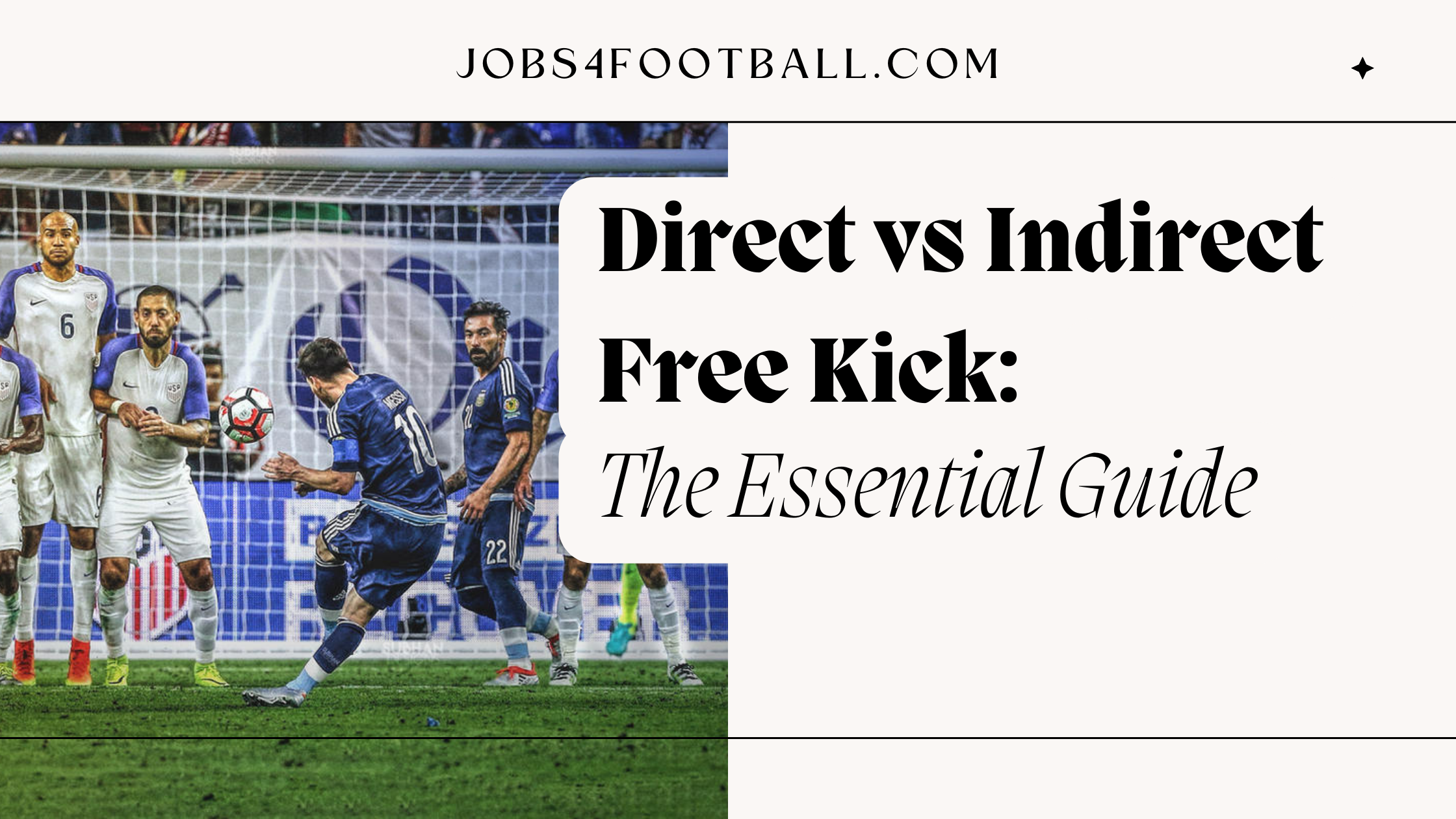
A direct free kick is a direct scoring opportunity. The kicker can shoot straight at goal, and if the ball crosses the line without touching anyone else, the goal stands. Think of Juninho Pernambucano, David Beckham, or Cristiano Ronaldo lining up from distance. They are shooting to score. The defensive wall exists solely to block that shot.
An indirect free kick cannot result in a goal unless the ball is touched by a second player after the kick is taken. If the ball goes directly into the opponent’s goal from an indirect free kick, a goal kick is awarded. If it goes directly into the kicker’s own goal, a corner kick is awarded.
An indirect free kick adds a mandatory second action. The kicker must pass or touch the ball to a teammate before a shot can be taken. This turns a set-piece into a mini-scenario. The defense isn’t just blocking a shot; they’re trying to intercept a pass or block the second touch. The attacking team might use a decoy runner, a lay-off, or a clever dummy.
TL;DR: See the referee’s arm go up? The shot must be a pass first. No arm? Shoot.
| Kick Type | Can Score Directly? | If Ball Goes Directly Into Opponent’s Goal | If Ball Goes Directly Into Own Goal |
|---|---|---|---|
| Direct Free Kick | Yes | Goal is awarded. | Own goal is awarded. |
| Indirect Free Kick | No | Goal kick to defending team. | Corner kick to opposing team. |
What Triggers Each Type of Free Kick?
The Laws of the Game draw a clear line between careless/reckardirect vs indirect free kick difference fouls and technical infractions. One gets you a yellow card and a direct kick. The other gets you a warning and an indirect kick.
Direct Free Kick Offenses
These are the fouls everyone recognizes. They involve contact that is careless, reckless, or uses excessive force. The official soccer free kick infractions listed in Law 12 are the foundation.
– Kicking or attempting to kick an opponent
– Tripping or attempting to trip
– Jumping at an opponent
– Charging in a violent or dangerous manner
– Striking or attempting to strike
– Pushing
– Tackling from behind without playing the ball
– Holding an opponent
– Impeding an opponent with contact (obstruction)
– Handling the ball deliberately (except the goalkeeper within their own penalty area)
These are the fouls that stop promising attacks and produce dramatic moments. A foul from these categories committed by a defender inside their own penalty area escalates immediately to a penalty kick offenses. That’s the direct free kick’s big brother.
Indirect Free Kick Offenses
This list is less about violence and more about prevention and procedure. It’s the referee managing the game’s flow and safety.
1. Goalkeeper-specific offenses in their own penalty area:
* Handling the ball after it has been deliberately kicked to them by a teammate (the back-pass rule).
* Handling the ball after receiving it directly from a teammate’s throw-in.
* Holding the ball for more than six seconds before releasing it.
2. Playing in a dangerous manner. This is subjective. High boot near an opponent’s head is the classic example, even if no contact is made.
3. Impeding an opponent without contact. Shepherding the ball out of play while standing between the opponent and the ball.
4. Offside. The restart for an offside offense is always an indirect free kick from where the offending player became involved.
5. Verbal offenses, dissent, or other misconduct when play is stopped to caution or send off a player.
Common mistake: Assuming a high foot is always a direct free kick — if there’s no contact, it’s only dangerous play and an indirect free kick. The attacker gets the kick, but the defender doesn’t get a card.
The most tense moments come from the first category. A defender nervously passes back to the keeper, the keeper fumbles and picks it up, and the referee whistles. The ensuing indirect free kick offenses happens inside the six-yard box. Chaos is guaranteed.
The Referee’s Signal: Reading the Official’s Arm
You don’t need to hear the whistle to know the call. Watch the referee’s left or right arm the moment the whistle sounds.
For an indirect free kick, the referee will raise one arm vertically above their head. They hold this signal until the kick is taken and the ball either touches a second player or goes out of play. If the ball goes directly into the goal, the signal makes the reason for disallowing the goal clear to everyone.
For a direct free kick, there is no specific signal. The referee points to the spot of the foul. The absence of the raised arm tells every player on the field that a direct shot is legal.
I learned this the hard way coaching a youth team. Our keeper held the ball for eight seconds during a tight cup match. The referee blew, raised his arm, and awarded an indirect free kick just outside the six-yard box. I was screaming from the touchline about the call, not realizing the arm signal had been up for three full seconds before the kick. My players didn’t know to charge the first touch. They stood still, the opponents tapped it, scored, and we lost. The signal was the entire story. I missed it.
Tactical & Positioning Consequences
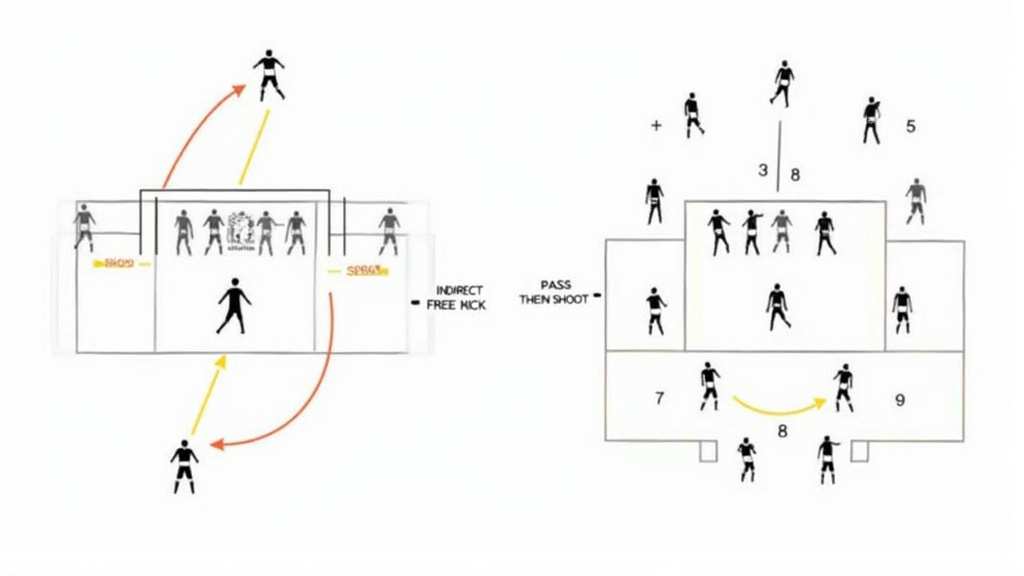
The type of kick doesn’t just change the shooter’s option. It rewrites the tactical script for all 22 players on the field.
Defensive Organization
For a direct free kick in shooting range, the priority is the defensive free kick wall. The goalkeeper organizes it to block the most likely shot trajectory. The wall must stand on the goal line, at the official wall distance of 9.15 meters. Everyone else marks zonally or man-to-man.
For an indirect free kick, especially inside the penalty area, the wall is irrelevant. The ball must be touched twice, so defenders pack the goal line and focus on attacking the first pass. The goalkeeper’s role shifts from shot-stopper to organizer of a charging defense. The referee’s vanishing spray still marks the 9.15-meter line, but it’s a formality.
Attacking Strategy
A direct free kick is about the specialist. It’s a duel between the kicker and the goalkeeper. The free kick technique for curling, dipping, or knuckling the ball over the wall is a refined skill. The run-up and body shape give away the intended corner.
An indirect free kick is a rehearsed play. It requires two or more players. The options are broader:
* The Lay-Off: Player A taps the ball sideways for Player B to blast through the crowd.
* The Dummy Run: Player A runs over the ball, deceiving the wall and goalkeeper, while Player B shoots.
* The Chip: For very close-range indirect kicks, a delicate chip for a teammate to head or volley.
These plays are drilled on the training ground. The success rate for indirect free kicks from inside the box in top leagues is surprisingly low precisely because the defense knows a pass is coming. The bending the ball technique is useless here. It’s about disguise and speed of the second action.
| Aspect | Direct Free Kick | Indirect Free Kick |
|---|---|---|
| Primary Attacking Goal | Shoot to score. | Pass, then shoot. |
| Defensive Priority | Block the shot with a wall. | Intercept the first touch. |
| Key Player | One specialist kicker. | Two coordinated attackers. |
| Common Range | 18-30 yards from goal. | Anywhere, often inside penalty area. |
| Set-Piece Routine | Individual skill. | Rehearsed team play. |
Special Situations & Common Confusions
The laws have specific wrinkles that even seasoned fans mix up.
The “Quick” Indirect Free Kick. Can you take it quickly? Yes, but with a huge caveat. The ball is not in play until it has traveled the distance of its own circumference. A tiny tap that barely moves the ball is not a legal kick. The referee will order a retake. This prevents a player from legally “touching” the ball by just nudging it with their toe for a teammate to smash.
The Second Touch Rule. If the kicker touches the ball again before it touches another player, an indirect free kick is awarded to the opposing team. This is true for both direct and indirect kicks. So if you take a direct free kick, it hits the wall, and rebounds straight back to you, you cannot kick it again. You must leave it for a teammate.
Offside Restarts. This is always an indirect free kick. It is taken from where the offending player was when the ball was last played by a teammate, not from where they received it.
The Attacking Player Wall Rule. This is a recent addition. If three or more defenders form a wall, all attacking players must stay at least 1 meter (1 yard) away from that wall until the ball is in play. This prevents attackers from interfering with the wall’s setup. Violation is an indirect free kick to the defending team. This rule applies equally to both direct and indirect free kicks.
Understanding these details helps you see the game’s structure. A transition phases often starts from a cleared free kick. Knowing whether the defending team won a goal kick or a corner from an indirect free kick mix-up changes the counter-attacking dynamic completely.
Frequently Asked Questions
Can a goalkeeper score from a direct free kick?
Yes. If a goalkeeper takes a direct free kick from their own half and the ball goes directly into the opponent’s goal, it is a valid goal. This is exceptionally rare but legal.
What happens if the referee forgets to signal for an indirect free kick and a goal is scored directly?
The goal must be disallowed. The kick is retaken because the referee’s error misled the players. This is why referees are trained to hold the signal clearly.
Is a handball always a direct free kick?
No. A deliberate handball by an outfield player is a direct free kick. An accidental handball is only an offense if it creates a goal or chance immediately afterward, and even then, it’s often debated. A goalkeeper handling a deliberate back-pass from a teammate’s foot is an indirect free kick offense.
Why is offside an indirect free kick?
Offside is considered a technical infringement, not a foul involving contact or dangerous play. It’s a rule to prevent goal-hanging, so the restart is the less severe indirect free kick.
Can you be offside from a direct or indirect free kick?
Yes. You can be offside from any restart of play, including free kicks, unless you receive the ball directly from a goal kick, corner kick, or throw-in.
What’s the difference between this and a penalty kick?
penalty kick is a specialized direct free kick awarded for a direct free kick offense committed by the defending team inside their own penalty area. The ball is placed on the penalty spot, and only the goalkeeper defends the goal directly.
Before You Go
Forget just memorizing lists. Watch the referee’s arm first. That vertical signal changes the entire geometry of the play. A direct free kick is a duel. An indirect free kick is a puzzle.
The real understanding comes from recognizing the goalkeeper offenses that lead to indirect kicks in the box. That’s where games turn. And remember the scoring rule—it’s the single law that separates a moment of individual brilliance from a choreographed team move. Keep this free kick definition in mind as the foundation, and you’ll start reading set-pieces like a coach.

I come from the “soccer heart” of Germany, the Ruhrpott. I have played, trained and followed soccer all my life and am a big fan of FC Schalke 04. I also enjoy following international soccer extensively.