How to Become a Soccer Coach in : A Real Guide
The path to becoming a soccer coach in 2026 involves a non-negotiable sequence: prerequisites, entry-level education, practical application, and progressive licensing. The specific badges. USSF, UEFA, AFC, are just the visible stamps. The real work is in the sessions you run between courses.
To become a soccer coach in 2026, you must follow a structured pathway defined by your national federation, starting with mandatory prerequisites like a background check and First Aid certification, then progressing through a series of licenses that match your target age group and coaching ambition. The core process is identical worldwide: start free online, earn your first in-person badge, gain real experience, then climb the ladder.
Most guides talk about licenses. They skip the three things that actually stop you before you even pay for a course. You show up for your first in-person FA Intro to Coaching course without a valid DBS check? They send you home. Your USSF D License application gets rejected because your Safeguarding certificate is from the wrong provider. You spend six months coaching a youth team in Australia only to find out your Working with Children Check expired. This guide maps the 2026 pathways for the US, UK, and Australia, but we start with the paperwork that gates everything else.
Key Takeaways
- Your first investment isn’t a course fee. It’s the time and money for a clean background check (like a DBS or WWCC) and an in-person First Aid certificate. Federations will not let you register without them.
- Licenses are tiered by player age and development stage. A USSF D License focuses on U6-U12 fundamentals. A UEFA B License deals with adolescent tactical shape. Picking the wrong starting point wastes months.
- Higher licenses require proof of active coaching. You cannot go from a D to a C License without logging at least six months of consistent, documented work with a team. Theory without practice is a dead end.
- The most common career killer isn’t a lack of tactical knowledge. It’s poor communication and session planning. Your first course teaches you how to structure a 60-minute practice for eight-year-olds. That skill matters more than any formation.
- Networking happens on the touchline, not just online. Assistant coach roles, local club meetings, and federation workshops are where real job opportunities surface. A recommendation from a club director beats a perfect resume.
The 5 Non-Negotiable Prerequisites (Before You Spend a Cent)
Forget about licenses for a minute. These are the barriers to entry that federations treat as non-negotiable. Get them wrong and your application gets shredded.
First, the background check. In the UK, it’s a Disclosure and Barring Service (DBS) check. In Australia, it’s a Working with Children Check (WWCC). In the US, it’s a state-specific child abuse clearance, often through a system like Pennsylvania’s Child Abuse History Clearance. The process takes two to six weeks. It costs money. And it expires. A DBS check is typically renewed every three years. Let yours lapse and you are legally barred from coaching until it’s current again.
Second, the First Aid certificate. This is not an online quiz. Federations demand a hands-on, in-person course from a recognized provider like the Red Cross or St. John Ambulance. The certificate must include CPR and managing a catastrophic bleed. It also expires, usually every two years. I’ve seen a coach miss his entire season because his FA-recognized first aid lapsed two days before the first match. The club’s insurance wouldn’t cover him.
Common mistake: Assuming an old First Aid certificate from your workplace is sufficient, federation portals require specific accredited providers, and an expired or non-compliant certificate will freeze your license application for weeks.
Third, Safeguarding or Child Protection training. This is often an online module from the federation itself. US Soccer’s SafeSport, The FA’s Safeguarding Children, Football Australia’s Play by the Rules. It’s a few hours long. You cannot coach anyone under 18 without this certificate on file. It’s the one piece of paperwork clubs audit ruthlessly.
Fourth, a valid federation membership. You must register as a coach with US Soccer, The FA, or Football Australia. This creates your unique ID number in their system. All your courses, badges, and compliance documents attach to this number. Trying to take a course without being a registered member is like showing up to a match without boots.
Fifth, age minimums. For the first formal licenses, you must be at least 16 years old (FA Intro to Coaching) or 18 years old (USSF D License). They check your date of birth against your membership profile. No exceptions.
TL;DR: Secure a current background check, an in-person First Aid cert, and the online Safeguarding module before you look at course dates. These three documents are your ticket to the starting line.
Which Coaching Pathway Matches Your Country and Goals?
The badges have different names, but the ladder’s shape is universal. You start with fundamentals, move to age-specific development, then into high performance. The table below shows how the major pathways align.
| License Level (Focus) | US Soccer Federation (USSF) | The FA / UEFA (UK/Europe) | Football Australia / AFC |
|---|---|---|---|
| Entry / Volunteer | Grassroots Intro (Free Online) | FA Playmaker (Free Online) | Community Coaching Course (Often Free) |
| Foundational (Youth) | D License (U6-U12) | Intro to Coaching Football (U7-U16) | FFA C Licence (Skill Training) |
| Developmental (Teen) | C License (U13-U17) | UEFA C Licence | AFC B Licence |
| Advanced (Adult / Semi-Pro) | B License | UEFA B Licence | AFC A Licence |
| High Performance (Pro) | A License | UEFA A Licence | AFC Pro Diploma |
| Elite (Managerial) | Pro License | UEFA Pro Licence | (AFC Pro Diploma) |
The USSF pathway, revamped in 2018, is brutally logical. You must complete two in-person Grassroots courses (like 4v4 or 9v9) before you can even apply for the D License. The D License itself is a grueling combination of online modules, in-person instruction, and a final assessment where you run a training session with real kids while an evaluator watches. Fail the practical assessment and you retake the entire course. No partial credit.
The FA pathway now starts with the free FA Playmaker online module. It’s a brilliant piece of marketing, low commitment, high inspiration. From there, the old “Level 1” is now “Introduction to Coaching Football.” This 24-hour blended course is the minimum to be a head coach for a youth team. The jump to the UEFA C Licence is significant. It costs over £500, requires a season of coaching logs, and introduces formal tactical periodization. This is where you stop just organizing games and start designing training cycles.
The UEFA C Licence is the first badge that signals you’re a serious coach, not just a volunteer parent. The course materials shift from “how to set up a cone” to “how to construct a 4-week microcycle to improve build-up play against a mid-block.” It’s a different language.
The Australian system, governed by Football Australia and the Asian Football Confederation (AFC), is similarly structured. The FFA C Licence is the common starting point. The critical detail is that Australia recognizes UEFA licenses as equivalent to AFC badges. A UEFA B Licence holder can work in Australia without re-taking the AFC B course, though they must still register with Football Australia and hold the local prerequisites (WWCC, First Aid). This reciprocity is a major advantage for coaches who want international mobility.
Your choice depends on where you live and where you want to work. A USSF A License is required to be a head coach in MLS. A UEFA Pro Licence is mandatory for managing in the English Premier League. If your goal is to coach your daughter’s U10 rec team, the Grassroots or Intro course is all you need. Ambition dictates the climb.
The USSF Pathway: Costs, Timelines, and the Pro License Gate
Let’s get specific about America. The USSF system is a pay-to-play pyramid with clear gates. You don’t just learn; you prove competency at each stage.
The Grassroots level is your on-ramp. After the free online intro, you pick in-person courses based on the age you want to coach: 4v4 (U6-U8), 7v7 (U9-U10), 9v9 (U11-U12), or 11v11 (U13+). Each course is a single weekend, costs about $75-$125, and ends with you running a short practice. You need two of these before the D License. Most people do 9v9 and 11v11 to cover the broadest range.
The D License is the first major commitment. It costs around $400-$500. The process takes 2-3 months: online assignments, a 4-day in-person residency, and that final practical assessment. The focus is exclusively on the player in front of you. Can you design a session that improves their first touch? Can you give a coaching point in ten words or less? The evaluators are looking for clarity, not complexity. The pass rate is high if you prepare, but about 15% of candidates fail the practical because they over-coach.
The C License is where it gets expensive and selective. Prerequisites: hold the D License for at least six months, be 18+, and be actively coaching a team. The course fee is $1,500-$2,000. It’s a hybrid model with extensive online work, two in-person weekends, and a long-term project where you document a season of coaching a U13-U17 team. They assess your ability to develop players over time, not just in a single session. This badge qualifies you for most competitive youth club and high school varsity positions.
The B and A Licenses are for the professional track. The B License focuses on coaching the team unit (defensive shape, pressing triggers). The A License deals with the whole club environment (squad management, style of play implementation). Each costs over $3,000 and requires access to a high-level team for the assessment, a college, USL, or MLS Next team. You cannot fake this. The federation verifies your access.
Then there’s the Pro License, the peak of the US pyramid. It’s a $10,000, year-long executive program. The prerequisite is holding the A License for one year while actively coaching as a head or assistant coach in MLS, NWSL, or a similar professional league. The curriculum is about club leadership, sporting director principles, and high-performance management. It’s less about coaching a drill and more about running a department.
| USSF License | Typical Cost | Time Commitment | Primary Focus & Career Door |
|---|---|---|---|
| Grassroots | $75-$125 per course | 1 weekend per course | Youth recreational coaching; assistant club roles. |
| D License | $400-$500 | 2-3 months | Head coach for youth club teams (U6-U12). |
| C License | $1,500-$2,000 | 6-9 months | Competitive youth club director; high school varsity. |
| B License | $3,000+ | 9-12 months | USL League One / Two assistant; college assistant. |
| A License | $3,500+ | 12-18 months | MLS assistant coach; USL head coach; college head coach. |
| Pro License | $10,000+ | 12-24 months | MLS head coach (mandatory unless waived). |
TL;DR: The USSF path is a sequential financial and time investment. You cannot skip levels. Budget at least $6,000 and four years to go from zero to A License, assuming you pass every assessment on the first try.
How to Start Coaching Before You Have a Single Badge
You do not need a license to begin. You need a club that needs a volunteer. This is the secret apprenticeship.
Email your local recreational soccer club director in late July. Subject line: “Volunteer Coach Availability for Fall Season.” State that you’re eager to learn, are pursuing certification, and can commit to two practices and a game per week. Offer to assistant coach first. Clubs are desperate for reliable bodies. I got my start this way with a U8 boys team in Gelsenkirchen. For three months, I just set up cones and collected pinnies. I watched how the head coach managed parents, how he structured a warm-up, where he stood during a small-sided game. That was my real education.
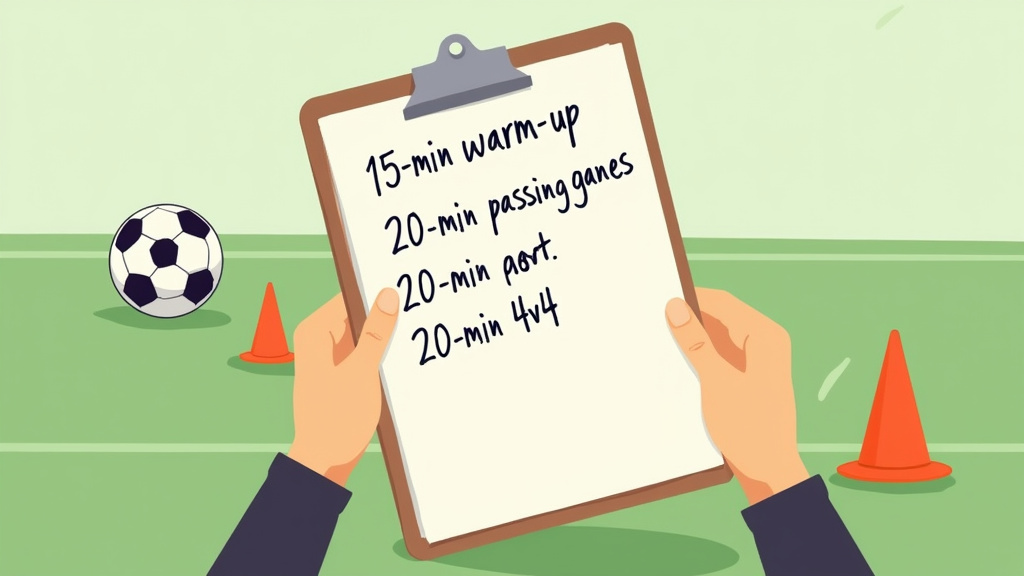
Your first task is not tactics. It’s organization. Create a simple session plan for 60 minutes: 15-minute warm-up with the ball, 20-minute technical drill (passing gates), 20-minute conditioned game (4v4 with two goals), 5-minute cool-down. Write it down. Follow it. When you inevitably have to change it because the kids are tired or it’s raining, note why. This log becomes gold later.
I spent my first season trying to teach a sweeping 4-3-3 to ten-year-olds. The result was chaos and two kids quitting. The club director pulled me aside: “They need to learn how to pass and move first. The formation is for you, not for them.” That lesson cost me two players. Don’t make that mistake.
Communicate with parents once a week. A simple email: practice time, what we worked on, what to look for in the game. This builds trust and prevents weekend drama. Learn every player’s name by the second practice. This seems obvious, but in the rush of admin, it’s the first thing new coaches forget.
Use this volunteer period to complete your free online modules (USSF Grassroots Intro, FA Playmaker). Now you’re coaching with a bit of theory. You’ll start to see why the course tells you to use positive reinforcement instead of shouting corrections. You’ll understand why the session plan has more games than drills. This is where the licensing theory connects to the muddy reality of a Tuesday evening practice.
This phase also lets you test your commitment. Do you enjoy the planning? Can you handle an angry parent? Does watching a kid finally nail a Cruyff turn give you a buzz? If not, you’ve saved thousands in course fees. If so, you now have a season of experience to list on your first license application.
What Do Professional Clubs Actually Look for in a Coach?

Tactical knowledge is the price of admission. It’s assumed. What gets you hired, and fired, is everything else.
First, session design. Can you create a week of training that logically progresses from individual technique to team tactic, culminating in a match-relevant situation? Can you do it for a U14 team on a Tuesday and a first-team squad on a Thursday? Clubs want to see your training plans. They are a window into your football brain. A well-structured plan shows you understand the game’s principles, not just its patterns. This is where diving into a detailed soccer tactics guide pays off, moving beyond basic drills to understanding why you choose a 4-3-3 press versus a 5-3-2 block.
Second, communication clarity. Can you give an instruction in under ten seconds? Can you demonstrate a technique cleanly? Can you hold a team talk that motivates and informs without rambling? I once watched a candidate for an academy job lose the room during a simple passing drill because his explanation took two minutes. The director shook his head and walked away. The job was gone.
Third, relational skills. Can you manage a 25-man squad with different personalities? Can you develop a personal connection with a shy 16-year-old prospect while also holding a 30-year-old veteran accountable? This is soft skill territory, but it’s what separates a manager from a trainer. Clubs assess this in interview scenarios: “How would you handle a player who is consistently late?” Your answer reveals your philosophy.
Fourth, adaptability and continuous learning. The game evolves. Are you watching match analysis from platforms like StatsBomb? Are you familiar with load management technology like Catapult GPS? Can you use video editing software to create pre-match clips for your team? Mentioning your use of specific tools for shooting drills for players or agility ladder drills shows a commitment to player development across all domains, not just tactics.
Finally, a defined coaching philosophy. This is your “why.” Is it possession-based? High-pressing? Counter-attacking? It must be coherent and you must be able to articulate how every training exercise feeds into it. When interviewing for a professional role, you will be asked to present your philosophy for 45 minutes. They will pick it apart. You need conviction backed by methodology.
Common mistake: Building a philosophy around a trendy formation like the 3-5-2 without understanding the player profiles it requires, if your club has no wing-backs, the system collapses by October. Your philosophy must be adaptable to the material you have.
The jump from volunteer to paid professional often hinges on a recommendation. That’s why networking at coaching conferences, United Soccer Coaches events, and even on online forums is critical. A paid role with a local club might come from impressing a director during a coaching clinic. A semi-pro opportunity could emerge from a conversation after a match. Your license opens the door, but your reputation and relationships get you the seat.
Building Your First Season: A 12-Month Action Plan
This is the calendar. Treat it like a project plan.
Months 1-3 (The Foundation):
- Secure your prerequisites: Background check, First Aid, Safeguarding. Register with your national federation.
- Complete the free online introductory course (USSF Grassroots Intro, FA Playmaker).
- Contact three local clubs. Offer to volunteer as an assistant coach. Accept the first offer that gives you consistent time with a team.
- Start a coaching journal. After every session, write three lines: what worked, what didn’t, one thing to try next time.
Months 4-6 (The Apprenticeship):
- Enroll in your first formal in-person course (e.g., USSF 9v9 Grassroots, FA Intro to Coaching). Apply the concepts directly to your volunteer team.
- Begin studying foundational tactics. Don’t just watch matches; watch analysis. Read the United Soccer Coaches career guide to understand the profession’s landscape beyond the field.
- Start building a digital portfolio. Take photos (with permission) of your session layouts. Save your session plans.
Months 7-9 (The Application):
- Apply for your first full license (USSF D License, or equivalent). Use your coaching journal as evidence of your practical experience.
- Begin to specialize. If you’re with a U12 team, study age-appropriate skill acquisition. If you’re with older players, delve into basic small-sided game tactics.
- Attend a local coaching workshop or clinic. Introduce yourself to the presenter.
Months 10-12 (The Transition):
- Complete your first license. Update your LinkedIn and local federation profile with the new badge.
- Have a conversation with your club director. Express your desire to take on more responsibility, perhaps as a head coach for a team next season or leading a skills clinic.
- Assess your next move. Are you ready for the C License pathway? Does your goal require moving to a more competitive club? Use your network to explore opportunities.
This plan forces progression. Without it, it’s easy to volunteer for three years without ever taking the next step. The license courses provide deadlines. Use them.
Frequently Asked Questions
Can I become a soccer coach without any playing experience?
Yes, absolutely. While playing experience provides intuitive understanding, it is not a formal requirement for any coaching license. The courses teach you the “why” behind the “what.” Many successful coaches had modest playing careers. Your ability to teach, communicate, and analyze matters more than your past playing level.
How long does it take to become a professional soccer coach?
From zero to a first paid, full-time professional role (e.g., academy coach, USL assistant), expect a minimum of 3-5 years. This includes time to earn a C or B License and, crucially, to build the necessary experience and reputation. Reaching a top-tier head coaching role (MLS, Premier League) typically takes 10-15 years of continuous progression and career breaks.
Is the USSF license recognized in Europe?
Not automatically. USSF licenses are respected but are not direct equivalents to UEFA badges. To coach in Europe, you would likely need to have your qualifications assessed by the relevant national federation (e.g., The FA). They may grant some equivalency or require you to complete specific modules. A USSF A License might allow you to enter the UEFA B License process, but it’s a case-by-case assessment.
What’s the single most important skill for a new coach?
Session management. This is the ability to organize 20 players, with one ball, across six cones, into a drill that actually improves them, within a 60-minute window, while accounting for a lost shin guard and a sudden downpour. It’s logistics, psychology, and pedagogy rolled into one. You learn it by doing it, failing, and refining your plans. Studying a defensive formation tactics guide is important, but it’s useless if you can’t run a tight, engaging practice.
Can I make a living as a soccer coach?
Yes, but the pyramid is steep. Most youth club coaches are part-time, with modest stipends. Full-time salaries become common at the competitive club director, elite academy, or semi-professional level. Professional league salaries (MLS, NWSL, USL) can be substantial but are highly competitive. Diversifying your skills, becoming a director of coaching, running camps, offering individual training, is often necessary to build a stable income. A comprehensive soccer player workout plan is also a valuable asset you can offer for additional revenue.
The Bottom Line
The pathway to becoming a soccer coach in 2026 is more structured and accessible than ever, with clear online starting points. The real challenge isn’t passing the courses. It’s doing the unglamorous work between them: the background checks, the session planning for rowdy ten-year-olds, the networking on cold Saturday mornings. Your first license teaches you how to coach a player. Your second teaches you how to coach a team. Everything after that is about coaching a culture.
Start with the paperwork. Find a team to volunteer with today. The badges will come. The experience you gain while earning them is what actually makes you a coach. Forget about the Champions League final for now. Focus on making next Tuesday’s practice 10% better than last week’s. That’s the climb.
I come from the “soccer heart” of Germany, the Ruhrpott. I have played, trained and followed soccer all my life and am a big fan of FC Schalke 04. I also enjoy following international soccer extensively.