7v7 Indoor Soccer Formations Guide () | Tactics & Strategies
The best 7v7 indoor soccer formations are the 2-3-1 for midfield control, the 3-2-1 for defensive solidity, and the 2-2-2 for balanced play. Your choice hinges on three things: your team’s dominant trait, the opponent’s main threat, and the current scoreline. No offside rule means your defensive shape is non-negotiable.
Most coaches pick a formation based on what they like, not what their players can actually execute. They force a possession-based 2-3-1 onto a team of sprinters, or they deploy a defensive 3-2-1 with a lead only to watch their midfield get overrun because the wingers don’t track back. The formation number is just a starting point. The real work is in the transitions, the spacing, and the goalkeeper’s first pass.
This guide breaks down the six core 7v7 indoor formations. You’ll get the pros, the specific player requirements, the exact transition patterns, and the in-game adjustments that separate a drawn match from a win.
Key Takeaways
- The 2-3-1 formation dominates midfield but isolates your striker if the three midfielders don’t push forward in unison.
- A 3-2-1 setup is your best bet for protecting a lead, but it surrenders midfield control and requires your lone forward to press relentlessly.
- No offside rule changes everything defensively; your deepest defender must always stay goal-side, acting as a permanent sweeper.
- Your goalkeeper is your first attacker; their quick, accurate throws to the wings launch the most dangerous counter-attacks.
- The most common mistake is sticking rigidly to one formation. You must shift shapes between attack, defense, and rest defense.
What Are the Most Common 7v7 Indoor Formations?
You have six primary structures to build from. Each creates a different shape on the floor, demanding specific skills from your players. The classic 4-4-2 or 4-3-3 from 11v11 formations doesn’t translate directly. You’re working with a condensed space, fewer players, and faster transitions.
The 2-3-1 formation, often considered the standard for 7v7, positions two defenders, three midfielders, and one striker. Its strength lies in midfield numerical superiority, creating a diamond or flat three in the center to control possession and tempo. The single striker must be mobile and comfortable playing with back to goal, while the wide midfielders provide essential width and defensive cover.
The 3-2-1 is the defensive counterpart. It trades a midfielder for an extra defender, forming a back three that’s very difficult to break down. The 2-2-2 offers perfect symmetry, with two lines of two players creating a box midfield and a double striker partnership. Then you have the hybrid shapes: the 2-1-2-1, which adds a dedicated attacking midfielder, and the more aggressive 3-1-2 and 2-1-3 systems that push numbers forward.
Your first training session with a new shape will feel awkward. Players drift into old habits. That’s normal. Spend twenty minutes just walking through the positions, then another twenty with no opposition, passing in the pattern. The muscle memory comes later.
How to Choose the Right Formation for Your Team
Forget the opponent for a moment. Look at your own squad. Can your best player dribble past two defenders in a phone booth? Then a 2-1-3 might unleash them. Do you have two tireless runners who love to tackle? A 2-2-2 lets them patrol the entire midfield channel. The formation is a tool to maximize your talent, not a philosophy to suffer for.
I once coached a recreational team with one brilliant playmaker and ten hard workers. I tried a fancy 2-1-2-1 to highlight him. It was a disaster. The three lines confused everyone, and our star was marked out of the game. We switched to a simple 3-2-1, told him to play as the central midfielder, and told everyone else to win the ball and give it to him. We finished second. Play to your strength.
TL;DR: List your three best players and their best attributes. Build your formation to get them the ball in positions where those attributes matter.
Assessing Player Strengths and Weaknesses
Make a simple table. Be brutally honest.
| Player Type | Best Formation Fit | Worst Formation Fit |
|---|---|---|
| Mobile, Target Striker | 2-2-2 (has a partner) | 2-3-1 (gets isolated) |
| Creative Playmaker | 2-1-2-1 (AM role) | 3-2-1 (too deep) |
| Defensive Destroyer | 3-2-1 (central of three) | 2-1-3 (exposed) |
| Speedy Winger | 2-1-3 (wide forward) | 3-2-1 (defensive duty) |
If your table is mostly “Defensive Destroyer,” you are a counter-attacking team. Build from a 3-2-1. If it’s filled with “Creative Playmakers,” you want a 2-3-1 or 2-1-2-1 to own the ball. This isn’t rocket science. It’s matching.
Factoring in the Opponent and Match Context
Now look across the floor. What are they doing? A team playing a high 2-3-1 leaves space behind their two defenders. A 3-2-1 bunker is tough to pass through but vulnerable to long shots from the top of the arc. Your tactical adjustments happen here.
The scoreline dictates your shape. Up a goal with ten minutes left? Switch to a 3-2-1. Down a goal? You might need the aggressive 2-1-3. This is the fluidity most teams lack. They pick a formation in the locker room and stick with it until they lose.
Common mistake: Choosing a formation based on a famous pro team’s style — that 4-3-3 pressing system requires fitness and understanding your squad doesn’t have. You’ll be gassed by halftime, chasing shadows.
Breaking Down the Top 7v7 Formations
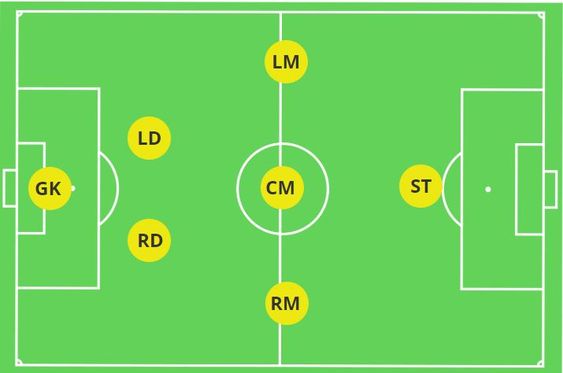
Let’s get into the specifics. Each of these formations has a core job, a required player profile, and a fatal flaw if executed poorly.
The 2-3-1: Controlling the Midfield
This is the default for a reason. It provides a solid base of two defenders, a bank of three midfielders, and a outlet striker. The three midfielders are the engine. They must rotate positions, with one holding and two advancing, or playing flat across the center line.
The wide midfielders have the most demanding role. They must provide width in attack, then sprint back to form a back four in defense. If one of them gets lazy, the whole shape collapses. Your striker cannot be a static poacher. They need to drop into midfield, link play, and spin for through balls. Otherwise, they become irrelevant.
Why the midfield triangle works: With three central players, you always have a passing option in the congested indoor middle. It creates short, sharp passing triangles that are easy to maintain under pressure. A two-man midfield gets outnumbered and bypassed.
The 3-2-1: Defensive Solidity and Counter-Attacks
You trade midfield presence for a wall at the back. The back three should shift as a unit, with the central defender directing traffic. The two midfielders are purely transitional—win it, feed the striker, and support. The lone forward must be a pest, pressing the opponent’s defenders to force bad passes.
This formation is boring. It’s effective. It wins close games. The risk is getting pinned in your own half because your two midfielders can’t get on the ball. Your goalkeeper’s distribution is critical here. A long throw to the striker’s chest can turn defense into attack in two seconds.
I won’t use a 3-2-1 with a young team. They lack the discipline to hold the shape. The extra defender gets bored, wanders up, and leaves a gaping hole for a counter. With adults who understand the assignment, it’s a fortress.
The 2-2-2: Balanced and Flexible
Symmetry. Two defenders, two midfielders, two forwards. It’s simple to understand, which makes it great for youth and recreational teams. The “box” of two midfielders and two strikers can combine in various ways, and defensively it morphs into a 4-2 shape.
The key is rotation between the front four. The two midfielders must join the attack to create overloads, and the two forwards must drop to help in midfield. If they play in rigid lines, the opponent’s three-man midfield will pass around them easily. It requires intelligent, unselfish movement.
The 2-1-2-1: The Hybrid with an Attacking Midfielder
This splits the midfield into a holder, two shuttlers, and a dedicated number 10. It’s a more advanced formation interpretation of the 2-3-1, designed to get a creative player on the ball between the lines. The attacking midfielder is the focal point.
It’s also the most demanding. The two wide midfielders must cover insane ground, and the single holder can be overwhelmed if the number 10 doesn’t defend. Use this only if you have a special talent in that AM role and two of the fittest players on the planet on the wings.
The 3-1-2 and 2-1-3: Aggressive Attacking Shapes
These are for when you need a goal. The 3-1-2 uses a back three, one defensive midfielder, and two outright forwards. It’s direct. The 2-1-3 is even more aggressive: two defenders, one midfielder, and a front three. It provides immense width and numbers in attack.
The cost is defensive vulnerability. In a 2-1-3, if your front three don’t press and track back, your two defenders are in a permanent two-versus-three situation. It’s a high-risk, high-reward gamble for the final minutes of a match.
Critical Indoor-Specific Tactical Adjustments
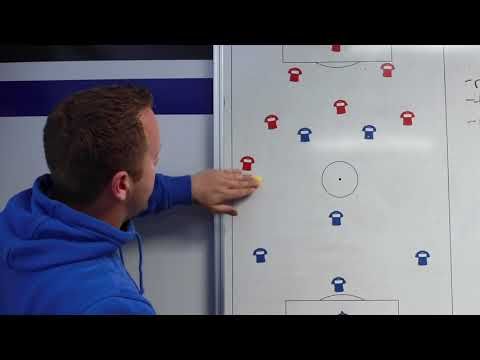
The walls and the rules change the game. You can’t just copy outdoor formation principles.
Adapting to No Offside Rule
This is the single biggest adjustment. Your last defender cannot step up to play an offside trap. They must always be the deepest player, focusing on intercepting through balls and dealing with players lurking behind them. This turns one of your defenders into a permanent sweeper, regardless of the formation number.
It makes through-balls down the sides incredibly dangerous. Defenders must learn to defend the space behind them first, the player second. It’s a backwards mindset for many.
Managing the Smaller Field and Transitions
The field is short. A goalkeeper’s throw can reach the opponent’s penalty area. This makes transition speed—the switch from defense to attack—the most critical phase. Your formation must have immediate outlets.
In a 2-3-1, that’s the striker and the wide midfielders. In a 3-2-1, it’s just the striker, so their hold-up play is vital. You must drill this: win the ball, head up, find the outlet within two seconds. Hesitate, and the opponent’s defense is set.
Common mistake: Trying to pass the ball out from the back every time under pressure. Sometimes, the smart play is for the defender to slam it off the boards behind the opponent’s goal to relieve pressure and reset your shape.
The Goalkeeper’s Role in Your 7v7 System
Your goalkeeper is not just a shot-stopper. They are a field player with gloves. With no offside, they can act as a sweeper, rushing out to clear through balls. Their distribution starts your attack.
A quick, flat throw to a winger breaking down the side is more effective than any goal kick. Train your keeper to look for this first. A team with a goalkeeper who can throw accurately to the halfway line has a built-in offensive weapon. This role is as important as any tactical role in your outfield setup.
Drills to Train Your Chosen Formation

You can’t just explain it. They have to feel it.
- Shadow Play (No Opposition): Have your team move the ball through the formation against no defenders. Call out the shape: “We’re in our 2-3-1 attacking shape!” Then shout “Turnover!” and have them sprint into their 4-2 defensive shape. Do this for five minutes, until the movement is automatic.
- Conditioned Small-Sided Games: Play 4v4 in half the field, but condition it so one team must always have a back three and one forward (simulating a 3-1-2). This forces players to think about their shape in a live, chaotic setting.
- Transition Rondo: Set up a 4v2 rondo in the center. The moment the defending duo wins the ball, they must find a target player (your striker) waiting on the edge of the grid. This drills the immediate outlet pass.
Skip the static passing drills that don’t mimic game pressure. Every drill must end with a shot on goal or a defensive transition. That’s the game.
How to Counter Common Opponent Formations

Your game plan changes based on what you see.
- Against a 2-3-1: Press their two defenders hard. Force them to play long to their isolated striker, where your defenders can clean up. Their weakness is the space behind their advanced midfielders.
- Against a 3-2-1: Be patient. Don’t force passes through the middle. Use the width, switch the ball, and take long-range shots. Their midfield two will struggle to cover the wide areas. Frustrate them, and gaps will appear.
- Against a 2-2-2: Match them in midfield. Your two midfielders must engage theirs physically. The battle is in the center circle. Whoever wins that battle wins the game.
Sometimes the best counter is to change your own shape at halftime. If your 2-3-1 isn’t breaking them down, shift to a 3-1-2 for the last fifteen minutes and overload the front line.
Frequently Asked Questions
What is the easiest 7v7 formation for beginners?
The 2-2-2 is the easiest. It’s symmetrical, easy to explain, and players naturally understand having a partner. Everyone has a clear role: defenders defend, midfielders run, forwards attack. It’s the best starting point before introducing more complex shapes like the 3-4-3 formation.
How do I adjust formations for youth players (U10, U12)?
Simplify. Use the 2-2-2 or a 3-2-1. Focus on one key concept per formation: “In the 2-2-2, stay with your partner.” Avoid hybrid shapes like the 2-1-2-1. At this age, understanding basic positioning and teamwork is more valuable than tactical complexity. The principles are similar to building a classic 4-4-2 foundation.
Can I use a “false nine” in 7v7 indoor soccer?
Absolutely, and it’s very effective in a 2-3-1. Have your central striker consistently drop deep into midfield. This pulls the opponent’s central defender out of position, creating space for your wide midfielders to cut inside and shoot. It requires a smart, technical player in that striker role.
What’s the biggest mistake coaches make with 7v7 formations?
They are too rigid. They pick a 2-3-1 and never change, regardless of the score, opponent, or flow of the game. Indoor soccer is a game of constant adjustments. Your formation should be fluid, changing between attack, defense, and when you have possession in your own half. This adaptive thinking is core to any modern soccer tactics guide.
How does the 7v7 2-3-1 compare to an 11v11 formation like 4-3-3?
They share a similar philosophy: control the midfield with numbers. However, the 7v7 2-3-1’s two defenders have much more ground to cover laterally than a back four, and the single striker is more isolated than a front three. The compact space makes the midfield battle even more crucial. It’s a concentrated version of the same idea.
Before You Go
Your formation is a living system, not a preset tactic. Start with the 2-2-2 for simplicity or the 2-3-1 for control. Drill the defensive transition until it’s a reflex—no offside means no mistakes allowed at the back. Use your goalkeeper as a weapon, not a spectator. And be ready to shift. The best 7v7 teams might play three different shapes in a single match, adapting to every moment. That flexibility, more than any magic number, is what wins games under those fluorescent lights.

I come from the “soccer heart” of Germany, the Ruhrpott. I have played, trained and followed soccer all my life and am a big fan of FC Schalke 04. I also enjoy following international soccer extensively.