When Is a Player Not Offside in Soccer? 5 Legal Scenarios
A player is not offside in soccer in five specific scenarios: when they are in their own half of the field, when they are level with the second-last opponent, when they receive the ball directly from a goal kick, throw-in, or corner kick, when they are not actively involved in play, or when a defending player has left the field. The key moment for judgment is the instant a teammate plays the ball.
Most fans get this wrong because they watch the player receiving the pass. They miss the freeze-frame moment that matters. The referee’s decision hinges on a snapshot taken a split-second before the through ball is struck.
This guide breaks down the five legal scenarios, the precise definitions from the IFAB Laws of the Game, and the subjective calls that even VAR struggles with. You will learn when a player can legally be ahead of the last defender and why being in an offside position is not a crime.
Key Takeaways
- The second-last opponent is the offside line, not the goalkeeper. If you are level with that defender, you are onside.
- Goal kicks, throw-ins, and corner kicks reset the offside phase. You can stand anywhere on those restarts.
- Active involvement is everything. Standing in an offside spot while a teammate scores from 30 yards out is perfectly legal.
- A defender who steps off the pitch without permission is still considered on the goal line for offside purposes.
- The arms and hands of all players, including goalkeepers, do not count when judging offside position.
The 5 Scenarios Where a Player Is NOT Offside
The official IFAB Law 11 guidelines define offside position with clinical precision. Forget the last defender. Think about the second-last opponent. That is your baseline.
Here are the five conditions that make an offside call impossible.
1. The Player is in Their Own Half
This is the simplest rule. The offside line is the halfway line. If any part of the player’s head, body, or feet that can legally play the ball is in their own half, they cannot be offside. The line itself belongs to the defending half.
2. The Player is Level with the Second-Last Opponent
This is the rule changed in 1990 that attackers love. You are onside if any part of your body you can score with is in line with the second-last defender. This includes the goalkeeper. If the keeper is up for a corner, the last outfield defender becomes the line.
The 1990 amendment to the offside law, which introduced the “level with the second-last opponent” clause, fundamentally shifted attacking tactics. It replaced the previous “level with the last opponent” rule, effectively moving the offside line forward by one player and creating more space for forwards to exploit behind defensive lines.
3. The Player Receives the Ball from a Goal Kick, Throw-in, or Corner Kick
These three restarts reset the offside phase entirely. On a goal kick, you can stand right next to the opponent’s goalkeeper. On a long throw-in, you can be three yards behind the last defender. It does not matter. This exception exists because these restarts are considered a new phase of play.
4. The Player is Not Actively Involved in Play
This is the biggest point of confusion. Merely being in an offside position is not an offense. The offense occurs only if the player then becomes “actively involved” by interfering with play or an opponent. We will dissect this crucial nuance in the next section.
5. A Defending Player Has Left the Field of Play
If a defender steps off the pitch without the referee’s permission, say, to tie a boot behind the goal, they are still considered to be on the goal line or touchline for offside purposes. This can drag the offside line backward, putting attackers who look offside actually onside.
TL;DR: Check the player’s half, their level relative to the second-last defender, and the type of pass. If any of the five conditions are met, the flag should stay down.
The Nuance of ‘Active Involvement’
The basic offside rule sets the position. The concept of active involvement decides the call. According to Law 11, a player in an offside position is only penalized if they do one of four things at the moment the ball is played or immediately afterward.
The first is touching the ball. That is obvious. The other three involve interfering with an opponent, and this is where referees earn their pay.
Interfering with Play vs. Interfering with an Opponent
Interfering with play means touching or challenging for the ball. Interfering with an opponent is subtler. It means blocking an opponent’s line of vision, making a movement that impacts an opponent’s ability to play the ball, or challenging an opponent for the ball.
I ran the line for a junior cup final where a striker stood in an offside position, directly in the goalkeeper’s eyeline as a free kick was taken. The keeper saw it late and palmed it in. I raised the flag for offside, not because the striker touched the ball, but because he was guilty of “preventing an opponent from playing or being able to play the ball by clearly obstructing the opponent’s line of vision.” The lead referee agreed after a long discussion with the striker’s coach.
The ‘Gaining an Advantage’ Clause
A player can also be penalized for “gaining an advantage” from being in an offside position. This applies when the ball rebounds to them off the post, crossbar, or an opponent after being last touched by a teammate. They are considered to have gained an advantage from their original illegal position.
| Type of Involvement | Example | Is It Offside? |
|---|---|---|
| Touching the ball | Receiving a pass while offside | Yes |
| Obstructing line of sight | Standing in front of the goalkeeper during a shot | Yes |
| Challenging for the ball | Jumping for a header while offside | Yes |
| No involvement | Standing offside while a teammate scores from distance | No |
| Gaining an advantage | Scoring from a rebound off the keeper after being offside | Yes |
TL;DR: A player must do something that affects the play or an opponent. Just being there is not enough.
Common Restarts Where Offside Does Not Apply
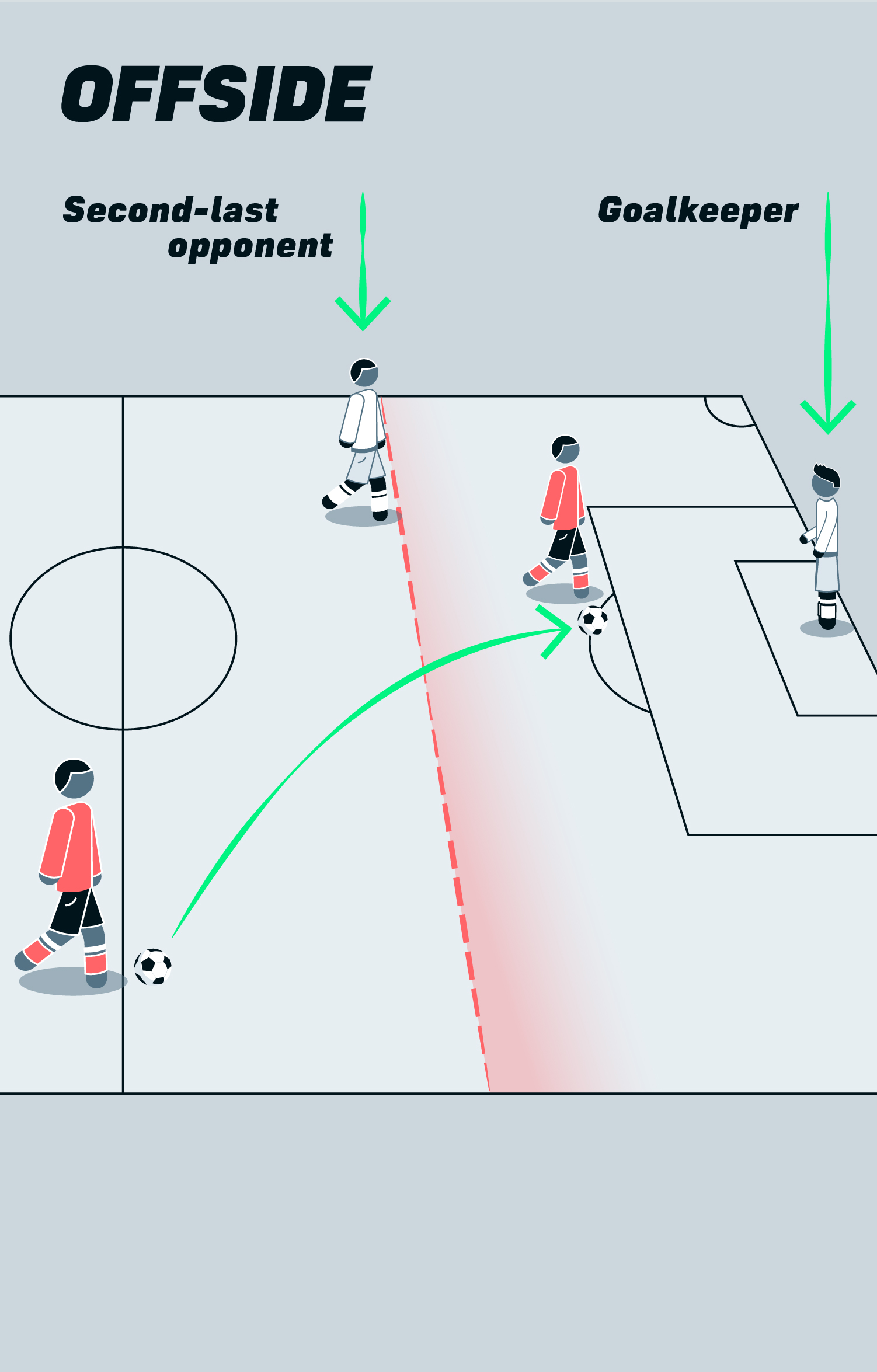
This is a non-negotiable, black-and-white part of the law. On three specific restarts, the offside law is suspended. This allows for different tactical setups, especially from set pieces.
Goal Kicks
When the goalkeeper or a defender takes a goal kick, the receiving player can be in any position. This is why you often see attackers lurking near the halfway line on goal kicks, ready to run onto a long punt. There is no offside until the ball is touched by a second player.
Throw-Ins
Similarly, a player cannot be offside directly from a throw-in. This rule enables the long throw into the box, a potent weapon for some teams. The player receiving the throw can be ahead of every defender.
Corner Kicks
The same logic applies to corner kicks. Attackers can crowd the six-yard box without fear of an offside call from the corner itself. The offside phase begins once the ball is touched by another player from the corner.
Common mistake: Assuming a player is offside from a flick-on after a goal kick, if the first touch from the goal kick is headed by a teammate, the player receiving the second ball can be offside. The exemption only applies to the first contact from the restart.
Exceptions and Edge Cases
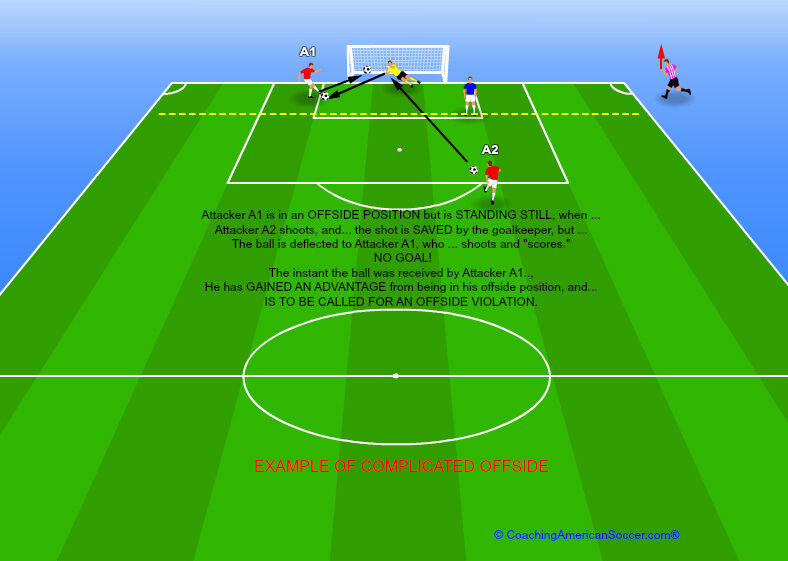
The laws account for weird situations. Two of the most obscure, and important, exceptions involve players leaving the field and the precise point of a goalkeeper’s release.
Defenders Leaving the Field
As mentioned, a defender who leaves the field without permission remains part of the defensive line. This rule prevents defenders from cynically stepping off to play attackers offside. They are considered on the boundary line until play stops or the ball moves toward the halfway line and out of their penalty area.
Goalkeeper’s Throws and Kicks
For determining offside position, the “last point of contact” with the goalkeeper’s hands is used. If a keeper throws the ball and it leaves their hand from the edge of the penalty area, that is the point from which offside is judged for the receiving attacker, not where the ball is caught.
Fouls Take Precedence
Here is a critical sequence. If an attacker in an offside position is fouled before they become actively involved in play, the foul is called. The potential offside offense is irrelevant. The foul happened first.
The Failed Wenger Proposal
Former Arsenal manager Arsene Wenger proposed a tweak where a player would be onside if any score-able body part was level. The IFAB rejected it in 2025. The current law uses any part of the head, body, or feet that can play the ball, making the line clearer for VAR but often harsher on attackers.
TL;DR: The rules cover players off the pitch and keeper releases. A foul always trumps an offside call, and the current “any body part” rule is here to stay.
Tools for Understanding: VAR and Positioning
The introduction of Video Assistant Referee (VAR) technology has not changed the law. It has only made its application more precise, and more debated. VAR officials use calibrated lines on a frozen video frame to judge the position of the second-last defender and the attacker’s relevant body parts.
What VAR Can and Cannot Do
VAR can definitively rule on offside position. Drawing the lines is a geometric fact. However, VAR cannot automatically rule on active involvement. That remains a subjective decision for the on-field referee, who can use the VAR monitor for a review.
The visual offside guide provided by broadcasters uses these same VAR principles. The semi-automated offside technology used in competitions like the UEFA Champions League uses limb-tracking cameras to make this line-drawing instantaneous.
Training Your Eye as a Fan
To spot offside live, don’t watch the ball. Watch the defensive line and the attacker’s shoulders in the instant the passer’s foot strikes the ball. It is a skill. Even assistant referees at the highest level, who must track the total players on field and the ball simultaneously, get it wrong sometimes because of angle and reaction time.
The match time structure means these split-second decisions are reviewed long after the fact, but the law demands they be made in a frozen moment.
Frequently Asked Questions
Can you be offside from a free kick?
Yes. The offside law applies to free kicks just as it does to open play. The exception is if the free kick is indirect inside the opponent’s penalty area and the ball is not yet in play, but this is a rare procedural nuance.
Is the goalkeeper always the last defender for offside?
No. The rule refers to the “second-last opponent.” The goalkeeper is usually the last opponent, but if the keeper is advanced, the last outfield defender becomes the key player for drawing the offside line.
Why is there no offside on a throw-in?
The law considers a throw-in a method of restarting play, not a pass in the continuous phase of play. This historical rule encourages flow and gives an advantage to the team taking the throw.
What if an attacker is in an offside position but the ball goes to a different onside player?
If the offside player does not interfere with play or an opponent, play continues. The passive offside position is legal. The goal will stand if the onside player scores.
Can a player be offside in their own half?
No. The halfway line is the absolute boundary. If any part of the player that can legally play the ball is on or behind this line, they cannot be offside.
How does the offside trap work with these rules?
The offside trap strategy relies on defenders stepping up in unison just as the pass is played, leaving attackers in an offside position. Its success depends on perfect timing and the attacker’s subsequent active involvement.
Before You Go
Remember, offside is about two things: position and activity. A player standing in an offside spot during a goal kick or while level with a defender is within the laws. The offense only occurs when that position is used to gain an unfair advantage by becoming involved.
The core soccer game objective is to score goals, and the offside rule exists to keep that pursuit fair, not to prevent it. Understanding these exceptions, the own half, the level position, the three exempt restarts, lets you see the tactical battles within the game. You will stop shouting at the assistant referee for a player standing still and start watching for the subtle interference that truly breaks the rule.

I come from the “soccer heart” of Germany, the Ruhrpott. I have played, trained and followed soccer all my life and am a big fan of FC Schalke 04. I also enjoy following international soccer extensively.