Conical vs Bladed Soccer Studs: The Traction & Injury Trade-Off
Choosing between conical and bladed soccer studs requires matching three things: your primary playing surface (firm ground vs. soft ground), your position’s movement pattern (straight-line sprinting vs. multi-directional pivoting), and your personal tolerance for the documented higher injury risk associated with bladed designs.
Most players grab a cleat based on brand or color. They miss the studs entirely. That’s why weekend warriors sprain ankles on dry pitches and why youth coaches see ACL tears spike when teams switch to bladed cleats on firm ground.
This guide breaks down the mechanical difference, the proven traction trade-off, the injury data you won’t find on the shoe box, and how to pick the right soleplate for your game.
Key Takeaways
- Bladed studs are thin, angled fins designed for aggressive, directional grip on firm, dry natural grass. They provide superior straight-line acceleration.
- Conical studs are rounded posts designed for multi-directional movement and safer pivoting. They sink into softer ground and reduce rotational torque.
- The injury risk is real and measurable. Bladed studs resist twisting, increasing torque on the lower limb, a key factor in ACL and ankle injuries, especially on firm ground.
- Surface dictates legality. Bladed studs belong on Firm Ground (FG) cleats. Using FG bladed cleats on artificial turf (AG) is dangerous and often banned.
- Your position should guide your choice. Strikers and wingers often prioritize bladed traction. Midfielders and defenders, who pivot constantly, benefit from conical safety.
How Do Conical and Bladed Studs Actually Work?
Look at the bottom of any cleat. The studs are the only part that touches the ground. Their shape changes everything.
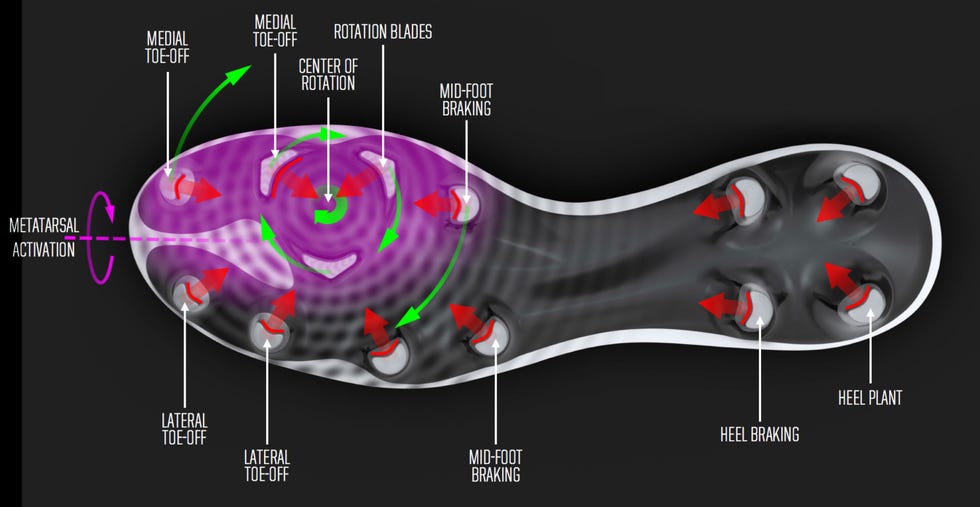
Conical studs are rounded, peg-like structures that penetrate the pitch vertically. Bladed studs are elongated, fin-shaped ridges molded into the soleplate that cut across the turf horizontally. This geometric difference alters the grip mechanism, the pressure distribution under your foot, and the force required to twist your planted foot.
Conical studs work like stakes. They sink into the turf, providing grip through vertical penetration. Because they’re round, they allow your foot to rotate within the ground with less resistance. This is crucial for pivoting, cutting, and changing direction without locking the foot in place.
Bladed studs work like blades. Their flat, angled edges cut into the surface, providing grip through horizontal shear. They excel at resisting backward and forward motion, giving you that explosive push-off for a sprint. But those same edges also resist rotational motion.
The soccer cleat stud patterns you see are built around this basic principle. A pattern with more conical studs feels looser, more adaptable. A pattern dominated by bladed studs feels locked-in, aggressive.
TL;DR: Conical studs sink and allow rotation. Bladed studs cut and resist rotation. That resistance is the source of both their traction advantage and their injury risk.
The Biomechanics: Why Bladed Studs Carry Higher Injury Risk
It’s not a rumor. The data is in sports medicine journals.
When your foot is planted and you try to turn your body, your foot needs to rotate within the ground. Conical studs, being round, permit some of this rotation. Bladed studs, with their flat edges, fight it. This creates rotational torque, a twisting force transferred up your leg.
Common mistake: Using bladed Firm Ground cleats on artificial turf, the studs grip the synthetic fibers too aggressively, multiplying rotational torque. The result is a significantly higher risk of knee and ankle ligament injury within a single season.
A systematic review published in the PMC systematic review on cleats-surface interaction notes that while bladed studs don’t necessarily increase load during straight-line running, they are significantly associated with higher odds of total lower limb injury due to this torque mechanism. The study points specifically to ACL injuries and ankle sprains.
The force isn’t just at the knee. It starts under your foot.
| Pressure Point | Conical Studs | Bladed Studs | Consequence |
|---|---|---|---|
| Lateral Forefoot | Lower peak pressure | Higher peak pressure | Risk of lateral metatarsal stress injury |
| Overall Distribution | More dispersed | Concentrated on blade edges | Less natural foot roll |
| Rotational Release | Allows gradual twist | Resists twist suddenly | Higher torque on ankle & knee |
That concentrated pressure on the lateral forefoot is why some players feel a sharp pain on the outer ball of their foot after a game in bladed cleats. It’s not just soreness, it’s a warning.
TL;DR: Bladed studs increase rotational torque on the lower limb and concentrate pressure on the lateral forefoot. This is a documented biomechanical risk factor for serious injury.
Which Stud Type Wins for Your Position?
Your role on the pitch dictates your movement pattern. The studs should match it.
For Strikers and Wingers: Bladed Studs Often Take Priority
You live off explosive acceleration, sharp stops, and straight-line bursts. The aggressive grip of bladed studs on firm ground gives you that extra bite for the first five yards. Your pivoting is often minimal, you receive the ball and go forward. The injury risk is a trade-off for the performance gain.
For Midfielders and Defenders: Conical Studs Are the Safer Bet
You pivot constantly. You receive the ball, turn, and pass. You defend, change direction, and track back. The multi-directional freedom and lower rotational torque of conical studs protect your knees and ankles over hundreds of twists per game. Your speed is more about agility than raw, straight-line explosion.
I played central midfield for a lower-tier club in the Ruhrpott for three seasons. Our coach mandated conical studs for all midfielders after two ACL tears in one year, both players were wearing the latest bladed Nike Mercurials on our firm, dry home pitch. We switched, the traction felt different, but the pivot was cleaner. No more knee injuries in that unit for the rest of the season.
This isn’t absolute. Many modern cleat stud configurations use a hybrid approach. Brands like Adidas and Puma mix bladed studs in the forefoot for acceleration with conical studs in the heel for stability. It’s a compromise.
| Position | Recommended Stud Bias | Why | Example Cleat Type |
|---|---|---|---|
| Striker / Winger | Bladed forefoot, hybrid sole | Maximizes sprint traction | Nike Mercurial Superfly (FG) |
| Central Midfielder | Conical dominant | Safeguards pivoting knees | Adidas Copa Pure (SG) |
| Defender | Conical or hybrid | Balance of grip & rotational safety | Puma Future (FG/AG hybrid) |
| Goalkeeper | Conical dominant | Lateral movement & stability | Any SG or AG cleat |
TL;DR: Attackers lean bladed for sprint traction. Midfielders and defenders lean conical for pivot safety. Hybrid soleplates try to serve both needs.
The Surface Is the Law: FG, SG, and AG Rules

The stud type isn’t just about preference. It’s about surface compatibility, a rule enforced by safety and league regulations.
Firm Ground (FG) – The Bladed Stud Domain
Dry, natural grass pitches. The ground is hard enough that studs need to cut into it. FG vs SG cleats differ fundamentally here: FG cleats use shorter, bladed or hybrid studs (12-15mm) to grip the firm surface. Using long conical studs on firm ground feels unstable, they don’t penetrate enough.
Soft Ground (SG) – The Conical Stud Realm
Wet, muddy, loose natural grass. The ground is soft enough for long studs (often 15-18mm) to sink deep. Conical studs are the norm here because they penetrate vertically and allow release. Bladed studs on soft ground can sink too deep and lock in, becoming dangerous.
Artificial Grass (AG) – The Bladed Stud Ban
Synthetic turf with a rubber/sand base. AG soccer cleats are designed with numerous short, rounded conical studs. The surface is already grippy. Bladed FG cleats are explicitly dangerous on AG, they over-grip, increasing torque and injury risk. Many youth leagues prohibit them.
Common mistake: Using your favorite FG bladed cleats on artificial turf because “they’re still soccer cleats.” The AG cleat design is different for a physical reason: synthetic fibers behave like a brush, not soil. Bladed edges grab and hold each fiber; conical tips depress and release.
TL;DR: Bladed studs belong on firm natural grass. Conical studs dominate on soft grass and are mandatory on artificial turf. Ignoring this surface match guarantees poor performance or injury.
How to Check and Choose Your Next Cleats

You don’t need to be an engineer. A five-minute inspection works.
- Look at the Soleplate. Identify the stud shapes. Are they round (conical) or thin, angled fins (bladed)? Many cleats label the soleplate type (FG, SG, AG) on the heel or inside the tongue.
- Know Your Primary Pitch. Is it hard and dry most of the season? That’s FG. Is it often wet and soft? That’s SG. Is it synthetic? That’s AG. Your cleats for foot type matter, but the surface matters first.
- Match Your Position. Refer to the table above. If you’re a winger on firm ground, a bladed forefoot is logical. If you’re a box-to-box midfielder on soft ground, conical studs are your friend.
- Consider Hybrid Options. If you play on varied surfaces, a FG/AG hybrid cleat with a mix of stud shapes offers versatility. It’s a safe compromise for recreational players.
- Feel the Pressure. When you try them on, think about the lateral ball of your foot. Bladed designs often create a distinct pressure point there. If it feels sharp even standing, consider a more conical option.
Skipping step 2 is the most frequent error. Players buy the flashy FG cleat and then play half their games on AG. The cleat wear signs come early: uneven stud abrasion on the synthetic surface and, worse, that nagging knee pain.
TL;DR: Inspect the stud shapes, know your surface, and align with your position’s movement pattern. Hybrid cleats are a practical solution for mixed conditions.
Frequently Asked Questions
Are bladed studs illegal or banned?
Modern plastic/rubber bladed studs are not banned outright. However, metal bladed studs that screw into the soleplate were historically banned by many coaches and leagues due to extreme safety concerns. Today, the ban is situational: using FG bladed cleats on artificial turf is prohibited by most organized leagues because of the proven injury risk.
Which stud type is better for speed?
For pure, straight-line acceleration on firm ground, bladed studs provide measurably higher traction. They resist backward motion better, giving a stronger push-off. For agility speed, quick changes of direction, the safer release of conical studs can actually allow faster pivoting without the body fighting the stuck foot.
Do professional players use bladed studs?
Yes, many do, especially attacking players on firm pitches. However, professionals also have access to perfectly maintained pitches and intensive medical support. They accept the risk for the performance edge. Many midfielders and defenders, even at the pro level, opt for conical-dominant SG cleats for the pivot safety and better soft-ground penetration.
Can I replace worn studs with a different type?
No. Studs are molded into the soleplate. You cannot change a bladed cleat into a conical one. When the studs wear down, you replace the entire cleat. This is why understanding worn-down studs is part of knowing when to retire your footwear.
Before You Go
The conical vs. bladed debate isn’t about which is universally better. It’s about a trade-off: traction versus safety, explosion versus agility, surface compliance versus injury risk.
Match the stud to the ground you play on most. Match the pattern to the way you move. And if you’re a parent buying for a young player, lean toward conical safety, their developing ligaments can’t handle the torque bladed studs generate on a firm pitch.
Your cleats are tools. Pick the tool that fits the job, not just the one that looks the sharpest.
I come from the “soccer heart” of Germany, the Ruhrpott. I have played, trained and followed soccer all my life and am a big fan of FC Schalke 04. I also enjoy following international soccer extensively.