What Is a Box-to-Box Midfielder? The Engine Room Explained
A box-to-box midfielder is a central player who operates from their own penalty area to the opponent’s, providing both defensive cover and attacking support. The role demands exceptional stamina, tactical intelligence, and versatility to influence all phases of play, making them the team’s engine room.
A box-to-box midfielder is a central player whose role is defined by extreme physical range and tactical versatility. They operate between their own penalty box and the opponent’s, contributing significantly to both defensive and attacking phases. The modern interpretation emphasizes intelligent movement and role-switching over mere endurance.
The biggest misconception is that this role is just about running. Stamina is the foundation, but a top-tier box-to-box midfielder reads the game to know when to sprint, where to position, and what to do upon arrival. Without that tactical layer, they become a liability, caught out of position, good at everything but great at nothing.
This guide breaks down the evolution, key traits, and modern tactical demands of the box-to-box midfielder. We’ll look at how formations changed the role, what separates the elite from the average, and why managers like Pep Guardiola have revived it.
Key Takeaways
- The role originated in the 4-4-2 era but thrives today in 4-3-3 and 4-2-3-1 systems that demand midfield connectors.
- Modern box-to-box players cover 11.5 to 13 kilometers per game, but the quality of their sprints and recoveries matters more than total distance.
- Tactical intelligence is the true separator. They must constantly switch between offensive and defensive mindsets based on possession state.
- The best examples, like Jude Bellingham, combine physical power with a “Total Football” approach, they can tackle, dribble, pass, and score.
- Without clear tactical instructions, a box-to-box midfielder risks becoming a positional ghost, leaving gaps in both defense and attack.
The Evolution: From 4-4-2 Engine to Modern Connector
The classic box-to-box midfielder was the heartbeat of the 4-4-2. Two central midfielders shared the entire vertical space. One often leaned defensive, the other attacking, but both had to cover ground. Steven Gerrard at Liverpool in the 2000s is the archetype, he could score from 30 yards and then make a tackle to stop a counterattack sixty seconds later.
That changed in the mid-2000s. The rise of the 4-2-3-1 and the 4-3-3 with a single pivot specialized midfield roles. The defensive midfielder role became a dedicated anchor. The attacking midfielder position became a fixed creator. The all-action runner seemed obsolete. Tactics demanded specialists.
But specialization created a problem. Teams became predictable in transition. The link between defense and attack was a chain with missing links. That’s why the box-to-box midfielder resurged. Managers like Pep Guardiola and Jürgen Klopp needed players who could fill multiple roles within a single system. They aren’t just runners; they are structural solutions. In a 4-3-3, the box-to-box player often operates as the “8”, connecting the defensive “6” and the attacking wingers or forward. Their job is to manipulate space, especially the half-spaces, to keep possession fluid and create overloads.
The modern box-to-box midfielder is a structural solution for possession-based systems, not just a physical phenomenon. Pep Guardiola uses them to connect the defensive line with the attacking line, occupy half-spaces, and provide diagonal passing options that break linear defensive structures.
Understanding this evolution is key to reading modern football. The soccer formation guide you learned ten years ago probably showed static roles. Today’s formations are dynamic, and the box-to-box player is the dynamo.
TL;DR: The box-to-box role faded with tactical specialization but returned as a necessary connector in modern, fluid systems like Guardiola’s 4-3-3.
The Core Traits: Beyond Stamina
Stamina is the ticket to the game. A top box-to-box midfielder covers between 11.5 and 13 kilometers per match, according to UEFA tracking data. That’s a baseline. The real traits are layered on top of that engine.
Physical power is non-negotiable. They need strength to win 50-50 duels and acceleration to surge past opponents in transition. Yaya Touré at Manchester City wasn’t just big; he could explode from a standing start and carry the ball 40 yards. That burst changes games.
Technical ability is equally critical. They must receive under pressure, often with back to goal, and distribute quickly. A sloppy first touch in midfield turns a promising attack into a counterattack against you. Their passing range isn’t about 60-yard diagonals, it’s about crisp, short-to-medium passes that maintain tempo and find the next player in space.
The mental layer is what separates the elite. Tactical intelligence means reading the game state every three seconds. Is my team in possession? I need to support circulation, maybe drift into a half-space. Have we lost the ball? I need to press immediately or drop to cover the runner. This constant role-switching burns mental energy faster than physical.
Common mistake: Judging a box-to-box midfielder solely by distance covered, a player who runs 13km but misplaces 20% of his passes in transition is a net negative. The purpose of each sprint matters more than the sum.
Here’s a breakdown of the non-physical key attributes of a box-to-box midfielder:
| Attribute | Why It Matters | Consequence If Missing |
|---|---|---|
| Game Reading | Anticipates possession changes and spaces. | Gets caught between roles, leaving defensive gaps or attacking voids. |
| First Touch Under Pressure | Maintains possession in congested midfield. | Turns a promising build-up into a counterattack opportunity for the opponent. |
| Decision Speed | Chooses pass, carry, or shoot in under 2 seconds. | Slows the team’s transition, allowing defenders to reorganize. |
| Vertical Awareness | Knows when to join attack or stay deep. | Becomes a passenger in one phase, overloading the other and breaking team shape. |
A player with just stamina and power is a bulldozer. A player with stamina, power, technique, and intelligence is a symphony.
TL;DR: Stamina gets you on the pitch; tactical intelligence, technical skill, and physical power keep you effective in both boxes.
The Modern Box-to-Box: Not Just Running

Watch Jude Bellingham at Real Madrid. He scores, he tackles, he dribbles, he passes. He’s the modern prototype. But he’s not just running. He’s interpreting Pep Guardiola’s, and now Carlo Ancelotti’s, tactical puzzles in real time.
The modern role has two key additions: pressing triggers and structural connectivity. In high-intensity systems, the box-to-box midfielder is often the first pressing trigger. If an opponent receives with his back to goal, the box-to-box player closes him down, forcing a hurried pass or a turnover. This isn’t reactive; it’s a calculated risk based on reading the opponent’s body shape and passing options.
The second is connectivity. In a possession system like Guardiola’s, every player is a node in a network. The box-to-box midfielder is the node that links the defensive node (the single pivot) with the attacking nodes (the wingers and forward). They do this by occupying the half-space, the channel between the central midfield and the wide area. This diagonal positioning gives the pivot a passing option that breaks the opponent’s linear defensive line.
I played in a system that tried to mimic this. Our coach drilled us on “scanning” before receiving. You look over your shoulder, see the defender’s position, see your teammate’s run, then decide. The first time I tried it, I missed three simple passes because I was processing too much. It takes months to automate. Bellingham does it instinctively.
I watched a Bundesliga match where a player was praised for his “12km work rate.” He spent most of that distance jogging into spaces that were already occupied. His team lost 3-0 because their transitions were slow. The coach replaced him the next week with a player who covered 11km but whose movements actually created passing lanes. They won.
The midfield transition phase is where the modern box-to-box player shines. When possession switches, they are the gear that changes the team’s direction. Their ability to shift from defensive transition phase to attacking transition phase within three strides is what makes a team look fluid.
| Traditional Box-to-Box | Modern Box-to-Box |
|---|---|
| Focus on vertical distance covered | Focus on intelligent occupation of half-spaces |
| Primary duty: defend & attack | Primary duty: connect & disrupt |
| Judged by tackles and goals | Judged by passing network influence and pressing success rate |
| Often a physical outlier | Often a tactical polymath |
The resurgence isn’t nostalgia. It’s a response to the tactical complexity of the 2020s. You need players who can do more than one thing well.
TL;DR: Modern box-to-box midfielders are tactical connectors and pressing triggers, not just endurance athletes. Their value is in intelligent movement.
How They Differ From Other Midfield Roles

This is where confusion sets in. A box-to-box midfielder isn’t a defensive midfielder, an attacking midfielder, or a regista. They overlap, but the core responsibilities split.
A defensive midfielder anchor sits deep. Their primary job is to screen the defense, intercept passes, and distribute safely. They rarely venture into the opponent’s box. A box-to-box player does that screening but also joins the attack. Think of it as a sliding scale. The defensive midfielder is at 0, the attacking midfielder is at 10, the box-to-box player oscillates between 3 and 8.
The classic number 10 role is fixed in the attacking third. Their creativity comes from staying high, between the lines, and picking passes. They don’t track back to make tackles in their own box. A box-to-box midfielder will drop deep to defend, then sprint forward to become a secondary creator or finisher. They are a hybrid.
The regista role, the deep-lying playmaker, is a specialist distributor. They orchestrate from behind the midfield line. They don’t press high or make late runs into the box. A box-to-box player can distribute, but their distribution is more about quick, vertical passes to advance the play, not long, sweeping diagonals to switch the point of attack.
The difference becomes clear in a single pivot system. In a 4-3-3 with one pivot (the “6”), the two players ahead of him (the “8s”) are often box-to-box types. One might lean more attacking, the other more defensive, but both must cover the vertical space. In a double pivot midfield, both players share defensive duties, but one usually has license to push forward, that’s the box-to-box player in that structure.
Common mistake: Calling a player “box-to-box” because they run a lot. If they only run forward and never defend, they’re an attacking midfielder. If they only run backward and never attack, they’re a defensive midfielder. The true box-to-box player does both, in the same game, constantly.
TL;DR: A box-to-box midfielder operates across the entire pitch, while a defensive midfielder stays deep and an attacking midfielder stays high. They are the bridge.
Why This Role Is So Demanding (And Often Misunderstood)
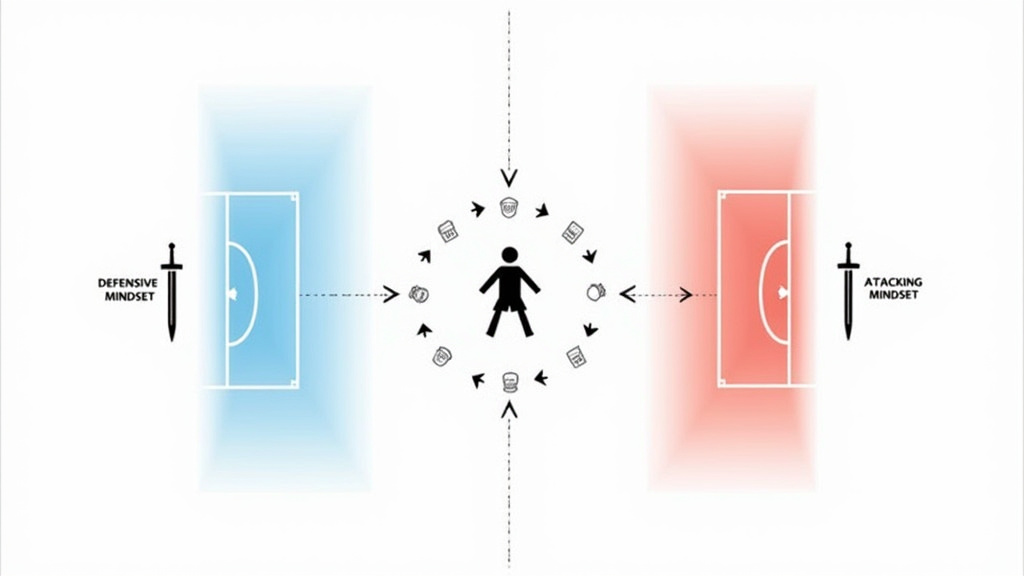
The mental load is heavier than the physical. Switching between an attacking mindset and a defensive mindset every few minutes requires cognitive flexibility that most players don’t have. It’s like driving a car while constantly swapping between a city map and a highway map.
You also need emotional resilience. When you’re caught out of position, which happens, you get blamed for both the defensive gap and the missed attacking opportunity. Fans and pundits see the error in both phases. A defensive midfielder who misses a tackle is blamed for the goal. An attacking midfielder who misses a pass is blamed for the wasted attack. A box-to-box midfielder who misreads a transition is blamed for both.
The importance of transitions in modern football amplifies this pressure. Teams attack and defend in shorter, more intense bursts. The box-to-box player is the pivot point. If they’re slow to react, the whole team’s structure suffers.
I remember a coach yelling at a young player trying this role. “You’re either a defender or an attacker right now! Pick one!” The kid froze. He didn’t understand that the role requires you to be both, sequentially, not simultaneously. That’s the hardest part. You’re never just one thing.
The midfield transition work is non-stop. It’s not a part of the game; it’s the game. And the box-to-box midfielder is the engine of that work.
TL;DR: The role demands constant mental switching between attack and defense, making it one of the most cognitively challenging positions on the pitch.
Frequently Asked Questions
What’s the main difference between a box-to-box midfielder and a roaming playmaker?
roaming playmaker, like a classic number 10, focuses on creating chances from advanced positions. They drift to find space but rarely engage in defensive duties in their own penalty area. A box-to-box midfielder does both: they defend deep and attack high. The roaming playmaker is a specialist creator; the box-to-box midfielder is a hybrid.
Can a box-to-box midfielder be the captain of a team?
Often, yes. Their central position and involvement in both phases give them a unique perspective on the game’s state. Leaders like Steven Gerrard and Roy Keane were box-to-box captains. They could organize the defense, then drive the attack, setting the emotional tone for the entire team.
Do all teams need a box-to-box midfielder?
Not necessarily. Some systems, like a strict 4-2-3-1 with a double pivot, use two specialized defensive midfielders and a fixed attacking midfielder. The box-to-box role thrives in systems that value fluidity and transition speed, like 4-3-3 or 4-4-2 diamond. If your tactic relies on specialists, you might not need one.
How do you identify a young player with box-to-box potential?
Look for two things beyond physical stamina. First, their comfort receiving passes with back to goal under pressure. Second, their instinct to immediately press after losing possession, then quickly look forward when regaining it. The technical and mental signs appear before the full physical engine develops.
Why did the role decline in the early 2000s?
Tactical specialization. Managers wanted dedicated holders and creators. The 4-2-3-1 formation split midfield roles clearly. The all-rounder seemed redundant. Its resurgence came when managers like Guardiola and Klopp needed players who could fulfill multiple tactical functions within a single, fluid system.
The Bottom Line
The box-to-box midfielder is the tactical glue of modern football. They connect defense to attack, disrupt opponent transitions, and provide the vertical thrust that breaks organized defenses. Stamina is the foundation, but the real magic is in their brain, the ability to read the game and switch roles every few seconds.
This isn’t a role for the merely athletic. It’s for the polymath who can tackle, pass, dribble, and score, all while knowing when to do which. From Steven Gerrard’s era to Jude Bellingham’s today, the essence remains: influence in both boxes. The methods have evolved from sheer force to intelligent design.
If you watch a game and see a central midfielder constantly adjusting his position based on who has the ball, you’re watching a box-to-box player. They are the engine room, the connector, the problem-solver. And they are why some teams look fluid while others look fragmented.

I come from the “soccer heart” of Germany, the Ruhrpott. I have played, trained and followed soccer all my life and am a big fan of FC Schalke 04. I also enjoy following international soccer extensively.