World Cup Group E Scenarios: Who Makes the Knockouts?
World Cup Group E knockout scenarios see Germany favored to win, with Ecuador and Ivory Coast battling for second. The third-place team can still advance, as the new 48-team format sends eight best third-placers to the Round of 32 alongside the group’s top two.
To understand the World Cup 2026 Group E qualification scenarios, you need to know three things: Germany is the heavy favorite to win the group, the battle for second place is between Ecuador and Ivory Coast, and the new format means even the third-place team has a strong chance to advance. The group winner and runner-up go straight to the Round of 32. The third-place team must then rank among the eight best third-placed finishers across all twelve groups.
Most people look at the group table and think it’s a simple two-horse race for the top spots. They forget the math. With 48 teams and 32 knockout spots, finishing third is no longer a death sentence. It’s a lifeline. That changes everything for Ecuador and Ivory Coast, and it’s why Curaçao, the smallest nation ever to qualify, still has a mathematical heartbeat.
This guide breaks down every path out of Group E. We’ll look at the key matches, the tactical battles, the tie-breakers that could decide everything, and what each team needs to do to survive and advance.
Key Takeaways
- Germany is projected to win the group with over a 70% probability, but their opening match against Curaçao is a potential trap game if they underestimate the underdog’s physicality.
- The match between Ecuador and Ivory Coast on June 14 in Philadelphia is essentially a play-in for second place and automatic qualification. A draw here complicates both teams’ paths.
- Four points (a win and a draw) is the magic number for a third-placed team to feel safe about advancing. Three points means sweating over goal difference against other third-placed teams.
- Curaçao’s best chance to influence the group is to snatch a point against Ivory Coast or Ecuador in their first two matches, severely damaging that opponent’s goal difference and automatic qualification hopes.
- Fair play points, yellow and red cards, are the final tie-breaker for ranking third-placed teams across different groups. A single red card could be the difference between going home and playing in the Round of 32.
The Teams: Strengths, Weaknesses, and Paths to Progression
Germany enters as the clear favorite. Julian Nagelsmann’s squad is stacked with attacking talent like Jamal Musiala, Florian Wirtz, and Kai Havertz. Their midfield control and defensive organization under Nagelsmann’s system make them the team to beat. But they carry the memory of 2022, when they crashed out in the group stage. That history is a weight, not an advantage.
The German squad under Nagelsmann averages 62% possession in competitive matches since 2024, a figure that forces opponents into a defensive shell and creates space for Musiala and Wirtz to operate between the lines.
Ecuador is the consensus pick for second. They finished fourth in the brutal CONMEBOL qualifying, ahead of teams like Chile and Paraguay. Their strength is a compact, physical defensive block marshaled by Moisés Caicedo and a relentless high press. They are built to frustrate superior technical teams and strike on the counter. Their altitude-trained endurance is a hidden weapon, especially in the later stages of matches played in hotter North American cities.
Ivory Coast is the reigning African champion, and that brings a certain tournament toughness. Players like Sékou Fofana and Simon Adingra provide power and experience. Their style is direct, physical, and punishing in transition. The concern is consistency; they can look world-beaters one match and disjointed the next. Their path hinges almost entirely on the opening match against Ecuador.
Curaçao is the story. Qualifying for the first time ever, they are the smallest nation by population to reach a World Cup. Coach Dick Advocaat has instilled a disciplined, counter-attacking system. They are physically robust from CONCACAF battles and dangerous from set pieces, with veteran Leandro Bacuna pulling the strings. The gulf in individual quality is real, but in a one-off match, their organization can cause problems.
| Team | Biggest Strength | Critical Weakness | Most Likely Finish |
|---|---|---|---|
| Germany | Squad depth & attacking versatility | Occasional defensive lapses in transition | 1st |
| Ecuador | Defensive organization & physical endurance | Lack of a prolific, world-class striker | 2nd or 3rd |
| Ivory Coast | Power, experience, and tournament mentality | Inconsistent midfield control against possession teams | 3rd or 2nd |
| Curaçao | Collective discipline & set-piece threat | Significant gap in individual technical quality | 4th |
TL;DR: Germany’s talent should see them top the group, but Ecuador’s defense and Ivory Coast’s power make the fight for second unpredictable. Curaçao’s role is that of a spoiler.
How Does Third-Place Qualification Work?
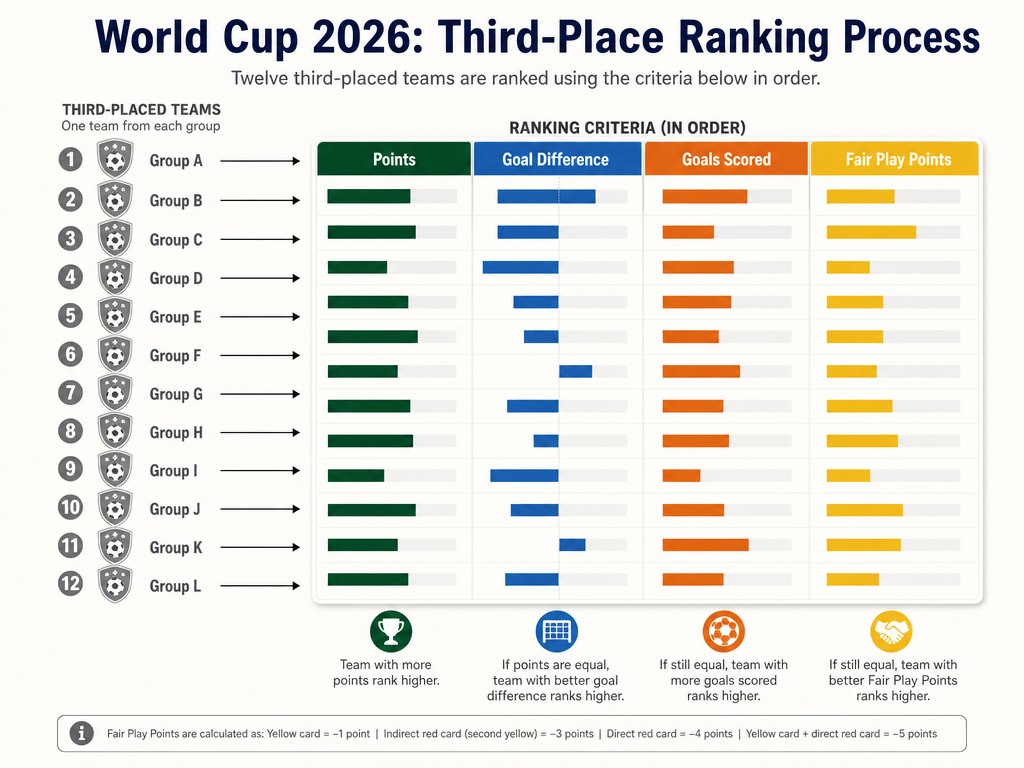
The 2026 World Cup format is new. Twelve groups of four feed into a 32-team knockout bracket. The top two from each group qualify automatically. That’s 24 teams. The remaining eight spots go to the best third-placed teams from across all twelve groups.
This isn’t a simple “third place gets in” rule. It’s a ranking. After all group matches conclude, FIFA will compile a table of the twelve third-placed teams. They will be ranked by:
1. Points
2. Goal Difference
3. Goals Scored
4. Fair Play Points
Head-to-head results between third-placed teams from different groups are not considered. It’s a pure numbers game across the entire tournament.
Common mistake: Assuming a single win guarantees third-place advancement. Three points (one win, two losses) often leaves a team “on the bubble.” In past 24-team tournaments, three-point third-placers have been eliminated. Four points is the safety zone.
The safety zone is four points. A win and a draw gives a third-placed team a strong statistical probability of advancing. Three points means your goal difference becomes your lifeline. A negative goal difference with three points is a very dangerous position.
Think of it as a second mini-league happening after the groups finish. Your third-placed team isn’t just competing against the teams in Group E; they’re competing against the third-placed teams from Groups A through L. A big win against Curaçao could be the difference between 8th and 9th in that final ranking.
TL;DR: Finishing third is not the end. Teams are ranked on points, goal difference, goals scored, and fair play points across all groups. Four points is safe; three points is a nail-biter.
The Key Matches That Will Decide Group E
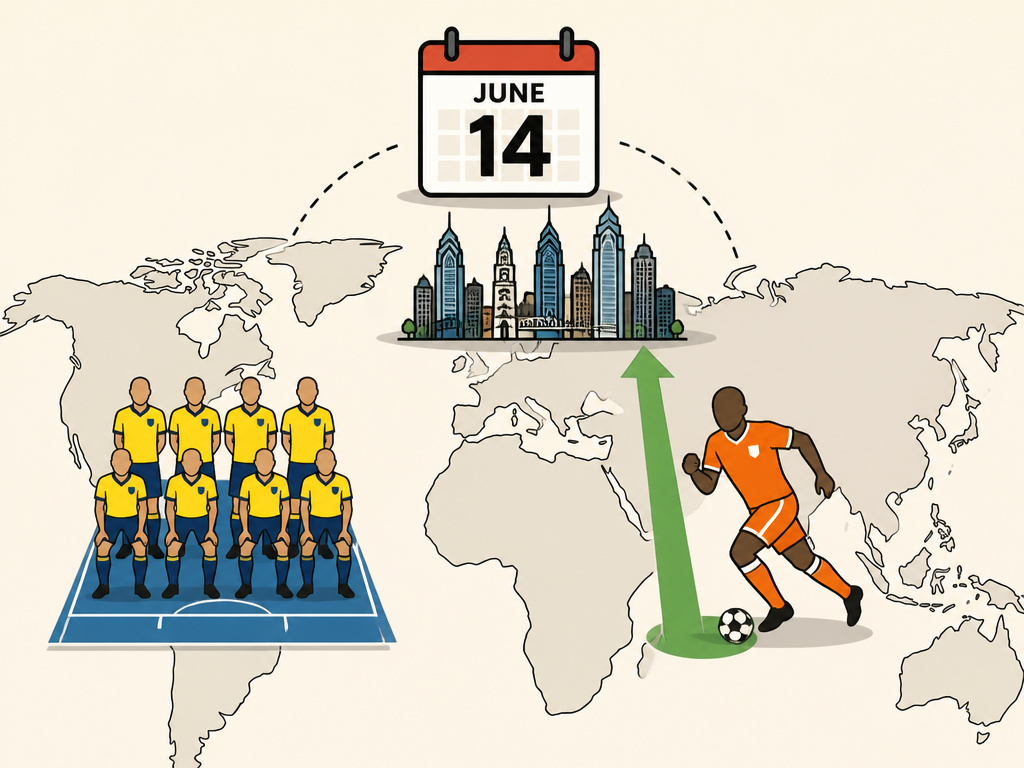
The schedule is set, and two fixtures stand out as pivotal. You can find the full tournament schedule and draw details on the official Wikipedia page for Group E.
Ivory Coast vs. Ecuador (June 14, Philadelphia)
This is the group’s decisive match. It’s a clash of contrasting team tactics: Ecuador’s structured, defensive block against Ivory Coast’s powerful, vertical attack. The result here likely determines who chases Germany for second and who faces the uncertainty of the third-place lottery. A win for either side puts them in the driver’s seat. A draw is a worst-case scenario for both, putting immense pressure on their final match against Germany.
Ecuador vs. Germany (June 25, New York/New Jersey)
Scheduled as the group finale, this match could decide first place. If Germany stumbles earlier, this becomes a battle for top spot. More likely, it’s a test of Ecuador’s resilience. Can their defense hold out against Germany’s fluid attack for 90 minutes in a potentially decisive match? A point here for Ecuador would be a monumental result, almost certainly securing advancement.
Curaçao vs. Ivory Coast (June 19, Houston)
This is Curaçao’s most realistic chance to impact the standings. Ivory Coast, coming off the high-stakes Ecuador match, could be vulnerable to a letdown. Houston’s heat and humidity could favor Curaçao’s CONCACAF-conditioned squad. A surprise result here, even a draw, would throw the group into chaos, crippling Ivory Coast’s goal difference and potentially handing second place to Ecuador on a silver platter.
| Match | Date & Location | Why It Matters | Potential Outcome Scenarios |
|---|---|---|---|
| Ivory Coast vs. Ecuador | June 14, Philadelphia | Likely decider for 2nd automatic spot | Winner controls destiny; loser faces 3rd-place battle. |
| Curaçao vs. Ivory Coast | June 19, Houston | Spoiler alert for Ivory Coast | Curaçao draw or win severely damages Ivory Coast’s goal difference and automatic hopes. |
| Ecuador vs. Germany | June 25, New York/New Jersey | Could decide 1st place; tests Ecuador’s defense | Ecuador point secures advancement; Germany win seals top spot. |
TL;DR: Mark June 14 and June 25 on your calendar. The Ivory Coast-Ecuador opener sets the tone, and the Ecuador-Germany finale could reshuffle the deck.
Projected Group E Standings and Scenarios
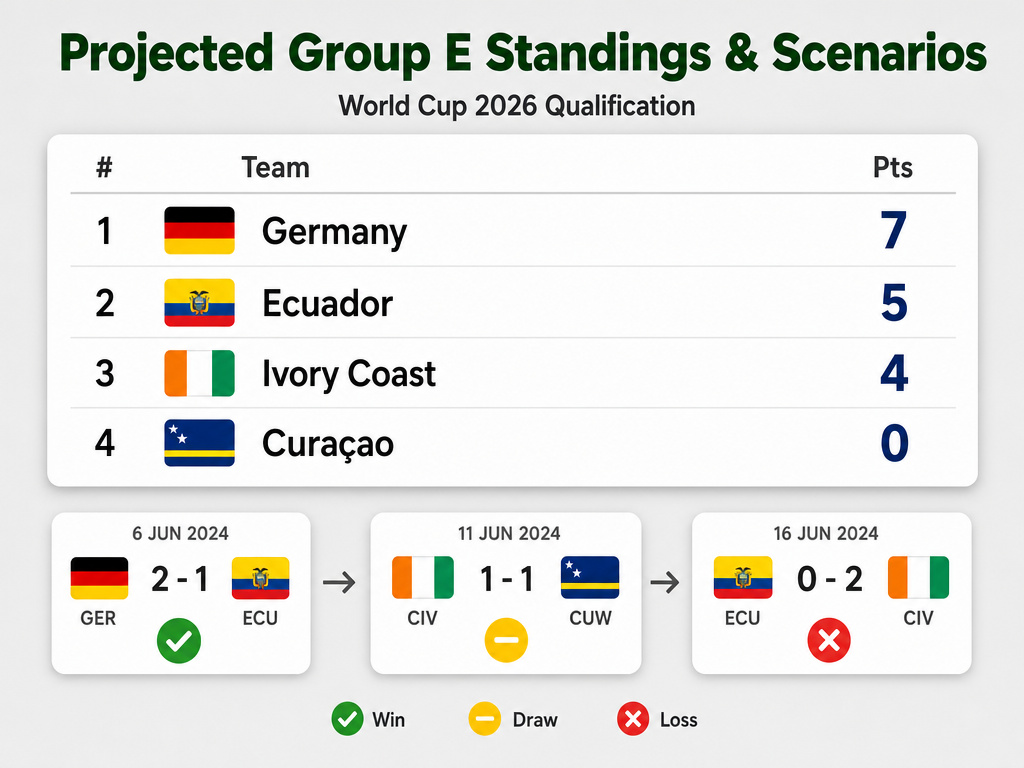
Let’s get concrete. Based on squad strength, form, and the match schedule, here’s the most probable outcome.
- Germany (7 points) – Wins against Curaçao and Ivory Coast, draws with Ecuador in a tense finale.
- Ecuador (5 points) – Beats Ivory Coast, draws with Curaçao, loses to Germany.
- Ivory Coast (4 points) – Loses to Ecuador, beats Curaçao, loses to Germany.
- Curaçao (0 points) – Loses all three, but puts up a stubborn fight in each.
In this scenario, Ivory Coast’s four points as the third-placed team would be a strong tally. They would very likely be among the eight best third-placed teams and advance. Ecuador would qualify automatically in second.
But football isn’t played on paper. Let’s run through some other plausible scenarios.
Scenario A: The Ecuador Slip-Up
Ecuador draws with Ivory Coast and then loses to Germany. Ivory Coast beats Curaçao but loses to Germany. Both Ecuador and Ivory Coast finish on 4 points. Goal difference from the Curaçao match becomes critical. The head-to-head between them is a draw, so it goes to overall goal difference. This is where a big win over Curaçao matters.
Scenario B: The Curaçao Shock
Curaçao manages a draw against Ivory Coast. Ivory Coast then only has 1 point from two matches. Even if they beat Germany (unlikely), they max out at 4 points and face a nervous wait on goal difference. Ecuador, with a win over Ivory Coast, suddenly finds itself in a commanding position for second, needing only a point from Germany to secure it.
Scenario C: The German Stumble
It happened in 2022. If Germany drops points against Curaçao or Ivory Coast, the entire group blows wide open. Suddenly, the match against Ecuador on the final day becomes a fight for first, not a formality. This scenario is less likely but lives in the back of every German fan’s mind.
I watched Germany lose to South Korea in 2018 and then to Japan in 2022. Both times, the issue wasn’t talent, it was a strange tactical rigidity and a failure to break down a packed, disciplined defense. Curaçao under Dick Advocaat is built exactly like those Korean and Japanese sides. If Germany approaches that match with arrogance, history could repeat.
TL;DR: The safe money is on Germany first, Ecuador second, Ivory Coast third. But a draw in the Ivory Coast-Ecuador opener or a Curaçao upset makes everything messy and pushes goal difference to the forefront.
Tactical Matchups and Manager Decisions
Photo: JazzyJoeyD / Wikimedia Commons / CC BY-SA 4.0

The chess match between managers will define this group. Germany’s Julian Nagelsmann favors a fluid 4-2-3-1 that can morph into a 3-4-3 in attack. His key is overloading the half-spaces with Musiala and Wirtz. Against Ecuador’s likely 5-3-2 formation or a 3-5-2 formation, he’ll need his wing-backs to provide width to stretch that compact back five.
Ecuador’s strength is their defensive shape. They will sit deep, stay compact, and look to hit on the counter through rapid wingers. Their match against Ivory Coast is a classic clash of styles. Ivory Coast will want to use their physicality in a more direct, vertical 4-4-2 formation or a 3-4-3 formation. Can Ecuador’s midfield trio of Caicedo, Cifuentes, and Mendez withstand that power?
Ivory Coast’s manager must decide how to approach the Ecuador game. Do they press high and try to impose their will, risking exposure to Ecuador’s counters? Or do they match Ecuador’s conservatism, ceding possession and hoping their individual quality in attack makes the difference? It’s a tactical dilemma with massive consequences.
Curaçao’s approach is simple: defend in two rigid banks of four, stay disciplined, and wait for a set piece or a transition moment. They have nothing to lose. A defensive setup with five at the back is probable against Germany and Ecuador. Against Ivory Coast, they might show slightly more ambition.
TL;DR: Nagelsmann’s fluidity vs. Ecuador’s block, Ivory Coast’s power vs. Ecuador’s organization, and Curaçao’s discipline against everyone, the managers’ choices in these matchups will decide who advances.
The Impact of Location and Conditions
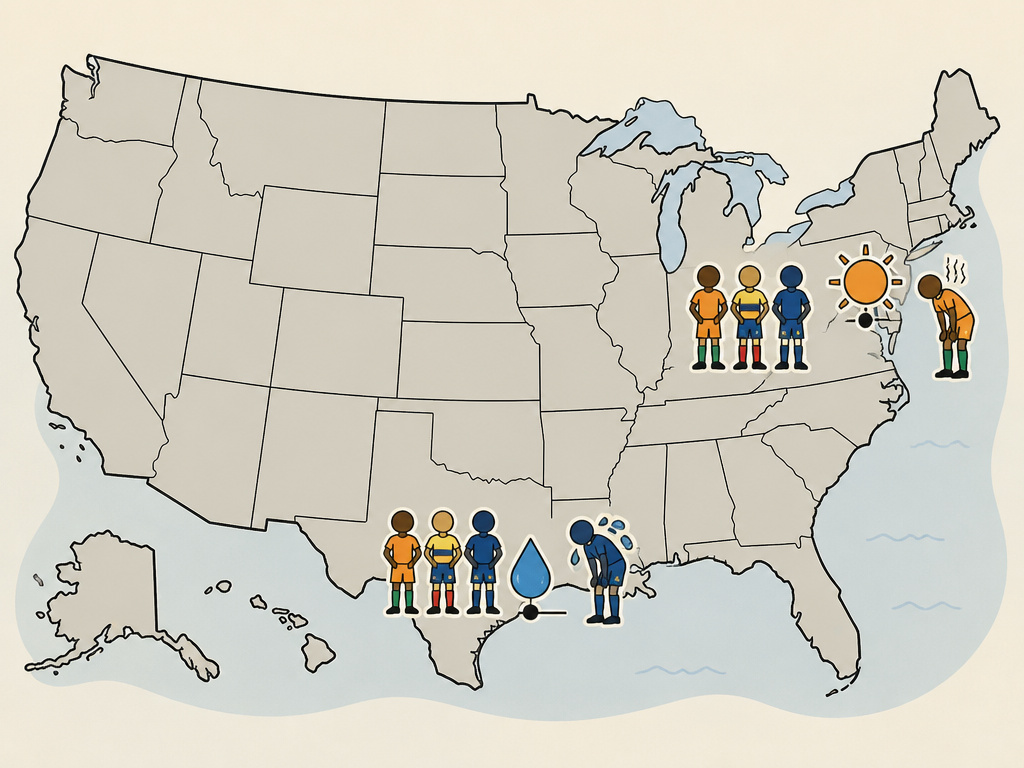
This isn’t a neutral-site tournament. The venues matter.
- Philadelphia (June 14): The opener between Ivory Coast and Ecuador will be played at Lincoln Financial Field. Potential early summer heat and humidity could benefit Ecuador, whose players are acclimated to varied South American climates, and Curaçao, used to Caribbean conditions. It could sap the energy of the powerful Ivorians if the match becomes a grind.
- Houston (June 19): NRG Stadium has a roof, but the Houston humidity in June is oppressive. The match between Curaçao and Ivory Coast here could be a war of attrition. The team that manages the conditions better, likely the one that scores first and can control tempo, will have a huge advantage.
- New York/New Jersey (June 25): MetLife Stadium for the Ecuador vs. Germany finale. A night game in late June should be cooler. This favors Germany’s high-pressing, possession-based game. Ecuador’s altitude endurance may be less of a factor here compared to the earlier matches in the heat.
Travel is minimal for these teams compared to other groups, but the shift from the humid south (Houston) to the potentially cooler north (New Jersey) between matchdays two and three is a small factor in recovery and preparation.
Player Battles to Watch
Beyond the teams, individual duels will swing matches.
- Moisés Caicedo (Ecuador) vs. Jamal Musiala (Germany): This is the key battle in the final group game. Caicedo’s defensive discipline and tackling against Musiala’s dribbling and creativity in tight spaces. If Caicedo can nullify Musiala, Ecuador has a chance.
- Sékou Fofana (Ivory Coast) vs. Ecuador’s Midfield Trio: Fofana’s driving runs from deep are Ivory Coast’s engine. If Ecuador’s midfield three of Caicedo, Cifuentes, and Mendez can cut off his passing lanes and isolate him, they neutralize Ivory Coast’s main threat.
- Leandro Bacuna (Curaçao) vs. Anyone: Bacuna’s experience and set-piece delivery are Curaçao’s only consistent source of creativity. The team that assigns a dedicated marker to shut him down will cut off Curaçao’s supply line.
These individual matchups, more than any overarching tactical adjustment, will decide moments. A Musiala dribble past Caicedo, a Fofana shot from distance, a Bacuna free-kick, these are the plays that define tournaments.
Frequently Asked Questions
What happens if two teams are tied on points in Group E?
The tie-breakers, in order, are: 1) Goal difference in all group matches, 2) Goals scored in all group matches, 3) Head-to-head points between the tied teams, 4) Head-to-head goal difference between the tied teams, 5) Head-to-head goals scored between the tied teams, 6) Fair play points (fewer yellow/red cards), 7) Drawing of lots.
Can Curaçao realistically qualify for the Round of 32?
Mathematically, yes. Realistically, it’s a monumental challenge. Their most likely path is finishing third with four points (a win and a draw). To do that, they’d need to beat either Ivory Coast or Ecuador and draw the other. That would require two massive upsets. Their primary role is that of a spoiler, damaging the goal difference of Ivory Coast or Ecuador.
How many points does a third-place team usually need to advance?
Historical data from 24-team World Cups (1986-1994) suggests four points is almost always enough. Three points is the borderline; it often comes down to goal difference. In 1986, third-place teams with four points all advanced. In 1994, one third-place team with four points even advanced over a second-place team from another group with the same points due to a better goal difference.
Does the group winner get an easier knockout match?
Yes. The Group E winner will play a third-placed team from either Group A, B, C, or D in the Round of 32. The Group E runner-up will play the runner-up from Group F. Generally, facing a third-placed team is considered an easier path than facing a group runner-up, who is likely a stronger side.
What are fair play points, and could they matter?
Fair play points are a tie-breaker based on yellow and red cards. A yellow card is -1 point, a second yellow/red card is -3 points, a direct red card is -4 points, and a yellow card followed by a direct red is -5 points. For qualification playoff rules in other tournaments, discipline often matters. In Group E, if Ivory Coast and Ecuador end up tied on all other metrics for a knockout spot, the team with fewer cards advances. A single reckless red card could be catastrophic.
The Bottom Line
Group E looks straightforward on paper: Germany first, a scrap for second between Ecuador and Ivory Coast, and Curaçao making up the numbers. But the new third-place rule injects chaos. It turns what would have been a disappointing draw for Ecuador or Ivory Coast into a likely ticket to the knockouts.
The entire group hinges on June 14 in Philadelphia. An Ecuador win there puts them in pole position for second. An Ivory Coast victory flips the script. A draw makes both teams sweat through their final matches, watching goal difference like hawks. Germany should navigate this group, but their history of group-stage complacency is a warning.
For Curaçao, the dream is alive as long as the math exists. Their goal is to be more than a footnote, to take points off someone and write their own small piece of history. In a group with a global powerhouse like Germany and continental champions like Ecuador and Ivory Coast, that alone would be a victory. For the others, it’s a brutal fight for survival where every goal, every card, and every point could mean the difference between an early flight home and a shot at glory in the Round of 32.

I come from the “soccer heart” of Germany, the Ruhrpott. I have played, trained and followed soccer all my life and am a big fan of FC Schalke 04. I also enjoy following international soccer extensively.