World Cup Weather Risks: Heat, Storms & Climate Impact
To manage World Cup 2026 weather and climate concerns, you must focus on Wet Bulb Globe Temperature (WBGT), not just the forecast. A quarter of matches could be played above 26°C WBGT, a threshold where heat stress becomes dangerous for elite athletes. FIFA has announced cooling breaks and schedule adjustments, but leading sports scientists call these measures inadequate for the projected conditions.
Most fans and even some organizers look at the forecast high and think they understand the risk. They don’t. The real danger is a metric most people have never heard of, and the science says the current safety plan is built for a climate that no longer exists.
Here is what the 2026 tournament faces, which cities are in the crosshairs, and what the players’ union says needs to change before a single ball is kicked.
Key Takeaways
- The Wet Bulb Globe Temperature (WBGT) is the critical metric, combining heat, humidity, wind, and sun. A WBGT of 28°C is the threshold where FIFPRO, the global players’ union, advises postponing matches.
- 14 of the 16 host stadiums are projected to experience dangerous heat levels, with a quarter of all matches likely played above 26°C WBGT. The risk of extreme heat has nearly doubled since the 1994 World Cup due to climate change.
- FIFA’s current plan includes mandatory three-minute cooling breaks each half and schedule adjustments, but a coalition of scientists warns these are “inadequate” and calls for longer breaks and a lower postponement threshold.
- Beyond heat, thunderstorms in the Midwest and South and wildfire smoke from Canada and the western US pose significant risks for delays, cancellations, and player health.
- Players face a “triple threat” of environmental stress: extreme conditions during matches, poor air quality and allergens in host cities, and travel fatigue across up to seven time zones.
The Wet Bulb Globe Temperature (WBGT): The Real Metric That Matters
Forget the number on your weather app. Air temperature tells a fraction of the story. The metric that decides if a match is safe to play is the Wet Bulb Globe Temperature. It is a composite index that factors in air temperature, humidity, wind speed, and solar radiation. This gives a precise reading of the heat stress a human body will experience.
The Wet Bulb Globe Temperature (WBGT) is the gold standard for measuring heat stress in athletic settings. Developed by the US military in the 1950s, it more accurately predicts the risk of heat-related illness than temperature alone because it accounts for the body’s reduced ability to cool itself through sweat evaporation in high humidity.
The thresholds are not arbitrary. At 26°C WBGT, organizations like the Korey Stringer Institute recommend implementing modified work-to-rest ratios and vigilance for heat illness. At 28°C WBGT, the risk becomes substantial. FIFPRO’s evidence-based environmental challenge guidelines explicitly state that matches should be considered for delay or postponement at this level. By 32°C WBGT, the heat stress is considered extreme and dangerous for strenuous activity.
TL;DR: WBGT, not the forecast high, is the only number that matters for player safety. FIFA must use it, not just monitor it.
How Hot Will It Really Get? The Stark Projections
The BBC Weather analysis of extreme weather for the 2026 tournament paints a concerning picture. Researchers from the World Weather Attribution group analyzed historical data and current climate models. Their conclusion is that the likelihood of dangerous heat during the June and July tournament window has increased dramatically.
A quarter of all matches are projected to be played above the 26°C WBGT concern level. Five matches could exceed the critical 28°C WBGT threshold. This isn’t a minor inconvenience. At these levels, core body temperature regulation fails, cognitive function declines, and the risk of heatstroke escalates rapidly. The physical demands on players in such conditions are immense, pushing athletic performance to a dangerous edge.
Common mistake: Comparing 2026 projected temperatures to past World Cups, climate change has shifted the baseline. The World Weather Attribution report states the risk of extreme heat and humidity has nearly doubled since the 1994 tournament held in the US. We are playing in a different climate.
The Al Jazeera FIFA heat warning report highlighted that these “gruelling heat” conditions could impact the final, scheduled for July 19 at MetLife Stadium in East Rutherford. An afternoon kick-off there in mid-July, even in New Jersey, is a serious gamble.
| WBGT Threshold | Physiological Impact | Recommended Action |
|---|---|---|
| Below 26°C | Moderate risk | Normal play with increased hydration vigilance. |
| 26–28°C | High risk | Mandatory cooling breaks. Enhanced medical monitoring. |
| 28–32°C | Very high risk | Consider postponement or delay. FIFPRO advises this. |
| Above 32°C | Extreme risk | Postpone or cancel. Dangerous for all participants. |
The Host City Hotspots: A Stadium-by-Stadium Breakdown
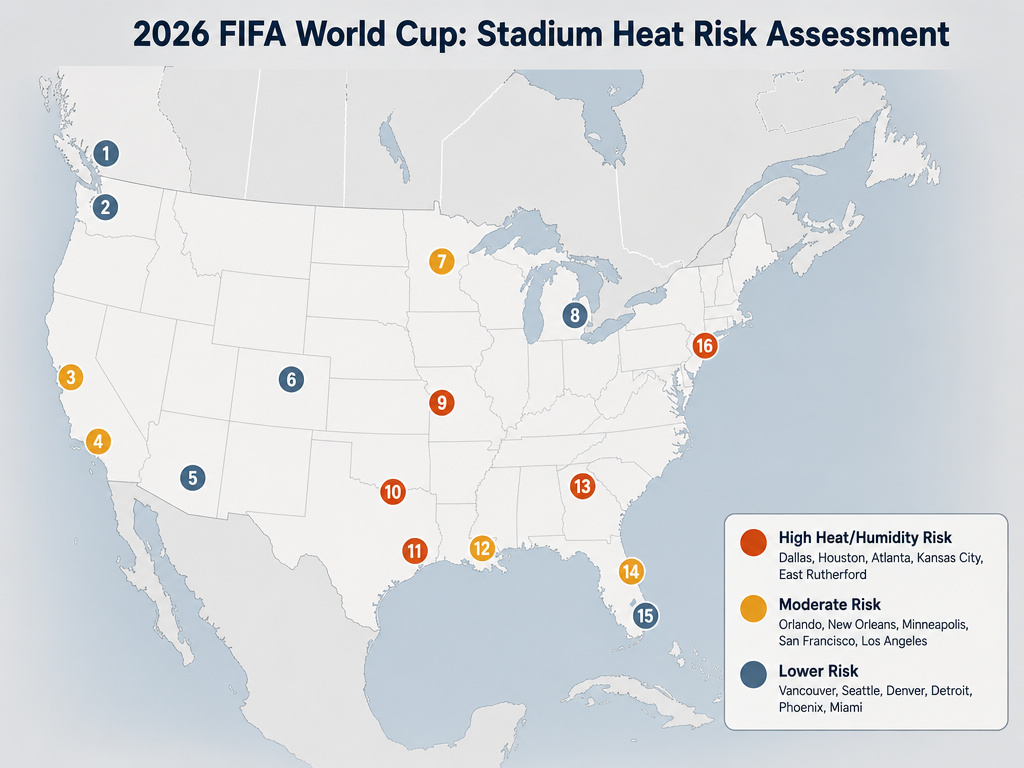
The geographic spread of the 2026 World Cup is its own enemy. The tournament spans from Vancouver, Canada, to Monterrey, Mexico, a distance that ensures wildly different climates. Not all venues are created equal when it comes to heat risk.
Southern and inland cities are the primary concern. Dallas (AT&T Stadium), Houston (NRG Stadium), and Atlanta (Mercedes-Benz Stadium) are infamous for their stifling summer humidity. Kansas City (Arrowhead Stadium) and East Rutherford (MetLife Stadium) also face significant heat risks. The pitch conditions in these enclosed or semi-enclosed stadiums can become oppressive, with little wind to disperse heat and humidity.
Coastal and northern cities offer some relief. Vancouver (BC Place) and Seattle (Lumen Field) have milder summer climates. Toronto (BMO Field) and Boston (Gillette Stadium) are warmer but less extreme. However, these locations trade heat for other challenges, like the potential for wildfire smoke in Vancouver or Seattle, which can create hazardous air quality independently of temperature.
Altitude adds another layer. Guadalajara (1566m) and especially Mexico City (2240m) will host matches at moderate elevation. The thinner air reduces oxygen availability, impacting player endurance and recovery, compounding the effects of heat for teams not acclimatized.
FIFA’s Plan vs. The Scientists’ Warning

Photo: FIFA / Wikimedia Commons / Public domain
FIFA has published a “tiered heat mitigation model.” Its core components are mandatory cooling breaks, schedule optimization, and fan protections.

- Cooling Breaks: Three-minute breaks in each half, regardless of conditions.
- Schedule Adjustments: Avoiding the hottest parts of the day for kick-offs, prioritizing stadiums with roofs or shade for players.
- Fan Measures: Allowing sealed water bottles, setting up hydration stations, and creating shaded cooling areas.
Many experts call this insufficient. A group of leading sports and climate scientists published a paper in Sports Medicine labeling the current measures “inadequate” and “impossible to justify.” Their argument hinges on the WBGT threshold. FIFA’s plan activates at 32°C WBGT. The scientists, and FIFPRO, say that is far too high.
Their counter-proposals are more aggressive:
* Postpone matches if WBGT exceeds 28°C, not 32°C.
* Extend cooling breaks to at least six minutes.
* Implement pre-cooling strategies for players (ice vests, cold towels).
* Alter warm-up routines to reduce heat load before kick-off.
The disconnect is stark. FIFA’s model is a reactive operational plan. The scientific community is demanding a preventative, safety-first protocol. This isn’t about comfort. It’s about preventing player fitness breakdowns and medical emergencies on the world’s biggest stage.
Beyond the Heat: Thunderstorms, Air Quality, and Travel
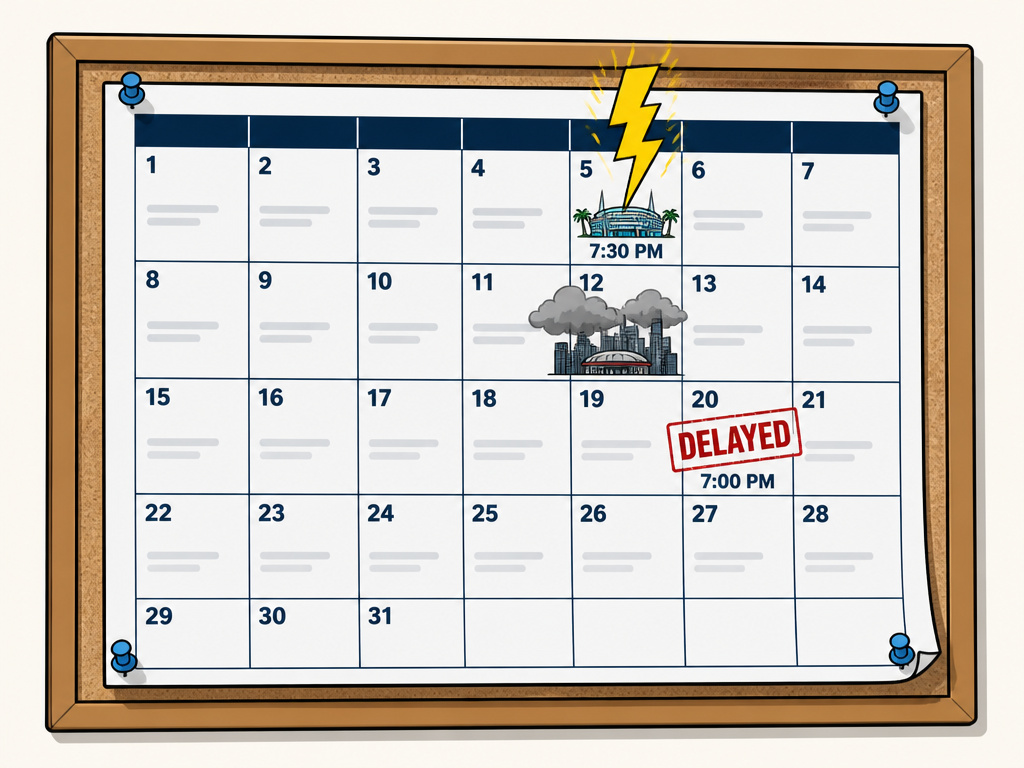
Heat is the headline, but it’s not the only weather threat. The summer climate across North America brings other disruptive forces.
Thunderstorms are a near-daily occurrence in regions like the Midwest and the American South. Host cities like Miami, Houston, Atlanta, and Kansas City are right in the storm belt. FIFA’s protocol is clear: lightning within 10 miles of the stadium means play stops. A severe thunderstorm can delay a match for hours or force a postponement to another day, wreaking havoc on tournament schedules and fan travel plans. There is no advanced technological fix for this.
Air Quality is the wildcard. The 2023 Canadian wildfire season, which blanketed the US East Coast in hazardous smoke, is a potent preview. Cities like Vancouver, Seattle, Toronto, and even New York could be affected. There is no fixed FIFA threshold for air quality cancellation. Decisions would be made in real-time based on local public health guidance, creating massive uncertainty.
Then there’s travel. The 2026 season will be a logistical marathon. Teams based in Vancouver could face a 7-hour flight to Miami for a knockout match. This circadian misalignment and cumulative fatigue is a silent performance killer, affecting sleep, recovery, and athletic conditioning. It turns a tournament into a test of survival as much as skill.
What It Means for Players, Fans, and the Future of the Game
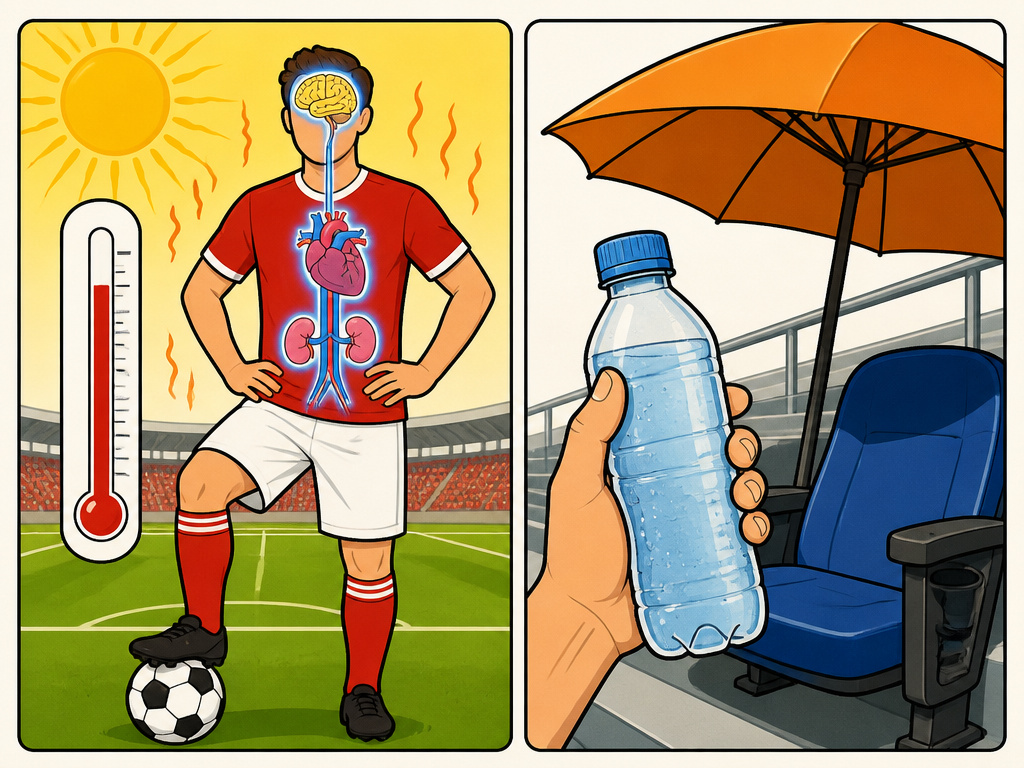
The implications are profound and layered. For players, it’s a direct health risk. The long-term health impacts of repeatedly pushing the body to its limit in extreme heat are not fully understood, but organ strain and accelerated dehydration are real concerns. Performance conditioning for this World Cup won’t just be about fitness; it will be about heat acclimatization and hydration strategies.
For fans, the experience changes. Expect longer hydration lines, more time spent in shaded areas, and a higher likelihood of weather-related delays. The economic ripple effects of a postponed match, flights, hotels, tickets, are enormous. FIFA’s insurance premiums for weather cancellation must be astronomical.
For the sport itself, this is a reckoning. The Sports Medicine environmental guidelines study is a warning shot. As climate change accelerates, hosting mega-events in the summer months becomes increasingly untenable. Future World Cups may need to shift to late spring or early autumn windows, or permanently favor cooler climates. The era of ignoring the environment when drawing up the tournament schedule is over.
TL;DR: The 2026 World Cup is a live stress test for football in the climate crisis. How FIFA responds will set a precedent for all future summer tournaments.
Frequently Asked Questions
What is the biggest weather threat to the 2026 World Cup?
Extreme heat, measured by Wet Bulb Globe Temperature (WBGT), is the primary concern. A quarter of matches could be played above dangerous levels, directly threatening player health and performance.
What is FIFA doing to protect players from the heat?
FIFA has mandated three-minute cooling breaks each half, adjusted kick-off times to avoid peak heat, and will use WBGT monitoring. However, leading scientists and FIFPRO argue these measures are inadequate and call for longer breaks and a lower temperature threshold for postponement.
Could matches be postponed or canceled due to weather?
Yes. Matches can be suspended for lightning within 10 miles. Postponement due to extreme heat is possible if WBGT exceeds 32°C, though experts argue the threshold should be 28°C. Cancellation due to hazardous air quality from wildfires is also a possibility, though there is no fixed rule.
Which host cities are most at risk for extreme heat?
Dallas, Houston, Atlanta, Kansas City, and East Rutherford (New Jersey) face the highest risk due to their inland southern locations and high summer humidity. West coast and northern cities like Vancouver and Seattle have lower heat risk but face other challenges like wildfire smoke.
How does climate change make this World Cup different?
World Weather Attribution study found the risk of dangerous heat and humidity during the World Cup window has nearly doubled since the 1994 tournament. Players will be competing in a fundamentally hotter and more hazardous climate than in past North American tournaments.
The Bottom Line
The 2026 World Cup’s weather and climate concerns are not hypothetical. The data is clear, and the warnings from the scientific community are unequivocal. Relying on old models and reactive measures is a gamble with athlete health.
The tournament will be a spectacle. It will also be a case study in how modern sport adapts, or fails to adapt, to a changing planet. The solutions exist: stricter safety thresholds, longer recovery breaks, and a willingness to reschedule for safety over broadcast slots. Implementing them requires prioritizing player health over commercial inertia.
Fans hoping to see the world’s best players at their peak should hope the organizers are listening. Because the greatest show on earth shouldn’t also be the most dangerous.

I come from the “soccer heart” of Germany, the Ruhrpott. I have played, trained and followed soccer all my life and am a big fan of FC Schalke 04. I also enjoy following international soccer extensively.