Transition Play in Soccer Explained: Tactics & Strategy
Transition play in soccer is the phase that occurs the instant possession of the ball changes between teams. It splits into two types: the Attacking Transition (winning the ball) and the Defensive Transition (losing the ball). This chaotic 5-10 second window is where teams are most vulnerable and most dangerous, making it a critical tactical battleground in the modern game.
Most people still view soccer as just attack and defense. They miss the decisive moments that happen in between. The real action starts when the ball turns over.
This guide breaks down why transitions are now a distinct phase of play, the specific tactics for attacking and defending them, and how coaches build teams to dominate these moments. You will see the game differently.
Key Takeaways
- Transitions are not just moments between attacks; they are a dedicated tactical phase where over 40% of high-quality chances are created.
- The first two actions after a turnover dictate success. A forward pass breaking a defensive line dramatically increases scoring probability.
- Defensive transition strategy is a binary choice: immediate counter-press (gegenpressing) or organized retreat. There is no middle ground.
- Training requires specific “Transition Games” – reactive small-sided drills – not just general possession exercises.
- Transition play demands peak physical output: repeated high-intensity sprints and rapid decelerations that define match fitness.
The Two Types of Soccer Transition
Forget the old model of soccer as just “we have the ball” and “they have the ball.” The modern game inserts a third, volatile phase. A transition is the bridge, and which bridge you cross depends on who just gained possession.
A transition in soccer is defined by the change of ball possession. It is characterized by a temporary state of disorganization for both teams, creating a window of high opportunity and high risk that lasts approximately 5-10 seconds before a new structured phase begins.
Attacking Transition begins the millisecond your team wins the ball. The opponent is likely stretched, out of position, and mentally switching from attack to defense. Your objective is brutal simplicity: exploit that disorganization to create a scoring chance before they can reset. This is where counter-attacks are born, but it also includes quick attacks from winning the ball in midfield. The principles are speed, forward penetration, and support.
Defensive Transition is the flip side. It starts the moment you lose possession. Your team is now vulnerable, potentially caught high up the pitch. Here, you have a stark, immediate choice. The first option is to counter-press – to swarm the ball carrier instantly, within 3-5 seconds, aiming to win it back before the opponent can launch their own attack. The German term gegenpressing made this famous. The second option is to retreat, to sprint back into a compact defensive shape to close spaces and kill the opponent’s transition before it starts. Hesitating between these two is how goals are conceded.
The choice between pressing and dropping isn’t random. It’s dictated by the zone of the pitch where the ball is lost, the positioning of your players, and the technical quality of the opponent. Lose it in their final third with numbers forward? You press. Lose it in your own half with your fullbacks ahead of the ball? You drop. This decision-making is the core of a modern team’s defensive discipline, a concept explored in depth in any foundational soccer tactics guide.
TL;DR: Transitions are the 5-10 seconds of chaos after a turnover. Attacking transition aims to score; defensive transition chooses between an immediate press or a tactical retreat.
Why Attacking Transition is Your Best Weapon
An effective attacking transition is a coordinated blitz. It is not just kicking the ball long and hoping. It is a structured, yet rapid, exploitation of space. The data is clear: a 2023 analysis of elite leagues found that a team’s first pass after regaining possession going forward and breaking at least one defensive line increases the probability of a shot within 15 seconds by over 40%.
The principles are non-negotiable. Speed of thought and action is first. Players must recognize the turnover and move the ball forward before the opponent’s defensive lines can condense. Penetration comes next – playing forward passes, preferably on the ground, to advance the play. Dribbling can work, but it risks slowing the move. Creating space is simultaneous. Wingers must provide immediate width to stretch the recovering defense, while central players make vertical runs to occupy defenders.
Common mistake: Winning the ball and immediately playing a safe, square or backward pass – this gifts the opponent the time they desperately need to reorganize. By the time you look forward again, the window has shut.
Support is the final pillar. The player on the ball needs passing options ahead, to the side, and from behind. This often requires the most physically demanding action: the defensive midfielder or center-back who started the transition must then sprint 30-40 yards to offer a passing lane as the attack develops. This kind of sustained, high-intensity effort is detailed in the demands of player running distance during a match.
Different formations enable different transition styles. A 3-5-2 formation naturally creates these attacks through its wing-backs, who are already positioned high and wide. In contrast, a 5-3-2 formation might prioritize a more direct transition, using the security of three center-backs to allow its midfielders to break forward aggressively.
| Type of Attacking Transition | Where Ball Is Won | Key Objective | Risk |
|---|---|---|---|
| High Regain (Counter-Press Goal) | Opponent’s final third | Immediate shot from close range | Over-commitment if shot is blocked |
| Classic Counter-Attack | Your own defensive/midfield third | Exploit space behind advanced opponent fullbacks | Poor final pass due to fatigue from long sprint |
| Escape Counter-Press | Central midfield under pressure | A quick combination to break the initial press | Loss of possession in a dangerous area |
The Defensive Transition: Press or Drop?
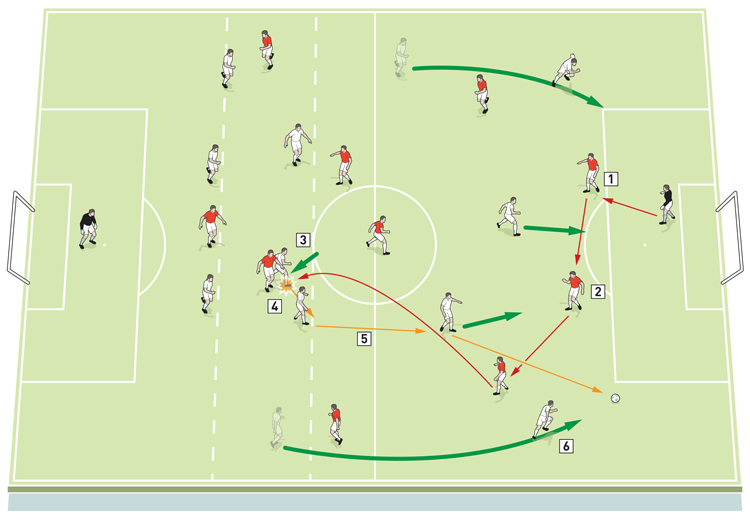
This is the moment that separates reactive teams from proactive ones. The defensive transition is a test of a team’s collective brain. There is no time for a committee meeting.
Counter-pressing (Gegenpressing) is the aggressive option. The philosophy is simple: the best moment to win the ball back is immediately after you lose it. The opponent is still in their attacking shape, their players are not yet oriented to receive passes, and their first touch is often a controlling one. By applying intense, coordinated pressure on the ball and nearby passing lanes, you can cause a panic turnover, often in an advanced area. The physical demand is extreme – it requires a burst of acceleration from every nearby player. But the reward is another immediate attacking transition, this time with the opponent’s defense in tatters.
The alternative is the organized drop. This is the pragmatic choice. The team collectively retreats, focusing not on winning the ball but on denying space. Players sprint to get goal-side of the ball, forming compact vertical and horizontal lines between the ball and their own goal. The aim is to force the opponent to slow down, to play in front of you, and to initiate a structured attack against your set defense. This is a cornerstone of a compact defensive shape, often used by teams that prioritize defensive solidity.
The choice is binary because a half-hearted press is useless. If only two players press while the rest drop, the pressing players are easily bypassed, leaving the team in a disastrous half-position – neither pressing nor compact. Coaches drill this decision into players based on triggers: if we lose it here, with these players nearby, we press. If we lose it there, we drop.
I learned this the hard way watching my youth team. We’d win the ball in midfield, push four players forward, then lose it. Instead of a unified decision, two would press, two would drop. The opponent played through the gap every single time for a 3v2. We conceded three identical goals in one half. Now the rule is absolute: all or nothing.
TL;DR: On losing the ball, your team must instantly and unanimously choose to either counter-press aggressively or drop into a compact block. Indecision is a recipe for disaster.
The Modern Game is Won in Transition
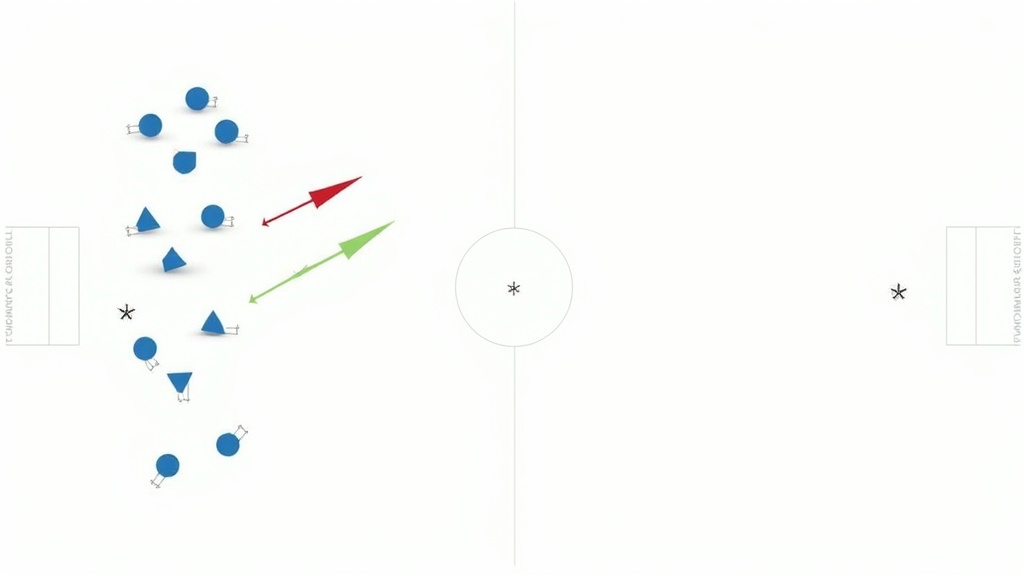
The tactical evolution of the last 15 years has been a shift from possession as an end to possession as a means. The era of “possession for possession’s sake” is over. Now, possession is often used to bait the opponent – to draw their lines forward, to create the very spaces that a devastating transition can exploit.
Modern analysts and coaches argue that the transition phase is now more important than sustained possession for creating high-quality scoring chances. Why? Because in organized attack versus organized defense, space is minimal. Defenses are trained to be compact and disciplined. But in the seconds following a turnover, that organization vanishes. Gaps appear. Players are out of position. The team that can best navigate this chaos gains a decisive edge.
This philosophy is embedded in the playing styles of the world’s top clubs. It demands not just tactical understanding but a specific athletic profile, which is why modern soccer workout plans heavily emphasize repeat sprint ability and explosive power over pure endurance. The game is decided in bursts.
Coaching Transition Play: Drills and the Game Model
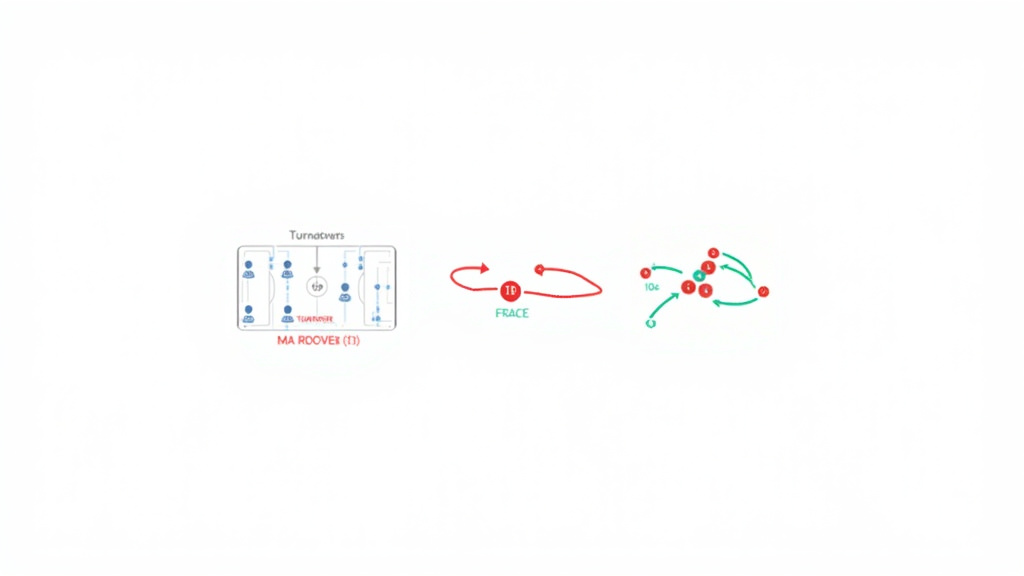
You cannot coach transition play with standard keep-away drills. The context is missing. Training must replicate the specific stress of the instant turnover. This is done through Transition Games.
These are small-sided exercises (like 4v4, 5v5, 7v7) where the objective changes the moment possession changes or on the coach’s whistle. For example, a drill might start as a possession game in one half of a field. Upon a turnover, the new attacking team now has 10 seconds to score on a full-size goal, simulating the need for speed. Or, a whistle might blow play dead, and all players must instantly react to a new ball served into a different area, training their reactive agility.
Common mistake: Running conditioning drills without a ball. Transition fitness is soccer-specific – it’s about sprinting while scanning for options, decelerating to change direction based on a pass, and doing it all under cognitive load. Laps around the track don’t cut it.
These drills serve a dual purpose: they hammer home tactical reactions and they provide the sport-specific high-intensity running stats players need. A full session plan, like those from the Player Development Project, will progress from a warm-up with transition elements, to a shooting/defending drill triggered by turnovers, to a small-sided game with transition rules.
All of this is directed by the coach’s Game Model. This is the master plan that defines how the team should act in every phase, including transitions. A clear Game Model answers questions like: When we win the ball in our right-back zone, where is our first pass? When we lose it in the attacking third, which three players press? This model turns abstract concepts into concrete, trainable actions. It is the blueprint that connects a team’s chosen formation strengths and weaknesses to its behavior in those critical seconds.
| Drill Type | Focus | Typical Setup | Coaching Point |
|---|---|---|---|
| Directional Transition Game | Speed of attack after regain | 5v5 in a 40×30 area with two end zones | “First pass forward! Don’t take more than two touches!” |
| Press & Recover | Defensive transition decision | 6v6 on a half-pitch with a midline | “If we lose it past the midline, press. If behind it, recover shape!” |
| Conditioned Scrimmage | Integrating transitions into full play | 8v8 with a rule: goals scored within 8 seconds of a turnover count double | Reward the behavior you want to see in matches. |
The Physical and Mental Toll
Transition play is the most physically demanding part of soccer. It is a series of maximal efforts: a 20-yard sprint to press, a violent deceleration to change direction, a jump to win a header, then another acceleration to join the attack. Studies tracking player workload show that the peak 5-minute periods of high-intensity running in a match almost always coincide with sequences of repeated transitions.
This is why generic fitness fails. Players need the specific endurance to repeat these sprints throughout the 90 minutes, not just a high VO2 max. Their strength for soccer performance must include powerful deceleration mechanics to prevent hamstring injuries from all the stopping and starting.
The mental load is equally heavy. Transitions are decision-making under extreme pressure and fatigue. A midfielder winning the ball must, in a split second, scan the field, assess the risk/reward of a forward pass, and execute the technique – all while an opponent is bearing down on him. This requires not just skill but courage and tactical clarity. It explains why certain midfield transition roles are reserved for a team’s most intelligent and composed players.
Fatigue degrades decision-making. A player in the 85th minute is more likely to play that safe, square pass rather than the risky through-ball. This is why coaches substitute not just for fresh legs, but for a fresh brain capable of making those critical transition decisions.
Frequently Asked Questions
What is an example of a transition in soccer?
The most classic example is a counter-attack. Your team defends a corner kick, wins the header, and the ball falls to your defensive midfielder. He quickly plays a forward pass to a winger who has already started sprinting into the vast space left by the opponent’s attacking fullback. The sequence from winning the header to the winger receiving the pass in space is the attacking transition.
What is the difference between transition and counter-attack?
counter-attack is a specific type of attacking transition. All counter-attacks are transitions, but not all transitions are counter-attacks. A transition can happen anywhere on the pitch. A quick attack launched after winning the ball in the midfield circle is a transition, but it’s not a classic counter-attack from a deep defensive position.
How do you coach transition play?
You coach it with game-realistic, reactive drills. Use small-sided “Transition Games” where the objective (e.g., which goal to attack) changes immediately upon a turnover or a coach’s whistle. Conditioned scrimmages where goals scored within 10 seconds of winning the ball are worth extra points also reinforce the behavior. Crucially, you must first establish a clear “Game Model” so players know the specific actions expected of them in different zones.
Why is transition so important in soccer?
Transitions are important because they represent moments of maximum opportunity and maximum vulnerability. Defensive structures are broken, and space is abundant. Data shows a significantly higher probability of creating a scoring chance in the 15 seconds following a regain of possession compared to a prolonged period of organized attack. The modern game is increasingly decided in these chaotic phases.
What is a defensive transition?
defensive transition is the phase that begins the instant your team loses possession of the ball. The primary objective is to prevent the opponent from exploiting your temporary disorganization. The team must collectively choose one of two strategies: an immediate counter-press to win the ball back within seconds, or a coordinated retreat into a compact defensive shape to kill the opponent’s attacking space.
Before You Go
Transition play is the heartbeat of modern soccer. It’s the phase that turns defenders into attackers in a blink and turns controlled possession into sudden chaos. Mastering it requires more than just fast players; it requires a team with a shared brain, programmed to react as one to the turnover.
Remember the sequence. Win the ball, then think forward and move forward instantly. Lose the ball, then press as a pack or drop as a unit – but decide together. Train for it with drills that mimic the panic and the pace of the real moment. Whether your team uses a 4-4-2 formation for direct transitions or a 3-4-3 formation for aggressive counter-pressing, the principles of speed, decision, and collective action remain the same. This is where games are won.
I come from the “soccer heart” of Germany, the Ruhrpott. I have played, trained and followed soccer all my life and am a big fan of FC Schalke 04. I also enjoy following international soccer extensively.