Achraf Hakimi Career & World Cup Story: A Modern Wingback
Achraf Hakimi’s career and World Cup story is the blueprint for the modern wingback. It is built on explosive pace, elite two-way stamina, and a technical skillset that allows him to function as both a winger and a defender, redefining the role for club and country.
Achraf Hakimi’s career and World Cup story is defined by elite speed, tactical versatility, and a deep commitment to Morocco, culminating in a historic 2022 World Cup semi-final and a Champions League title with Paris Saint-Germain. His journey from Real Madrid’s academy to global stardom mirrors the evolution of the modern wingback.
Most profiles get stuck listing his clubs and trophies. They miss the engine: how his specific skillset unlocked a tactical revolution for Morocco and why his choice of national team was never about football alone. It was about identity.
This guide breaks down Hakimi’s path, his World Cup heroics, and the technical details that make him one of the most complete defenders in the game.
Key Takeaways
- Hakimi’s explosive pace and two-way endurance redefined the wingback role, making him a system player for top coaches at Inter Milan, PSG, and Morocco.
- His decisive penalty against Spain in the 2022 World Cup Round of 16 was the catalyst for Morocco’s historic run to the semi-finals, changing African football forever.
- Choosing to represent Morocco over Spain was a profound personal decision based on heritage, directly inspiring a generation of dual-nationality talents.
- His trophy haul is uniquely broad: a Champions League with Real Madrid, a Serie A title with Inter Milan, multiple Ligue 1 crowns with PSG, and an AFCON with Morocco.
- Beyond athleticism, his game intelligence in reading transitions and delivering final passes places him among the world’s fastest players with an end product.
The Making of a Modern Wingback
Hakimi’s development wasn’t linear. It was a calculated exposure to contrasting football philosophies. He left Real Madrid’s castilla not as a finished product, but as a raw athlete with technique. The two-year loan to Borussia Dortmund under Lucien Favre was the masterclass. Bundesliga football demanded relentless high-pressing and recovery runs. His lungs burned for a season.
Achraf Hakimi’s value as a wingback stems from a rare combination of recorded top speed exceeding 35 km/h and the tactical discipline to hold a defensive shape, allowing systems like Morocco’s 4-1-4-1 to transition into a 5-4-1 without a substitution.
He returned to Madrid a different player, only to be sold to Inter Milan. Antonio Conte’s 3-5-2 system was the perfect cage. The 3-5-2 formation is built for wingbacks. Conte gave him the entire right flank, with one non-negotiable rule: you must be the first defender and the first attacker. That Serie A title in 2020-21 was built on his and Ivan Perisic’s miles.
Paris Saint-Germain’s €60 million acquisition in 2021 was the final piece. It wasn’t just a transfer; it was a statement of intent to build a team that could win the Champions League. His performance food choices and dedicated soccer workout plans became crucial for maintaining his explosive output across a 50-game season.
TL;DR: Hakimi’s education across Madrid, Dortmund, Milan, and Paris forged the prototype wingback: fast enough to recover, smart enough to create, and durable enough to do it 90 times a season.
Club Career: A Trophy Hunter’s Tour of Europe

Photo: Nawfel Ajari / Wikimedia Commons / CC BY-SA 4.0

His medal collection is a tour of Europe’s elite. It started with a learning role in Real Madrid’s 2018 Champions League win. He was a spectator in the big moments, but the training-ground exposure to Marcelo and Carvajal was priceless. The move to Inter Milan was where he became a protagonist.
The Scudetto-winning season saw him directly contribute to 7 goals and 8 assists from right wing-back. He wasn’t just overlapping; he was a primary creator. His cross for Romelu Lukaku’s winner against Juventus that season wasn’t hopeful. It was a whipped, first-time ball from a half-turn, the kind of technique that separates good crossers from game-changers.
At PSG, the pressure was different. The Champions League was the only metric. His goal in the 2025 final against Inter Milan wasn’t a tap-in. It was a late, arching run from deep, meeting a cut-back at the penalty spot. That’s the instinct of a winger in a defender’s body. It completed a set few players own: domestic titles in Spain, Germany, Italy, and France, plus the European crown.
| Club | Key Achievement | Defining Trait Developed |
|---|---|---|
| Real Madrid | UEFA Champions League (2018) | Tactical discipline & elite environment |
| Borussia Dortmund | DFL-Supercup (2019) | High-press endurance & attacking freedom |
| Inter Milan | Serie A Title (2021) | Wingback system mastery & final-third creation |
| Paris Saint-Germain | UEFA Champions League (2025) | Big-game mentality & consistent elite output |
The through-line isn’t luck. It’s adaptability. He mastered the soccer tactics guide for four different managers in four different leagues. That’s a footballer’s intelligence, not just an athlete’s gift.
The 2022 World Cup: A Continent’s Breakthrough
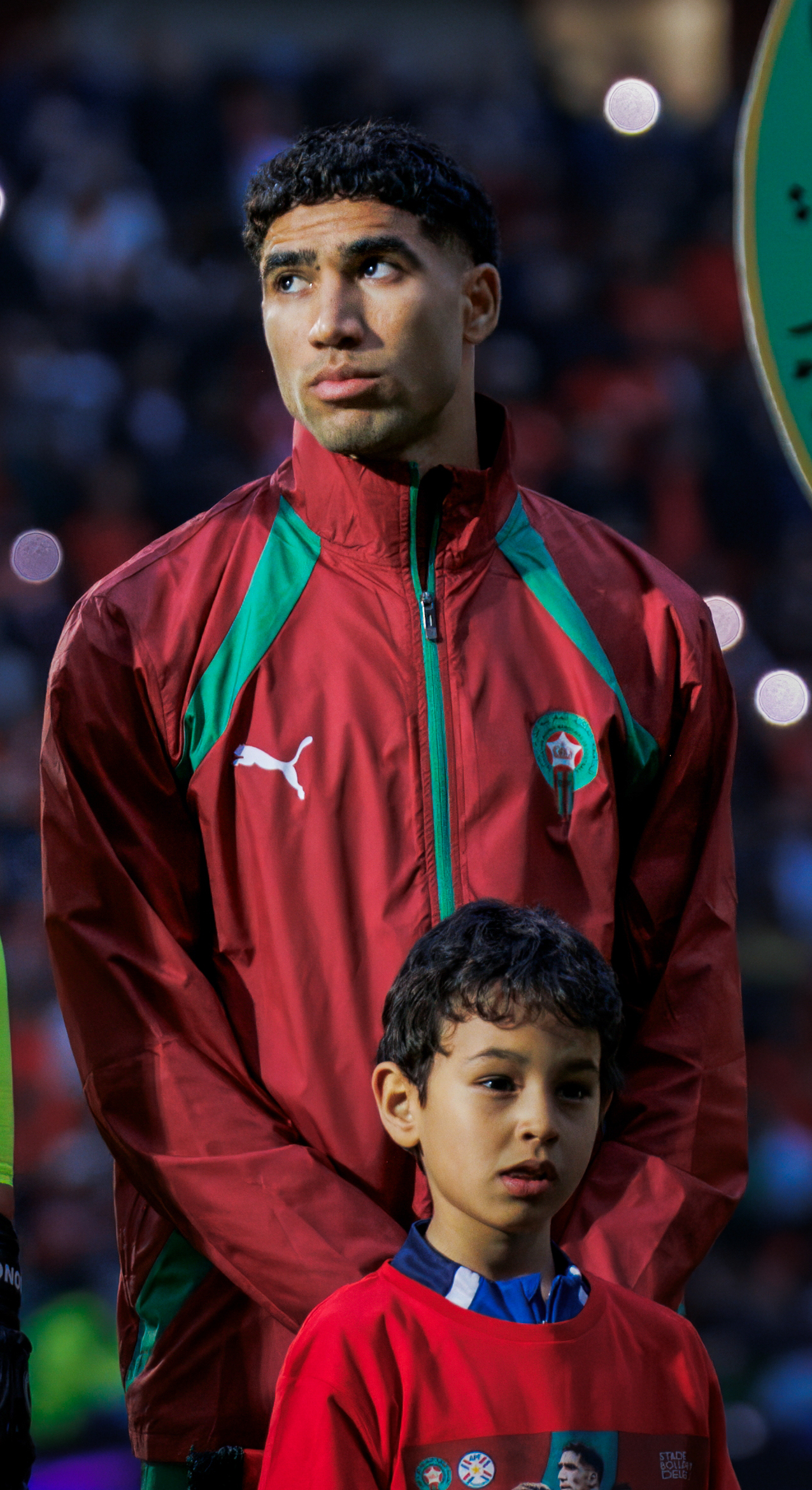
Photo: Abdelali Bentarki / Wikimedia Commons / CC BY 4.0
.jpg)
Morocco’s run in Qatar wasn’t a fluke. It was a defensive masterclass, and Hakimi was its chief architect on the right. The system, often a 4-1-4-1 that became a 5-4-1 in defense, relied on his ability to be in two places at once. Against Spain in the Round of 16, he played 120 minutes as a right-back, a right-winger, and a third centre-back.
The penalty. That’s the moment frozen in history. After a 0-0 stalemate where Morocco absorbed everything, he stepped up for the decisive kick in the shootout. Not the veteran strikers. The 24-year-old right-back. He didn’t blast it. He chipped it—a Panenka. The arrogance of it, under that pressure, told you everything about his mentality. It was the kick that sent Morocco through and broke a continental ceiling.
Common mistake: Thinking Morocco parked the bus. They executed a disciplined low-block, but Hakimi’s surges on the counter were a planned release valve. Ignoring that transition threat meant opponents overcommitted, leading to the very chances Morocco needed.
Their quarter-final win over Portugal was a defensive siege. Hakimi’s most memorable contribution was a last-ditch clearance off the line, not a run. That’s the complete picture. The semi-final loss to France was a bridge too far, but the point was made. Africa had arrived, and its standard-bearer wore number 2. This historic campaign immediately placed him among the standout players of 2026 in the global consciousness.
TL;DR: Hakimi was the two-way engine of Morocco’s historic 2022 World Cup run, embodying their defensive grit and rare attacking spark, culminating in a legendary penalty.
Why Morocco? The Decision That Defined a Legacy

Photo: Abdelali Bentarki / Wikimedia Commons / CC BY 4.0
Born in Madrid. Spanish youth international. The easy path was La Roja. His choice of Morocco in 2016 was a quiet earthquake. In his own words, it was “never a coincidence.” It was a pull from his parents, from Casablanca, from a sense of belonging that a Spanish passport couldn’t provide.
This decision had a ripple effect far beyond one player. It became a beacon for every dual-nationality talent with Moroccan roots. It said the top level was possible while representing the Atlas Lions. His success directly paved the way for others to follow, changing the talent pool for the national team overnight. It’s a case study in how identity can shape the modern soccer landscape.
The emotional weight was visible during the 2022 World Cup anthem. The tears weren’t for show. They were for a thousand family dinners, for parents who left home, for proving a point without saying a word. That commitment transforms a team. It’s the difference between a group of players and a brotherhood. This profound connection is what separates his story from many other famous Argentine players or European stars who represent their birth nations.
Playing Style: More Than Just Pace

Photo: MFonzatti / Wikimedia Commons / CC BY-SA 4.0

Everyone talks about his speed. It’s the first thing you see. But the second thing is his brain. His positioning as a wing-back isn’t just about hugging the touchline. He judges when to tuck inside and become a central midfielder, overloading the half-space to create numerical superiority. This is advanced coaching strategies.
His crossing technique is a lesson. He doesn’t just hit and hope. He uses his instep to whip balls with a low trajectory that bend away from goalkeepers and onto a striker’s foot. It’s a repeatable, coached skill. Defensively, his recovery tackling is clean. He doesn’t dive in; he shepherds, uses his body, and wins the ball with his feet. This composure prevents cheap fouls in dangerous areas.
Perhaps his most underappreciated achievement is his fitness durability. To play his high-intensity role for 90 minutes, across 50+ games a season, requires a monstrous physical base. It’s why his athletic conditioning is as critical to his value as his first touch.
Legacy and What’s Next

At 26, his trophy cabinet is already a hall-of-famer’s dream. He has the continental breakthrough with Morocco and the club zenith with PSG. The 2025 African Footballer of the Year award cemented his status. But his own ambition is clear: to “make football history” with Morocco. The 2022 run was a beginning, not a peak.
The 2026 World Cup, with Morocco as a legitimate contender, is the next chapter. His role will evolve from dynamic wing-back to seasoned leader, possibly captaining the side as he does now. The challenge is maintaining that explosive physical edge into his late twenties—a test of his professionalism and the same optimal recovery foods that got him here.
He stands as the definitive modern full-back. A player who didn’t just adapt to the evolution of the position but drove it. For a complete record of his journey, including every club transfer and international cap, the official Achraf Hakimi Wikipedia entry remains the authoritative source.
Frequently Asked Questions
How many World Cups has Achraf Hakimi played in?
Achraf Hakimi has played in two FIFA World Cups: 2018 in Russia and 2022 in Qatar. His defining performance came in 2022, where he was instrumental in Morocco’s historic run to the semi-finals.
What clubs has Achraf Hakimi played for?
His professional club career started at Real Madrid (2016-2020), which included a two-year loan to Borussia Dortmund (2018-2020). He then transferred to Inter Milan (2020-2021), winning Serie A, before his big-money move to Paris Saint-Germain in 2021, where he has won multiple Ligue 1 titles and the Champions League.
Why did Achraf Hakimi choose Morocco over Spain?
Despite being born in Madrid and eligible for Spain, Hakimi chose to represent Morocco due to a deep personal and familial connection to his Moroccan heritage. He has stated the decision was heartfelt and based on identity, not footballing convenience.
What is Achraf Hakimi’s best position?
His best and most influential position is right wing-back in a system that uses a back three or five (like a 3-5-2 or 5-4-1). This role maximises his unparalleled speed, stamina, and crossing ability while providing defensive cover behind him.
The Bottom Line
Achraf Hakimi’s story is more than a list of clubs and medals. It’s about how a specific skillset met a tactical revolution at the perfect time. He is the physical prototype for the modern wingback, but his legacy is tied to a penalty in Doha and a choice made for his family. He didn’t just have a great World Cup story; he changed the story for a continent. The next chapter, for both him and Morocco, is about turning that breakthrough into a lasting dynasty.
I come from the “soccer heart” of Germany, the Ruhrpott. I have played, trained and followed soccer all my life and am a big fan of FC Schalke 04. I also enjoy following international soccer extensively.