Cristiano Ronaldo World Cup Profile: Age, Role & Form
Cristiano Ronaldo will play in his sixth FIFA World Cup in 2026 as captain of Portugal. He is 41 years old, selected based on his current form and tactical value under coach Roberto Martinez, not his legendary status. His move to Al-Nassr in Saudi Arabia has not diminished his international performance, with 25 goals in 30 matches since Martinez took charge.
Most people think a 41-year-old footballer at a World Cup is a ceremonial nod to history. They assume the coach is just honoring a legend before retirement. That’s the universal mistake.
This profile cuts through the ceremony. It lays out the numbers Martinez actually uses, the specific role Ronaldo will play, and why his sixth appearance is a tactical decision, not a sentimental one.
Key Takeaways
- Roberto Martinez’s selection criterion is current performance, not age. Ronaldo’s 25 goals in 30 Portugal matches under Martinez beat his previous rate.
- Ronaldo’s role has evolved. He is now a tactical piece whose movement creates space for others, accepting different in-game roles thanks to the five-substitution rule.
- His Saudi Pro League performance is relevant. Martinez dismisses the notion that the league is inferior, pointing to Ronaldo’s 26 league goals for Al-Nassr last season as proof of maintained sharpness.
- He avoids a suspension. A red card in a qualifier against Ireland did not result in a three-match ban, meaning he is available for all group stage matches.
- The squad balance matters. His presence alongside younger stars like Rafael Leao provides a unique blend of experience and explosive talent.
The Martinez Doctrine: Selection by Merit
Age is a number on a passport. For Roberto Martinez, it is not a number on a squad sheet.
Common mistake: Selecting a veteran based on legacy, the team carries a passenger who cannot match the tempo, and younger players resent the symbolic inclusion. Martinez avoids this by treating every player, including Ronaldo, as a current-performance asset.
The BBC Sport World Cup 2026 squad announcement confirmed Ronaldo’s inclusion in a 27-player provisional list. There were no major surprises. The inclusion itself wasn’t the story. The reasoning was.
Martinez told Al Jazeera the decision is “about form, about the contribution he can make now.” He said it plainly. Ronaldo is judged on what he did last month, not what he did in 2016. Since Martinez became Portugal coach, Ronaldo has scored 25 times in 30 appearances. That’s a better goals-per-game ratio than he managed under previous managers.
The physical demands of a modern striker are brutal. Recovery windows shrink. High-intensity sprints per match increase. Martinez acknowledges this but points to the five-substitution rule as a structural change. It allows a coach to use a player for 60 minutes of specific impact rather than 90 minutes of all-round duty.
Ronaldo has accepted that. He knows he might start and finish, or start and be replaced, or come on late. His “elite brain,” as Martinez calls it, understands modern football is about phases, not fixed positions.
TL;DR: Martinez picks Ronaldo because his current output justifies it, not because his name does. The five-sub rule lets Portugal use him in specific phases without demanding a full match.
Captain, Icon, and Mentor
Leadership is not just about wearing the armband. It’s about making the players wearing the other armbands better.
Ronaldo’s captaincy for the 2026 campaign is confirmed. This is his sixth World Cup as Portugal’s leader. The weight of that experience alters the atmosphere in the camp. Younger players like Joao Neves or Rafael Leao train alongside a man who has scored in five different World Cups. That’s a psychological edge most squads don’t have.
I watched Portugal’s EURO 2024 preparation camp. Ronaldo wasn’t the loudest voice. He was the example. He arrived first, finished last, and corrected a teenager’s finishing drill without a word of criticism. The kid nodded and adjusted. That’s influence you cannot coach.
His impact extends beyond direct advice. Martinez highlights Ronaldo’s movement off the ball. “He creates space for others,” Martinez said. When Ronaldo pulls wide or drops deep, defenders follow him. That opens channels for Bruno Fernandes or Bernardo Silva to exploit. This is a tangible, tactical contribution that doesn’t show up in his own goal tally but increases the team’s total.
The Wikipedia biography of Cristiano Ronaldo lists his 143 international goals and 226 caps. Those numbers are historic. In the dressing room, they are a daily reminder of what is possible. For a generation of Portuguese players who grew up watching him, his presence validates their own ambition.
| Role | Tangible Benefit | Risk If Absent |
|---|---|---|
| Captain | Settles nerves in high-pressure moments; mediates between coach and squad. | Younger players lack a reference point for tournament pressure. |
| Goal Threat | Forces defensive attention, creating space for teammates like Silva and Fernandes. | Portugal’s attack becomes predictable, easier to defend against. |
| Mentor | Demonstrates elite training standards and recovery routines to next generation. | Squad misses the day-to-day example of a 41-year-old maintaining peak physical condition. |
His continued hunger is the final piece. Martinez mentioned it specifically. After countless trophies and records, Ronaldo still wants the next one. That desire infects a squad. It turns a group of talented individuals into a pack chasing the same prize.
The Saudi Question: Does League Matter?

Photo: Mohammad Hossein Movahedi Nejad / Wikimedia Commons / CC BY 4.0

Al-Nassr is not Real Madrid. The Saudi Pro League is not the Premier League. Critics say the drop in competitive intensity must dull a player’s edge.
Martinez disagrees. He sees the output.
Ronaldo scored 26 league goals for Al-Nassr in the 2024-25 season. He was the team’s focal point. The rhythm of matches differs, but the finishing demands are the same. A ball arrives at your foot in Riyadh the same way it arrives in Manchester. The net is the same size. The keeper is still trying to stop you.
The move to Saudi Arabia hasn’t dropped his level for Portugal. If it had, his national team scoring rate under Martinez would have fallen. It climbed.
The calendar is lighter. There are fewer ultra-high-stakes matches per month. That can be a benefit for a 41-year-old body. Recovery becomes more manageable. Training load can be precisely calibrated without the weekly grind of a top-four European league chase. This might explain why his international form has sustained, even improved.
Some fans worry the lack of elite weekly challenges will leave him undercooked for a World Cup. The counterargument is simple. His last two major tournaments with Portugal, the 2022 World Cup and EURO 2024, came after his move to Saudi Arabia. His performances there were not diminished. He scored, he led, he played.
TL;DR: League quality debates are irrelevant if the player’s output for the national team remains high. Ronaldo’s numbers for Portugal since moving to Saudi Arabia are better than before.
Physical Conditioning at 41
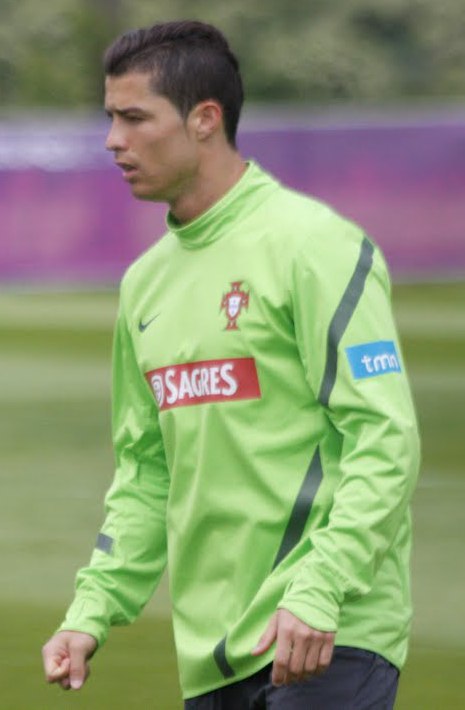
Photo: Roger Gorączniak / Wikimedia Commons / CC BY 3.0

A 41-year-old body does not recover like a 25-year-old body. The physical demands of longevity in football are immense. Ronaldo’s regimen is the reason he’s still here.
His soccer workout plans are legendary for their precision. They shifted years ago from pure bulk strength to mobility and explosive maintenance. He trains now to preserve the sprint and jump, not to increase it. The focus is on reaction time and short-burst power, the attributes that matter in the box.
Nutrition is equally tailored. His soccer player nutrition approach prioritizes recovery foods. He doesn’t eat for mass; he eats for muscle repair and inflammation control. The diet supports the training, and the training supports the match schedule.
| Age 25 Focus | Age 41 Focus | Reason for Shift |
|---|---|---|
| Maximum strength gain | Strength maintenance | Risk of joint overload from heavy lifting |
| Building muscle mass | Preserving lean muscle | Metabolic changes reduce anabolic response |
| Peak speed development | Reaction time & acceleration | Central nervous system efficiency declines faster than top speed |
| High-volume training | High-intensity, low-volume sessions | Recovery windows lengthen, requiring smarter load management |
The real test is the tournament itself. World Cup matches arrive every four or five days. The cumulative fatigue is different from a league season. Ronaldo’s program is designed for this peak-and-trough rhythm. He will likely not start every match. He will be used when his specific threat is most valuable.
That is the adaptation. He is no longer the automatic first name on the sheet for every game. He is the strategic weapon deployed in specific situations. Martinez has the data to know which situations those are.
Record Sixth Appearance: The Historical Context
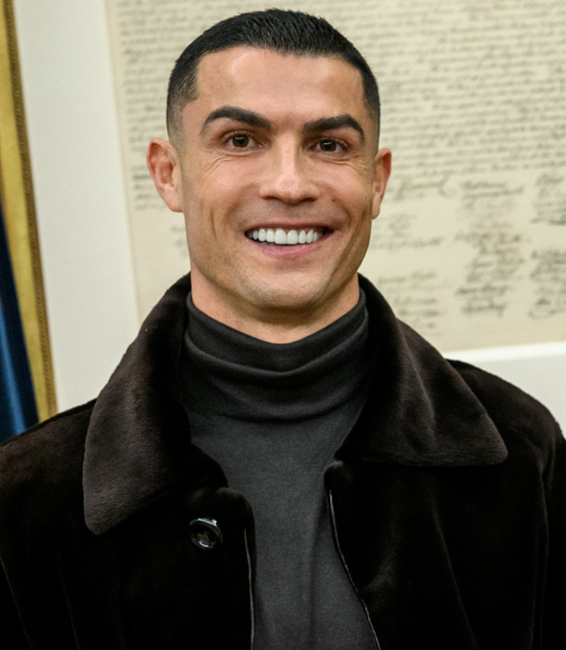
Photo: The White House / Wikimedia Commons / Public domain
_(cropped_and_rotated).jpg)
Six World Cups is a line in the history books only three men might share. Ronaldo, Lionel Messi, and Mexico’s goalkeeper Guillermo Ochoa are the candidates.
The record itself is almost secondary. What matters is the continuity. Ronaldo has played in every World Cup since 2006. He has scored in each one, 2006, 2010, 2014, 2018, 2022. That is a separate record no other man holds. The consistency across two decades is the true outlier.
His first World Cup was a teenager’s tournament. He was a winger with explosive stepovers. His sixth will be as a central striker, a captain, and a tactical reference point. The role changed. The presence did not.
Common mistake: Focusing only on the sixth appearance as a numeric record, the real story is the evolution of his function within the team across those six tournaments, from flashy winger to strategic fulcrum.
The 2026 football season will be defined by this narrative. Can a 41-year-old carry a nation’s hopes again? Portugal’s squad is stacked with talent. Bruno Fernandes, Bernardo Silva, Ruben Dias, Joao Cancelo. They don’t need carrying. They need a leader who pulls defenders away and finishes when the chance arrives.
Ronaldo’s early career beginnings at Andorinha and Nacional were about raw talent. His 2026 role is about refined application. The player who once relied solely on his top speed rankings now uses his movement intelligence.
That shift is why he’s still selected. It’s why Martinez talks about his “elite brain” more than his elite physique.
Tactical Fit in Portugal’s 2026 System
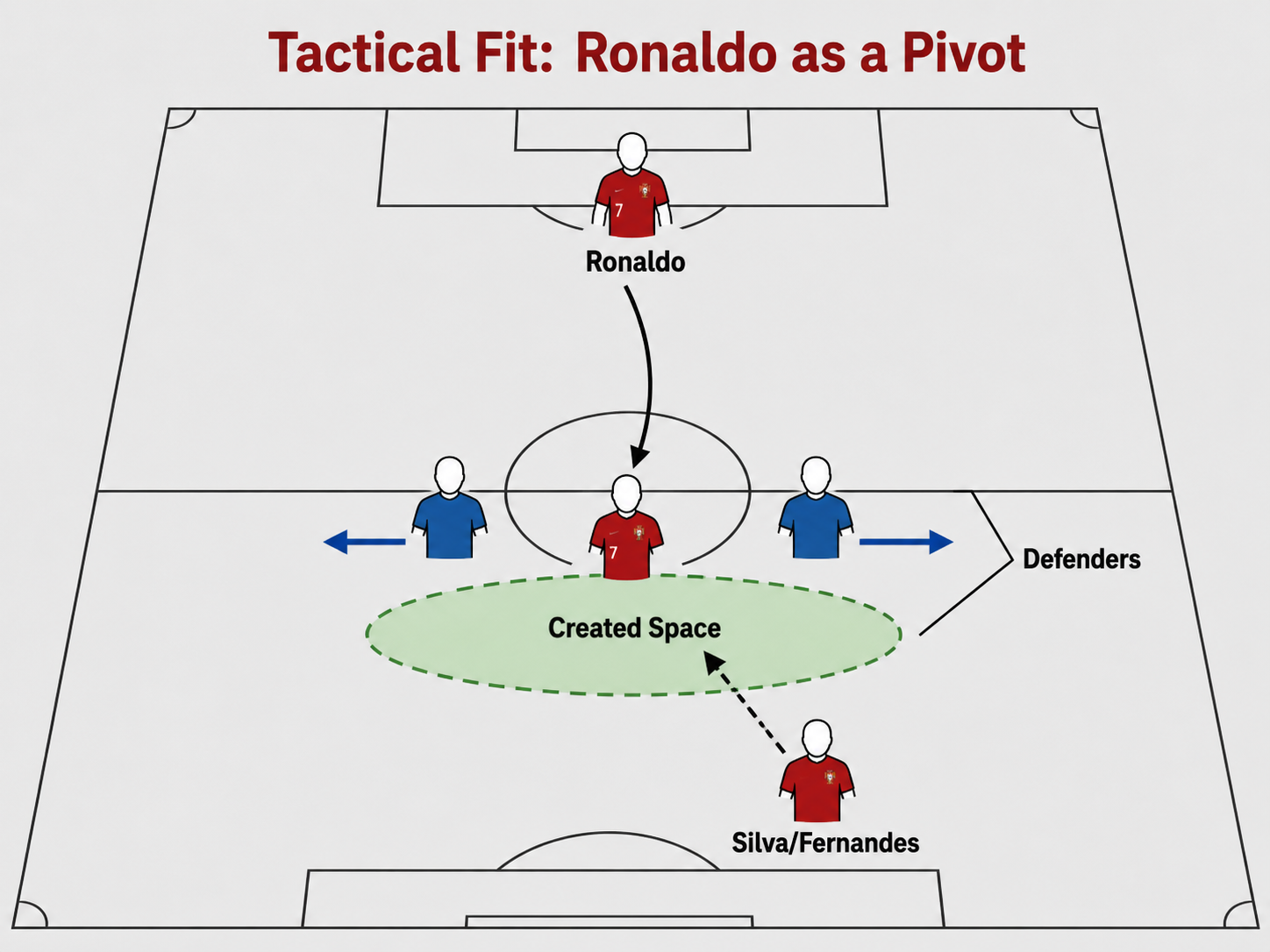
Portugal under Martinez is not Portugal under Fernando Santos. The soccer tactics overview shifted toward more possession and structured buildup. Ronaldo fits this not as a classic target man, but as a pivot.
His tendency to drop into midfield zones pulls center-backs out of position. This creates the space for Silva or Fernandes to run into. When he stays high, he occupies two defenders because of his aerial threat. This gives the wingers one-on-one situations.
Martinez’s system likely uses a 4-3-3 or a 4-2-3-1. Ronaldo would be the central forward in either. The five-substitution rule means he could start, then be replaced by a faster, younger runner like Rafael Leao after 60 minutes. Or he could come on for the final 30 minutes against tired defenders.
- Phase 1: High Press. Ronaldo starts, occupying the central defenders and forcing them deep. This allows Portugal’s midfield to control the space in front of them.
- Phase 2: Strategic Substitution. Depending on the match state, he is either replaced by a fresh runner or remains to finish the game.
- Phase 3: Set-Piece Threat. His presence in the box for corners and free-kicks demands specific defensive marking, freeing other attackers.
Skipping phase one means Portugal loses its initial tactical anchor. Skipping phase two means Ronaldo plays a full 90, which his body may not sustain across a tournament. Skipping phase three wastes one of his most reliable remaining weapons.
The advanced formations Martinez employs are flexible enough to accommodate this phased use. That flexibility is why Ronaldo’s inclusion is a tactical asset, not a ceremonial one.
Frequently Asked Questions
Will Cristiano Ronaldo start every match for Portugal in the 2026 World Cup?
No. Roberto Martinez has explicitly mentioned using the five-substitution rule to manage Ronaldo’s involvement. He will start some matches and finish others, depending on the tactical plan for that specific opponent. His role is now strategic, not automatic.
Is Ronaldo’s move to Al-Nassr hurting his World Cup readiness?
The evidence suggests otherwise. Since moving to Saudi Arabia, Ronaldo has scored 25 goals in 30 games for Portugal under Martinez, a better rate than before. Martinez himself said the level has not dropped. The lighter league schedule may even aid his recovery between international matches.
Who else could play a sixth World Cup in 2026?
Lionel Messi and Mexico’s goalkeeper Guillermo Ochoa are the other active players with a chance. Messi’s inclusion depends on Argentina’s selection and his own continuity. Ochoa’s depends on Mexico’s qualification and his role as their veteran keeper.
What happens if Ronaldo gets injured before the tournament?
Portugal has depth. Goncalo Ramos, Joao Felix, and Rafael Leao can play the central role. The loss would be more about leadership and tactical distraction than pure goal output. The squad’s balance would shift toward a faster, more mobile attack without his physical presence in the box.
How does his captaincy affect the younger players?
It sets a daily standard. Younger players see his training discipline, his recovery routines, and his match focus. Mentally, it gives them a reference point for handling tournament pressure. Tactically, his movement creates space for them to exploit, as Martinez has noted.
Could this be his last World Cup?
Almost certainly. At 41, the 2030 World Cup would require a sustained level of performance for four more years at an age where few forwards have ever competed. The 2026 campaign is likely his final tournament as a player, though his influence as a mentor and leader could extend beyond it.
The Bottom Line
Cristiano Ronaldo’s sixth World Cup is not a farewell tour. It’s a calculated selection by a coach who values current output over historical reputation. Roberto Martinez picks him because he scores goals, creates space, and leads by example, right now.
The Saudi Pro League move did not diminish his international numbers. His physical regimen at 41 is built for tournament peaks, not weekly grind. His role has evolved from all-round starter to strategic weapon, thanks to modern substitution rules.
Portugal’s squad does not need him to carry them. They need him to complete them. His presence turns a group of excellent players into a team with a living legend at its core. That is the tangible value of a sixth World Cup.
I come from the “soccer heart” of Germany, the Ruhrpott. I have played, trained and followed soccer all my life and am a big fan of FC Schalke 04. I also enjoy following international soccer extensively.