When to Use a Sliding Tackle in Soccer: 3 Key Situations
Use a sliding tackle in soccer only in three critical situations: as the last defender to prevent a goal, to stop a dangerous counter-attack, or to block an immediate shot inside the penalty area. It is a last-resort maneuver requiring perfect timing, as a mistimed tackle concedes a foul or leaves your team exposed.
Use a slide tackle in soccer only in three high-stakes situations: as the last defender to stop a certain goal, to halt a fast-breaking counter-attack, or to block an imminent shot from inside the penalty area. It is a last-resort defensive action, not a primary tool. The decision hinges on a split-second cost-benefit analysis where losing the challenge means conceding a goal.
Most players get this wrong because they see the highlight-reel glory and miss the catastrophic risk. They lunge when they should jockey. They go to ground when staying on their feet keeps them in the play. That mistake leaves a team defensively exposed for a full seven to ten seconds, the time it takes to scramble back into shape.
This guide breaks down the exact game states that justify a slide tackle, the non-negotiable technique that keeps it legal, and the recovery drill that turns a risky move into a defensive reset. You will learn to read the cues that separate a necessary gamble from a reckless foul.
Key Takeaways
- Slide tackles are a last-resort defensive action, not a routine challenge. Use them only when staying on your feet guarantees failure.
- The three justifiable triggers are: you are the last defender, a counter-attack is developing at speed, or an attacker is lining up a shot from a dangerous area.
- Timing is everything. You must anticipate the attacker’s touch and commit the moment the ball is pushed slightly away from their feet.
- “Studs up” is a straight red card at any level. The side of your foot must make contact with the ball, with your cleat’s sole pointed at the ground.
- Practice the recovery first. A perfect tackle that leaves you on the ground is a tactical failure. Drill the push-up and sprint-back sequence until it’s automatic.
A legal slide tackle under the IFAB Laws of the Game requires the defender to play the ball first, without careless, reckless, or excessive force. Incidental contact with an opponent after winning the ball is not a foul, but any challenge that endangers the safety of an opponent is punishable by a direct free kick or penalty and a disciplinary card.
The 3 High-Stakes Situations for a Slide Tackle
Your brain should have a mental checklist. If the scenario doesn’t match one of these three boxes, keep your feet. The ActiveSG slide tackle guide from Singapore’s sports agency frames it as a decisive, all-or-nothing move for specific moments. That’s the right mindset.
Situation 1: You Are the Last Defender
This is the most clear-cut case. If an attacker gets past you with only the goalkeeper to beat, a successful slide tackle prevents a certain goal-scoring opportunity. A failed one results in a red card for denying an obvious goal-scoring opportunity (DOGSO). The calculus is simple: a red card and a penalty might still save the shot, whereas a goal is a goal.
Situation 2: To Stop a Fast-Breaking Counter-Attack
When your team loses possession high up the pitch and the opponent launches a quick counter, the defensive structure is shattered. A well-timed slide tackle in the midfield third can kill the attack before it reaches your backline. It’s a tactical foul in spirit, but executed cleanly it’s just a turnover. This is where understanding counter-attacking triggers within your team’s pressing tactics helps you anticipate the danger.
Situation 3: To Block an Imminent Shot
Inside the penalty area, especially near the six-yard box, an attacker setting up to shoot has a high probability of scoring. A standing block tackle might be too slow. A sliding block tackle, with your body extended, covers more area and can deflect the shot wide. The key is that you are sliding to intercept the shot, not to tackle the player. Your leg is a barrier.
Common mistake: Sliding in a 50/50 challenge in the middle third when you have covering defenders. You take yourself out of the play for a low-reward gamble. The attacker easily hops over your leg, and your team plays short-handed for the next 10 seconds.
TL;DR: Slide only on a clear path to goal, a breaking counter, or a point-blank shot. Every other time, stay up and use a standing tackle vs sliding tackle approach.
Why “Last Resort” Isn’t Just a Saying

Paolo Maldini’s famous quote holds the truth: “If I have to make a tackle, I have already made a mistake.” He wasn’t saying never tackle. He was stating that elite defending is about positioning, anticipation, and channeling, solving problems before they require a desperate, ground-level lunge. A slide tackle is the admission that earlier defensive principles failed.
The physical cost is high. When you leave your feet, you surrender all ability to change direction. You are committed. If you misjudge by a tenth of a second, you miss the ball completely. The attacker is now past you, and you are lying on the turf. Your team is effectively down a player for the seven seconds it takes you to stand up, turn, and accelerate. In modern soccer, that’s an eternity for a team to exploit.
This is why a solid defensive midfielder or a sweeper position in a low defensive block is coached to stay on their feet. Their role is to hold shape and delay, not to make heroic last-ditch tackles. The slide tackle exists outside the system, a necessary override when the system breaks.
The Anatomy of a Legal (and Safe) Slide Tackle

Technique separates a tactical tool from a career-ending lunge. The Wikipedia entry on slide tackles outlines the basic mechanics, but the devil is in the physical details most guides skip.
| Technical Element | Correct Execution | Risk of Incorrect Form |
|---|---|---|
| Foot Selection | Use the leg closest to the ball (right/right, left/left). | Using the far leg twists your body, exposing your shin and making recovery impossible. |
| Contact Point | Side of the foot (instep or outstep), ankle locked. | Toe-poke or laces lose control; studs-up contact is a red card for serious foul play. |
| Body Height | Slide low, with your bottom leg bent and close to the ground. | Coming in high catches the opponent’s ankle or knee, causing injury and a certain foul. |
| Supporting Arm | One arm extended to cushion impact and initiate the push-up. | Tucking arms leads to a hard shoulder impact and a slower recovery. |
| Follow-Through | Hook or block the ball, then immediately retract the leg. | A sweeping follow-through through the player’s legs is a reckless foul, even if ball contact was first. |
The “studs up” rule is non-negotiable. Showing the sole of your cleat to an opponent is interpreted as a weapon. Referees are instructed to view it as excessive force by default. Your cleats must be facing the grass.
The psychological cue is to look at the ball, but turn your face away at the moment of contact. It’s an instinctive flinch that protects your eyes from kicked-up dirt or a stray follow-through. It feels unnatural but prevents a surprising number of minor injuries.
TL;DR: Lead with the side of your foot, keep it low, and get up faster than you went down. That’s the entire technical manual.
How to Train the Decision (Not Just the Technique)
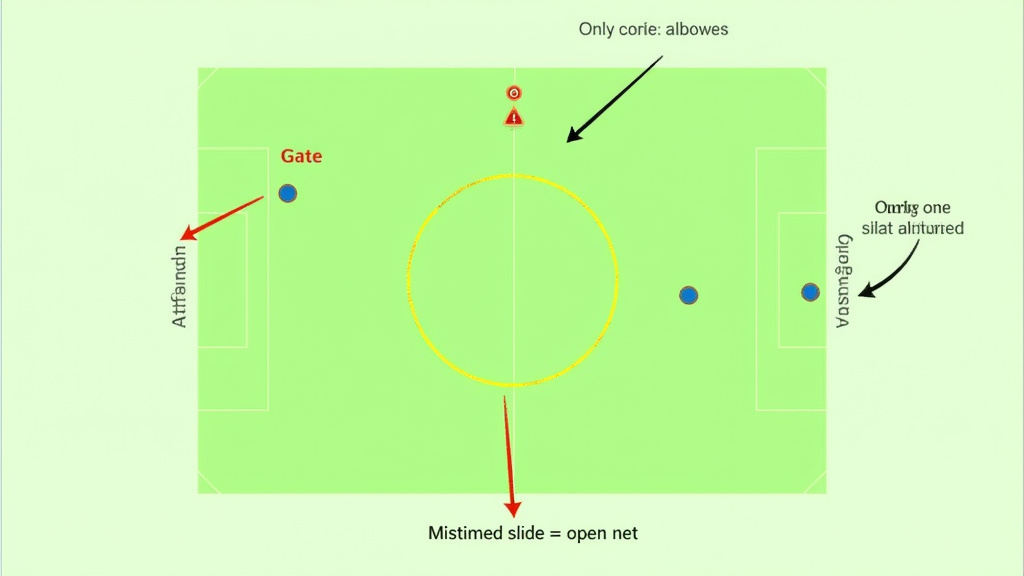
You can drill slide tackle form on a static bag all day. It won’t teach you when to use it. Decision training requires constrained scenarios that force the cost-benefit analysis.
Drill 1: The Last Defender Gate
Set up a 20×20 yard grid with a small goal at one end. One attacker starts at midfield with the ball, one defender starts on the edge of the penalty area. The defender must prevent a shot. The only rule: the defender can only go to ground once per repetition. They quickly learn that a mistimed slide results in an open net. It quantifies the risk.
Drill 2: Counter-Attack Recognition
Play a 4v4+2 in a larger grid. The two neutrals always play for the team that just won possession. The moment a turnover happens, the coach shouts “Counter!” Defenders must identify the most dangerous passing lane and decide if a sliding interception is warranted or if dropping off is safer. It trains the split-second read of body shape and space.
Drill 3: The Recovery Race
This is the most overlooked part. Execute a slide tackle on a dummy bag. The moment you make contact, push up with your arm and back foot, sprint 5 yards back, then sprint 5 yards forward to touch a cone. Time it. The goal is under 3 seconds from ground to cone-touch. If you aren’t drilling this, you’re only practicing half the skill. This kind of explosive recovery is built on a foundation of leg strength exercises and power training.
These drills move the skill from a isolated technique to an integrated, game-speed decision. They build the muscle memory for the push-up recovery, which is as important as the tackle itself.
What Referees Look For (And What Gets You Sent Off)
The Laws of the Game categorize foul challenges as careless, reckless, or using excessive force. A slide tackle can fall into any of these categories regardless of ball contact.
- Careless (Yellow Card Possible): A mistimed tackle where you trip an opponent after getting a nick on the ball. You made a genuine attempt but got it wrong.
- Reckless (Yellow Card): A tackle with disregard for the opponent’s safety. This includes sliding in with one foot raised, or making contact with the opponent before the ball despite trying to play it.
- Excessive Force (Red Card): A challenge that endangers the opponent’s safety. This is the “studs up” tackle, the two-footed lunge, or any tackle with high speed and intensity that makes solid contact above the ankle.
Common mistake: Yelling “I got the ball!” after a heavy challenge. Referees don’t care. If your follow-through is dangerously through the player, the initial ball contact is irrelevant. The safety of the opponent is the primary judgment factor.
The direction of the tackle matters less than people think. A tackle from the side or front can be just as illegal as one from behind if it’s reckless. The “tackle from behind” myth persists, but the law penalizes the manner of the challenge, not its compass point. This nuance is critical for any player studying the fundamental tactical principles of the modern game.
When NOT to Slide Tackle: The Forbidden Zones
Certain game contexts make a slide tackle a terrible idea, regardless of technique.
On a Wet, Soggy Pitch
The slide itself is slower, and your ability to push up and recover is crippled. You’ll slide farther, but you’ll also struggle to stand. The risk of getting stuck and leaving your team exposed skyrockets. On a waterlogged pitch, your feet are your best friends.
In Youth Soccer (Below U14)
Most youth leagues and academies restrict or ban slide tackling until players develop the physical control and judgment to execute it safely. The SEFA Soccer safety guide explicitly notes that very few players under 14 possess the skill and experience for a legal tackle. The potential for injury outweighs the tactical benefit. Coaching focus should be on proper tackling techniques that keep players on their feet.
When You’re Already on a Yellow Card
This is simple risk management. Even a perfectly executed slide tackle can look reckless from the referee’s angle. The marginal gain of winning the ball is not worth the near-certain second yellow and subsequent red. Your job is to stay on the pitch, especially if you’re in a key defensive midfield role.
TL;DR: Bad field, young players, or a yellow card next to your name? The answer is always no.
Frequently Asked Questions
Is a slide tackle illegal in soccer?
No, a slide tackle is a legal defensive maneuver. It becomes a foul only if the defender makes contact with the opponent before the ball, uses excessive force (like a two-footed lunge or studs-up challenge), or acts in a reckless manner that endangers the opponent’s safety. The referee’s interpretation of “careless, reckless, or excessive force” is what determines the call.
What is the best timing for a slide tackle?
The best timing is the split-second when the attacker pushes the ball slightly out of their immediate control, typically about a foot to a foot and a half away from their leading foot. You must commit as they are in the motion of taking their next touch, not when the ball is glued to their foot. Anticipation is everything.
Can you get a red card for a slide tackle if you get the ball first?
Yes, absolutely. Playing the ball first does not grant immunity. If the challenge is still deemed reckless or made with excessive force, for example, following through with your studs into the opponent’s shin after hooking the ball, the referee can and should show a red card. Player safety is the overriding priority in the Laws of the Game.
How do you practice slide tackling without getting hurt?
Use a training dummy or a tackling bag, not a teammate. Wear full protective gear (shin guards, long pants). Practice on soft grass or artificial turf. Focus first on the safe landing and recovery motion, the slide, the cushioned arm impact, and the explosive push-back-up. Add ball contact only after the safe body mechanics are automatic.
Why do coaches say slide tackling is a last resort?
Because it removes you from the play. A defender on the ground is a defender out of the game. Coaches prioritize defensive systems, like a defensive block or organized pressing, where players stay on their feet, maintain shape, and win the ball in a position to immediately counter. A slide tackle is a system breakdown, a necessary gamble when structured defense has already failed.
The Bottom Line
A slide tackle is not a skill to be collected, like a fancy dribble. It is a contingency plan for when your primary defense fails. Its value lies in its controlled, infrequent use in moments where the cost of inaction is a goal. Master the three triggers, drill the safe technique until your body screams, and practice the recovery until it’s faster than your opponent’s first thought. Then, put it back in the toolbox. The best defenders, the ones who anchor a defensive formation for 90 minutes, are defined by the tackles they don’t have to make.

I come from the “soccer heart” of Germany, the Ruhrpott. I have played, trained and followed soccer all my life and am a big fan of FC Schalke 04. I also enjoy following international soccer extensively.