How to Improve Soccer Ball Control With 5 Essential Drills
To improve soccer ball control, you must master three non-negotiable fundamentals: cushioning the first touch, training with maximal intent, and committing to short, daily sessions. The physical skill is about withdrawing your foot upon contact to absorb the ball’s energy. The mental skill is practicing every repetition as if a defender is closing in. Ten focused minutes a day for three weeks rewires muscle memory more effectively than one two-hour weekly session.
Most players get this wrong because they practice ball control like it’s a chore, not a game. They go through the motions at half-speed, stare at the ball, and only use their dominant foot. That builds slow, predictable habits that vanish under pressure. You build real control by practicing the way you play: fast, unpredictable, and with your head up.
This guide breaks down the five proven methods that separate useful practice from wasted time. You will learn the exact mechanics of a soft first touch, a 10-minute daily ball mastery routine, how to use a wall as your best training partner, and why your weakest foot deserves half your attention starting today.
Key Takeaways
- The cushioning technique, pulling your foot back upon contact, is the physical secret to a soft first touch. A stiff foot guarantees a bouncing, uncontrollable ball.
- Maximal Intent is the practice rule: every drill repetition must be performed at game speed. Slow, sloppy touches build slow, sloppy game habits.
- Consistency beats duration. Ten minutes of focused, daily ball mastery rewires neural pathways more effectively than a single two-hour weekly session.
- Train your weak foot first. Spend the first 30% of every session exclusively on your non-dominant side. The gap never closes if you don’t force it.
- Scanning is non-negotiable. If your eyes are locked on the ball during drills, you are training to be blind in games. Look up every third touch.
What is the single most important skill for ball control?
First touch. Every other skill, dribbling, passing, shooting, depends on what you do with the ball in the half-second after it arrives. A bad first touch forces you into a recovery scramble. A good one gifts you time and space to pick your next move.
The mechanics are not intuitive. Your instinct is to stop the ball by blocking it with a rigid foot. That is wrong.
Controlling a ground pass requires meeting the ball with the appropriate foot surface (inside, outside, or sole) and cushioning the impact by withdrawing the foot slightly upon contact. This absorption of kinetic energy prevents the ball from rebounding away. Simultaneously, the player’s body should be angled to open up the field of vision, a technique often referred to as “checking the shoulder” before reception.
Cushioning is the withdrawal. Think of catching an egg. You don’t hold your hands stiff; you give with the catch to soften the impact. Your foot must do the same. As the ball makes contact, pull your foot back six to ten inches along the ball’s incoming path. The ball dies at your feet instead of popping into the air.
The second half of the equation is body shape. Receive the ball sideways-on, at a 45-degree angle to the passer. This opens your hips and lets you see both the ball and the playing field ahead of you in one glance. It turns a simple stop into a directional touch that sets up your next pass or dribble. For a deeper breakdown of the angles and surfaces, our guide on first touch techniques covers the specifics.
TL;DR: Master the cushioning touch and open your body shape. These two actions turn a trapping motion into a proactive, game-changing skill.
Ball Mastery vs. Juggling: What Actually Builds Control?
Juggling gets the glory, but ball mastery does the work. Juggling improves aerial touch and coordination. Ball mastery builds the foundational, ground-level relationship between your foot and the ball that you use in 95% of a match.
Ball mastery is the unconscious ability to manipulate the ball with all surfaces of both feet, inside, outside, sole, laces, in tight spaces. It is the skill that lets you dribble through a crowded midfield without thinking about your feet. Juggling is a test of touch; ball mastery is the application of it.
A common mistake is to think 100 juggles equals good control. It does not. I have seen players who can juggle a ball on their neck struggle to dribble ten meters under light pressure. Their feet lack the vocabulary for ground movement.
Focus your solo time on ball mastery drills that force variety.
* Sole Rolls: Place the sole of your foot on the ball and roll it forward, backward, and in circles. This builds feel and stability.
* Inside-Outside Taps: Tap the ball between the inside of one foot and the outside of the other in a rhythmic V-shape.
* Box Dribbling: Set up a small square with cones. Dribble around it using only the outside of your right foot, then only the inside of your left.
These home ball control exercises are designed for limited space and maximum payoff. They build the specific muscle memory for close control dribbling in traffic.
The 5 Proven Methods to Wire Better Control
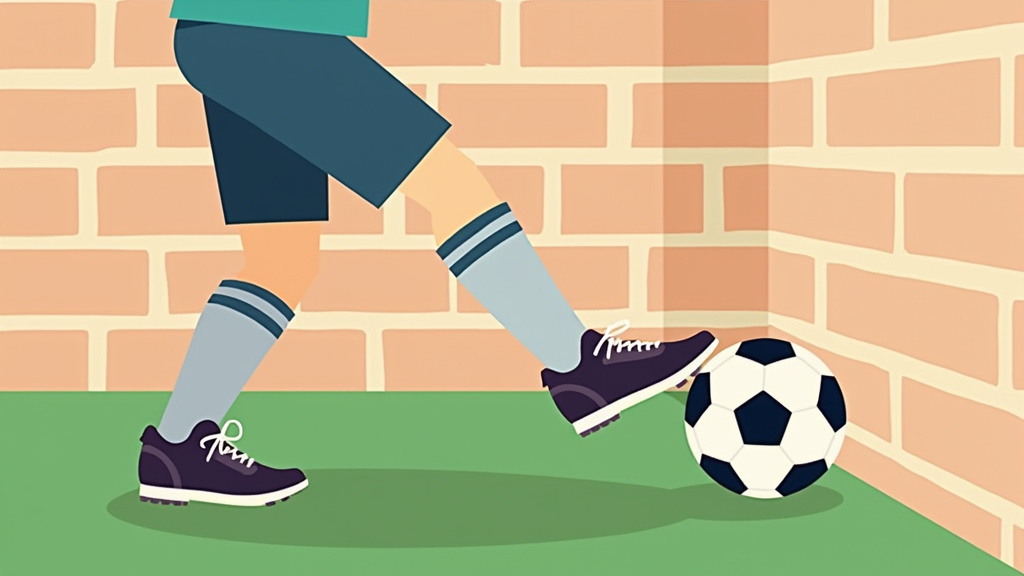
Improvement requires a multi-pronged attack. Relying on one type of practice leaves gaps in your game. These five methods, stacked together, create a comprehensive control system.
1. The Wall Is Your Best Coach
A brick or concrete wall does not get tired, it returns the ball exactly as you strike it, and it forces quick reactions. This is the most efficient solo tool for first touch and passing repetition.
Start three meters back. Pass the ball firmly against the wall with your right foot. Control the return with one touch, then pass it back with your left. The sequence is: pass right, control, pass left, control. This trains control and passing with both feet under time pressure. Increase the distance for softer returns to practice receiving lofted balls.
Common mistake: Standing too close to the wall, the ball returns too fast and you develop a panicked, stabbing touch. Start at a distance where you have a full second to prepare your controlling foot.
2. Implement Maximal Intent
This is the rule most players ignore. Maximal Intent means performing every repetition of a drill at the maximum speed you can while maintaining clean technique. If you can dribble through cones cleanly at a jog, you must now sprint through them. The moment you start going through the motions, you stop improving.
Your nervous system learns what you teach it. Slow, lazy drills teach your body to be slow and lazy. Game speed is chaotic and fast. Your practice must match that intensity to build usable skills. This principle is critical for translating practice to dribbling speed in matches.
3. Follow Progressive Overload
You would not try to lift your maximum weight on day one in the gym. Ball control follows the same principle. Start simple and add layers of difficulty only after you master the current level.
| Progression Level | Focus | Example Drill | Next Step Trigger |
|---|---|---|---|
| Stationary | Isolated touch | Inside-outside taps in place | 50 clean, rhythmic touches |
| Moving | Touch while traveling | Dribbling in a straight line | Confident change of direction |
| Direction Changes | Agility with the ball | Figure-8 dribble around cones | No ball loss for 5 circuits |
| Passive Pressure | Touch with distraction | Drill while a partner shadows | Consistent control for 2 mins |
| Active Pressure | Touch under duel | 1v1 in a small grid | Successful shield & turn 3x |
This structured climb prevents frustration and ensures each new skill has a stable foundation. The final stage, active pressure, is where ball-less training for agility pays off, as your body can handle the physical contest.
4. Train Your Brain: Scanning and Visualization
Your feet can only go where your eyes tell them to go. If you stare at the ball during drills, you are programming yourself to play with tunnel vision.
Force a scanning habit. During any stationary drill, pick a visual target five meters away, a tree, a window, a crack in the wall. Look up at it every second or third touch. It will feel awkward and you will lose the ball more at first. That is the point. You are building the neural connection between touch and awareness.
Off the field, spend five minutes visualizing. Close your eyes and see yourself receiving a hard pass, cushioning it perfectly, and looking up to spot a teammate. Mental rehearsal strengthens the same pathways used in physical execution.
5. Commit to the 10-Minute Daily Rule
Long, infrequent practices are less effective than short, daily ones. Skill development is about frequency, not marathon sessions. Ten minutes of maximal-intent, focused ball mastery every day forces consistent neural adaptation.
The daily habit also defeats procrastination. It is easier to commit to ten minutes than to find a free two-hour block. This consistency is the engine behind all soccer performance exercises.
The 10-Minute Daily Ball Control Routine
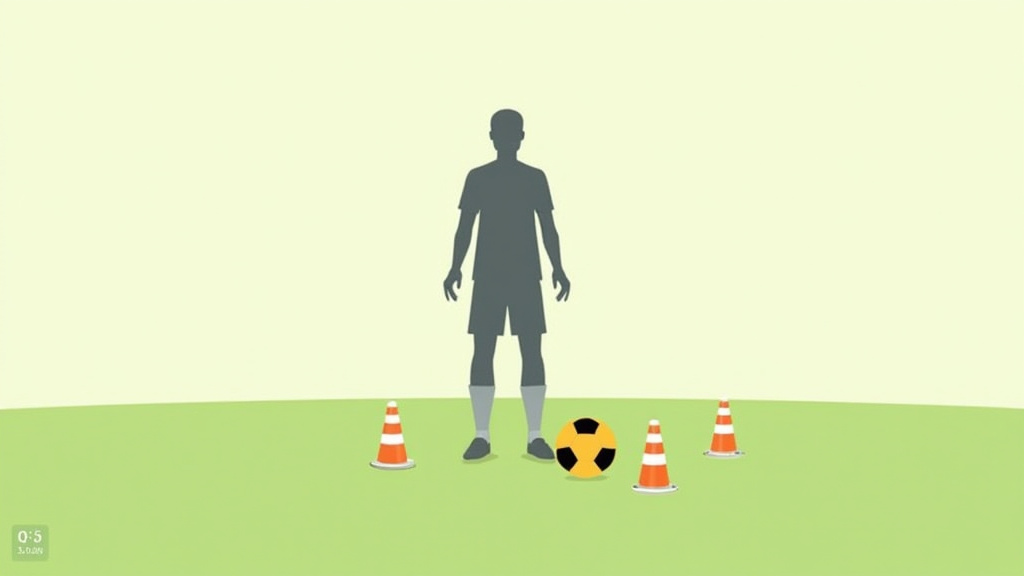
This routine balances first touch, ball mastery, and weak-foot training. Use a timer.
Minute 0–2: Weak-Foot Foundation.
Dribble slowly in a small area using only the inside and outside of your non-dominant foot. No strength work, just touch. This wakes up the neural connections.
Minute 2–5: Wall Pass & Control.
Stand 4 meters from a wall. Pass and control with the inside of your foot for 90 seconds, then switch to controlling with the sole for 90 seconds. Focus on cushioning every single return.
Minute 5–8: Ball Mastery Circuit.
Perform 45 seconds of sole rolls (15s per foot, 15s both feet together). Then 45 seconds of inside-outside V-taps. Finally, 60 seconds of box dribbling around four cones. This is your core first touch practice.
Minute 8–10: Maximal Intent & Scanning.
Re-run the box dribbling drill, but at a sprint. As you approach each cone, snap your head up to spot an imaginary teammate before making your turn. Push speed to the edge of control.
How to Fix a “Brick Foot” First Touch
The “brick foot”, receiving with a stiff leg, is the most common technical error. The symptom is a ball that pings off your foot unpredictably. The cause is a misunderstanding of physics.
When your foot is rigid, the ball’s kinetic energy has nowhere to go but back into the ball, causing a rebound. Cushioning converts that energy into the backward motion of your leg, dissipating it.
To fix it, practice with a very soft ball or a partially deflated ball against a wall. The softer object exaggerates the need to withdraw your foot. You will feel the absorption. After twenty reps, switch back to a normal ball. The difference in required sensitivity trains the precise motor skill.
This fix requires the underlying leg strength to control the withdrawal motion smoothly. A weak ankle will collapse instead of moving back with control.
Position-Specific Control Nuances
While all players need great control, how you use it changes by position. A defender’s control is often about safety and clearance. A midfielder’s is about turning under pressure. A forward’s is about setting up a shot.
| Position | Primary Control Goal | Key Surface | Drill Priority |
|---|---|---|---|
| Central Defender | Secure possession, immediate clearance | Inside of foot, instep | First touch away from pressure, long passing |
| Fullback | Control in stride, early cross | Outside of foot, laces | Receiving while sprinting, one-touch crosses |
| Central Midfielder | Turn under pressure, link play | Sole, inside/outside combo | Shielding drills, 360-degree turning |
| Winger | Explosive first touch past defender | Outside of foot, laces | Heavy first touch into space, fast dribbling techniques |
| Striker | Set up shot with first touch | Inside of foot, instep | Turn-and-shoot drills, receiving with back to goal |
A midfielder should live in turning drills like the Cruyff Turn receive. A winger’s daily routine must include pounding a ball against a wall and taking their first touch at a sprinting angle. This specificity makes practice time efficient.
Integrating Control into Game Play
Drill mastery means nothing if it vanishes on Saturday. The bridge is small-sided games.
Play 3v3 or 4v4 in a tight space. The limited time and constant pressure force you to use your first touch and close touch technique under real conditions. This is where you practice the give-and-go tactic, which is essentially a perfect first touch followed by an immediate return pass.
Another method is the “two-touch” rule game. In a casual pickup match, impose a rule on yourself: you may only take two touches maximum whenever you get the ball. The first touch must control, the second must pass or shoot. This is brutally effective at highlighting poor control and forcing rapid improvement.
Frequently Asked Questions
I’m 17 and just starting. Is it too late to build good ball control?
No. The “golden age” for skill acquisition is a real neurological window, but the brain remains plastic. An older beginner can absolutely achieve a high level of control. The key is deliberate, consistent practice. You will progress faster than a child because you can understand the why behind the drills. Start with the 10-minute daily routine and be patient for the first month.
How long until I see real improvement?
With consistent daily practice (5-7 days a week), you will notice a tangible difference in your comfort level within 2-3 weeks. After 6-8 weeks, teammates will comment on your improved first touch. The timeline depends entirely on the quality and frequency of your sessions.
Should I practice barefoot?
Yes, but cautiously. Practicing barefoot on safe grass enhances foot sensitivity and strengthens the small muscles in your feet and ankles, which improves fine motor control. Limit these sessions to 15-20 minutes to avoid injury, and never do it on hard surfaces. It is a useful supplementary tool, not a replacement for training in boots.
Is juggling important for control?
Juggling is important for aerial control, coordination, and building a general feel for the ball. It is a valuable piece of the puzzle, but not the whole picture. Prioritize ground-based ball mastery skills first, then add 5 minutes of juggling fundamentals at the end of your session.
My weak foot feels useless. How do I fix it?
Allocate the first 30% of every training session exclusively to your weak foot. Start with simple rolling and tapping drills where failure is cost-free. Use a wall, pass with your strong foot, control with your weak foot. The gap will never close if you only use it when you have to in a game. This dedicated time is non-negotiable.
Before You Go
Ball control is not a talent you are born with. It is a set of mechanical habits wired into your nervous system through repetition. The formula is simple but demands honesty: cushion every first touch, practice with maximal intent, and show up for ten minutes today, and tomorrow, and the day after that.
The wall, four cones, and a ball are all the equipment you need. The rest is your willingness to do the boring work when no one is watching. That daily discipline separates the player who is comfortable on the ball from the one who is still hoping it doesn’t come to them. Start with the routine. In three weeks, you will not recognize your own first touch.

I come from the “soccer heart” of Germany, the Ruhrpott. I have played, trained and followed soccer all my life and am a big fan of FC Schalke 04. I also enjoy following international soccer extensively.