What is the 4-2-3-1 Formation in Soccer? Tactical Analysis
The 4-2-3-1 formation in soccer is a four-line tactical system using four defenders, two defensive midfielders (a double pivot), three attacking midfielders, and a single striker. It provides central control, defensive stability, and attacking flexibility, making it a cornerstone of modern football.
Most guides describe the shape but miss the fluid movement within it. They list the positions without explaining how a team like Manchester City uses the same numbers to play a completely different game than a counter-attacking side. The static diagram is a lie.
This breakdown covers the formation’s real mechanics, the specific player types it demands, and the tactical trade-offs every coach faces when using it.
Key Takeaways
- The double pivot is non-negotiable; one midfielder must be a destroyer, the other a distributor, or the system collapses under pressure.
- Your number 10 cannot be a luxury player; they must work defensively to form a midfield block or the double pivot gets overrun.
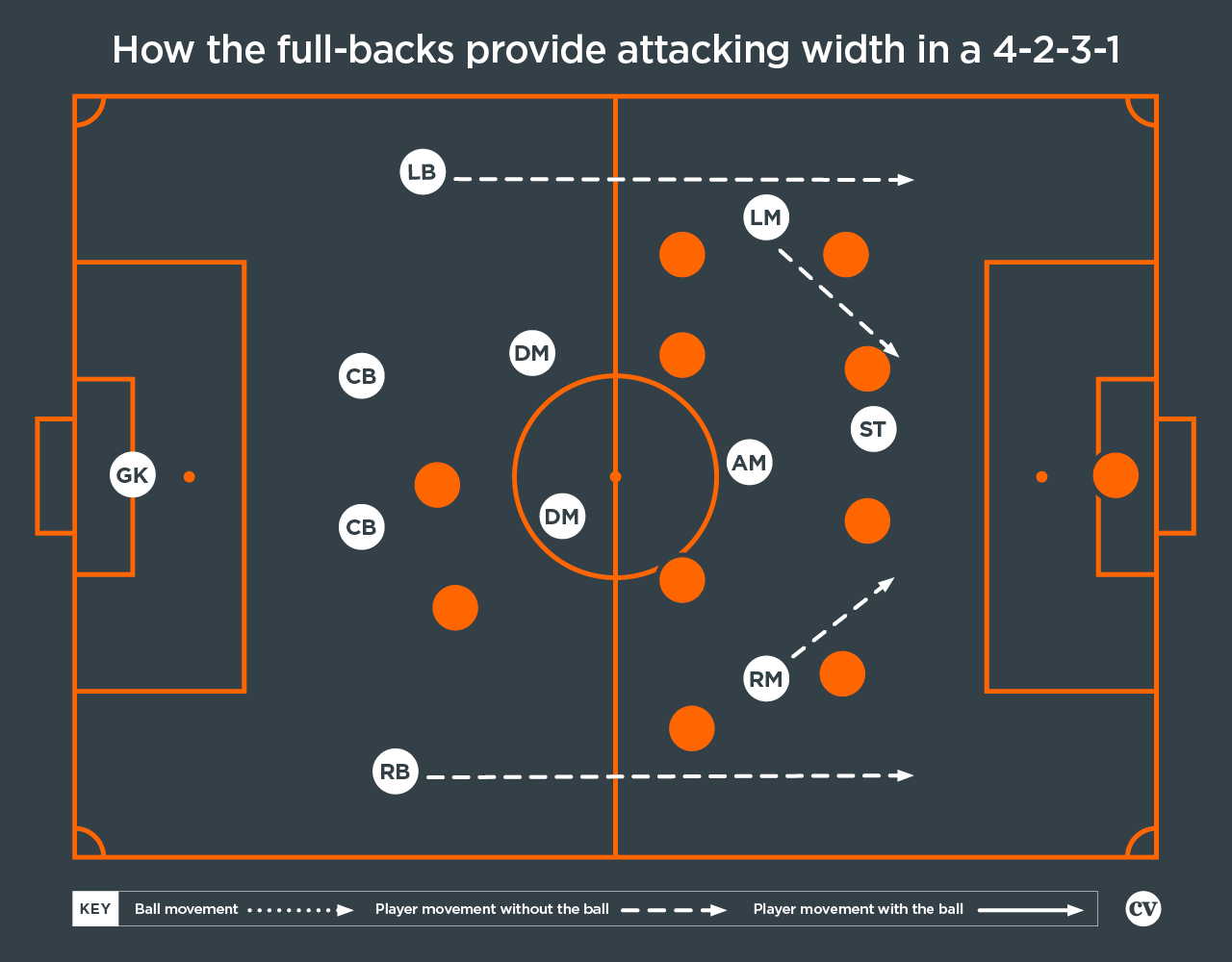
- Full-back aggression dictates your team’s width; if they stay back, your wingers must stay wide, which changes the entire attacking dynamic.
- The formation defensively morphs into a 4-4-2 or 4-4-1-1 almost instantly, a transition every player must rehearse.
- Isolating the lone striker is the most common tactical failure, usually caused by poor spacing from the attacking midfield trio.
How Does the 4-2-3-1 Formation Work?
The system builds play through four distinct horizontal lines. This creates natural triangles and passing lanes, which is why it’s a favorite for possession-based teams. The space between the lines, however, is where the real battle happens.
The 4-2-3-1 formation organizes ten outfield players into four strata: a back four, two central defensive midfielders (the double pivot), three attacking midfielders, and a lone striker. This structure prioritizes central midfield control through a 3v2 numerical advantage in the middle and provides multiple vertical passing options during build-up play.
Your base defensive shape is a 4-4-2. The moment you lose the ball, the number 10 drops level with the striker. The two wide attacking midfielders fall back alongside the double pivot. What looked like an attacking 4-2-3-1 becomes a compact 4-4-2 mid-block in eight seconds. Teams that don’t practice this transition get ripped apart on the counter.
TL;DR: The 4-2-3-1 is a 4-4-2 in defense and a 2-3-5 in attack; the numbers are just a starting point for continuous movement.
The 4-2-3-1 Player Roles and Responsibilities
Forget generic titles like “midfielder.” Each position has a specific physical and technical profile. Get one wrong and the whole structure cracks.
Goalkeeper and Defensive Line
The goalkeeper acts as a sweeper and first distributor. They need to read when to play short to a center-back or launch it to the striker.
Center-backs must be comfortable under a high press. One usually steps into midfield with the ball, while the other covers. Full-backs have the most physically demanding job. They provide the only true width in the formation. A slow full-back who can’t recover after an overlap is a liability that better teams will target every time.
The Double Pivot: The System’s Engine
This is the most important partnership on the pitch. It is not two identical players.
| Role Type | Primary Duty | Player Example (Style) |
|---|---|---|
| Ball-Winner | Break up opposition attacks, shield back four | N’Golo Kanté (circa 2017) |
| Deep-Lying Playmaker | Receive from defenders, dictate tempo, play line-breaking passes | Toni Kroos |
| Box-to-Box | Link defense and attack, cover ground | Jude Bellingham |
The ideal pair combines a destroyer and a distributor. Two playmakers lack defensive grit. Two destroyers kill your build-up. The partnership’s nature is why understanding a double pivot midfield is critical for any modern coach.
Common mistake: Using two similar, positionally rigid midfielders in the pivot — the opposition easily marks the distributor and plays around the static holder, bypassing your midfield entirely.
The Attacking Midfield Trio
This is the creative hub. The central player, the number 10, operates in the pocket between the opponent’s midfield and defense. Their first touch must be impeccable, often under immediate pressure.
The wide players are not traditional hug-the-touchline wingers. Most modern systems use inverted wingers who cut inside onto their stronger foot, aiming to shoot or combine with the number 10. This creates the need for overlapping full-backs. The choice between an inverted winger tactics approach or using traditional wingers fundamentally changes your team’s attacking patterns.
The Lone Striker
This is a brutally demanding role. The striker battles two center-backs, often with back to goal. They need strength to hold up play, intelligent movement to create space for the attacking midfielders, and clinical finishing. When the system fails, they look isolated and ineffective. It’s why some teams evolve the role into a false nine role, having the striker drop deep to create numerical superiority in midfield.
Why the 4-2-3-1 Dominated Modern Football
Its rise wasn’t an accident. It was a direct solution to the tactical problems of the late 1990s and early 2000s.
The old 4-4-2 was getting dismantled by teams playing a single attacking midfielder in the hole. The solution was to drop a central midfielder deeper, creating a dedicated holder like Claude Makelele. But one holder could be pulled out of position. Adding a second created the double pivot—a stable, rotating shield. This evolution coincided with the rise of coordinated pressing tactics, which the 4-2-3-1’s compact midfield lines excelled at executing.
Spanish coach Juanma Lillo is a key but often overlooked figure. His advocacy for the system influenced Pep Guardiola. Guardiola’s use at Manchester City, and Hansi Flick’s Champions League win with it at Bayern Munich, cemented its elite status. It provided the perfect blend of control and fluidity they demanded.
Tactical Strengths and Advantages
The formation’s benefits are interconnected. You don’t get one without the others.
- Central Control and Overloads: The double pivot plus the number 10 creates a central midfield three. This almost always guarantees a numerical overload against a standard two-man midfield (like in a 4-4-2). More players in the middle means more passing options and less chance of being overrun.
- Defensive Stability: The double pivot acts as a permanent buffer in front of the back four. It’s very difficult for opponents to play through the central channels. This solid base gives the attacking four players the freedom to take risks.
- Attacking Fluidity and Versatility: The attacking quartet can interchange positions. The number 10 can drift wide, a winger can cut inside as a second striker, and the full-backs can underlap or overlap. This movement confuses static defenses.
- Smooth Build-Up Play: The structure naturally creates triangles (e.g., center-back, defensive midfielder, full-back). These triangles are the foundation of playing out from the back under pressure, a core principle for any top team’s comprehensive tactics guide.
I tried implementing a 4-2-3-1 with a youth team using two creative midfielders in the pivot. We kept the ball beautifully for 60 minutes. Then the opponent brought on a physical striker, bypassed our soft center, and scored three times in twenty minutes by winning second balls in the space our pivots couldn’t protect. I learned the hard way that balance in the pivot isn’t a suggestion.
Weaknesses and How to Exploit Them
Every strength has a corresponding vulnerability. Smart opponents will target these.
- The Isolated Striker: If the attacking midfielders don’t support quickly, the striker fights two center-backs alone. The striker’s touch and hold-up play must be exceptional.
- Wide Area Vulnerability: When full-backs push high to provide width, enormous spaces open behind them. A quick switch of play to the opposite flank can trigger a devastating counter-attack. The double pivot must shuffle across to cover, but that leaves the near side open.
- Midfield Overloads: The formation can be beaten by a midfield diamond (4-1-2-1-2) or a 4-3-3 with three central midfielders. If the number 10 doesn’t defend diligently, the double pivot can be outnumbered 3v2 in the heart of the pitch.
The table below shows how opponents might set up to target these flaws.
| Opponent Formation | Targeted Weakness | Exploitation Method |
|---|---|---|
| 4-3-3 | Midfield Overload | Pin the double pivot with three midfielders, isolate the number 10. |
| 3-5-2 | Wide Vulnerability | Use wing-backs to occupy advanced full-backs, create 2v1 overlaps. |
| 4-4-2 Diamond | Pivot Pressure | Number 10 marks one pivot, strikers split the center-backs, forcing long balls. |
TL;DR: To beat a 4-2-3-1, overload the wings after a turnover or crowd the central midfield to disconnect the pivot from the number 10.
Adapting the 4-2-3-1 In-Game
The best teams use the 4-2-3-1 as a defensive starting point. In possession, it transforms.
Against a deep block, one pivot might join the attack, forming a temporary 4-1-4-1. The full-backs might tuck inside to form a back three, allowing the wingers to stay high and wide. This fluidity is why simply reading tactical diagrams isn’t enough; you must understand the principles behind the movement.
Defensively, as stated, it becomes a 4-4-2. But the type of 4-4-2 matters. A high-pressing 4-4-2, led by the striker and number 10, aims to win the ball in the opponent’s half. A low-block 4-4-2 focuses on compactness and forcing crosses. This decision is the core of a coach’s in-game management and is a fundamental part of any coaching tactical principles curriculum.
Common mistake: Coaching the 4-2-3-1 as a rigid shape — the players stick to their zones, movement stagnates, and the formation’s main advantage (flexibility) is completely lost.
Is the 4-2-3-1 Right for Your Team?
It depends on your personnel. Ask these questions:
- Do you have two complementary central midfielders for the pivot (one ball-winner, one passer)?
- Do you have a creative, hard-working player for the number 10 role?
- Do your full-backs have the engine to sprint the flank for 90 minutes?
- Do you have a striker who can play with back to goal and finish half-chances?
If you answer “no” to more than one, another modern 11v11 formation guide might offer a better fit, like a 4-3-3 or a 4-4-2. The 4-2-3-1 is a system that magnifies both quality and flaws. It requires intelligent players who understand formation fundamentals beyond their own position.
Frequently Asked Questions
What is the main difference between 4-2-3-1 and 4-3-3?
The key difference is in midfield structure. The 4-2-3-1 uses a double pivot (two holding mids) and a dedicated number 10. The 4-3-3 typically uses a single pivot (one holder) with two more advanced central midfielders ahead. The 4-3-3 often provides more control in the middle third, while the 4-2-3-1 can create more defined chances for the central attacking midfielder.
Which famous teams use the 4-2-3-1?
Pep Guardiola’s Manchester City and Hansi Flick’s 2020 Bayern Munich are prime examples. Historically, Jose Mourinho’s Real Madrid and Joachim Low’s 2014 World Cup-winning Germany team also used it to great effect, showcasing its adaptability for both possession and counter-attacking styles.
Can the 4-2-3-1 be used in youth soccer?
Yes, but with a focus on principles over perfection. It’s an excellent formation for teaching positional play, the importance of defensive shape, and the roles of a creative number ten. Simplify the instructions: emphasize the double pivot staying connected and the front four rotating.
What is the best formation to counter a 4-2-3-1?
4-3-3 with three central midfielders is often effective, as it can overrun the double pivot. Alternatively, a 3-5-2 can match the 4-2-3-1 in midfield and provide extra width to exploit the advanced positioning of the opposition’s full-backs.
How do you beat a low block with a 4-2-3-1?
You need to create width to stretch the defense. This means encouraging your full-backs to overlap aggressively and instructing your wingers to make runs inside to create space. One of the double pivot midfielders may also need to push forward to add an extra body in the box, turning the shape into a 4-1-4-1 during sustained attacks.
Before You Go
The 4-2-3-1 is more than a set of numbers. It’s a framework for control. Its success hinges on the double pivot’s balance and the attacking quartet’s synergy. It can be a possession monster or a lethal counter-attacking tool, but it demands specific players and relentless coaching on defensive transitions. While it’s a dominant force in the modern game, its effectiveness will always come down to the players within it and their grasp of the broader understanding formation notation and movement. Choose it not because it’s popular, but because your squad’s profile makes its strengths inevitable.

I come from the “soccer heart” of Germany, the Ruhrpott. I have played, trained and followed soccer all my life and am a big fan of FC Schalke 04. I also enjoy following international soccer extensively.